My Haas Vitajte,
!
Haas Tooling MyHaas/HaasConnect Prihlásiť sa Zaregistrovať Haas Tooling MyHaas/HaasConnect Odhlásiť sa Vitajte, Moje stroje Najnovšia činnosť Moje cenové ponuky Môj účet Moji používatelia Odhlásiť sa
Nájdite svojho distribútora
  1. Zvoliť jazyk
    1. English
    2. Deutsch
    3. Español - España
    4. Español - México
    5. Français
    6. Italiano
    7. Português
    8. Český
    9. Dansk
    10. Nederlands
    11. Magyar
    12. Polski
    13. Svenska
    14. Türkçe
    15. 中文
    16. Suomi
    17. Norsk
    18. الإنجليزية
    19. български
    20. Hrvatski
    21. Ελληνικά
    22. Română
    23. Slovenský
    24. Slovenščina
    25. 한국어
    26. 日本語
    27. Українська
  • stroje Main Menu
    • Vertikálne obrábacie centrá
      Vertikálne obrábacie centrá
      Vertikálne obrábacie centrá View All
      • Vertikálne obrábacie centrá
      • Séria VF
      • Univerzálny stroj
      • Séria VR
      • Prizmatický VP-5
      • Vertikálne obrábacie centrá s výmenou paliet
      • Mini frézovačky Mini Mills
      • Formovacie stroje
      • Vysokorýchlostné vŕtacie centrá
      • Séria strojov na vŕtanie/rezanie závitov/frézovanie
      • Nástrojárske frézky
      • Pocket Mill
      • Kompaktné frézovačky
      • Séria portálových strojov Gantry
      • Portálové frézky série SR
      • Mimoriadne veľké vertikálne obrábacie centrá (VMC)
      • Frézky s dvoma stojanmi
    • Viacosové riešenia
      Viacosové riešenia
      Viacosové riešenia View All
      • Viacosové riešenia
      • Sústruhy s osou Y
      • 5-osové frézky
    • Sústruhy
      Sústruhy
      Sústruhy View All
      • Sústruhy
      • Séria ST
      • Stroje s dvojitým vretenom
      • Séria s klzným vedením
      • Nástrojárske sústruhy
      • Skľučovací sústruh
      • Vreckový sústruh
      • Podávače tyčí Haas
    • Horizontálne obrábacie centrá
      Horizontálne obrábacie centrá
      Horizontálne obrábacie centrá View All
      • Horizontálne obrábacie centrá
      • Kužeľ 50
      • Kužeľ 40
    • Otočné zariadenia a deličky
      Otočné zariadenia a deličky
      Otočné zariadenia a deličky View All
      • Otočné zariadenia a deličky
      • Otočné stoly
      • Deličky
      • 5-osové otočné stoly
      • Extra veľké otočné stoly
    • Systémy automatizácie
      Systémy automatizácie
      Systémy automatizácie View All
      • Systémy automatizácie
      • Automatizácia frézky
      • Automatizácia sústruhu
      • Automatické nakladače obrobkov
      • Modely automatizácie
    • Stolné stroje
      Stolné stroje
      Stolné stroje View All
      • Stolné stroje
      • Stolná frézka
      • Stolný sústruh
      • Simulátor riadenia, štandardný
      • Simulátor riadenia, prémiový
    • Vybavenie dielne
      Vybavenie dielne
      Vybavenie dielne View All
      • Vybavenie dielne
      • Kolenová frézka
      • Manuálne sústruhy Haas
      • Píly Haas
    • Výrobné stroje
      Výrobné stroje
      Výrobné stroje View All
      • Výrobné stroje
      • Laserové rezné stroje
      • CNC ohraňovacie lisy
    • RÝCHLE ODKAZY Špeciálne série  Špeciálne série 
      SÉRIA EU SÉRIA EU ZOSTAVENIE A CENA | CENNÍK ZOSTAVENIE A CENA | CENNÍK Stroje na sklade Stroje na sklade NOVINKY NOVINKY VÁŠ PRVÝ STROJ CNC VÁŠ PRVÝ STROJ CNC
      NÁKUPNÉ NÁSTROJE
      • Zostavte a naceňte si stroj Haas
      • Cenník
      • Dostupné zariadenia
      • Financovanie CNCA
      CHCETE SA PORADIŤ?

      Na vaše otázky vám odpovedia a tými najlepšími alternatívami vás prevedú v podnikovej predajni spoločnosti Haas.

      CONTACT YOUR DISTRIBUTOR >
  • Voliteľné položky Main Menu
    • Product Image Vretená
      Vretená
      Vretená View All
      • Vretená
    • Product Image Meniče nástrojov
      Meniče nástrojov
      Meniče nástrojov View All
      • Meniče nástrojov
    • Product Image 4. | 5. os
      4. | 5. os
      4. | 5. os View All
      • 4. | 5. os
    • Product Image Revolvery a poháňané nástroje
      Revolvery a poháňané nástroje
      Revolvery a poháňané nástroje View All
      • Revolvery a poháňané nástroje
    • Product Image Snímanie
      Snímanie
      Snímanie View All
      • Snímanie
    • Správa triesok a chladiacej kvapaliny od spoločnosti Haas Manažment triesok a chladiacej kvapaliny
      Manažment triesok a chladiacej kvapaliny
      Manažment triesok a chladiacej kvapaliny View All
      • Manažment triesok a chladiacej kvapaliny
    • Riadenie Haas Riadenie Haas
      Riadenie Haas
      Riadenie Haas View All
      • Riadenie Haas
    • Product Image Doplnková výbava
      Doplnková výbava
      Doplnková výbava View All
      • Doplnková výbava
    • Product Image Nástroje a upnutie
      Nástroje a upnutie
      Nástroje a upnutie View All
      • Nástroje a upnutie
    • Product Image Upnutie obrobku
      Upnutie obrobku
      Upnutie obrobku View All
      • Upnutie obrobku
    • Product Image 5-osové riešenia
      5-osové riešenia
      5-osové riešenia View All
      • 5-osové riešenia
      • 5 Easy Steps to 5-Axis
    • Product Image Automatizácia
      Automatizácia
      Automatizácia View All
      • Automatizácia
    • RÝCHLE ODKAZY Špeciálne série  Špeciálne série 
      SÉRIA EU SÉRIA EU ZOSTAVENIE A CENA | CENNÍK ZOSTAVENIE A CENA | CENNÍK Stroje na sklade Stroje na sklade NOVINKY NOVINKY VÁŠ PRVÝ STROJ CNC VÁŠ PRVÝ STROJ CNC
      NÁKUPNÉ NÁSTROJE
      • Zostavte a naceňte si stroj Haas
      • Cenník
      • Dostupné zariadenia
      • Financovanie CNCA
      CHCETE SA PORADIŤ?

      Na vaše otázky vám odpovedia a tými najlepšími alternatívami vás prevedú v podnikovej predajni spoločnosti Haas.

      CONTACT YOUR DISTRIBUTOR >
  • Why Haas Main Menu
      Spoznajte zmenu vďaka spoločnosti Haas
    • Prečo Haas
    • MyHaas
    • Vzdelávacia komunita
    • Industry 4.0
    • Certifikát Haas
    • Vyhlásenia zákazníkov
  • Servis Main Menu
      Víta vás Haas Service
      DOMOV SERVISU Návody na obsluhu Postupy Ako na to Sprievodca riešením problémov Preventívna údržba Diely od spoločnosti Haas Haas Tooling Videá
  • Videá Main Menu
  • Main Menu
    • HFO Slovakia
      HFO Slovakia
      HFO Slovakia View All
      • HFO Slovakia
      • O nás
      • Servis
      • Školenie
      • Financovanie
      • Podujatia
      • Inventár showroomu
      • Kontaktujte nás
      • Referencie zákazníkov
    • RÝCHLE ODKAZY Špeciálne série  Špeciálne série 
      SÉRIA EU SÉRIA EU ZOSTAVENIE A CENA | CENNÍK ZOSTAVENIE A CENA | CENNÍK Stroje na sklade Stroje na sklade NOVINKY NOVINKY VÁŠ PRVÝ STROJ CNC VÁŠ PRVÝ STROJ CNC
      NÁKUPNÉ NÁSTROJE
      • Zostavte a naceňte si stroj Haas
      • Cenník
      • Dostupné zariadenia
      • Financovanie CNCA
      CHCETE SA PORADIŤ?

      Na vaše otázky vám odpovedia a tými najlepšími alternatívami vás prevedú v podnikovej predajni spoločnosti Haas.

      CONTACT YOUR DISTRIBUTOR >
My Haas Vitajte,
!
Haas Tooling MyHaas/HaasConnect Prihlásiť sa Zaregistrovať Haas Tooling MyHaas/HaasConnect Odhlásiť sa Vitajte, Moje stroje Najnovšia činnosť Moje cenové ponuky Môj účet Moji používatelia Odhlásiť sa
Nájdite svojho distribútora
  1. Zvoliť jazyk
    1. English
    2. Deutsch
    3. Español - España
    4. Español - México
    5. Français
    6. Italiano
    7. Português
    8. Český
    9. Dansk
    10. Nederlands
    11. Magyar
    12. Polski
    13. Svenska
    14. Türkçe
    15. 中文
    16. Suomi
    17. Norsk
    18. الإنجليزية
    19. български
    20. Hrvatski
    21. Ελληνικά
    22. Română
    23. Slovenský
    24. Slovenščina
    25. 한국어
    26. 日本語
    27. Українська
×

Výsledky vyhľadávania

Web Pages

Images

    • <
    • 1
    • >

8 - UMC - Geometry and Alignment

Séria UMC – Návod na servis


  • UMC – Vreteno
  • 1 – UMC – Úvod
  • 2 – UMC Špecifikácie
  • 3 – UMC-400/500/750 – Inštalácia
  • 4 – UMC-1000/1250 – Inštalácia
  • 5 – UMC-1500-DUO/1600-H – Inštalácia
  • 6 – UMC – Ukotvenie
  • 7 – UMC – Prevádzka
  • 8 – UMC – Geometria a zoradenie
  • 9 – UMC – MRZP a bezpečné zóny
  • 10 – UMC – B/C – Os rotácie
  • 11 – UMC – Menič nástrojov
  • 12 – UMC – Odvádzanie triesok a chladiaca kvapalina
  • 13 – UMC – Elektrické ovládanie
  • 14 – UMC – Mazanie
  • 15 – UMC – Údržba
  • 16 – UMC - paletový systém
  • 17 – UMC – Hydraulické upnutie obrobku
  • 18 – UMC – pneumatické upnutie obrobku

Go To :

  • 8.1 Sprievodca geometriou
  • 8.2 Zarovnanie – indikačné zóny
  • 8.3 Geometria – riešenie problémov
  • 8.4 Aplikácie – Riešenie problémov
  • 8.5 UMC-750 – Kontrolný zoznam súpravy vyrovnávacích podložiek
  • 8.6 Priesečník osí B/C – zarovnanie

8.1 Sprievodca geometriou

Recently Updated

Sprievodca geometriou – Séria UMC


Úvod

  1. Hlava vretena
  2. Piest
  3. Suport
  4. Mostík
  5. Základňa
  6. Os C otočného zariadenia
  7. Os B otočného zariadenia

Pred začatím zaznamenajte továrenskú hodnotu parametra alebo nastavenia nižšie. Počas nastavovania budete musieť túto hodnotu nastaviť na nulu a po dokončení ju znova vynulovať na pôvodnú hodnotu. Hodnota môže byť kladná alebo záporná.

  • Classic Haas Control (CHC) Parameter 1314 (Rotary Axes Center Deviation in X)
  • Next Generation Control (NGC) Nastavenie 254 (5 Axis Rotary Center Distance)

Potrebné náradie a súpravy:

  • T-2193A - UMC-750 SPINDLE HEAD ALIGNMENT PIN *
  • T-2181 - CNC DUAL LEVELING TOOL
  • T-2192 - LEVELING ADAPTER UMC-750
  • 93-2236 - SHIM KIT FOR UMC-750 *

Kliknutím na odkaz si pozrite video  Vyrovnávanie a zoradenie UMC-750 .

*  : Používa sa len pri modeloch predrebootov. 

Vyrovnanie stroja

1

Nastavte výšku stroja:

Posuňte osi X a Y do východzej polohy.

Povoľte stredné vyrovnávacie skrutky [2 a 5] tak, aby nepodopierali žiadnu hmotnosť.

Nastavte stroj na (4) rožných vyrovnávacích skrutkách 3" (76.2 mm) nad podlahou.

2

Hrubé vyrovnanie stroja:

Vyskrutkujte vyrovnávaciu skrutku č. 4.

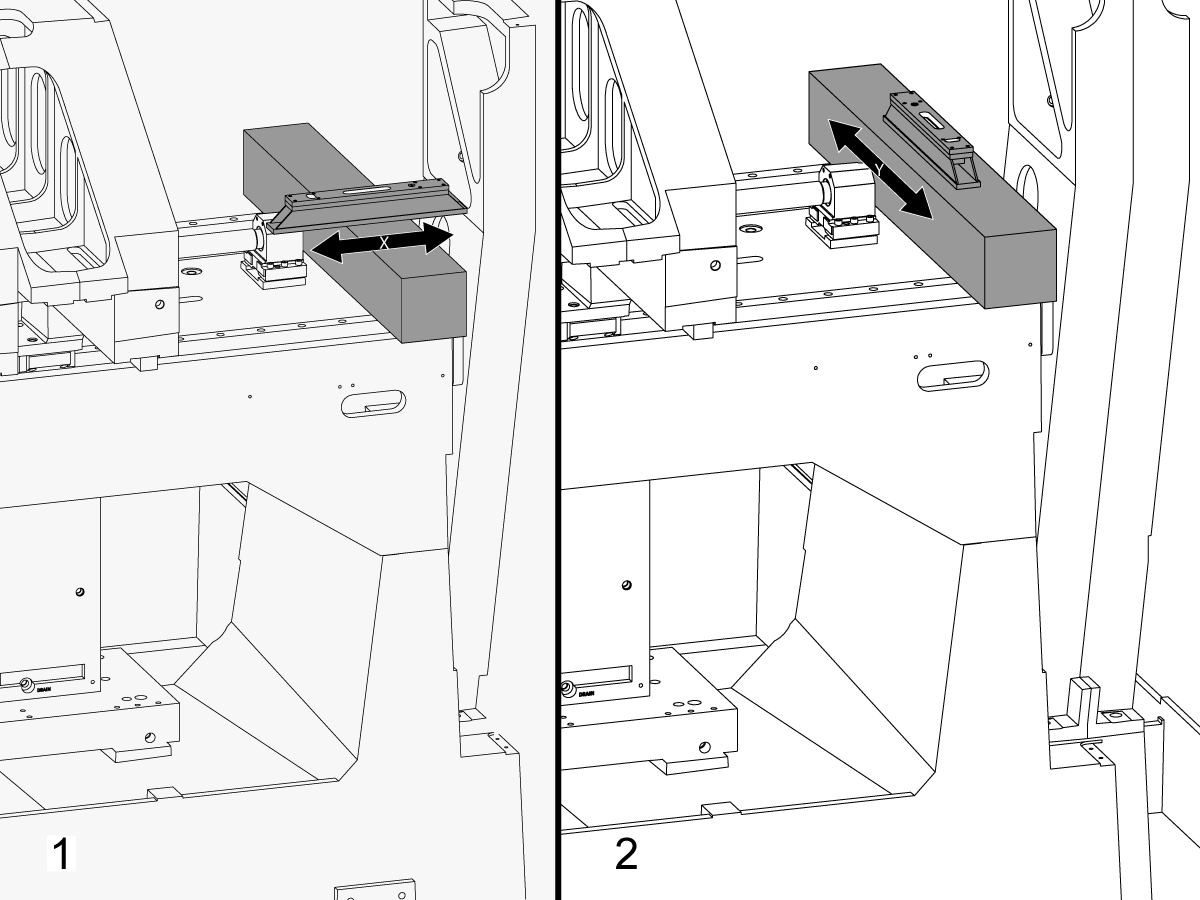
Umiestnite žulu cez lineárne vedenia osi X blízko podpery ložiska guľôčkovej skrutky na osi X.

Nastavte úroveň strojníka na vrchu žuly rovnobežne k osi X. [1]

Upravujte nastavovaciu skrutku č. 6, až kým nie je stroj vyrovnaný v osi X.

Nastavte úroveň strojníka na vrchu žuly kolmo k osi X. [2]

Upravujte nastavovaciu skrutku č. 3, až kým nie je stroj vyrovnaný v osi Y.

Zaskrutkovávajte vyrovnávaciu skrutku č. 4, až kým nebude v kontakte s vyrovnávacou podložkou.

3

Nastaviť valenie osi X:

Zostavte T-2192 s T-2181.

Posuňte os Y do stredu pojazdu.

Položte T-2192 na bok vretena.

Uistite sa, že bublina na T-2181 je v čitateľnom rozsahu.

Ak tomu tak nie je, povoľte skrutku, ktorá upevňuje T-2192 k magnetickej základni a podľa potreby posuňte adaptér.

Ručne posúvajte os X zo strany na stranu a zmerajte valenie osi X. Odčítajte hodnoty vo východzej polohe, v strede a na konci pojazdu.

Upravujte vyrovnávaciu skrutku č. 4, až kým nebude žiadna odchýlka medzi údajom vo východzej polohe a údajom na konci pojazdu.

Poznámka: Bublina na T-2181 NEMUSÍ byť v strede injekčnej trubice libely. Musí byť iba v čitateľnom rozsahu.

4

Nastavte stredne vyrovnávacie skrutky:

Zaskrutkovávajte stredné vyrovnávacie skrutky, až kým nevytvárajú kontakt s vyrovnávacími podložkami, a potom ich zaskrutkujte o ďalších 45° stupňov.

Overte valenie osi X. Upravte stredné vyrovnávacie skrutky tak, aby korigovali valenie osi X.

Zarovnanie osi X k osi Y

1

Zarovnajte čelnú plochu suportu rovnobežne s pohybom osi X:

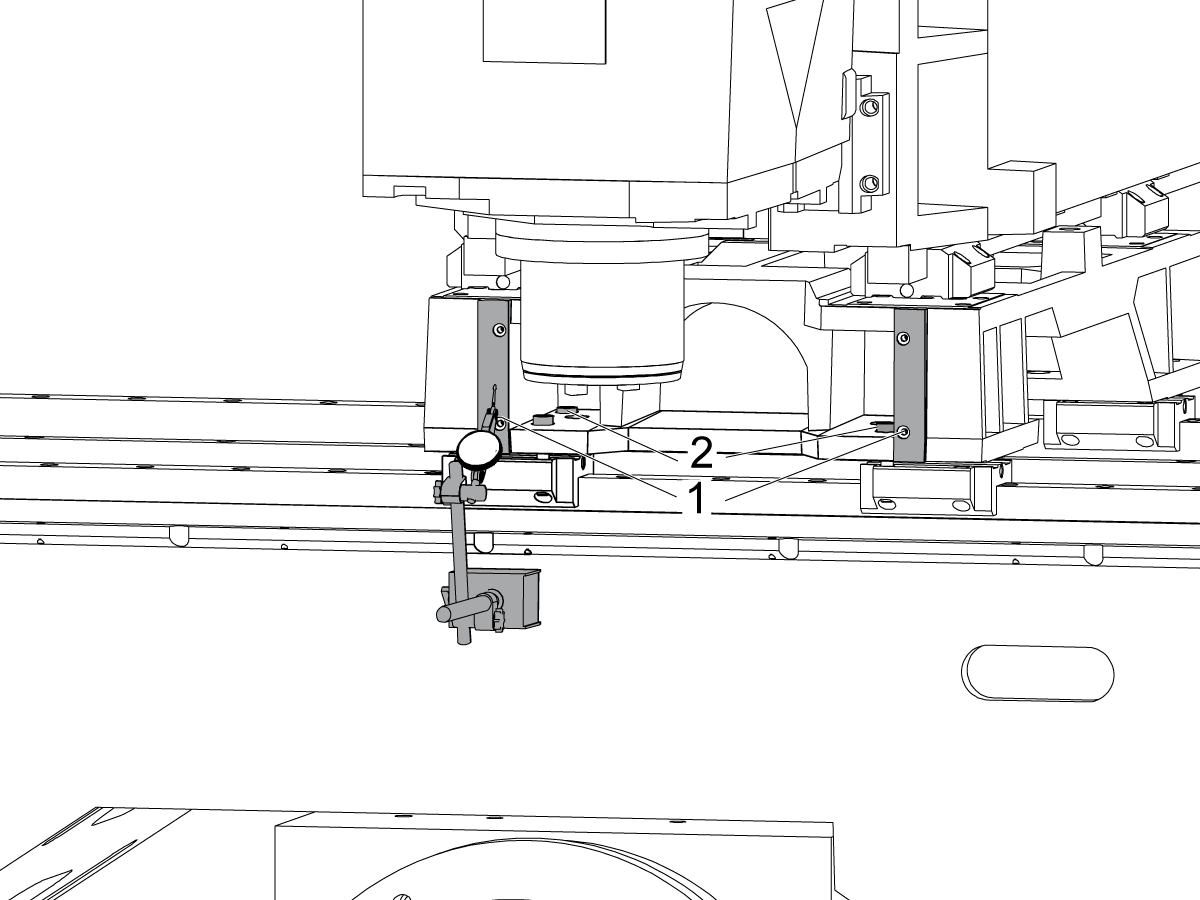
Prejdite cez opracovaný povrch na prednej strane supportu [1] ručným posúvaním osi X.

Povoľte skrutky, ktoré zaisťujú support k vozíkom na osi X [2], a podľa potreby zarovnajte čelnú plochu supportu rovnobežne k pohybu osi X v rámci 0.001".

Utiahnite skrutky. Pozrite si Špecifikácie krútiaceho momentu upínacích prvkov spoločnosti Haas.

2

Zarovnajte os Y kolmo na os X:

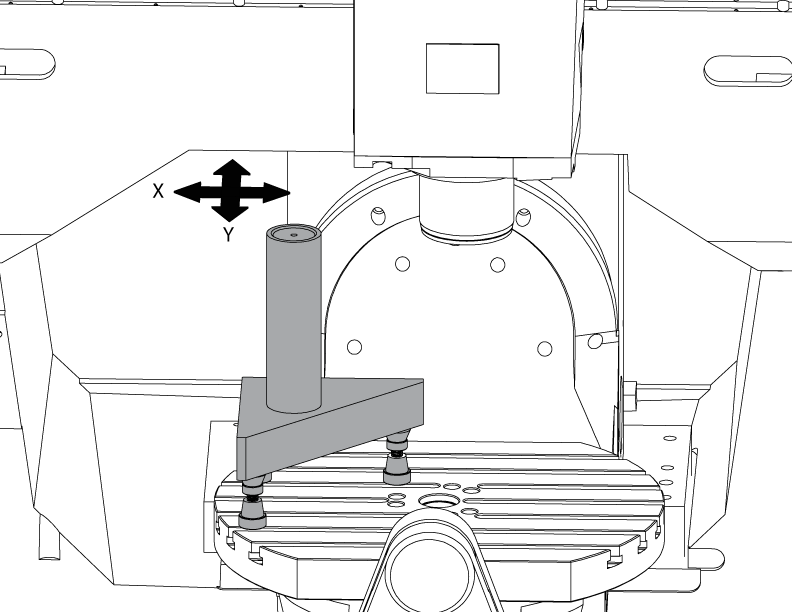
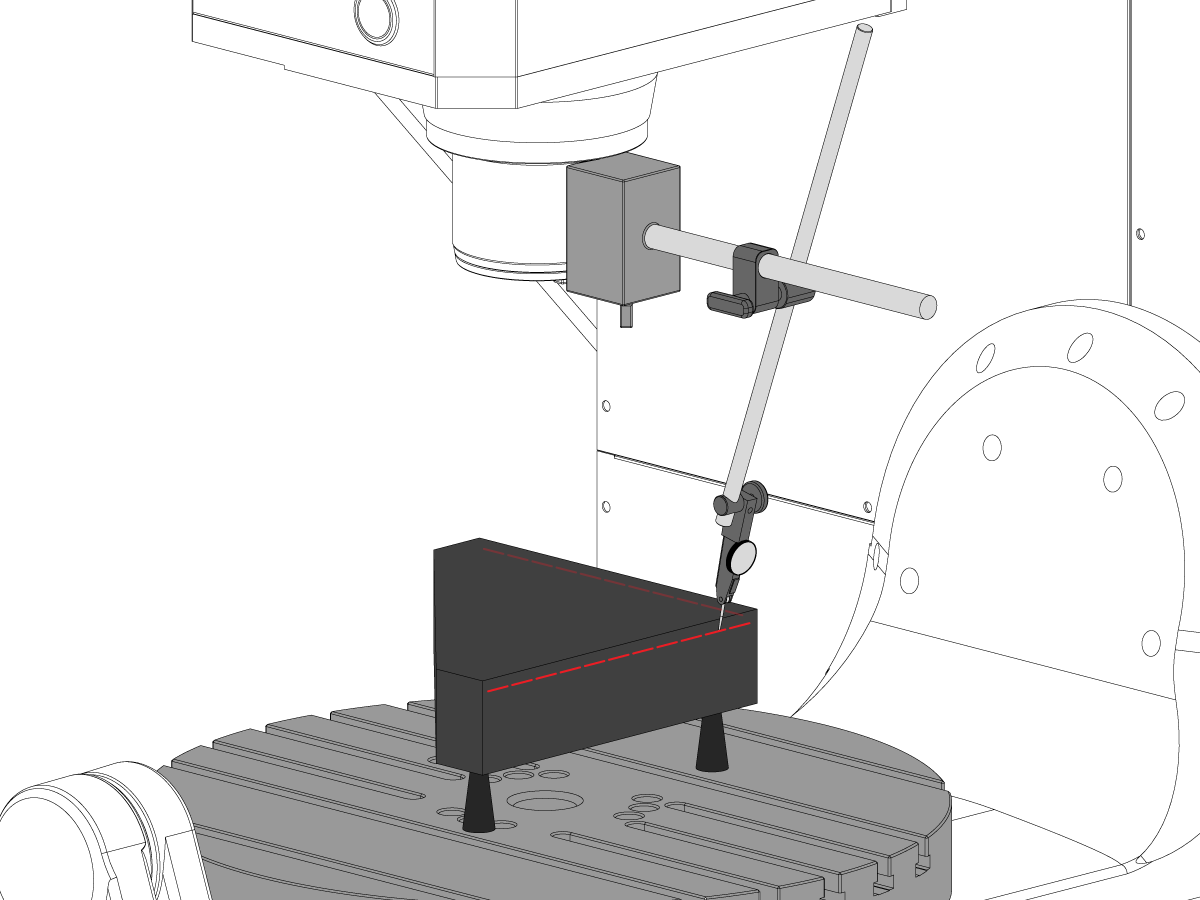
Nastavte trojito kolmú žulu na ľavú stranu platne na osi C na strojných zdvihákoch.

Nastavte zadnú stranu trojito kolmej žuly rovnobežne k osi X. NTE 0.0001"/10"

Prejdite hornou stranou trojito kolmej žuly pozdĺž osí X a Y.

Upravujte strojné zdviháky dovtedy, kým nie je horná plocha trojito kolmej žuly rovnobežne k rovine X-Y NTE 0.0005".

Overte, či je zadná strana žuly rovnobežná s osou X. NTE 0.0001"/10".

Povoľte skrutky, ktoré zaisťujú vozíky osi Y k suportu a zarovnajte os Y kolmo na os X. NTE 0.0005"/10"

Utiahnite skrutky. Pozrite si Špecifikácie krútiaceho momentu upínacích prvkov spoločnosti Haas.

Overte kolmosť osi Y voči osi X XTE 0.0005"/10" po utiahnutí skrutiek.

Zarovnanie osi Z k rovine X-Y

1

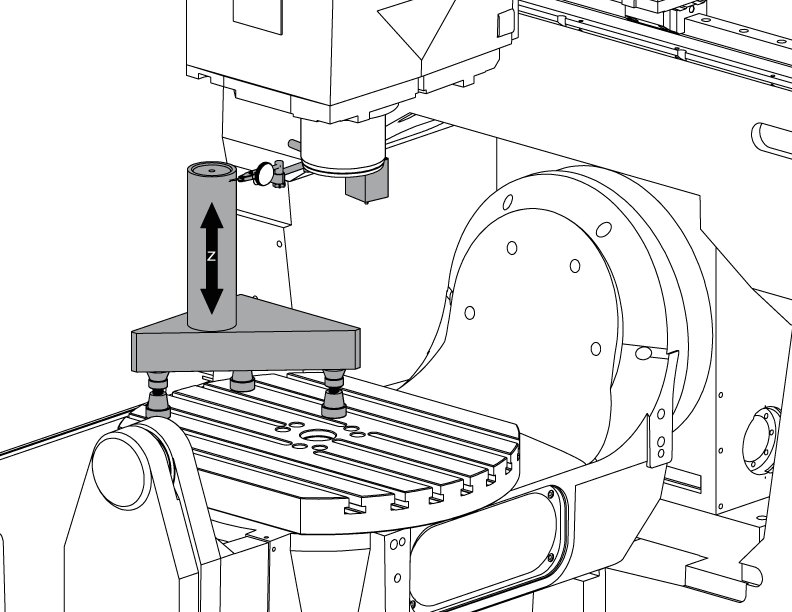
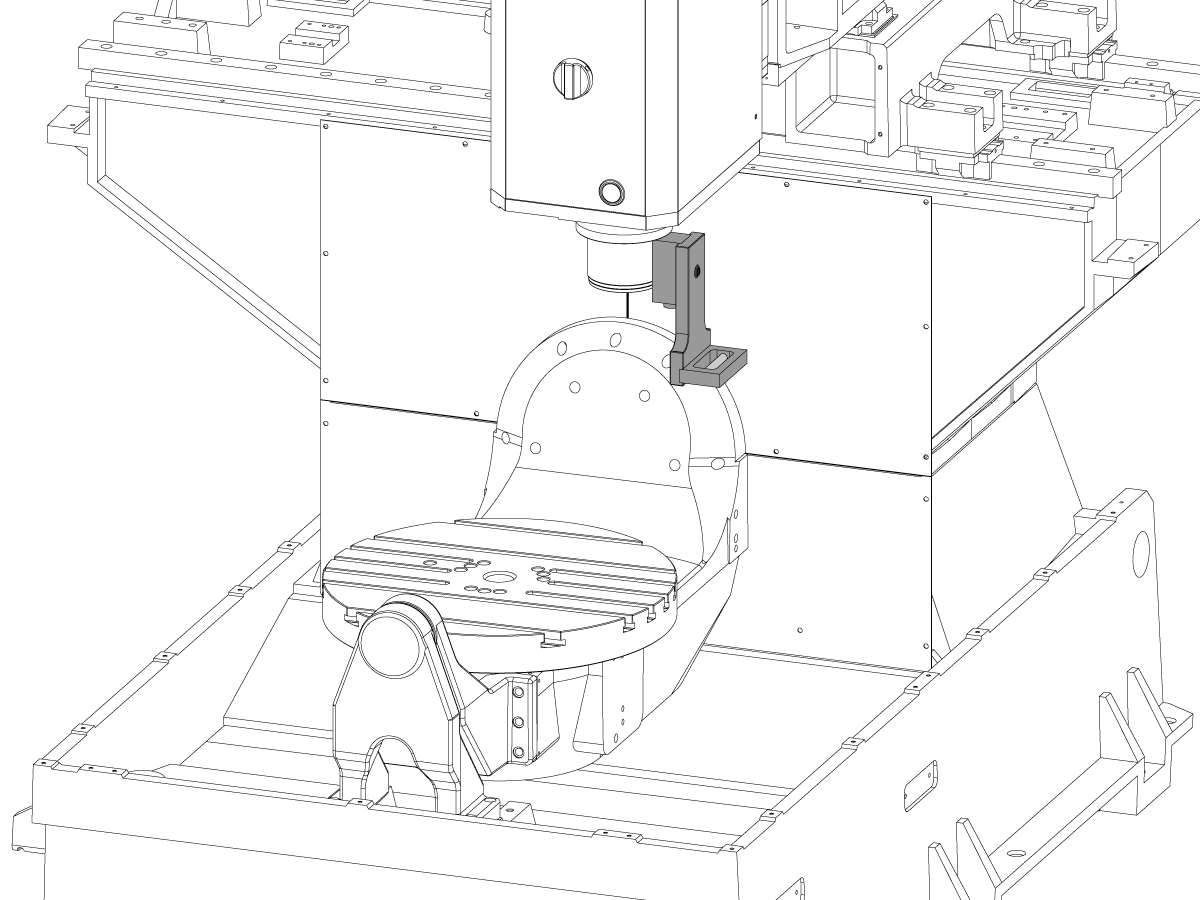
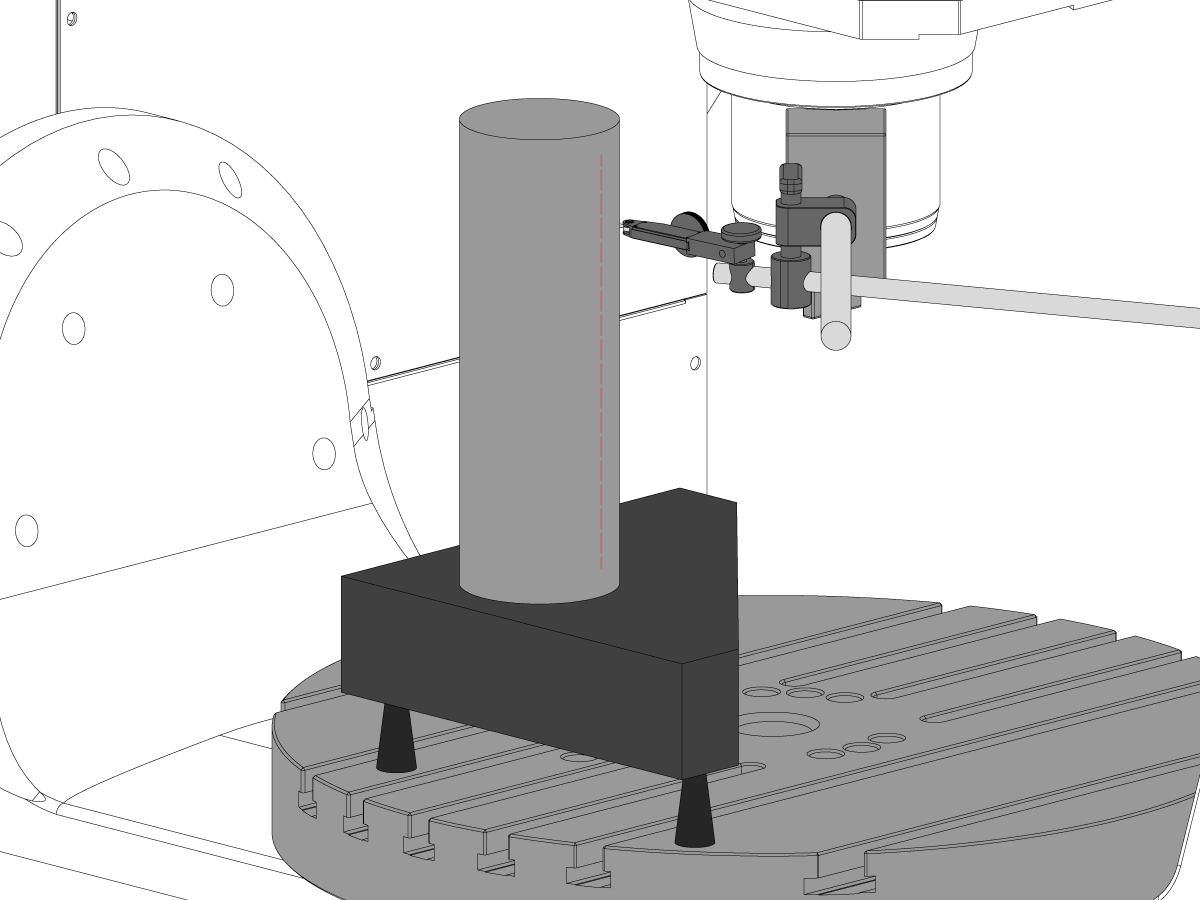
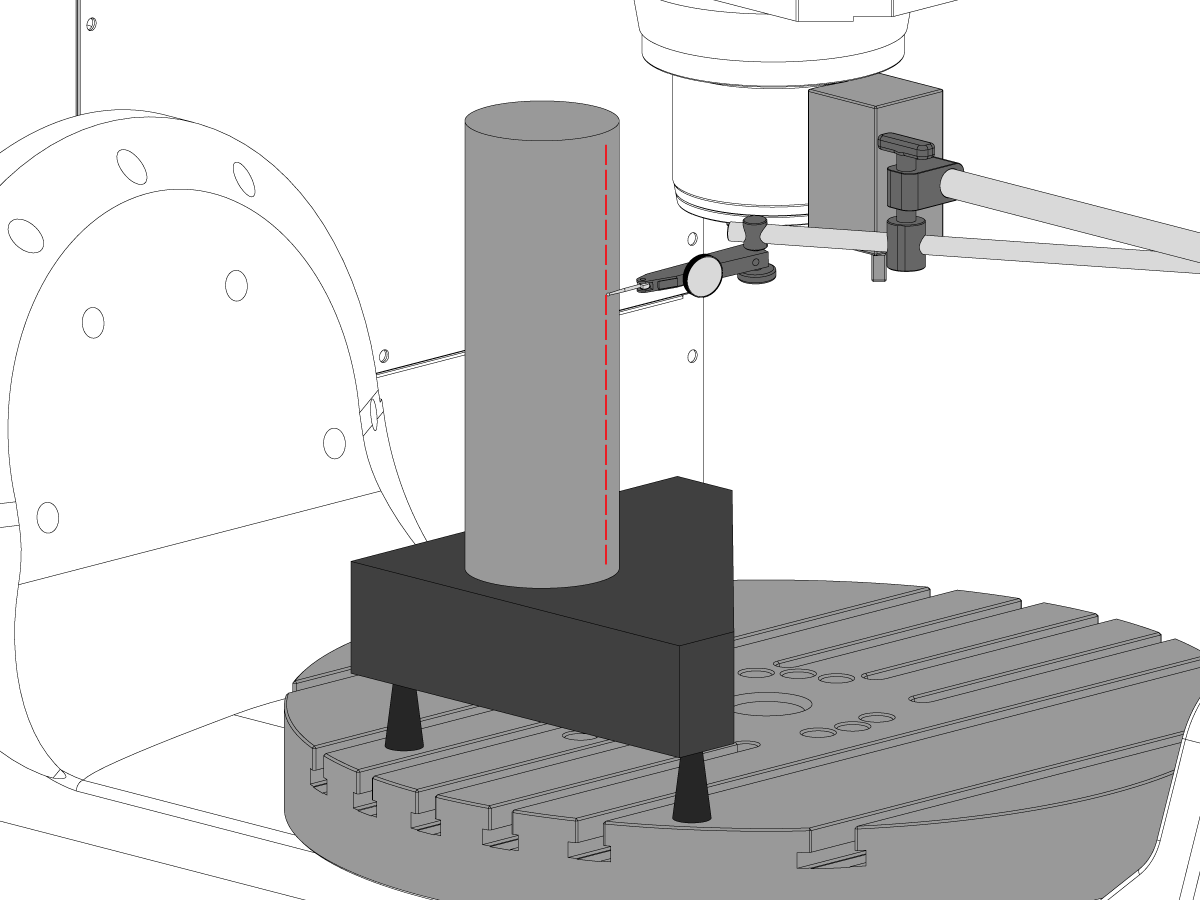
Nastavte valec.

Položte valec na hornú stranu trojitého kameňa, ako je to znázornené na obrázku.

Zarovnajte horný povrch valca rovnobežne s rovinou X-Y NTE 0.0001" otáčaním strojných zdvihákov.

Stroj ručne otočte do nasledovnej polohy:

  • UMC-750 do polohy X -7.000" a Y -10.000"
  • UMC-750SS do polohy X -10.000" a Y-10.000"

2

Zarovnajte os Z kolmo na os X:

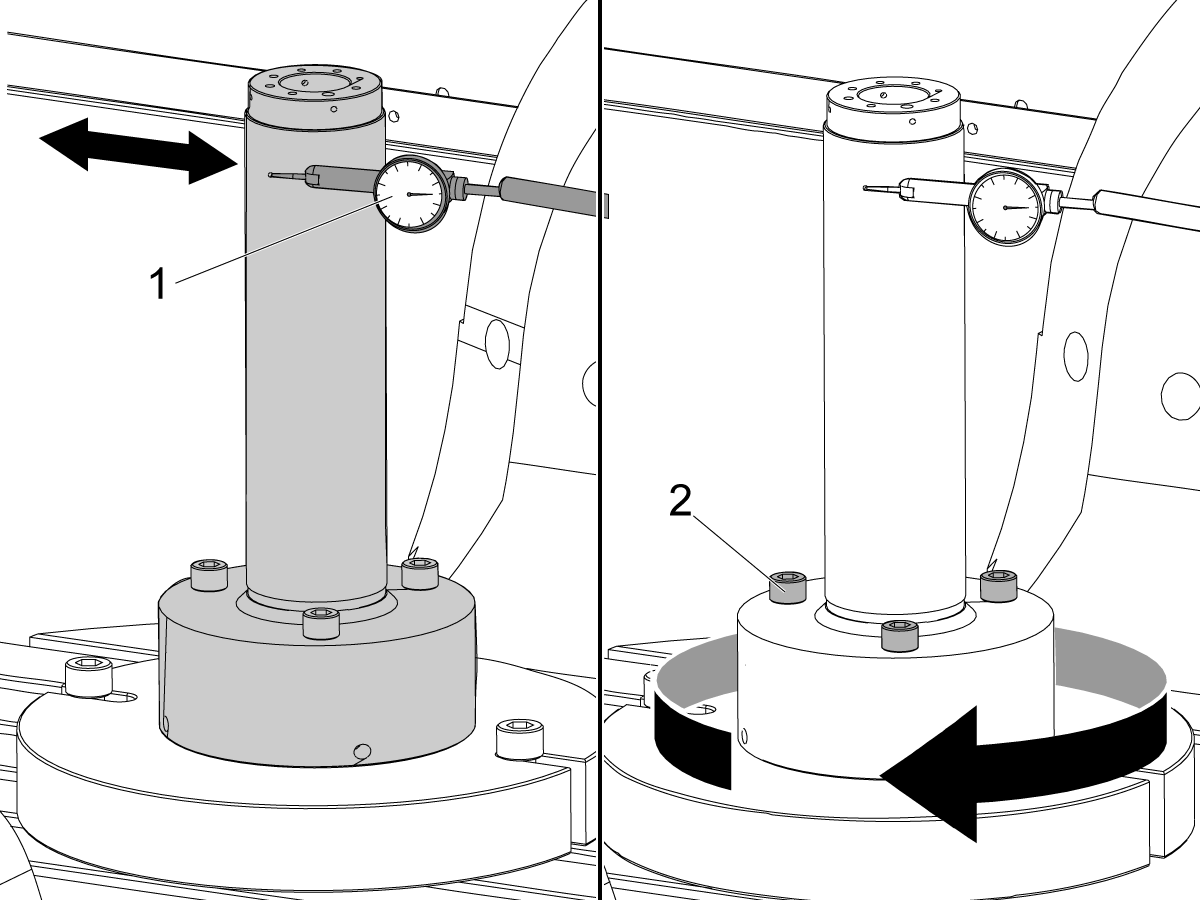
Vymeňte jednu z horných rožných skrutiek na vozíkoch osi Z za T-2193A *, aby ste okolo nej otáčali hlavu vretena.

Indikujte stranu valca pozdĺž osi Z.

Povoľte skrutky, ktoré zaisťujú vozíky osi Z k piestu.

Zarovnajte os Z kolmo na os X NTE 0.0005"/10" otáčaním hlavy vretena zo strany na stranu.

Utiahnite skrutky. Pozrite si Špecifikácie krútiaceho momentu upínacích prvkov spoločnosti Haas.

Overte kolmosť osi Z voči osi X po utiahnutí skrutiek.

Po dokončení vyrovnania vymeňte T-2193A * so skrutkou

*  : Používa sa len pri modeloch predrebootov. 

3

Zarovnajte os Z kolmo na os Y:

Indikujte prednú stranu valca pozdĺž osi Z.

Vložte vyrovnávaciu podložku medzi vozíkmi osi Z a piestom, aby ste zarovnali os Z kolmo k osi Y NTE 0.0005"/10".

Poznámka: Vyrovnajte buď horné dva vozíky, alebo dolné dva vozíky s rovnakými podložkami.

Utiahnite skrutky. Pozrite si Špecifikácie krútiaceho momentu upínacích prvkov spoločnosti Haas.

Overte kolmosť osi Z voči osi Y a osiam X po utiahnutí skrutiek.

4

Zarovnajte a utiahnite plášte s guľovou maticou osí Y a Z:

Povoľte skrutky, ktoré zaisťujú guľovú maticu k plášťu a skrutky, ktoré zaisťujú plášť k odliatku.

Najprv utiahnite skrutky, ktoré zaisťujú plášť guľovej matice k odliatku a skrutky, ktoré zaisťujú guľovú maticu k plášťu.

Pomocou funkcie uzamknutia posuvu môžete pohybovať osou tam a späť po celej dĺžke pojazdu.

Poznámka: Nepoužívajte ručné koleso ani rýchle posúvanie.

Utiahnite skrutky. Pozrite si Špecifikácie krútiaceho momentu upínacích prvkov spoločnosti Haas.

Prístup k plášťu matice osi Y môžete získať v zadnej časti stroja, keď je piest ručne posunutý úplne dopredu k stroju.

Prístup k plášťu matice osi Z môžete získať z prednej strany stroja, keď je hlava vretena ručne posunutá úplne nadol.

Poznámka: Kryt motora motora musí byť odstránený, aby ste získali prístup k plášťu guľovej matice osi Z.

Vráťte vreteno do roviny X-Y

1

Nastavte žulu:

Nastavte strojné zdviháky a žulu na stred platne osi C, ako je znázornené na obrázku.

Zarovnajte horný povrch žuly rovnobežne k rovine X-Y nastavením výšky strojných zdvihákov NTE 0.0001".

Umiestnite vreteno nad stred platne.

2

Vráťte vreteno do roviny X-Y:

Na hriadeľ vretena položte odchýlkomer.

Urobte meranie na vrchu žuly v každých 90° rotácie.

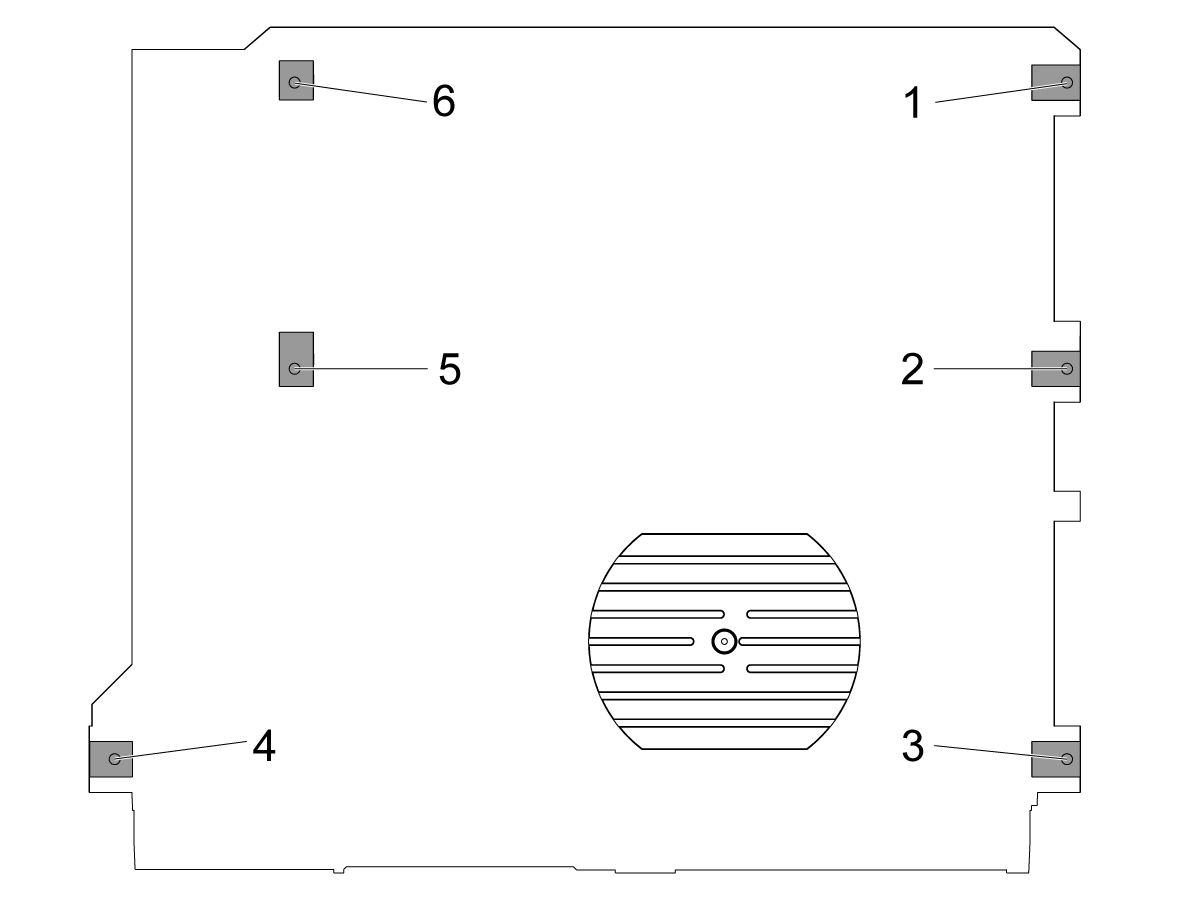
Povoľte (6) skrutiek v základnej doske pre hlavu vretena.

Pridajte alebo odstráňte vyrovnávacie podložky medzi odliatkom hlavy vretena a základnou doskou, aby ste vreteno vrátili do roviny X-Y NTE 0.0005"/10".

Poznámka: Ak chcete zmeniť uhol základnej dosky, použite vyrovnávacie podložky nerovnakej hrúbky [1].

Ak je vytočenie v rámci špecifikácie, dotiahnite (6) skrutiek. Pozrite si Špecifikácie krútiaceho momentu upínacích prvkov spoločnosti Haas.

Overte vrátenie vretena po utiahnutí skrutiek.

Zarovnanie osí B voči osiam XYZ

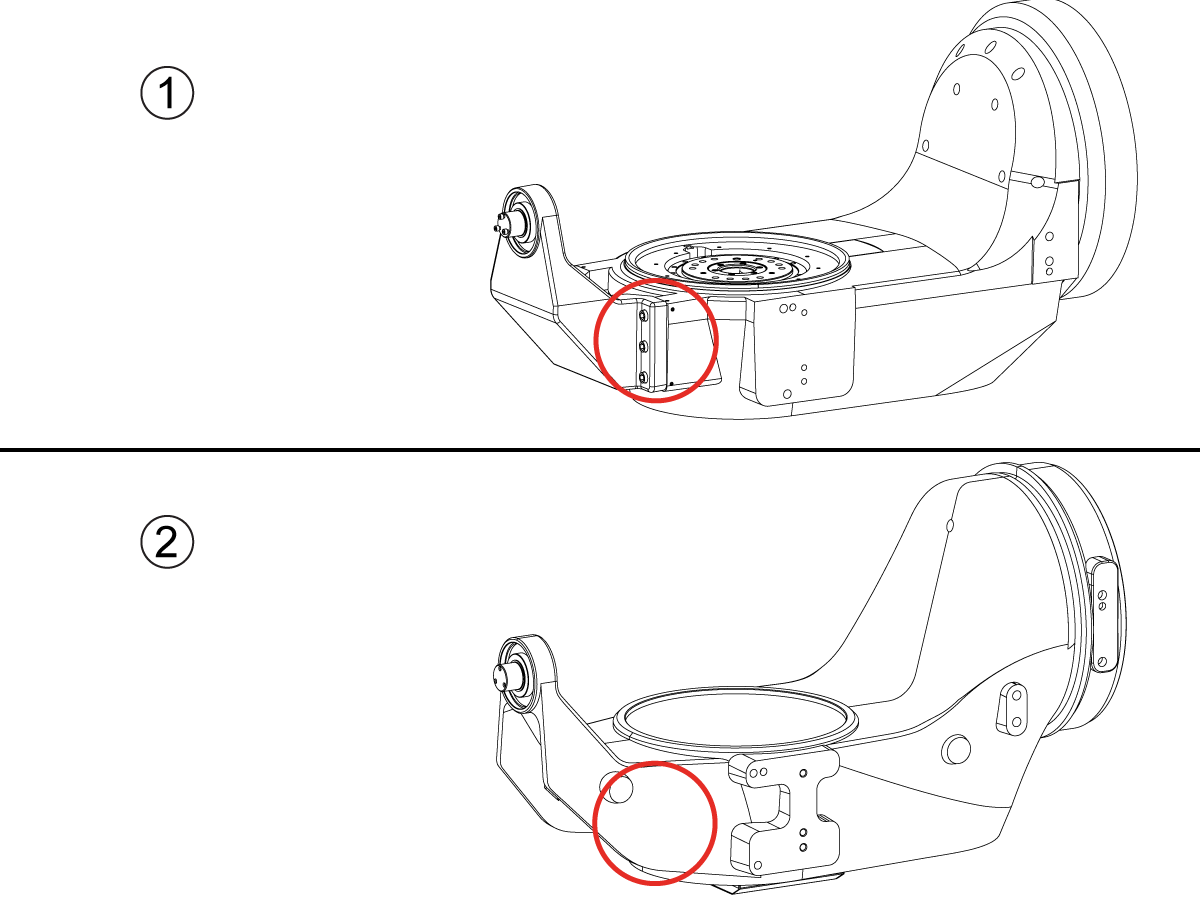
How to identify the Multi-Piece and the Unibody trunnion   

1) Multi-Piece trunnion:    UMC machines built approximetely before 11/2022 will have this configuration.

2) Unibody trunnion:    UMC machines built approximetely after 11/2022 will have this configuration.

1

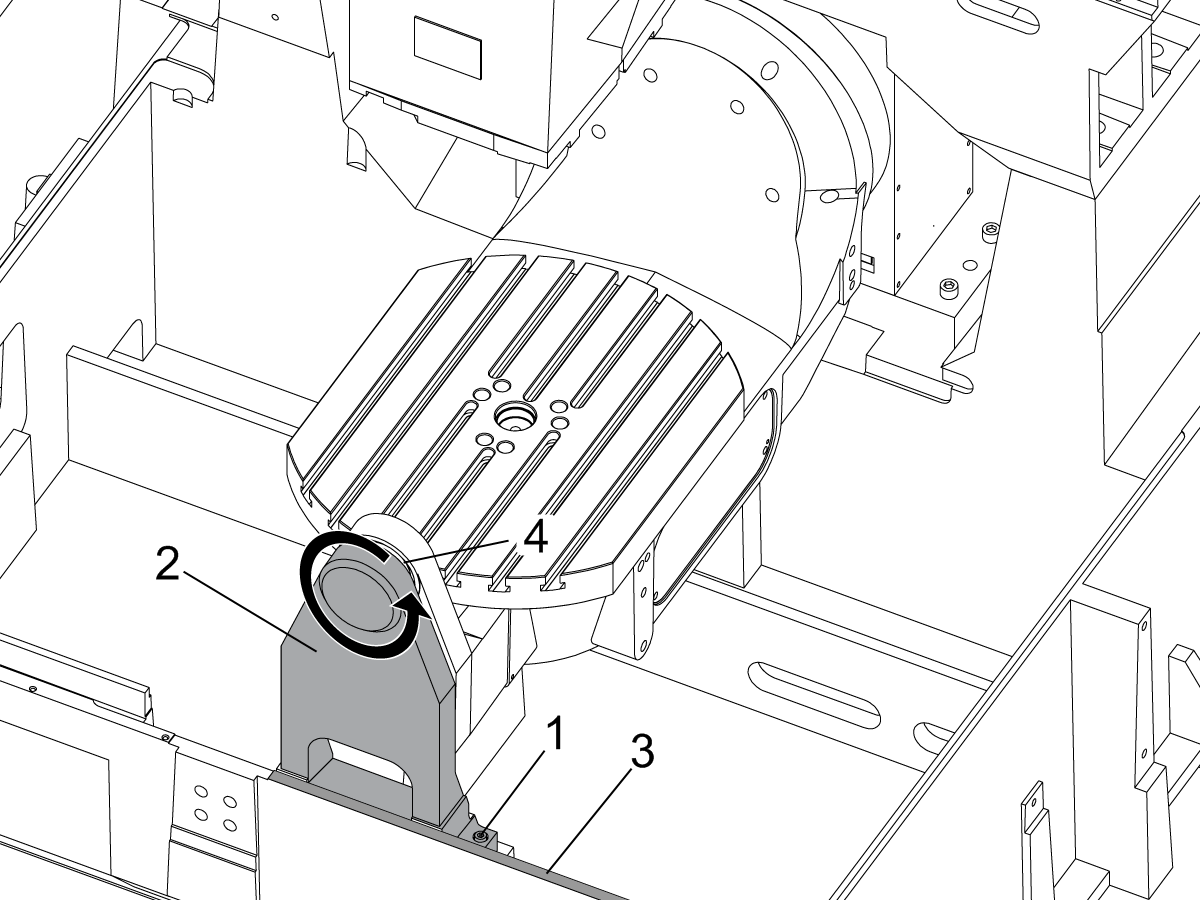
Remove the A-frame trunnion support:

Remove the bolts [1] that secure the A-frame trunnion support [2] to the base and take out the shims between A-frame support and the base.

Rotate the A-frame support [2] counter-clockwise to clear the edge of the base [3].

Pull the A-frame support off the bearings.

 Note: The A-frame support might vacuum lock on the bearings. Use the zip-tie to pry the seal [4] open.

 Caution: To lift the trunnion support, get the aid of another person. The support weighs 85 lbs (39 kg).

2

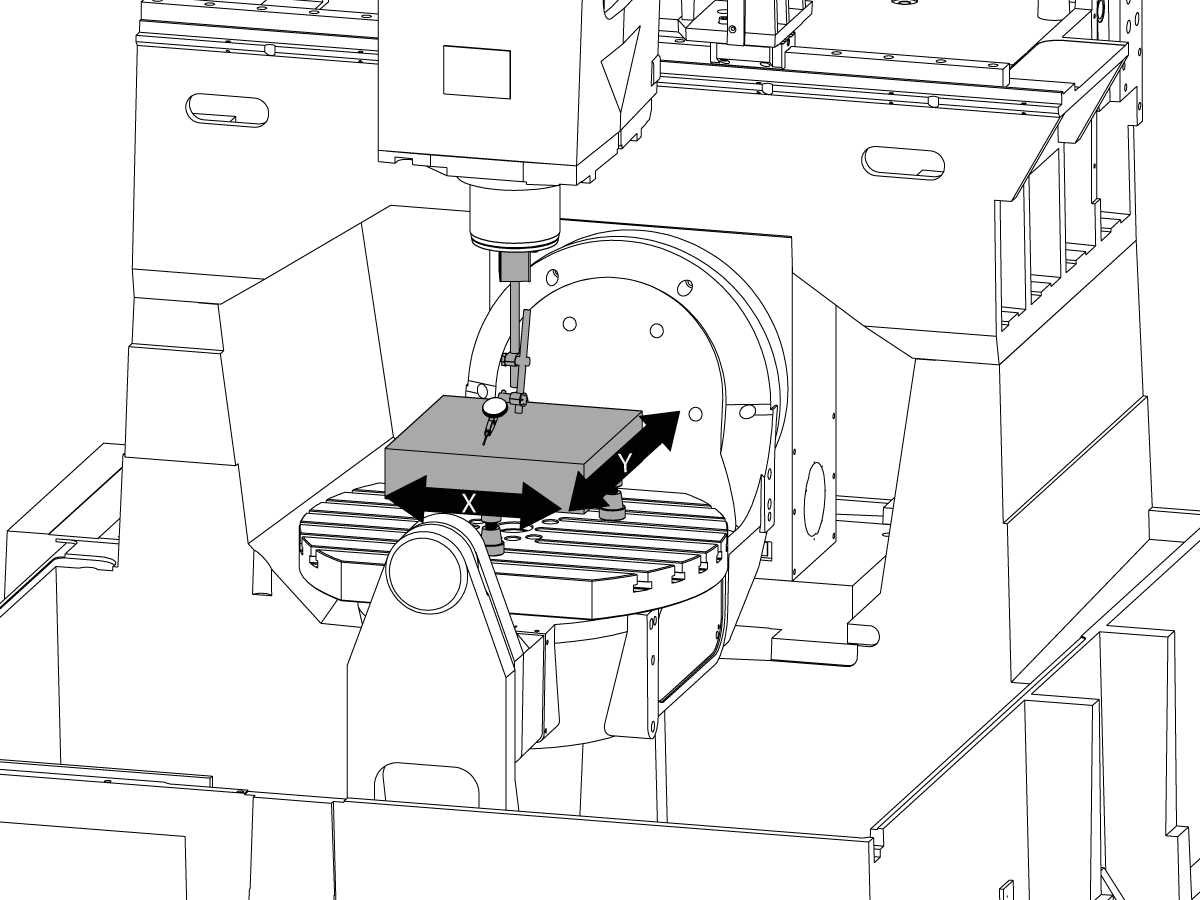
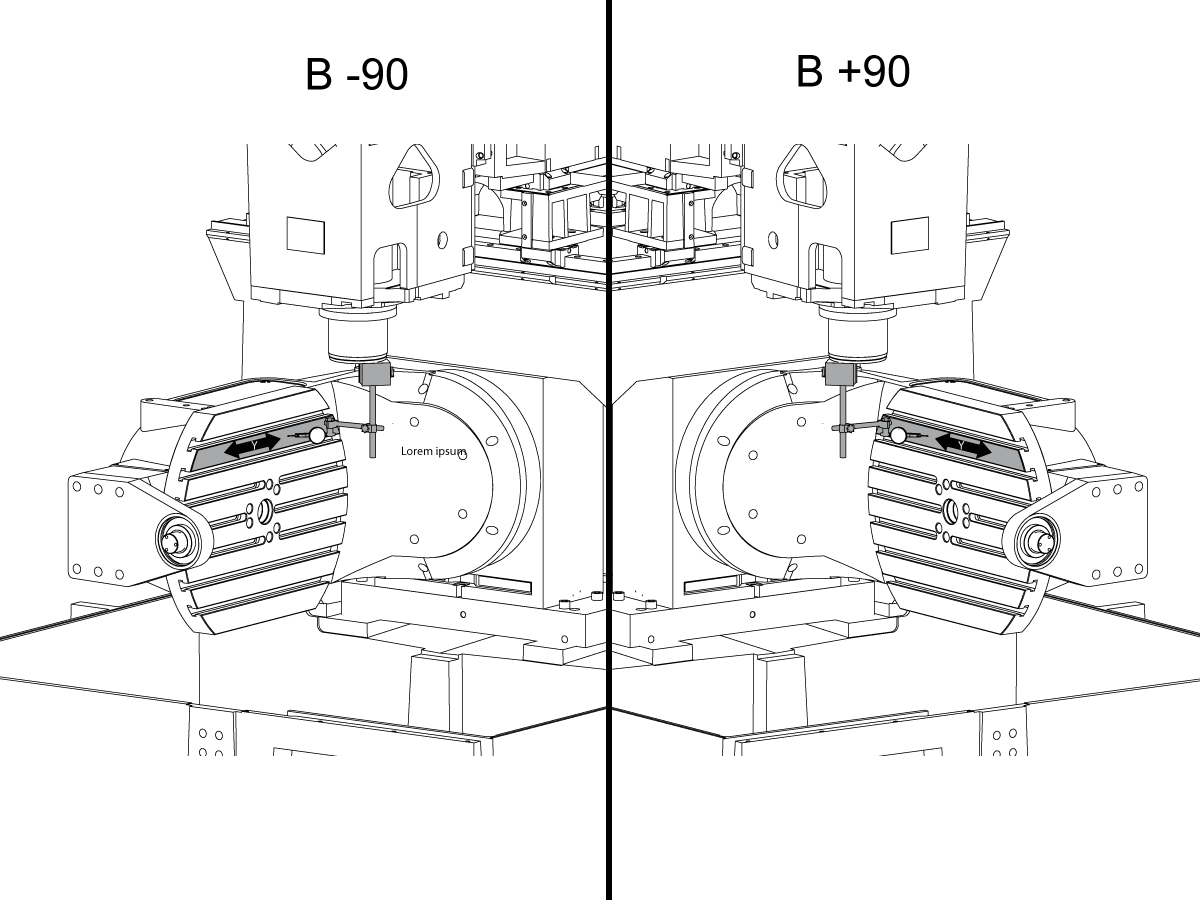
Measure the B- axis of rotation parallelism to the Y-Z plane:

For a machine with a Classic Haas Control, change Parameter 151:20 (B axis CHK TRAVL LIM) to 0.

For a machine with a Next Generation Control, change Parameter 6.021 (B axis CHK TRAVL LIM) to FALSE.

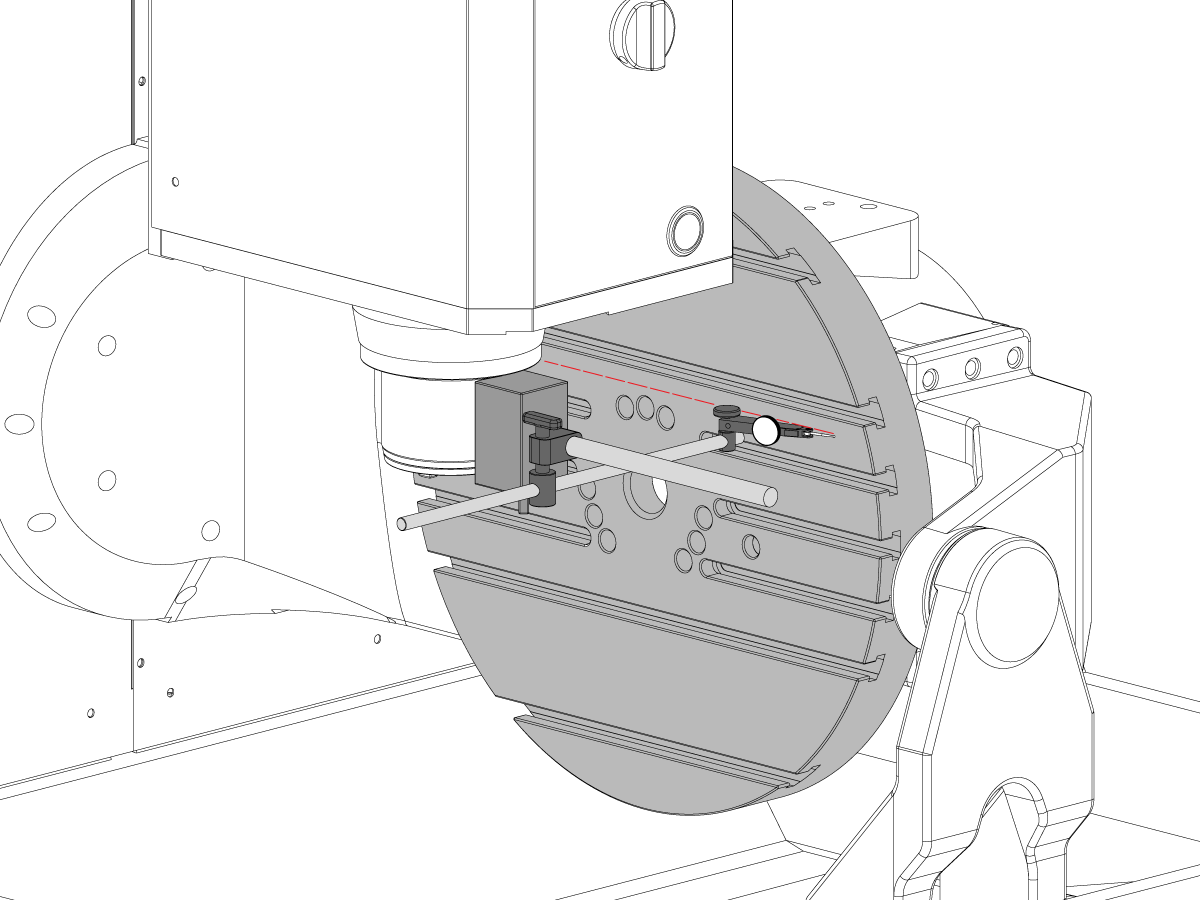
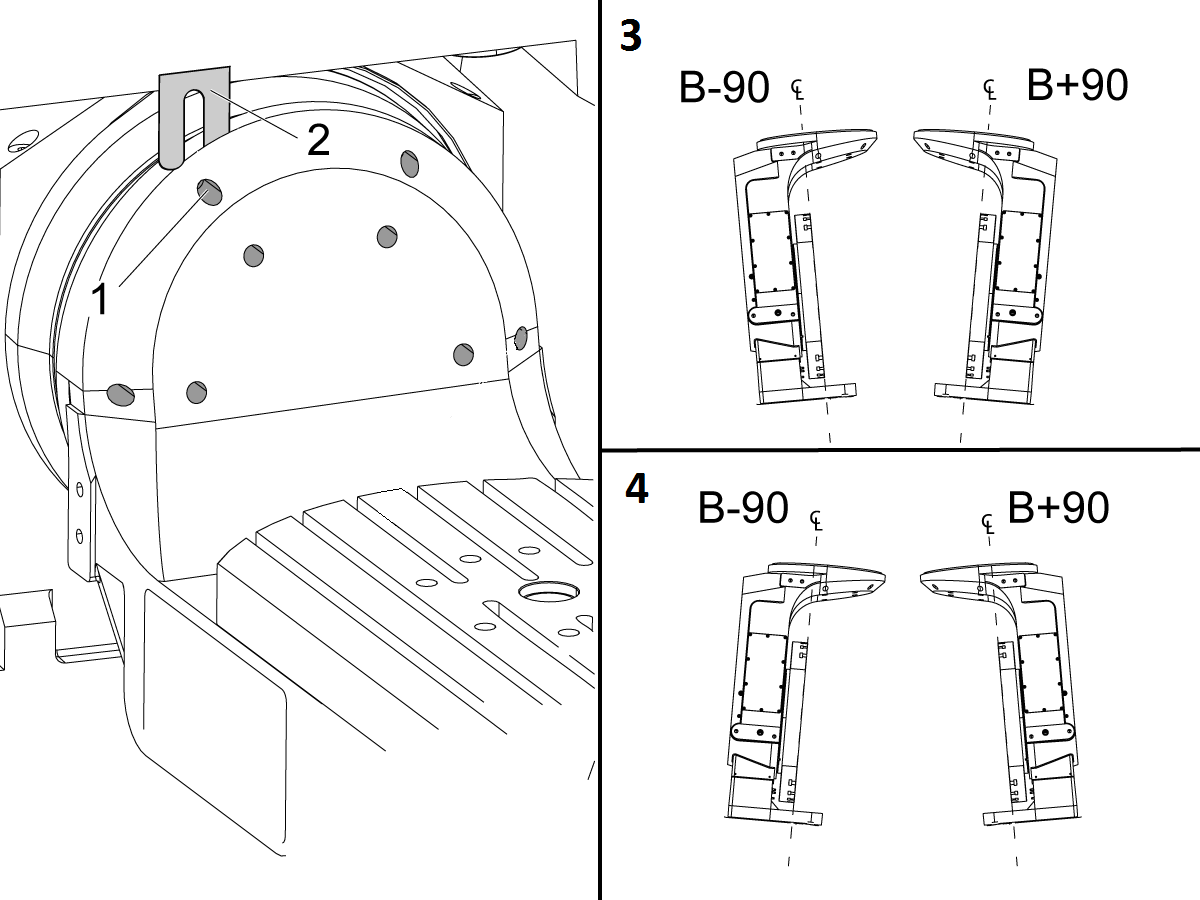
Measure the parallelism of the platter to the Y-Z plane with the B axis at 90° and then the B axis at -90° as shown in the picture.

Position the Y-Axis in the following starting position:

UMC-500: Y=0, Sweep 15”, 3rd T-Slot Land from the top.

UMC-750/1500-Duo: Y=-1.0, Sweep 18", 3rd T-Slot Land from the Top .

UMC-1250: Y=-1.0, Sweep 28", 3rd T-Slot Land from the Top.

UMC-500PP: Y=-4.0, Sweep 7".

UMC-750PP: Y=-2”, Sweep 15".

UMC-1000PP: Y=-4”, Sweep 15".

Compare the results at B 90° and B-90°. The results should be...

  • Symmetric against the Y-Z plane, positive or negative direction
  • Less than 0.0010"/20"

If the results are symmetric against Y-Z plane, and are less than 0.0010"/20 inches: Go to Step 5.

If the results are symmetric against Y-Z plane, but are more than 0.0010"/20 inches: Go to Step 4.

 Warning: If the results [3] are not symmetric against the Y-Z plane, the B axis rotary needs to be aligned: Go to Step 3.

3

Align the B axis of rotation parallel to the Y-Z plane:

Loosen the (6) bolts [1] that secure the B axis rotary to the base casting.

 Note: Keep the bolts sufficiently snug to control the adjustments.

Adjust the front and rear setscrews [2] until the measurements taken in Step 2 are symmetric against the Y-Z plane.

Torque the (6) bolts [1]. Refer to Haas Fastener Torque Specification.

Verify the measurements in Step 2 after the bolts have been torqued.

4

Align the C Axis of rotation perpendicular to the B Axis of rotation:

Remove the bottom C-Axis access cover.

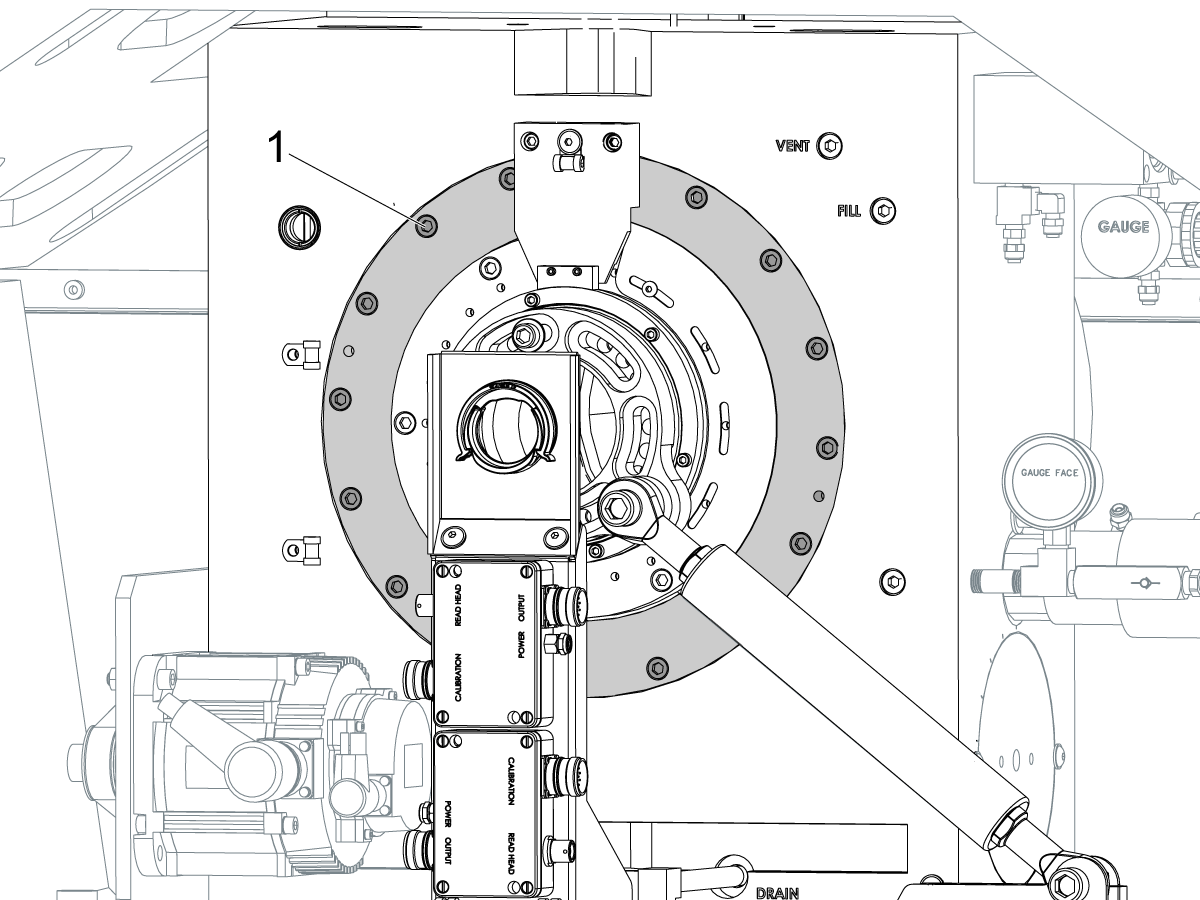
Loosen the (12) bolts [1] that hold the C Axis body to the B Axis platter face.

Reach the bottom (4) bolts through the C Axis access port.

If the B Axis is symmetric in the positive direction [4], install horseshoe shims [2] of appropriate size behind the top (2) bolts.

If the B Axis is symmetric in the negative direction [5], install horseshoe shims [2] of appropriate size behind the bottom (2) bolts.

Torque the (12) bolts to 80 Ft-lbs (108 Nm).

Cut the excessive shim material off.

Verify the measurements in Step 2 after bolts are torqued.

5

Align the trunnion support shaft co-axial with the B Axis of rotation:

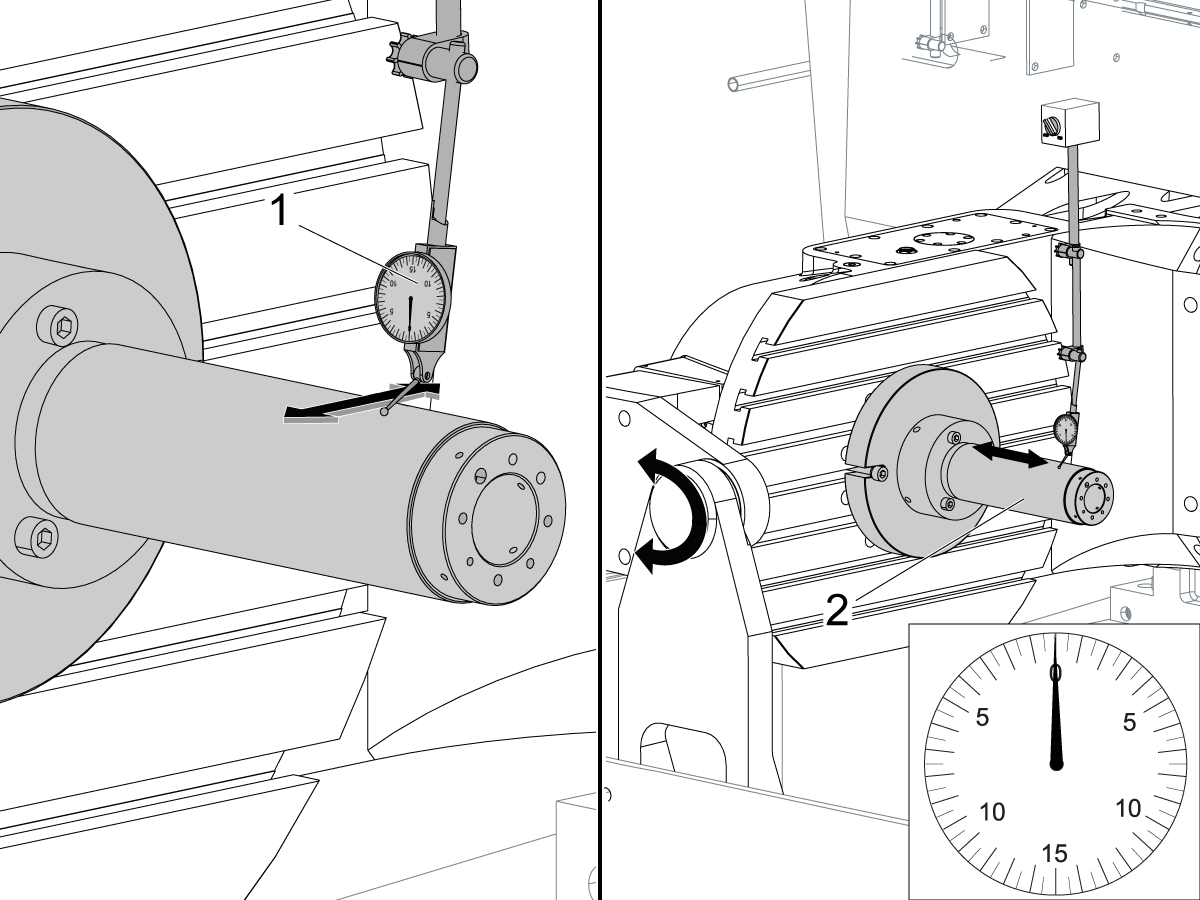
Setup (2) indicators on the outer race of the trunnion support bearing [2] as shown in the picture.

Mark the spot on the outer race where one of the indicator needles is contacting the surface.

After moving the B Axis to 90° or -90° you will align the marked spot with the needle again to exclude the bearing runout error from the measurements.

Take the readings when B is at 90° and B at -90°. Compare the readings. 

 Caution: The B axis brake needs to be clamped when taking the readings.

The deviation between the results when B is at 90° and at -90° needs to be less than 0.001" on each indicator.

 Note: The indicator on the side of the bearing will measure top to bottom alignment and the indicator on the top of the bearing will measure side to side alignment.

____

For models with a multi-piece trunnion

Loosen the (6) bolts [3] on the C Axis body support. Keep the bolts sufficiently snug to control adjustment.

Adjust the (8) set screws [4] until deviation between B at 90° and B at -90° is within 0.001".

Torque the (6) bolts [2] on the C Axis body support to 80 Ft-lbs (108 Nm).

Verify the alignment after the bolts have been torqued.

____

For models with a unibody trunnion

Jog rotary to B90. Set up an indicator on the highlighted surface as shown in the lower diagram .

Rotate B-axis 180 degrees (90 to -90).

Run out (NTE 0.010” TIR).

 Caution: If the measurement exceeds the tolerance then contact support.

6

Install and shim the A-frame trunnion support:

Move the B Axis to 90°.

Setup an indicator [1] against a machined surface of the C Axis body. Set the indicator to 0.

Use plastic zip ties [2] to pry the seal open while installing the A-frame support. This lets unwanted air and grease out of the assembly.

Install the A-frame trunnion support [3] over the bearings.

Remove the cable ties.

Turn the trunnion support clockwise until it is vertical.

 Note: The weight of the A-frame support will cause the trunnion to sag. The amount of sag is measured with the indicator that was previously setup on the side of the C Axis body.

____

For multi-piece trunnions

Adjust the shims [4] between the A-frame support and the base casting to remove the sag until indicator reads 0 again.

When the indicator reading is 0, torque the (4) bolts. Refer to Haas Fastener Torque Specification.

Verify the reading after bolts are torqued. Adjust the shims again if necessary until the indicator reads 0.

____

For models with unibody trunnion

Determine the amount of shim stock [4] needed to raise the Trunnion arm so the indicator reads 0.005".

The indicator [1] value will change once the support is torqued.

With indicator still in place:

  • Torque trunnion support bolts to appropriate values.
  • Check indicator to make sure it reads between the range of

Trunnion arm raised (0.005” to  0.010”).

 Note: For unibody trunnions, the shim location may also be used to correct the C-axis to X-Y plane perpendicularity instead of shimming the saddle trucks.

 Caution: Use equal amount of shims on each side of the A-frame support. Unequal shims will cause the A-frame support to pull the trunnion to the side.

Verify the B Axis of rotation alignment to the Y-Z plane (Step 2). Loosen the bolts and tap the A-frame support side to side if necessary to correct the B axis to Y-Z plane alignment.

7

Set C-axis perpendicular to X/Y plane:

Move the axes to

UMC-750's........X= -10.5" & Y=0."

UMC-1000's......X=-17.0" & Y=-0."

Zero an indicator [1], on a Ground Block [2], 1/2" off the edge at the rear of the platter (Mag-Base on Spindle), with C at 0 Degrees

Rotate C-Axis to 180°.

Move Y axis, and ground block, in Y Axis negative direction until you are 1/2" away from platter edge, and take the perpendicularity measurement

Adjust the shims until the average error is within 0.0005" end to end.

 Note: For unibody trunnions, the shim location under the bearing support may also be used to correct the C-axis to X-Y plane perpendicularity instead of shimming the saddle truck.

Caution: Shim either two front trucks or two rear trucks with the equal shim.

Note: Shim one truck at the time to maintain the X to Y squareness.

Verify the measurements after all bolts are torqued.

Verify the X to Y alignment in Step 2.

8

Set the tool change offsets:

B-axis tool change offset [1]

For Classic Haas Controls, change Parameter 213. 

For Next Generation Controls, go to: Settings>Rotary Tab>Highlight the rotary and press [INSERT], or change Parameter 6.078 (B TOOL CHANGE OFFSET) to set the trunnion (B Axis) parallel to the X Axis.

For models with multipiece trunnion

(NTE 0.001/10"; NTE 0.0020" overall)

For models with unibody trunnion

(NTE 0.0005/10"; NTE 0.0010" overall)

___

C-axis tool change offset [2]

For Classic Haas Controls change Parameter 523.

For Next Generation Control go to: Settings>Rotary Tab> Highlight the rotary and press [INSERT], or change Parameter 7.078 (C TOOL CHANGE OFFSET) to set the table T-slot (C Axis) parallel to the X Axis

For models with multipiece trunnion

(NTE 0.001/10"; NTE 0.0020" overall)

For models with unibody trunnion

(NTE 0.0005/10"; NTE 0.0010" overall)

9

Check C-axis perpendicularity to X/Y plane:

Align the indicator centered over the C-axis bore with the Y-axis at -10.

Jog positive in the Y-axis and align the indicator over the center of the last section of the platter and make a mark at this spot with a washable marker.

Insert 1-2-3 block as shown and set the indicator to zero.

Remove the block and rotate the platter 90 degrees, following the marked spot with the indicator.

Insert block back between the indicator and platter. Note reading.

Repeat the previous two steps, taking readings with the platter at 180, 270 and 360 degrees.

Multi-piece trunnion:  (NTE 0.0005")

Unibody trunnion: (NTE 0.001")

10

Measure the intersection of the B and C axis:

Follow the linked instruction manual to complete this step.

B-Axis and C-Axis intersection Adjustment

11

Align the B-Axis brake disk:

 Note: Do not do this step if you are working on a SS machine.

Operate this code in MDI mode to unclamp the brake:

M11;

Loosen all of the brake disc bolts [1] and torque them to 5 Ft-lbs (7 Nm).

Operate this code in MDI mode to clamp the brake:

M10;

Wait 10 seconds.

Torque the bolts. Refer to Haas Fastener Torque Specifications.

Nastavenie parametra/nastavenia späť na továrenské hodnoty

Nastavte Parameter 1314 pre CHC / Nastavenie 254 pre NGC späť na továrenskú hodnotu. (Po zmene hodnoty reštartujte napájanie stroja.)

Zarovnajte a kalibrujte WIPS. Bezdrôtový intuitívny systém sondovania (WIPS) – Kalibrácia

Nastavte nulové body otočného zariadenia stroja. 

  • UMC-750 – Nastavenia korekcií MRZP WIPS – CHC
  • UMC-750 – Nastavenia korekcií MRZP WIPS – NGC

Vyplňte celú kontrolnú správu:

  • EA0420 UMC-500 kontrolná správa
  • EA0373 UMC-750 kontrolná správa
  • EA0418 UMC-1000 kontrolná správa

Kópiu kontrolnej správy nechajte pri stroji.

Ak ste vymenili zostavu osí B a C, vykonajte postup UMC-750 – Priesečník osi B a C – Zarovnanie

8.2 Zarovnanie – indikačné zóny

Recently Updated

Indikačné zóny zarovnania UMC


AD0490

Indikačné zóny

1

Valec osi X

  • Najskôr pripevnite nástroj T-2192 na stranu vretena.
  • Pri meraní valca osi X držte nasledujúce polohy osi Y a Z:
    • UMC 500 (Y, Z): -8, -8
    • UMC 750 (Y, Z): -10, -10
    • UMC 1000 (Y, Z): -12, -12
  • Zmerajte valec osi X (NTE 0,0005" / 10")


2

Rovnobežnosť osi B a osi Y

  • Návrat do nulovej polohy osi B a C.
  • Zmerajte chybu platne v osi Y (NTE: 0,0008"/10"; 0.0012"/15")
  • Potom zmerajte ten istý povrch s osou B pri -90 ° aj +90 °  (NTE: 0,0008" / 10"; 0.0012" / 15")
  • Pre UMC 500 a 750 zmerajte celú dĺžku platne
  • Pre UMC 1000 nastavte korekciu 2 "od okraja platne a potom zmerajte cez 20"

3

Kolmosť osi Y na os X

  • Použite zdvíhacie skrutky, aby bol horný povrch žuly rovnobežne s rovinou XY (NTE: 0,0002")
  • Ďalej skontrolujte, či je Y kolmá na X (NTE 0,0005" / 10")

4

Kolmosť osi X na os Z

  • Položte žulový a presný valec na platňu v zobrazenej orientácii
  • Použite zdvíhacie skrutky na nastavenie povrchu valca rovnobežne s rovinou XY (NTE: 0,0002")
  • Umiestnenia vretena XY pre tento krok:
    • UMC 500, X = -6, Y = -8
    • UMC 750, X = -10, Y = -10
    • UMC 1000, X = -17, Y = -12
  • Počiatočná poloha Z pre toto meranie:
    • UMC 500, Zštart = Zvrch - 2”
    • UMC 750, Zštart = Zvrch - 5”
    • UMC 1000, Zštart = Zvrch - 7“
  • Zvrch je limit pojazdu osi Z v kladnom smere (hore)
  • Od Zštartu odmerajte 10“ pozdĺž valca

5

Kolmosť osi Y na os Z

  • Položte žulový a presný valec na platňu v zobrazenej orientácii
  • Použite zdvíhacie skrutky na nastavenie povrchu valca rovnobežne s rovinou XY (NTE: 0,0002")
  • Umiestnenia vretena XY pre tento krok:
    • UMC 500, X = -6, Y = -8
    • UMC 750, X = -10, Y = -10
    • UMC 1000, X = -17, Y = -12
  • Počiatočná poloha Z pre toto meranie:
    • UMC 500, Z štart = Z vrch - 2”
    • UMC 750, Z štart = Z vrch - 5”
    • UMC 1000, Z štart = Z vrch - 7 “
  • Z vrch je limit pojazdu osi Z v kladnom smere (hore)
  • Od Z štartu odmerajte 10“ pozdĺž valca

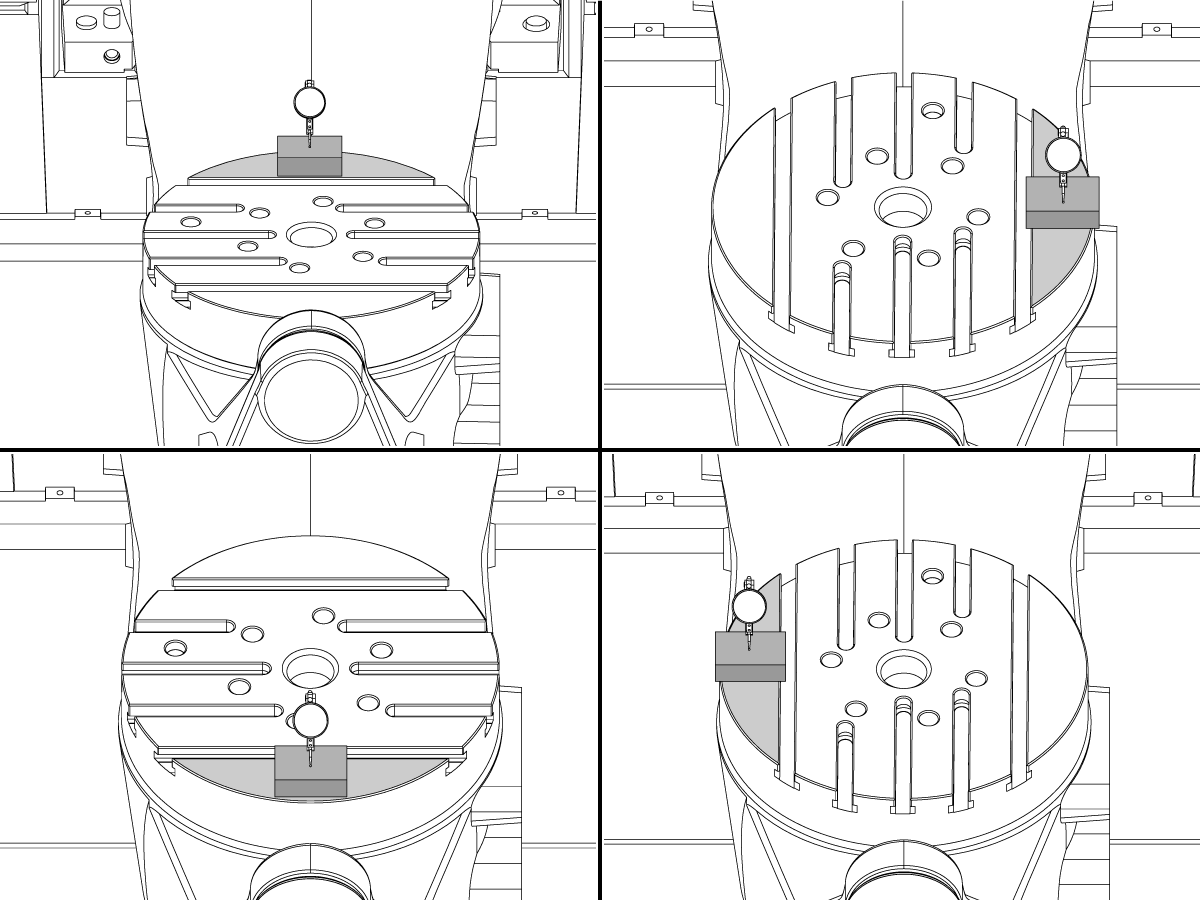
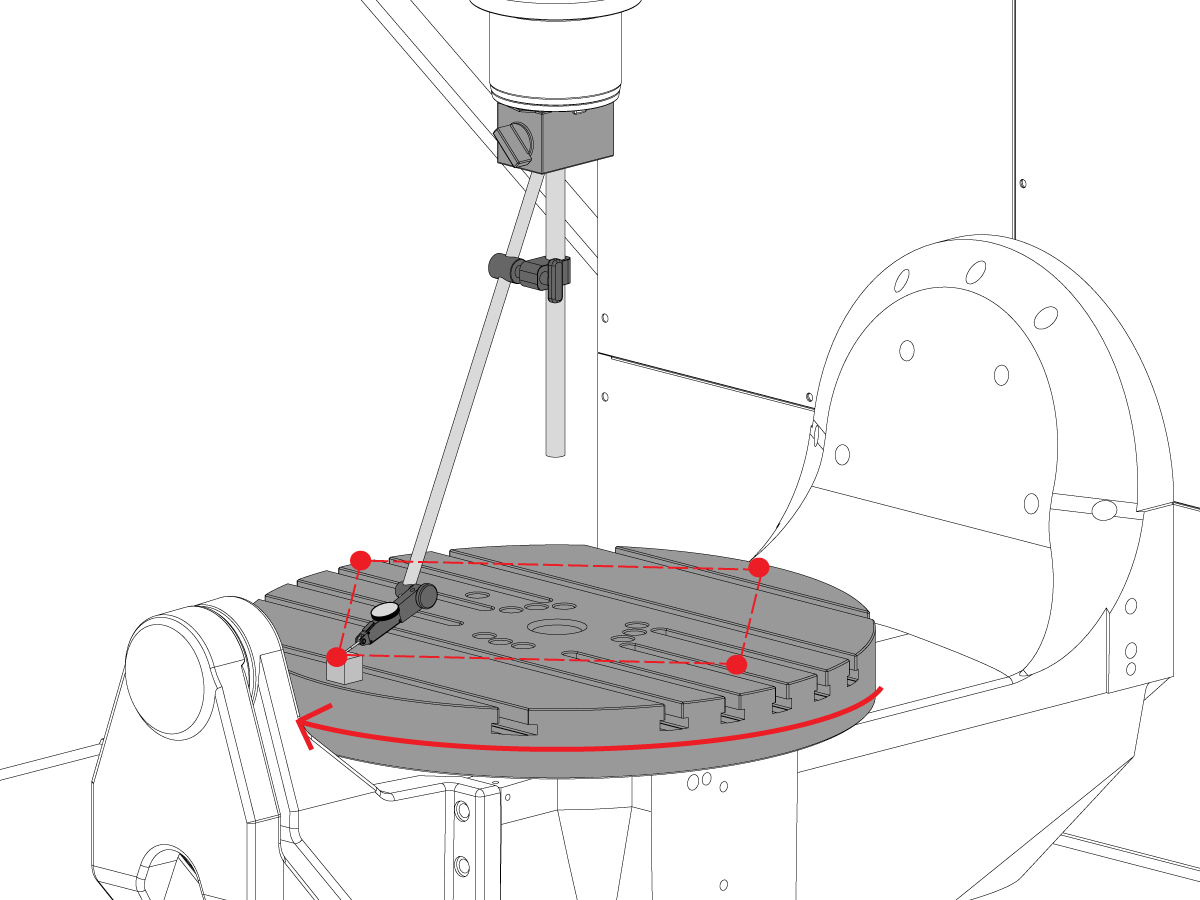
6

Kolmosť os C na rovinu XY

  • Umiestnite magnetickú základňu na vreteno tak, aby sa nemohla otáčať spolu s vretenom.
  • Umiestnite presný merací blok na okraj platne do polohy 12 hodín. 
  • V tejto polohe vynulujte špičku ukazovateľa na meracom bloku.
  • Otočte os C  o 90 ° 
  • Ďalej posuňte vreteno v osi X a Y, aby ste sledovali merací blok a zmerajte ten istý bod na platni. Nesmie dôjsť k otáčaniu vretena
  • Tento postup zopakujte ešte dvakrát, celkovo 4 polohy, od seba vzdialené 90°, na okraji palety, ako je to znázornené. 
  • Rozdiel medzi polohami merania 12 a 6 hodín určuje plochosť pozdĺž osi X (NTE 0,0005")
  • Rozdiel medzi polohami merania 3 a 9 hodín určuje plochosť pozdĺž osi Y (NTE 0,0005")

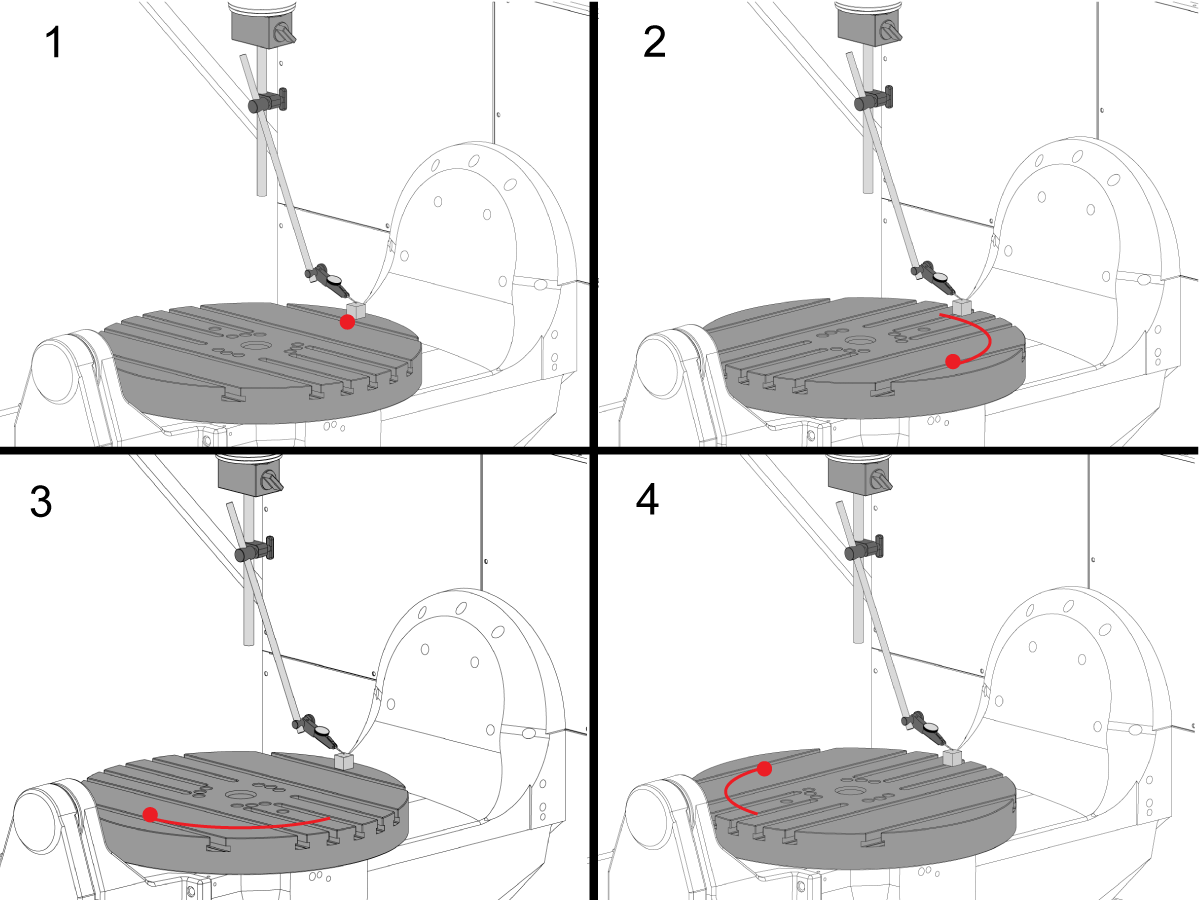
7

Chyba čelnej plochy platne

POZNÁMKA: Brzda osi C je pre tento krok vypnutá

  • Umiestnite presný merací blok na okraj platne do polohy 12 hodín. 
  • V tejto polohe vynulujte špičku ukazovateľa na meracom bloku.
  • Otočte os C  o 90°, ale merací blok udržujte v polohe 12 hodín
  • Vykonajte meranie z hornej časti meracieho bloku
  • Tento postup zopakujte ešte dvakrát, celkovo 4 polohy, od seba vzdialené 90°, na okraji palety, ako je to znázornené. 
  • Všimnite si celkovú indikovanú chybu. (NTE 0,001")

8

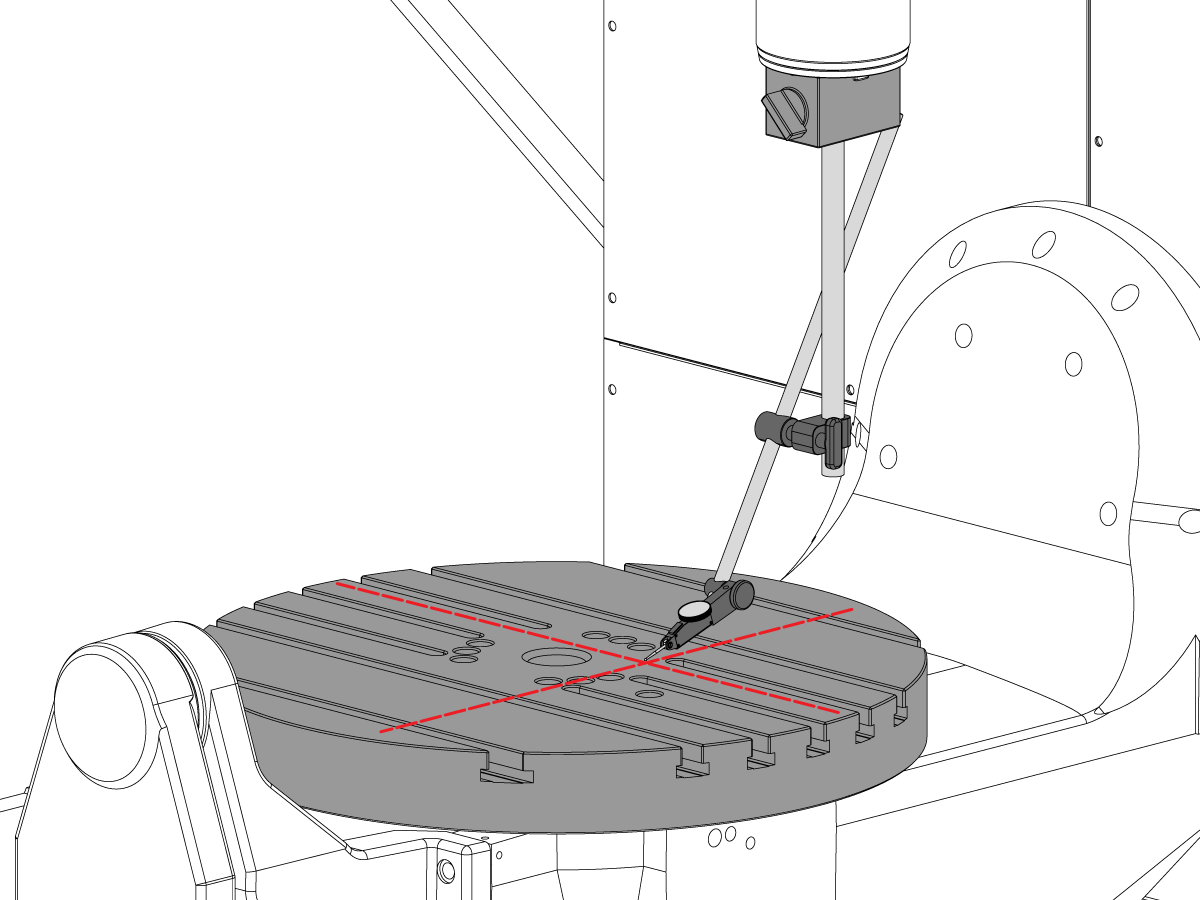
Rovnobežnosť povrchu platne s rovinou XY

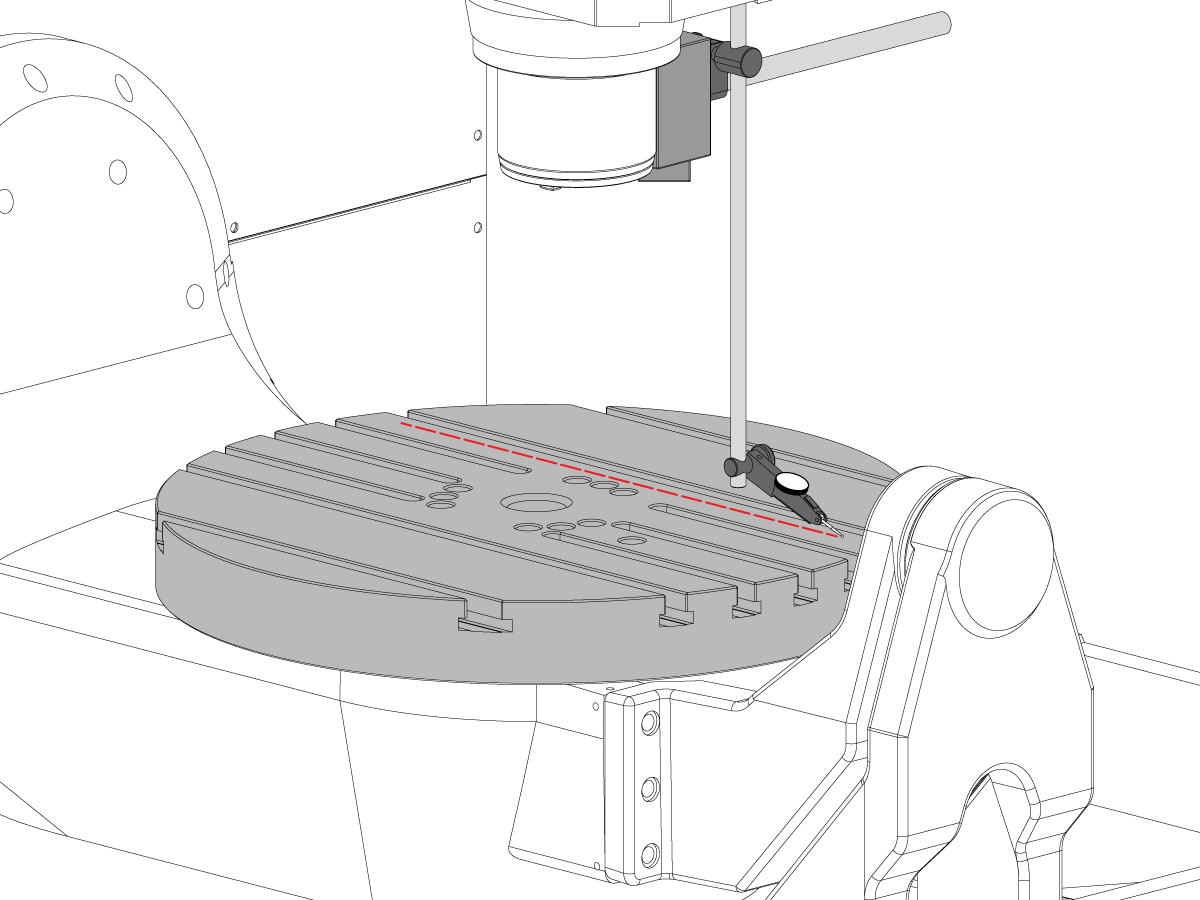
  • Vráťte os C do nulovej polohy, aby boli drážky T rovnobežne s osou X
  • Umiestnite špičku ukazovateľa na platňu a posuňte sa sa do osi X pozdĺž platne, aby ste našli rovnobežnosť platne na osi X (NTE 0,001” / 10"; 0,0015" / 15")
  • Potom sa posuňte do osi Y pozdĺž platne, aby ste našli rovnobežnosť platne na osi Y (NTE 0,001” / 10"; 0,0015" / 15")

9

Chyba vretena

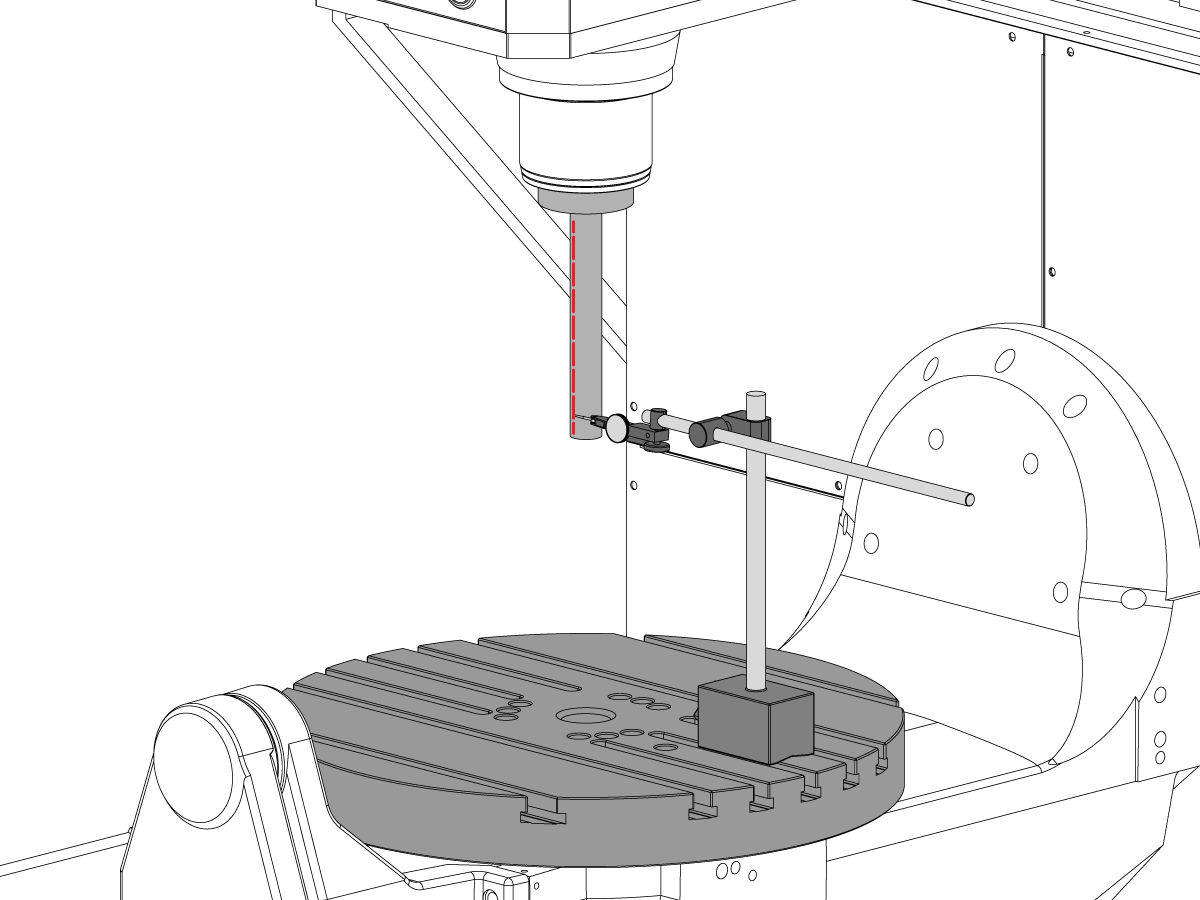
  • Vycentrujte vreteno cez otvor osi C.
  • Položte magnetickú základňu na stôl a vložte testovaciu tyč.
  • Skontrolujte chybu vretena na spodku testovacej tyče (NTE 0,0005" TIR)
  • Skontrolujte chybu vretena 6" nadol od základe testovacej tyče (NTE 0,001" TIR)

10

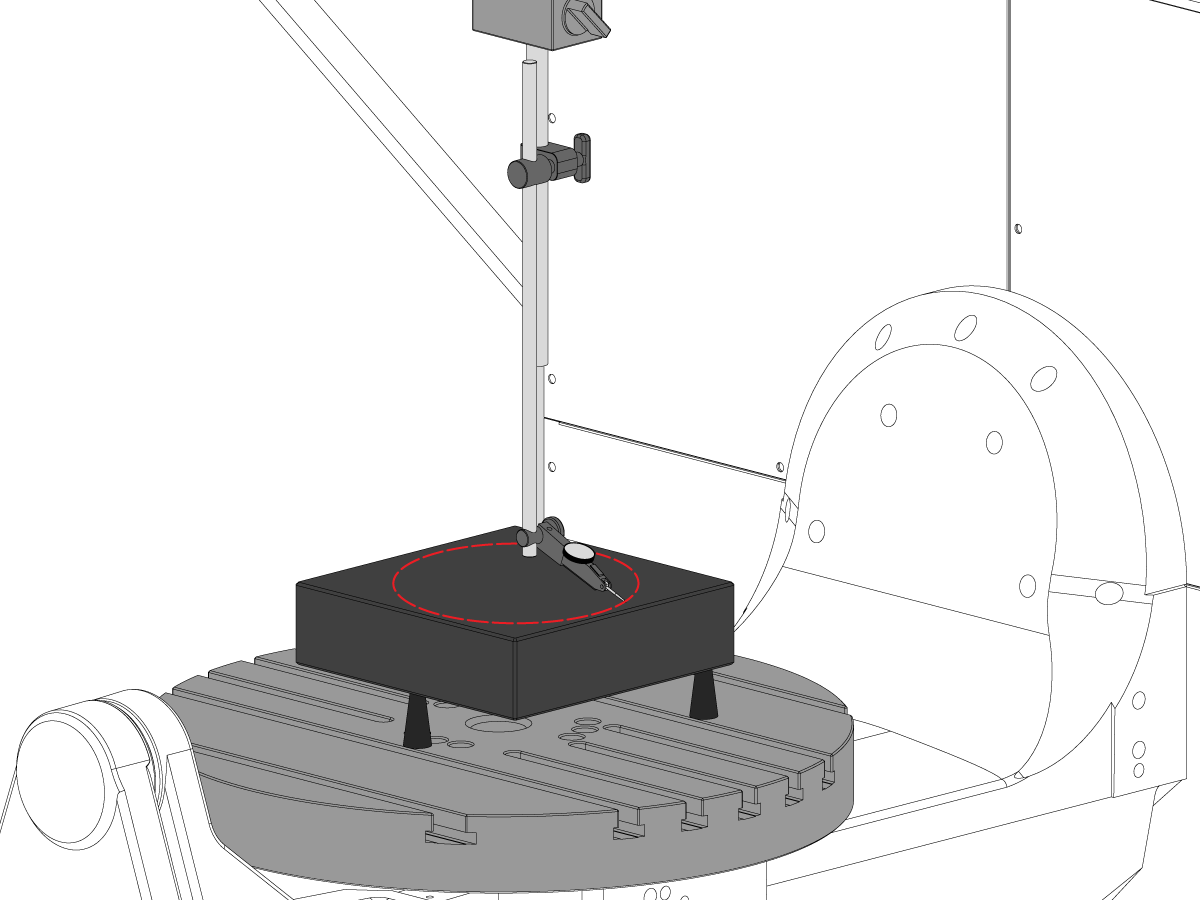
Rovnobežnosť stredovej osi vretena s osou Z

  • Použite zdvíhacie skrutky, aby bola žula rovnobežne s rovinou XY v zobrazenej orientácii (NTE: 0,0002")
  • Vycentrujte vreteno ponad otvor platne osi C
  • Prejdite kruh s priemerom 10"
  • Zaznamenajte XZ TIR  (NTE 0,0005")
  • Zaznamenajte YZ TIR  (NTE 0,0005")

11

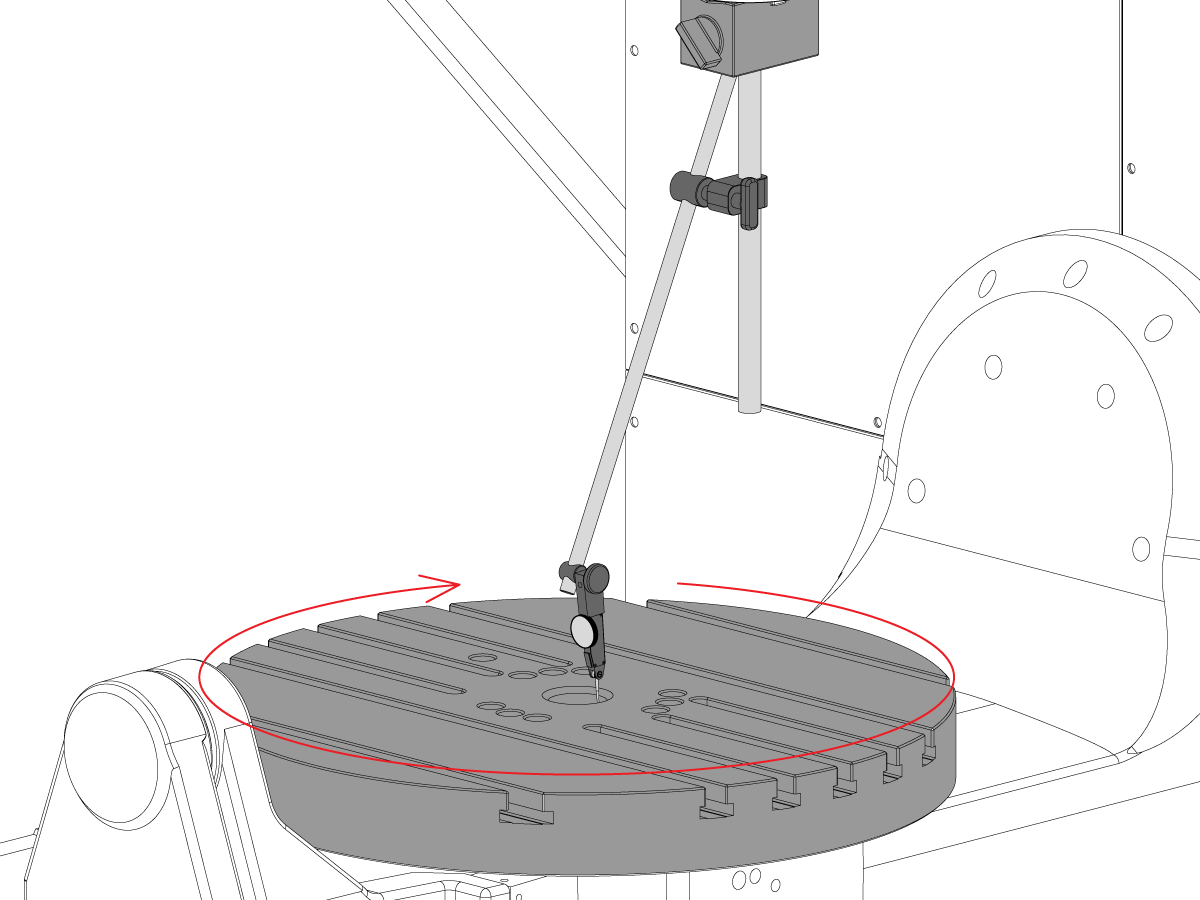
Sústrednosť otvoru osi C

  • Ukazovateľ umiestnite ako je zobrazené a posuňte os C o 360°
  • Zaznamenajte TIR presného otvoru (NTE 0,002")

12

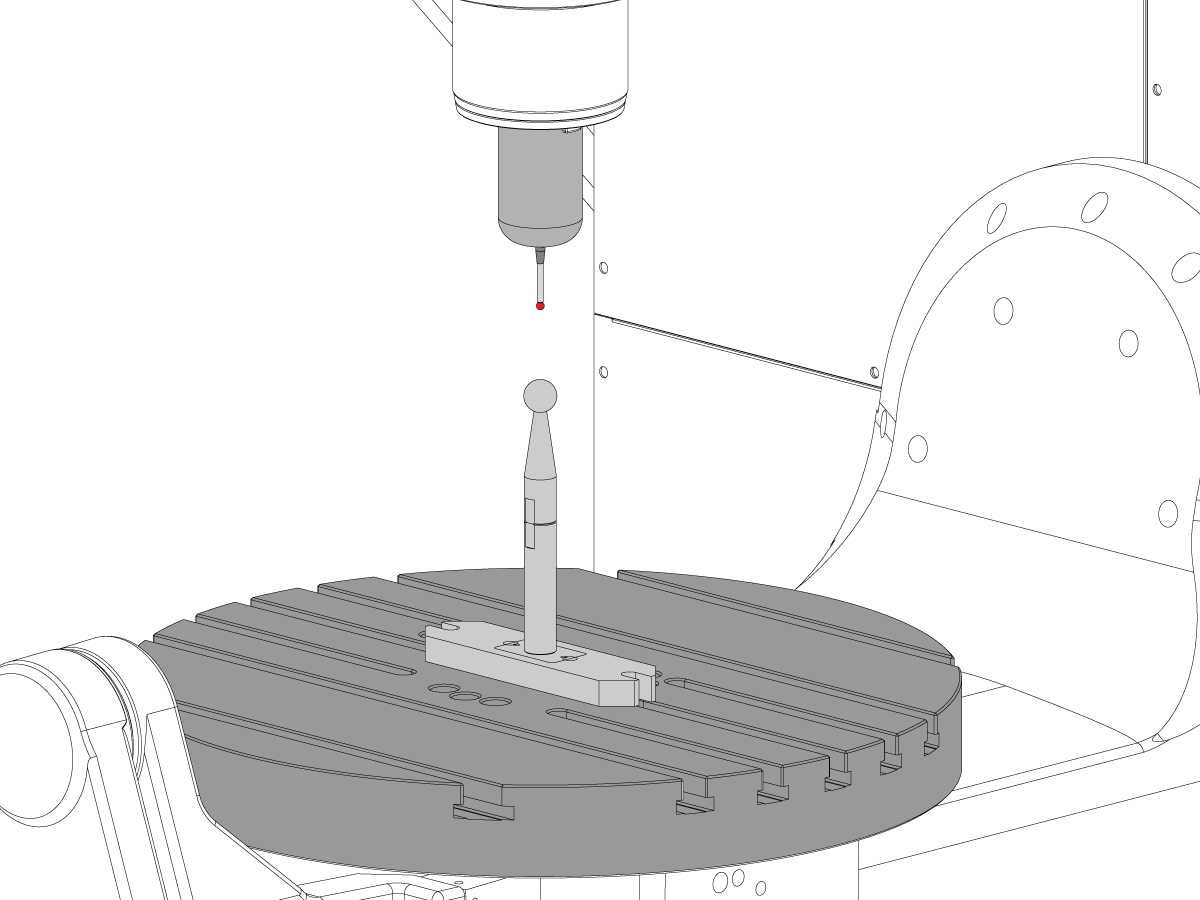
Nulový bod otočnej osi stroja (MRZP)

  • Na overenie hodnôt parametrov Coldfire alebo nastavení NGC, ktoré sú uvedené nižšie, použite program Macro VQC a sondovací systém:
    • 255 – KOREKCIA MRZP X
    • 256 – KOREKCIA MRZP Y
    • 257 – KOREKCIA MRZP Z
    • 254 - VZDIALENOSŤ STREDU 5. OTOČNEJ OSI
  • Pre kompletné pokyny k MRZP si pozrite Haas  postup nastavenia korekcie MRZP WIPS

8.3 Geometria – riešenie problémov

Recently Updated

UMC – geometria – príručka na riešenie problémov


TG0151

Prehľad

Pred odstránením problému s presnosťou alebo geometriou stroja UMC-750 sa musí technik dôkladne oboznámiť s nasledujúcimi základmi:

  • Ako vyrovnať a zarovnať otočné osi stroja UMC
  • Ako zmeniť zarovnanie všetkých osí stroja
  • Ako vykonať kalibráciu MRZP a dôkladné pochopenie toho, čo sú priradené parametre a ich vplyv na stroj
  • Pochopenie možností presnosti strojov a schopnosť uvažovať o problémoch s geometriou
  • Zarovnanie prierezu osi B na C

K problému s geometriou alebo presnosťou stroja UMC-750 je potrebné pristupovať systematicky a v správnom poradí. Nasledujúce informácie by sa mali prísne dodržiavať a postupovať podľa nich.

Je nesmierne dôležité, aby sa pred vykonaním akéhokoľvek posúdenia alebo úpravy geometrie stroja skontrolovala správne vyrovnanie a zarovnanie otočných osí so strojom.

Mnohé chyby možno pripísať stroju, ktorý mal haváriu, alebo problémom s aplikáciami nástrojov, prípadne s programovaním. Nepokúšajte sa zmeniť geometriu stroja bez toho, aby ste úplne neskontrolovali vodorovnú polohu a geometriu celého stroja podľa Správy o kontrole. To zahŕňa kontrolu Machine Rotary Zero Point (MRZP).

V prípade havárie sú na stroji 4 klzné spoje. Týmito oblasťami sú vretenová hlava k zarážke, zarážka k suportu, suport k mostu a otočný čap k podpere otočného čapu.

 Poznámka: Žiadny z týchto spojov by nemal byť nikdy podložený. Havária stroja by nikdy nemala meniť množstvo klinov potrebných pre stroj z výrobných nastavení.

Je dôležité si uvedomiť, že lineárna presnosť stroja je 0,0004/10" a uhlová presnosť je +/- 15 oblúk. sek. Tieto tolerancie sa môžu rýchlo nahromadiť.

Malo by sa vynaložiť všetko úsilie, aby sa zistilo, či je aplikácia obrábania opodstatnená a v rámci možností stroja, upnuti a nástrojov.

Posúdenie stavu stroja

Zistite, či sa stroj v minulosti pokazil. Skontrolujte históriu alarmov, hľadajte fyzické poškodenie plechu, stola, vretena, atď. Bez ohľadu na to, aká malá havária bola, bude to mať vplyv na geometriu stroja. Ak dôjde k havárii stroja, musí sa vykonať úplná kontrola geometrie stroja.

Posúďte celkový stav upínania dielu a stav rezných nástrojov.

Získajte úplnú zálohu stroja a správu o chybách.

Overte vodorovnú polohu a geometriu stroja

Skontrolujte, či stroj stojí vodorovne a či je rotačná os zarovnaná so strojom

 Poznámka: Nepokúšajte sa v tomto okamihu robiť žiadne úpravy geometrie stroja, iné ako nastavovanie nôh do vodorovnej polohy.

Ak stroj nie je vo vodorovnej polohe alebo nie je otočný nástroj vyrovnaný, obnovte vodorovnú polohu a vyrovnajte otočný nástroj.

Vykonajte kontrolu celej geometrie a zaznamenajte mieru rozsahu a smer akýchkoľvek chýb pre každú os.

Analyzujte správu o kontrolách.

Ak je ktorákoľvek z častí správy o kontrolách mimo tolerancie, stroj musí byť znovu zarovnaný.

Skontrolujte aplikáciu

Zhromaždite nasledujúce informácie o obrobku, upínaní a nástrojoch:

  • Ktoré prvky sú mimo tolerancie, miery rozsahu a smeru chyby
  • Je obrobok obrábaný pomocou 5 osí, 3 + 2 osí alebo 3-osí?
  • Skontrolujte obrobok a postup obrábania
  • Dá sa niektorá z chýb presnosti obrobku minimalizovať zmenou postupu obrábania?
  • Je problémom opakovateľnosť, veľkosť alebo geometria?
  • Používa program funkcie TCPC alebo DWO?
  • Sú v tabuľkách kompenzácií uvedené nejaké hodnoty?

8.4 Aplikácie – Riešenie problémov

Recently Updated

UMC – aplikácie – príručka na riešenie problémov


TG0150

Prístup

Ako sa dostať k príručke na riešenie problémov s aplikáciami UMC:

Kliknite na tento odkaz Dokumenty a softvér | HBC

Alebo

Prihláste sa na HBC.HAASCNC.COM

POZNÁMKA: Na tieto stránky sa môžu prihlásiť iba certifikovaní servisní technici spoločnosti Haas. 

Vyberte kartu Service (Servis).

V rámci položky Utilities (Siete) vyberte možnosť Documents and Software (Dokumenty a softvér).

Vyberte priečinok Applications (Aplikácie).

8.5 UMC-750 – Kontrolný zoznam súpravy vyrovnávacích podložiek

Recently Updated

UMC-750 – Kontrolný zoznam súpravy podložky


AD0131

Úvod

Toto je kontrolný zoznam súpravy podložky pre nasledujúcu súpravu:

  • 93-2236  SLÚCHADIEL A PODLOŽIEK PRE UMC-750

Kontrolný zoznam: Lem-priestor-stĺpec

Hrúbka Obrobok č. Množstvo v súprave Použité
.02100 20-9358A 2  
0.2105 20-9359A 2  
.02110 20-9383A 2  
0.2115 20-9365A 2  
0.2120 20-9384A 2  
0.2125 20-9385A 2  
0.2130 20-9368A 2  
0.2135 20-9369A 2  
0.2140 20-9386A 2  
0.2145 20-9371A 2  
0.2150 20-9372A 2  
0.2155 20-9387A 2  
0.2160 20-9374A 2  
0.2165 20-9375A 2  
0.2170 20-9376A 2  
0.2175 20-9377A 2  
0.2180 20-9378A 2  
0.2185 20-9379A 2  
0.2190 20-9380A 2  
0.2195 20-9381A 2  
0.2200 20-9382A 2  

Poznámka:  Len vlastníci súprav: Pri objednávaní náhradných dielov špecifikujte hrúbku podložky. Napríklad, 20-9382 0.2145

Kontrolný zoznam: Košele pre horolezectvo

Hrúbka Obrobok č. Množstvo v súprave Použité
0.0010 59-0240 2  
0.0020 59-0241 2  
0.0030 59-0242 2  

Kontrolný zoznam: Lem-Spacer-Column-veľký

Hrúbka Obrobok č. Množstvo v súprave Použité
0.2130 20-6282A 2  
0.2135 20-6283A 2  
0.2140 20-6284A 2  
0.2145 20-6285A 2  
0.2150 20-6286A 2  
0.2155 20-6287A 2  
0.2160 20-6288A 2  
0.2165 20-6289A 2  
0.2170 20-6290A
2  
0.2175 20-6291A 2  
0.2180 20-6294A 2  
0.2185 20-6295A 2  
0.2190 20-6292A 2  
0.2195 20-6293A 2  
0.2200 20-6296A 2  
0.2205 20-6297A 2  
0.2210 20-6277A 2  
0.2215 20-6279A 2  
0.2220 20-6278A 2  
0.2225 20-6298A 2  
0.2230 20-6281A 2  

Poznámka:  Len vlastníci súprav: Pri objednávaní náhradných dielov špecifikujte hrúbku podložky. Napríklad 20-6290A 0,2080

ZAZNAMENAJTE, KTORÉ VYROVNÁVACIE PODLOŽKY BOLI V POUŽITOM STĹPCI ODSTRÁNENÉ ZO SADY.

NÁVRAT NA KONTROLNÝ ZOZNAM SO SADAMI VYROVNÁVACÍCH PODLOŽIEK.

NÁVRAT NA ORIGINÁLNE VYROVNÁVACIE PODLOŽKY V PREPRAVKE.

8.6 Priesečník osí B/C – zarovnanie

Úvod

Tento postup vám ukáže, ako merať a zarovnávať priesečník osí B a C.  Pred vykonaním tohto postupu overte, či je stroj na úrovni vyrovnávania UMC-750.

Osi B a C budete musieť zarovnať potom, čo:

  • Vymeníte osi B a C
  • alebo dokončíte správu o inšpekcii UMC a nájdete problém

5-osová rotačná vzdialenosť stredu určuje rozdiel medzi rotačnými stredmi rotácie: Bod nula otočnej osi stroja v osi C (MRZP) a MRZP v osi B v osi X.

Je možné, že neexistuje žiadny rozdiel medzi MRZP v osi C a v osi B.

  • Klasické ovládanie Haas (CHC): Parameter 1314 – Rotary Axes Center Deviation in X
  • Ovládanie novej generácie (NGC): Nastavenie 254 – 5 Axis Rotary Center Distance

Budete potrebovať nasledujúce nástroje:

  • T-2195A UMC Aligment Bar Adapter
  • T-2113 Alignment bar
  • Tepelná pištoľ a rukavice odolné voči teplu

Zarovnanie osí B voči osiam XYZ

How to identify the Multi-Piece and the Unibody trunnion   

1) Multi-Piece trunnion:    UMC machines built approximetely before 11/2022 will have this configuration.

2) Unibody trunnion:    UMC machines built approximetely after 11/2022 will have this configuration.

1

Remove the A-frame trunnion support:

Remove the bolts [1] that secure the A-frame trunnion support [2] to the base and take out the shims between A-frame support and the base.

Rotate the A-frame support [2] counter-clockwise to clear the edge of the base [3].

Pull the A-frame support off the bearings.

 Note: The A-frame support might vacuum lock on the bearings. Use the zip-tie to pry the seal [4] open.

 Caution: To lift the trunnion support, get the aid of another person. The support weighs 85 lbs (39 kg).

2

Measure the B- axis of rotation parallelism to the Y-Z plane:

For a machine with a Classic Haas Control, change Parameter 151:20 (B axis CHK TRAVL LIM) to 0.

For a machine with a Next Generation Control, change Parameter 6.021 (B axis CHK TRAVL LIM) to FALSE.

Measure the parallelism of the platter to the Y-Z plane with the B axis at 90° and then the B axis at -90° as shown in the picture.

Position the Y-Axis in the following starting position:

UMC-500: Y=0, Sweep 15”, 3rd T-Slot Land from the top.

UMC-750/1500-Duo: Y=-1.0, Sweep 18", 3rd T-Slot Land from the Top .

UMC-1250: Y=-1.0, Sweep 28", 3rd T-Slot Land from the Top.

UMC-500PP: Y=-4.0, Sweep 7".

UMC-750PP: Y=-2”, Sweep 15".

UMC-1000PP: Y=-4”, Sweep 15".

Compare the results at B 90° and B-90°. The results should be...

  • Symmetric against the Y-Z plane, positive or negative direction
  • Less than 0.0010"/20"

If the results are symmetric against Y-Z plane, and are less than 0.0010"/20 inches: Go to Step 5.

If the results are symmetric against Y-Z plane, but are more than 0.0010"/20 inches: Go to Step 4.

 Warning: If the results [3] are not symmetric against the Y-Z plane, the B axis rotary needs to be aligned: Go to Step 3.

3

Align the B axis of rotation parallel to the Y-Z plane:

Loosen the (6) bolts [1] that secure the B axis rotary to the base casting.

 Note: Keep the bolts sufficiently snug to control the adjustments.

Adjust the front and rear setscrews [2] until the measurements taken in Step 2 are symmetric against the Y-Z plane.

Torque the (6) bolts [1]. Refer to Haas Fastener Torque Specification.

Verify the measurements in Step 2 after the bolts have been torqued.

4

Align the C Axis of rotation perpendicular to the B Axis of rotation:

Remove the bottom C-Axis access cover.

Loosen the (12) bolts [1] that hold the C Axis body to the B Axis platter face.

Reach the bottom (4) bolts through the C Axis access port.

If the B Axis is symmetric in the positive direction [4], install horseshoe shims [2] of appropriate size behind the top (2) bolts.

If the B Axis is symmetric in the negative direction [5], install horseshoe shims [2] of appropriate size behind the bottom (2) bolts.

Torque the (12) bolts to 80 Ft-lbs (108 Nm).

Cut the excessive shim material off.

Verify the measurements in Step 2 after bolts are torqued.

5

Align the trunnion support shaft co-axial with the B Axis of rotation:

Setup (2) indicators on the outer race of the trunnion support bearing [2] as shown in the picture.

Mark the spot on the outer race where one of the indicator needles is contacting the surface.

After moving the B Axis to 90° or -90° you will align the marked spot with the needle again to exclude the bearing runout error from the measurements.

Take the readings when B is at 90° and B at -90°. Compare the readings. 

 Caution: The B axis brake needs to be clamped when taking the readings.

The deviation between the results when B is at 90° and at -90° needs to be less than 0.001" on each indicator.

 Note: The indicator on the side of the bearing will measure top to bottom alignment and the indicator on the top of the bearing will measure side to side alignment.

____

For models with a multi-piece trunnion

Loosen the (6) bolts [3] on the C Axis body support. Keep the bolts sufficiently snug to control adjustment.

Adjust the (8) set screws [4] until deviation between B at 90° and B at -90° is within 0.001".

Torque the (6) bolts [2] on the C Axis body support to 80 Ft-lbs (108 Nm).

Verify the alignment after the bolts have been torqued.

____

For models with a unibody trunnion

Jog rotary to B90. Set up an indicator on the highlighted surface as shown in the lower diagram .

Rotate B-axis 180 degrees (90 to -90).

Run out (NTE 0.010” TIR).

 Caution: If the measurement exceeds the tolerance then contact support.

6

Install and shim the A-frame trunnion support:

Move the B Axis to 90°.

Setup an indicator [1] against a machined surface of the C Axis body. Set the indicator to 0.

Use plastic zip ties [2] to pry the seal open while installing the A-frame support. This lets unwanted air and grease out of the assembly.

Install the A-frame trunnion support [3] over the bearings.

Remove the cable ties.

Turn the trunnion support clockwise until it is vertical.

 Note: The weight of the A-frame support will cause the trunnion to sag. The amount of sag is measured with the indicator that was previously setup on the side of the C Axis body.

____

For multi-piece trunnions

Adjust the shims [4] between the A-frame support and the base casting to remove the sag until indicator reads 0 again.

When the indicator reading is 0, torque the (4) bolts. Refer to Haas Fastener Torque Specification.

Verify the reading after bolts are torqued. Adjust the shims again if necessary until the indicator reads 0.

____

For models with unibody trunnion

Determine the amount of shim stock [4] needed to raise the Trunnion arm so the indicator reads 0.005".

The indicator [1] value will change once the support is torqued.

With indicator still in place:

  • Torque trunnion support bolts to appropriate values.
  • Check indicator to make sure it reads between the range of

Trunnion arm raised (0.005” to  0.010”).

 Note: For unibody trunnions, the shim location may also be used to correct the C-axis to X-Y plane perpendicularity instead of shimming the saddle trucks.

 Caution: Use equal amount of shims on each side of the A-frame support. Unequal shims will cause the A-frame support to pull the trunnion to the side.

Verify the B Axis of rotation alignment to the Y-Z plane (Step 2). Loosen the bolts and tap the A-frame support side to side if necessary to correct the B axis to Y-Z plane alignment.

7

Set C-axis perpendicular to X/Y plane:

Move the axes to

UMC-750's........X= -10.5" & Y=0."

UMC-1000's......X=-17.0" & Y=-0."

Zero an indicator [1], on a Ground Block [2], 1/2" off the edge at the rear of the platter (Mag-Base on Spindle), with C at 0 Degrees

Rotate C-Axis to 180°.

Move Y axis, and ground block, in Y Axis negative direction until you are 1/2" away from platter edge, and take the perpendicularity measurement

Adjust the shims until the average error is within 0.0005" end to end.

 Note: For unibody trunnions, the shim location under the bearing support may also be used to correct the C-axis to X-Y plane perpendicularity instead of shimming the saddle truck.

Caution: Shim either two front trucks or two rear trucks with the equal shim.

Note: Shim one truck at the time to maintain the X to Y squareness.

Verify the measurements after all bolts are torqued.

Verify the X to Y alignment in Step 2.

8

Set the tool change offsets:

B-axis tool change offset [1]

For Classic Haas Controls, change Parameter 213. 

For Next Generation Controls, go to: Settings>Rotary Tab>Highlight the rotary and press [INSERT], or change Parameter 6.078 (B TOOL CHANGE OFFSET) to set the trunnion (B Axis) parallel to the X Axis.

For models with multipiece trunnion

(NTE 0.001/10"; NTE 0.0020" overall)

For models with unibody trunnion

(NTE 0.0005/10"; NTE 0.0010" overall)

___

C-axis tool change offset [2]

For Classic Haas Controls change Parameter 523.

For Next Generation Control go to: Settings>Rotary Tab> Highlight the rotary and press [INSERT], or change Parameter 7.078 (C TOOL CHANGE OFFSET) to set the table T-slot (C Axis) parallel to the X Axis

For models with multipiece trunnion

(NTE 0.001/10"; NTE 0.0020" overall)

For models with unibody trunnion

(NTE 0.0005/10"; NTE 0.0010" overall)

9

Check C-axis perpendicularity to X/Y plane:

Align the indicator centered over the C-axis bore with the Y-axis at -10.

Jog positive in the Y-axis and align the indicator over the center of the last section of the platter and make a mark at this spot with a washable marker.

Insert 1-2-3 block as shown and set the indicator to zero.

Remove the block and rotate the platter 90 degrees, following the marked spot with the indicator.

Insert block back between the indicator and platter. Note reading.

Repeat the previous two steps, taking readings with the platter at 180, 270 and 360 degrees.

Multi-piece trunnion:  (NTE 0.0005")

Unibody trunnion: (NTE 0.001")

10

Measure the intersection of the B and C axis:

Follow the linked instruction manual to complete this step.

B-Axis and C-Axis intersection Adjustment

11

Align the B-Axis brake disk:

 Note: Do not do this step if you are working on a SS machine.

Operate this code in MDI mode to unclamp the brake:

M11;

Loosen all of the brake disc bolts [1] and torque them to 5 Ft-lbs (7 Nm).

Operate this code in MDI mode to clamp the brake:

M10;

Wait 10 seconds.

Torque the bolts. Refer to Haas Fastener Torque Specifications.

Nastavenie priesečníka z osi B na os C

1

Install the B Axis and C Axis intersection tool:

Jog the C Axis to 0°.

Push [EMERGENCY STOP].

Clean the table.

Guide the shaft of the adapter [1] while you slowly lower it into the center bore.

Attach the adapter to the table with (2) screws [4] and (2) T-nuts.

Attach the alignment bar [2] to the adapter with (3) screws [3].

Snug the (3) screws to allow for adjustments in the next step.

2

Align the B/C intersection tool with the C Axis:

Put an indicator on the front side of the alignment bar near the base.

Release the [EMERGENCY STOP]. Push [RESET] to clear any alarms.

Jog across the tool in the X Axis to find the high spot.

Set the indicator to 0.

Jog the C Axis 360°.

Lightly tap the base with a rubber mallet to adjust the radial error on the alignment bar.

Note: Adjust the alignment bar to half of the measured error, because you are measuring the diameter error.

Jog the C Axis 360°.

When correctly adjusted the radial error is less than 0.0002" (0.005 mm).

3

Check the B/C intersection:

Center the indicator [1] on the front side of the alignment bar near the top of the cylinder.

Jog across the tool in the X Axis to find the high spot.

Zero the indicator.

Jog the C Axis 360°.

Turn the (3) screws [2] on the alignment bar to adjust the runout.

Jog the C Axis 360°.

When correctly adjusted the radial error is less than 0.0002" (0.005 mm).

Repeat Step 2 and verify the alignment did not change.

Nastavenie prieniku osi B s osou C

1

For a machine with a Classic Haas Control change:

  • Parameter 151:20 (B-axis CHK TRAVL LIM) to 0.
  • Parameter 1314 (ROTARY AXIS CENTER DEVIATION IN X) to 0.

For a machine with a Next Generation Control change:

  • Parameter 6.021 (B-axis CHK TRAVL LIM) to FALSE.
  • Setting 254 (5-Axis Rotary Center Distance) to 0.

Push [ZERO RETURN]. Then push [ALL].

Jog the B-axis to -90°.

Note: The rotary positions are for reference only.

Put an indicator [1] on top of the alignment bar.

Jog in the Y-axis to find the high point.

Set the indicator to 0.

Jog across the alignment bar in the X-axis [2].

Jog the B-axis to adjust the alignment bar parallel to the X plane.

Set the indicator to 0.

Jog the Y-axis to 0.

Caution: Make sure the indicator assembly is clear of the B-axis movement.

 Caution: Do not move the Z-axis.

2

Jog the B-axis to +90°.

 Caution: Make sure the indicator assembly is clear of the B-axis movement.

Jog the Y-axis [1] to find the high point on the alignment bar.

Note: Do not set the indicator to 0.

Jog across the alignment bar in the X-axis.

Jog the B-axis to adjust the alignment bar parallel [2] to the X plane.

When the alignment bar is parallel to the X plane, the indicator reading is the change needed in the Z-Axis (∆Z=indicator reading).

Record the value shown on the indicator. In this example the indicator now shows 0.0015". ∆Z is 0.0015".

3

Do these calculations to get the value for CHC Parameter 1314 or NGC Setting 254. (In this example the difference in readings for the B-C intersection (∆Z) is 0.0015".):

  • ∆Z / 2 x 10,000 = CHC Parameter 1314 / NGC Setting 254
  • 0.0015 / 2 = 0.00075
  • Round down to 4 decimal places: 0.00075 = 0.0007 (NGC Setting 254)
  • 0.0007 x 10,000 = 7 (CHC Parameter 1314)

Set Parameter CHC Parameter 1314 (Rotary Axes Center Deviation in X) or NGC Setting 254 (5-Axis Rotary Center Distance), to the calculated value.

In this example, set parameter CHC Parameter 1314 to 7 or NGC Setting 254 to 0.0007.

Cycle the power to save CHC Parameter 1314 or NGC Setting 254.

Repeat Steps 1-3 to verify that the value for ∆Z is less than 0.0002" (0.005 mm).

4

Jog the B-Axis to the home position.

Set Parameter 151:20 (B-Axis CK Travel Limit) to 1.

Make sure the MRZP offsets are correct.

Calibrate WIPS per Wireless Intuitive Probe System (WIPS) - Calibration.

Complete an inspection report. Refer to UMC-750 Inspection Report.

Recently Viewed Items

You Have No Recently Viewed Items Yet

Odozva
Haas Logo

Cena spoločnosti Haas za dodanie

Táto cena zahŕňa náklady na prepravu, vývozné a dovozné clá, poistenie a akékoľvek ďalšie výdavky, ktoré sa vyskytnú počas prepravy na miesto vo Francúzsku dohodnuté s vami ako kupujúcim. Žiadne ďalšie povinné náklady nemožno pridať k dodávke CNC produktu Haas.

DRŽTE KROK S NAJNOVŠÍMI TIPMI A TECHNOLÓGIAMI OD SPOLOČNOSTI HAAS

Prihláste sa na odber!   

HAAS TOOLING PRIJÍMA NASLEDUJÚCE:

  • Servis a podpora
  • Vlastníci
  • Požiadať o servis
  • Návody na obsluhu
  • Diely od spoločnosti Haas
  • Žiadosť o opravu otočného zariadenia
  • Sprievodcovia prípravy inštalácie
  • Nákupné nástroje
  • Zostavenie a cena nového zariadenia Haas
  • Dostupné zariadenia
  • Cenník Haas
  • Financovanie CNCA
  • Informácie o spoločnosti Haas
  • Vyhlásenie o prístupnosti
  • Vyhlásenie DNSH
  • Súlad pri exporte
  • Pracovné príležitosti
  • Certifikáty a bezpečnosť
  • Kontaktujte nás
  • História
  • Obchodné podmienky
  • Podmienky a pravidlá pre Haas Tooling
  • Ochrana osobných údajov
  • Záruka
  • Komunita Haas
  • Certifikačný program Haas
  • Haas Motorsports
  • Nadácia Gene Haas Foundation
  • Komunita technického vzdelávania spoločnosti Haas
  • Podujatia
  • Zapojte sa do diskusie
  • Facebook
  • X
  • Flickr
  • YouTube
  • LinkedIn
  • Instagram
  • TikTok
© 2026 Haas Automation, Inc – CNC obrábacie stroje

This site is protected by reCAPTCHA and the Google Privacy Policy and Terms of Service apply.

2800 Sturgis Rd., Oxnard, CA 93030 / Toll Free: 800-331-6746
Phone: 805-278-1800 / Fax: 805-278-2255