Moj Haas Dobrodošli,
!
Haas Tooling MyHaas/HaasConnect Vpis Registrirajte Haas Tooling MyHaas/HaasConnect Izpis Dobrodošli, Moji stroji Zadnja dejavnost Moje ponudbe Moj račun Moji uporabniki Izpis
Poiščite distributerja
  1. Izberite jezik
    1. English
    2. Deutsch
    3. Español - España
    4. Español - México
    5. Français
    6. Italiano
    7. Português
    8. Český
    9. Dansk
    10. Nederlands
    11. Magyar
    12. Polski
    13. Svenska
    14. Türkçe
    15. 中文
    16. Suomi
    17. Norsk
    18. الإنجليزية
    19. български
    20. Hrvatski
    21. Ελληνικά
    22. Română
    23. Slovenský
    24. Slovenščina
    25. 한국어
    26. 日本語
    27. Українська
  • stroji Main Menu
    • Vertikalni rezkarji
      Vertikalni rezkarji
      Vertikalni rezkarji View All
      • Vertikalni rezkarji
      • v nizu
      • Univerzalni stroji
      • Serija VF
      • VP-5 prizmatično
      • VMC z menjavo palet
      • Rezkalni stroji Mini Mills
      • Kalupni stroji
      • Visokohitrostni vrtalni centri
      • Serija Drill/Tap/Mill
      • Rezkarji Toolroom Mill
      • Pocket Mill
      • Kompaktni rezkarji
      • Serija Gantry
      • SR usmerjevalniki pločevine
      • Izjemno velik vertikalni obdelovalni center (VMC)
      • Rezkarji z dvema stebroma
    • Večosne rešitve
      Večosne rešitve
      Večosne rešitve View All
      • Večosne rešitve
      • Stružnice z Y-osjo
      • 5-osni rezkarji
    • Stružnice
      Stružnice
      Stružnice View All
      • Stružnice
      • Serija ST
      • Dvojno-vreteno
      • Serija drsnih vodil
      • Stružnice Toolroom Lathe
      • Stružnica Chucker
      • Podajalec palic Haas
    • Horizontalni rezkarji
      Horizontalni rezkarji
      Horizontalni rezkarji View All
      • Horizontalni rezkarji
      • 50-konusni
      • 40-konusni
    • Rotacijske mize in indekserji
      Rotacijske mize in indekserji
      Rotacijske mize in indekserji View All
      • Rotacijske mize in indekserji
      • Vrtljive mize
      • Indekserji
      • 5-osne vrtljive mize
      • Zelo velike vrtljive mize
    • Avtomatizirani sistemi
      Avtomatizirani sistemi
      Avtomatizirani sistemi View All
      • Avtomatizirani sistemi
      • Avtomatizacija rezkarja
      • Avtomatizacija stružnice
      • Avtomatske naprave za nalaganje kosov
      • Modeli avtomatizacije
    • Namizni stroji
      Namizni stroji
      Namizni stroji View All
      • Namizni stroji
      • Namizni rezkar
      • Namizna stružnica
      • Simulator krmilja, standardni
      • Simulator krmilja, Premium
    • Oprema za delavnice
      Oprema za delavnice
      Oprema za delavnice View All
      • Oprema za delavnice
      • Rezkar za koleno
      • Haas ročne stružnice
      • Žage Haas
    • Stroji za proizvodnjo
      Stroji za proizvodnjo
      Stroji za proizvodnjo View All
      • Stroji za proizvodnjo
      • Laserski rezalni stroj
      • CNC stiskalnice
    • HITRE POVEZAVE Posebna serija  Posebna serija 
      EU SERIJA EU SERIJA IZDELAVA IN CENA | CENIK IZDELAVA IN CENA | CENIK Stroji na zalogi Stroji na zalogi KAJ JE NOVEGA? KAJ JE NOVEGA? VAŠ PRVI CNC VAŠ PRVI CNC
      ORODJA ZA NAKUPOVANJE
      • Sestavi in preveri ceno Haas
      • Cenik
      • Razpoložljiv inventar
      • Financiranje CNCA
      SE ŽELITE S KOM POGOVORITI?

      Tovarniška izpostava Haas (HFO) lahko odgovori na vaša vprašanja in vam predstavi vaše najboljše možnosti.

      CONTACT YOUR DISTRIBUTOR >
  • Možnosti Main Menu
    • Product Image Vretena
      Vretena
      Vretena View All
      • Vretena
    • Product Image Menjalci orodja
      Menjalci orodja
      Menjalci orodja View All
      • Menjalci orodja
    • Product Image 4. | 5. os
      4. | 5. os
      4. | 5. os View All
      • 4. | 5. os
    • Product Image Revolverji in gnana orodja
      Revolverji in gnana orodja
      Revolverji in gnana orodja View All
      • Revolverji in gnana orodja
    • Product Image Merjenje s sondo
      Merjenje s sondo
      Merjenje s sondo View All
      • Merjenje s sondo
    • Obvladovanje odrezkov in emulzije Haas Obvladovanje odrezkov in emulzije
      Obvladovanje odrezkov in emulzije
      Obvladovanje odrezkov in emulzije View All
      • Obvladovanje odrezkov in emulzije
    • Krmilje Haas Krmilje Haas
      Krmilje Haas
      Krmilje Haas View All
      • Krmilje Haas
    • Product Image Opcije izdelka
      Opcije izdelka
      Opcije izdelka View All
      • Opcije izdelka
    • Product Image Orodje in vpenjanje
      Orodje in vpenjanje
      Orodje in vpenjanje View All
      • Orodje in vpenjanje
    • Product Image Vpenjanje obdelovanca
      Vpenjanje obdelovanca
      Vpenjanje obdelovanca View All
      • Vpenjanje obdelovanca
    • Product Image 5-osne rešitve
      5-osne rešitve
      5-osne rešitve View All
      • 5-osne rešitve
      • 5 Easy Steps to 5-Axis
    • Product Image Avtomatizacija
      Avtomatizacija
      Avtomatizacija View All
      • Avtomatizacija
    • HITRE POVEZAVE Posebna serija  Posebna serija 
      EU SERIJA EU SERIJA IZDELAVA IN CENA | CENIK IZDELAVA IN CENA | CENIK Stroji na zalogi Stroji na zalogi KAJ JE NOVEGA? KAJ JE NOVEGA? VAŠ PRVI CNC VAŠ PRVI CNC
      ORODJA ZA NAKUPOVANJE
      • Sestavi in preveri ceno Haas
      • Cenik
      • Razpoložljiv inventar
      • Financiranje CNCA
      SE ŽELITE S KOM POGOVORITI?

      Tovarniška izpostava Haas (HFO) lahko odgovori na vaša vprašanja in vam predstavi vaše najboljše možnosti.

      CONTACT YOUR DISTRIBUTOR >
  • Why Haas Main Menu
      Spoznajte Haasovo razliko
    • Zakaj Haas?
    • MyHaas
    • Skupnost za izobraževanje
    • Industrija 4.0
    • Certifikat Haas
    • Pričevanja strank
  • Servis Main Menu
      Dobrodošli v Haas Service
      DOMAČA STRAN ZA SERVIS Priročniki za operaterja Postopki z navodili Navodila za odpravljanje napak preventivno vzdrževanje Deli Haas Haas Tooling Videoposnetki
  • Videoposnetki Main Menu
Moj Haas Dobrodošli,
!
Haas Tooling MyHaas/HaasConnect Vpis Registrirajte Haas Tooling MyHaas/HaasConnect Izpis Dobrodošli, Moji stroji Zadnja dejavnost Moje ponudbe Moj račun Moji uporabniki Izpis
Poiščite distributerja
  1. Izberite jezik
    1. English
    2. Deutsch
    3. Español - España
    4. Español - México
    5. Français
    6. Italiano
    7. Português
    8. Český
    9. Dansk
    10. Nederlands
    11. Magyar
    12. Polski
    13. Svenska
    14. Türkçe
    15. 中文
    16. Suomi
    17. Norsk
    18. الإنجليزية
    19. български
    20. Hrvatski
    21. Ελληνικά
    22. Română
    23. Slovenský
    24. Slovenščina
    25. 한국어
    26. 日本語
    27. Українська
×

Iskalni rezultati

Web Pages

Images

    • <
    • 1
    • >

8 - UMC - Geometry and Alignment

Serija UMC – Servisni priročnik


  • Univerzalni centri strojnega obdelovanja (UMC) - Vreteno
  • 1 – Univerzalni centri strojnega obdelovanja (UMC) – Uvod
  • 2 – UMC – Specifikacije
  • 3 - UMC-400/500/750 - Namestitev
  • 4 – UMC-1000/1250 – Namestitev
  • 5 – UMC-1500-DUO/1600-H – Namestitev
  • 6 – UMC – Sidranje
  • 7 – UMC – Delovanje
  • 8 – UMC - Geometrija in poravnava
  • 9 – UMC – MRZP in varna območja
  • 10 – UMC – B/C – Rotacijska os
  • 11 – UMC – Menjalec orodja
  • 12 – UMC – Odstranjevanje odrezkov in emulzije
  • 13 – UMC – Električno krmilje
  • 14 – UMC – Mazanje
  • 15 – UMC – Vzdrževanje
  • 16 – UMC – Zalogovnik palet
  • 17 - UMC - Hidravlično vpenjanje obdelovanca
  • 18 - UMC - Pnevmatsko vpenjanje obdelovanca

Go To :

  • 8.1 Vodič za geometrijo
  • 8.2 Poravnava - Označitev con
  • 8.3 Geometrija - Odpravljanje težav
  • 8.4 Aplikacije – Odpravljanje težav
  • 8.5 UMC-750 - Kontrolni seznam kompleta podložnih lističev
  • 8.6 Uravnavanje sečišča B/C osi - Poravnava

8.1 Vodič za geometrijo

Recently Updated

Vodnik po geometriji - UMC-Series


Uvod

  1. Glava vretena
  2. Bat
  3. Sedlo
  4. Most
  5. Osnova
  6. Rotacijska C-os
  7. Rotacijska B-os

Pred začetkom zapišite tovarniško nastavljeno vrednost za spodnji parameter ali nastavitev. To nastavitev boste morali med prilagajanjem nastaviti na nič in jo na koncu ponastaviti na prvotno vrednost. Vrednost je lahko pozitivna ali negativna.

  • Kontrola Classic Haas (CHC) Parameter 1314 (Rotary Axes Center Deviation in X)
  • Kontrola naslednje generacije (NGC) Nastavitev 254 (5 Axis Rotary Center Distance)

Potrebni pripomočki in kompleti:

  • T-2193A - UMC-750 SPINDLE HEAD ALIGNMENT PIN *
  • T-2181 - CNC DUAL LEVELING TOOL
  • T-2192 - LEVELING ADAPTER UMC-750
  • 93-2236 - SHIM KIT FOR UMC-750 *

Kliknite povezavo in si oglejte  UMC-750 Izravnava in poravnava video.

*  : Uporablja se samo pri seriji pred ponovnim zagonom. 

Izravnava stroja

1

Nastavite višino stroja:

X- in Y-os premaknite na referenčno pozicijo.

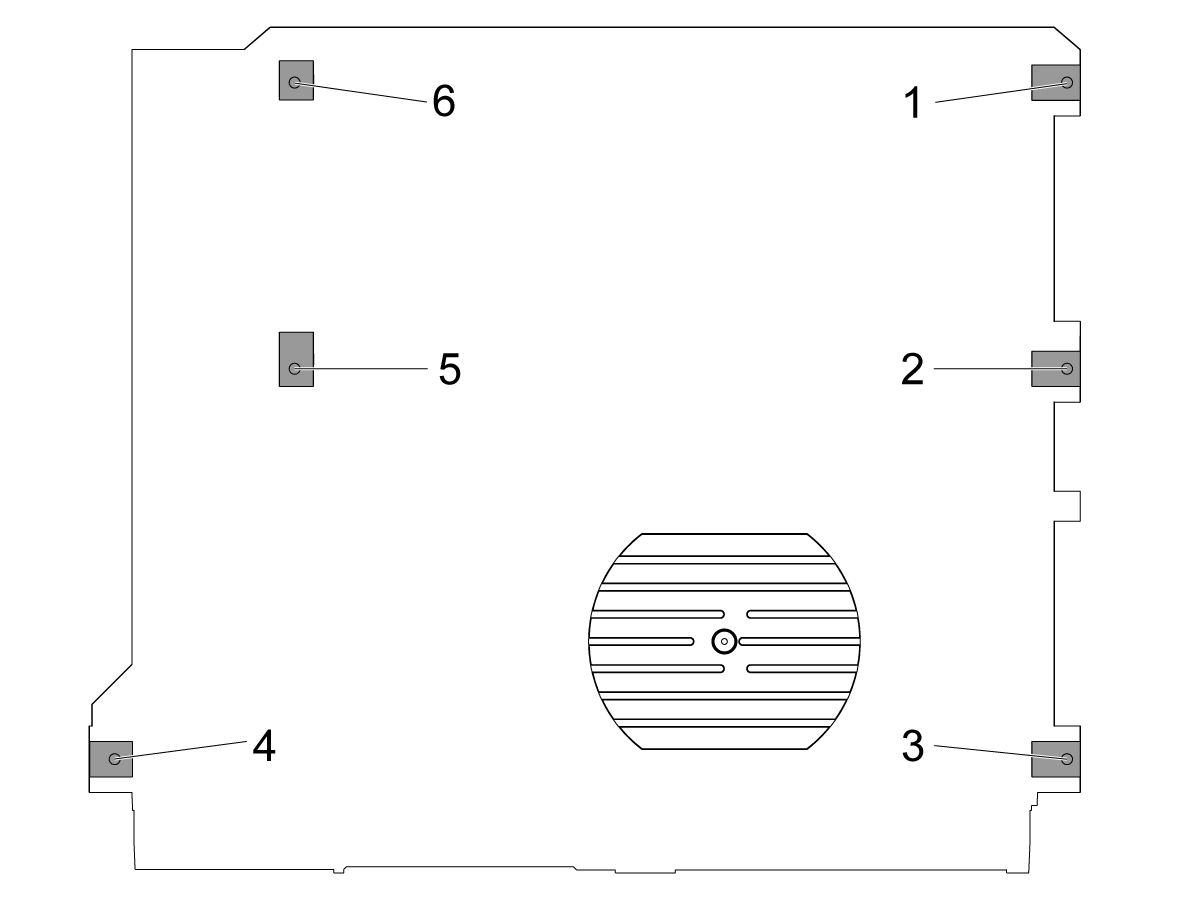
Razrahljajte sredinska izravnalna vijaka [2 and 5] in s tem zagotovite, da ne podpirajo nobene teže.

Stroj na 4 kotne izravnalne vijake namestite 3" (76,2 mm) nad tlemi.

2

Približna izravnava stroja:

Izravnalni vijak št. 4 obrnite navzgor.

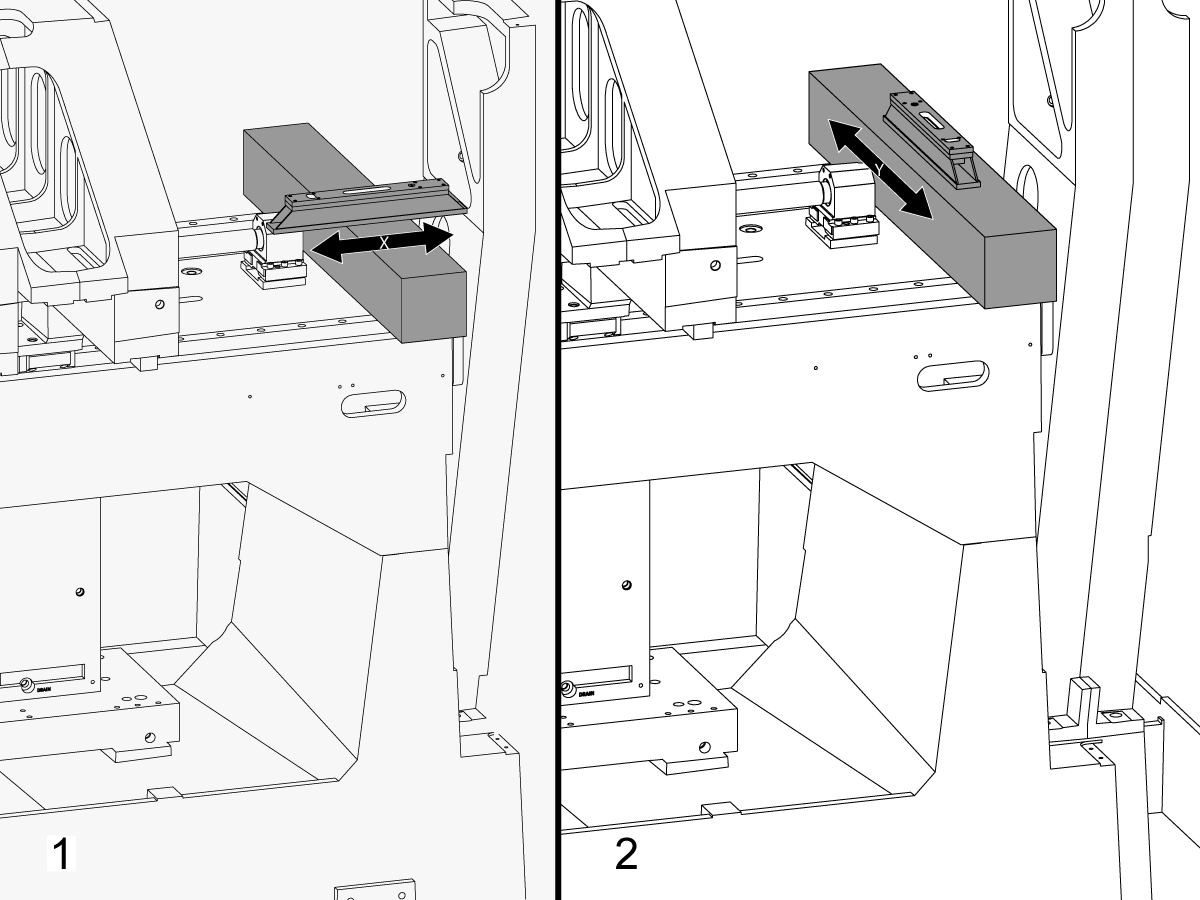
Čez linearne vodnike na X-osi postavite granit blizu nosilca ležajev krogličnega navojnega vretena na X-osi.

Nivo strojnice postavite na granit vzporedno z X-osjo. [1]

Prilagodite izravnalni vijak št. 6, dokler stroj ni izravnan na X-osi.

Nivo strojnice postavite na granit pravokotno na X-os. [2]

Prilagodite izravnalni vijak št. 3, dokler stroj ni izravnan na Y-osi.

Izravnalni vijak št. 4 obrnite navzdol, dokler ne pride v stik z izravnalno blazinico.

3

Prilagodite obračanje X-osi:

Sestavite T-2192 s T-2181.

Y-os premaknite na sredino gibanja.

T-2192 postavite na stran vretena.

Prepričajte se, da je libela na T-2181 dovolj blizu, da je z nje mogoče odčitati vrednost.

Če ni, razrahljajte vijak, s katerim je T-2192 pritrjen na magnetno osnovo, in po potrebi premaknite adapter.

X-os potegnite na stran in izmerite obračanje X-osi. Odčitajte vrednosti na referenčni poziciji, na sredini in na koncu gibnja X-osi.

Prilagodite izravnalni vijak št. 4, če med odčitkom na referenčni poziciji in odčitkom na koncu gibanja ni odstopanja.

Opomba: Pri tem NI treba, da se libela na T-2181 nahaja na sredini viale. Biti mora le dovolj blizu, da je z nje mogoče odčitati vrednost.

4

Nastavite srednje izravnalne vijake:

Srednje izravnalne vijake obrnite navzdol, dokler niso v stiku z izravnalnimi blazinicami, nato pa jih zavrtite še za 45 stopinj.

Preverite obračanje X-osi. Prilagodite srednje izravnalne vijake, da popravite obračanje X-osi.

Poravnava X-osi glede na Y-os

1

Poravnajte sprednji del sedla vzporedno z gibanjem X-osi:

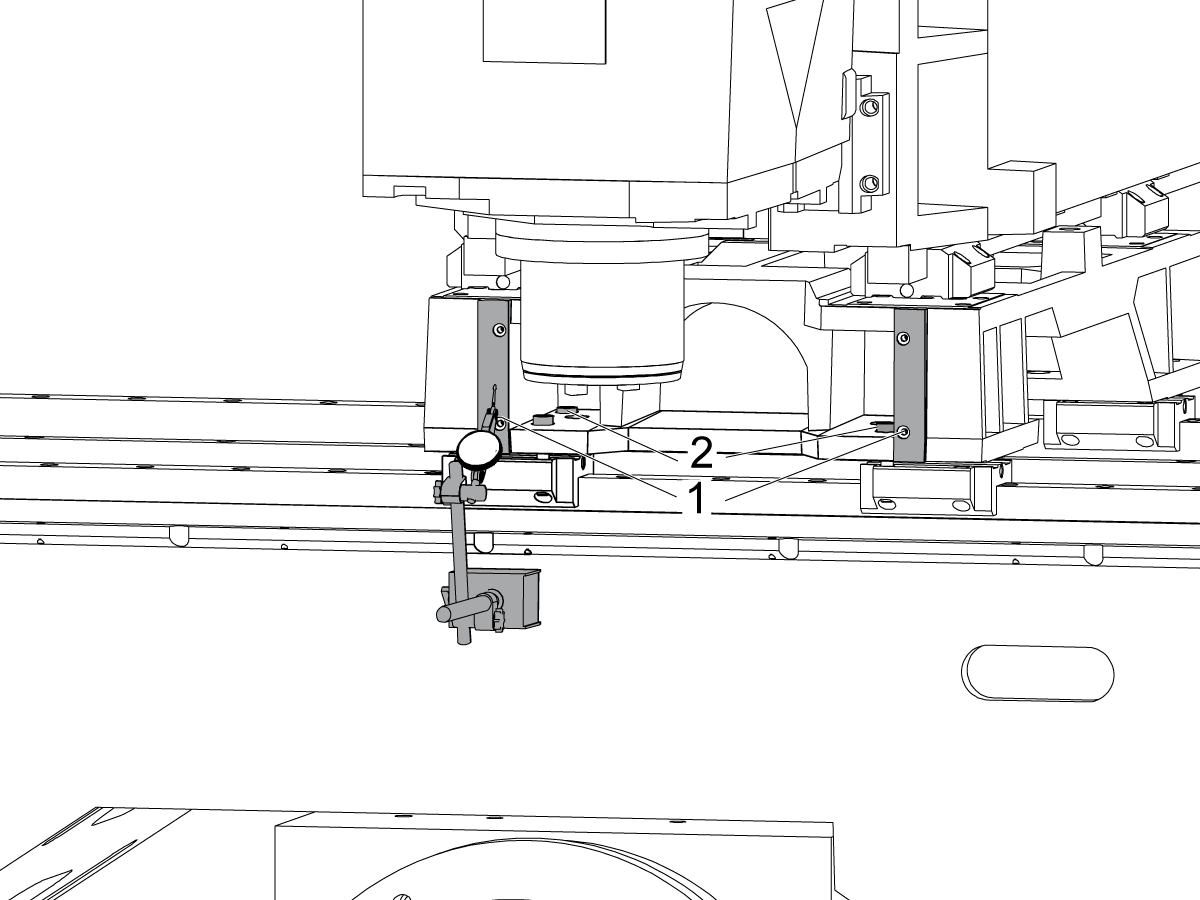
Z premikom X-osi v JOG načinu se pomaknite čez strojno obdelano površino na sprednjem delu sedla [1].

Razrahljajte vijake, s katerimi je sedlo pritrjeno na vozičke na X-osi [2], in sprednji del sedla po potrebi poravnajte vzporedno s premikom X-osi znotraj 0,001".

Privijte vijake. Nanašati se na Specifikacije navora Haas Fastener.

2

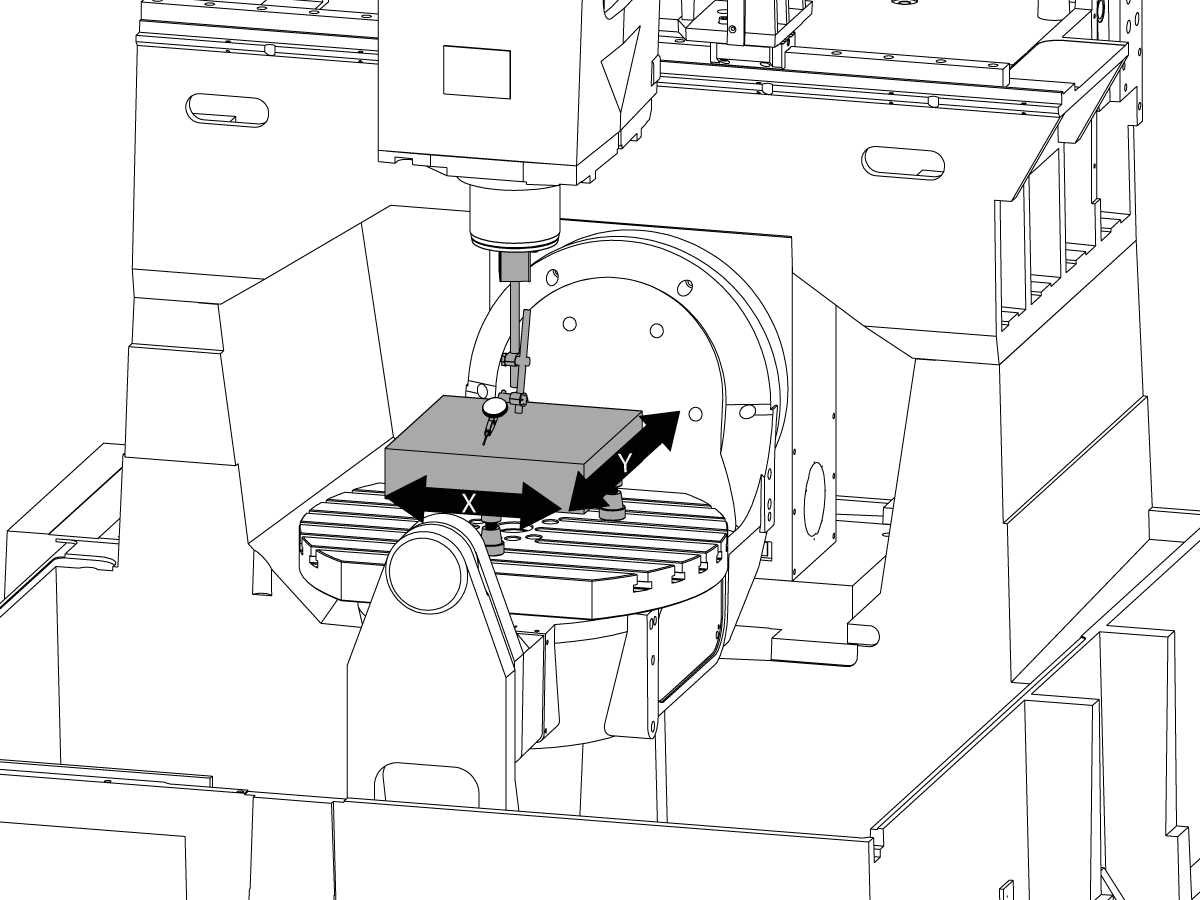
Y-os poravnajte pravokotno glede na X-os:

Trikotni granit na levi strani pladnja C-osi namestite na dvigalnike na strojnici.

Hrbtno stran trikotnega granita postavite vzporedno z X-osjo. NTE 0,0001"/10"

Vrh trikotnega granita pomaknite vzdolž X- in Y-osi.

Dvgalnike na strojnici prilagodite tako, da bo zgornja površina trikotnega granita vzporedna z ravnino X–Y z NTE 0,0005".

Preverite, ali je hrbtna stran trikotnega granita vzporedna z X-osjo. NTE 0,0001"/10".

Razrahljajte vijake, s katerimi so vozički na Y–osi pritrjeni na sedlo, in Y-os poravnajte pravokotno glede na X-os. NTE 0,0005"/10"

Privijte vijake. Nanašati se na Specifikacije navora Haas Fastener.

Po navoju vijakov preverite, ali je za Y-os, pravokotno na X-os z NTE 0,0005"/10".

Poravnava Z-osi glede na ravnino X–Y

1

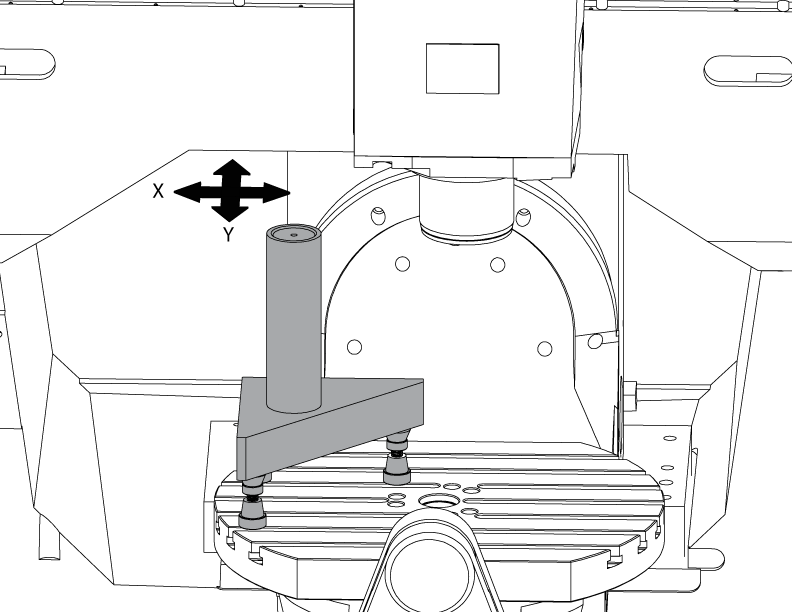
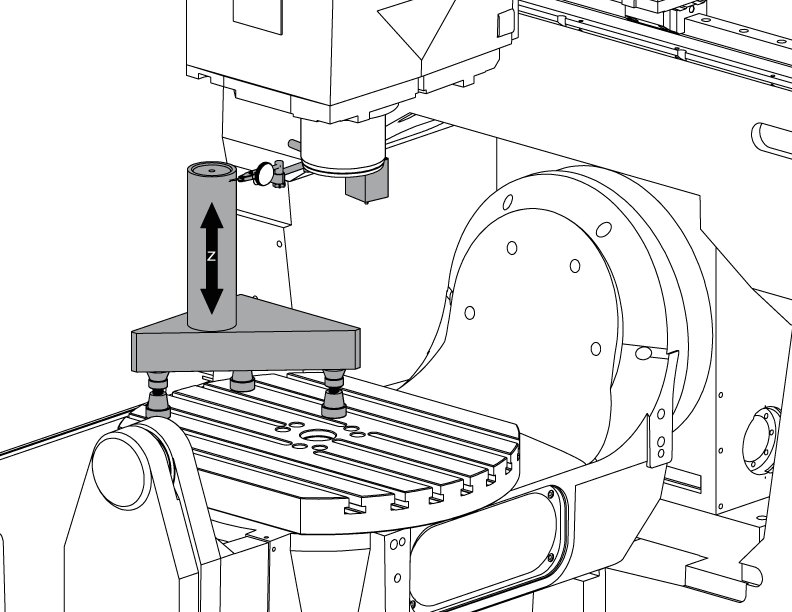
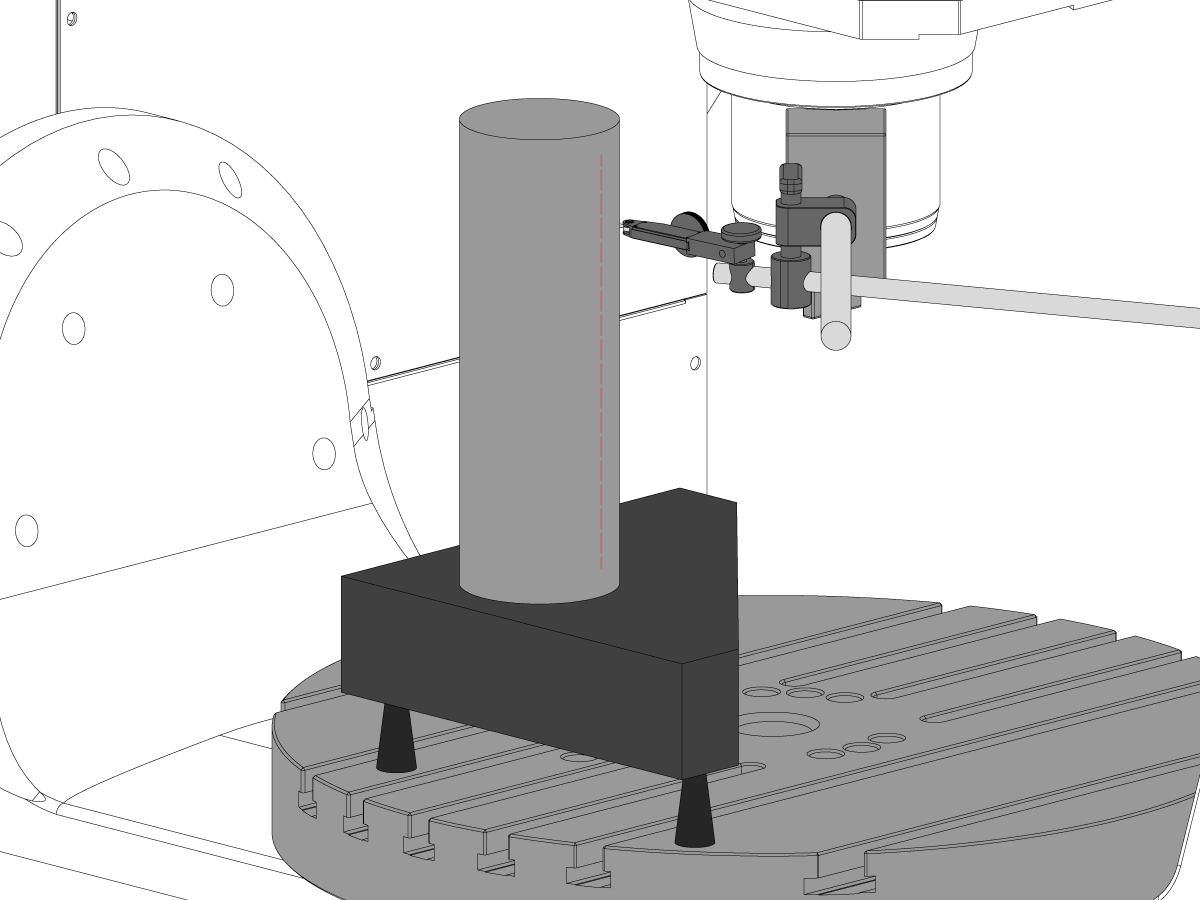
Namestite cilinder.

Na trikotni granit postavite cilinder, kot je prikazano na sliki.

Z obračanjem dvigalnikov na strojnici poravnajte zgornjo površino cilindra, da bo vzporedna z ravnino X–Y z NTE 0,0001".

Stroj v JOG načinu premaknite na naslednji položaj:

  • UMC-750 na X -7,000" in Y -10,000"
  • UMC-750SS na X -10,000" in Y-10,000"

2

Z-os poravnajte pravokotno glede na X-os:

Enega od vrhnjih kotnih vijakov z vozičkov na Z-osi zamenjajte s T-2193A *, da lahko okoli njega zavrtite glavo vretena.

Označite stranski del cilindra vzdolž Z-osi.

Razrahljajte vijake, s katerimi so vozički na Z-osi pritrjeni na bat.

Glavo vretena zanihajte na obe strani in Z-os poravnajte pravokotno na X-os z NTE 0,0005"/10".

Privijte vijake. Nanašati se na Specifikacije navora Haas Fastener.

Po navoju vijakov preverite, ali je Z-os pravokotna na X-os.

Ko je poravnava opravljena, vijak zamenjajte s T-2193A *.

*  : Uporablja se samo pri seriji pred ponovnim zagonom. 

3

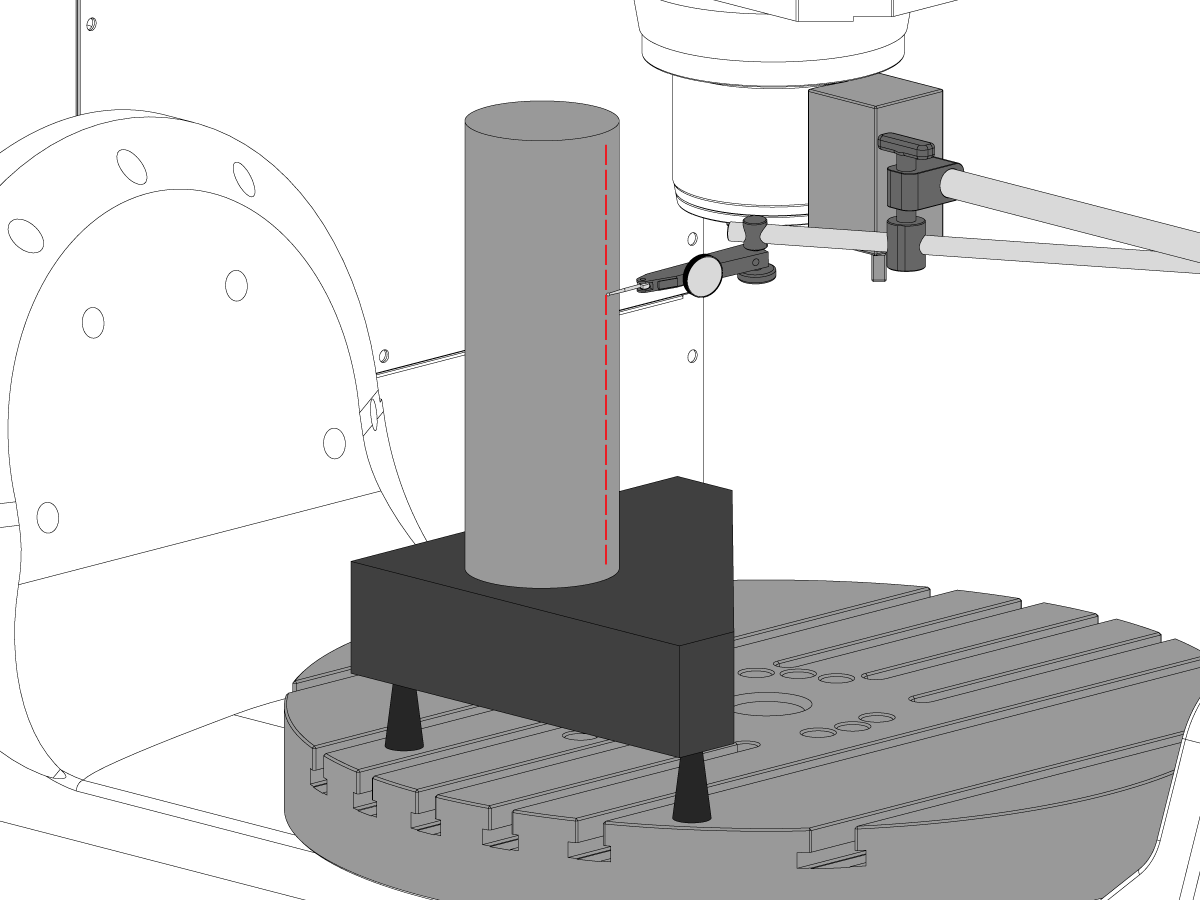
Z-os poravnajte pravokotno glede na Y-os:

Označite sprednji del cilindra vzdolž Z-osi.

S podložnimi lističi prilagodite vozičke na Z-osi in bat, da Z-os poravnate pravokotno glede na Y-os z NTE 0,0005"/10".

Opomba: Z enako količino podložnih lističev prilagodite bodisi zgornja bodisi spodnja dva vozička.

Privijte vijake. Nanašati se na Specifikacije navora Haas Fastener.

Po navoju vijakov preverite, ali je Z-os pravokotna na Y- in X-os.

4

Poravnajte in navijte ohišja krogličnih matic na Y- in Z- osi:

Razrahljajte vijake, s katerimi je kroglična matica pritrjena na ohišje, in vijake, s katerimi je ohišje pritrjeno na ulitek.

Najprej zatisnite vijake, s katerimi je ohišje pritrjeno na ulitek, nato pa še vijake, s katerimi je kroglična matica pritrjeno na ohišje.

S funkcijo zaklepanja JOG načina izvedite celoten hod osi naprej in nazaj.

Opomba: Ne uporabljajte ročnega krmilnega kolesa ali hitrega hoda.

Privijte vijake. Nanašati se na Specifikacije navora Haas Fastener.

Ohišje matice na Y-osi lahko dosežete na hrbtnem delu stroja, in sicer tako, da bat v JOG načinu premaknete vse do sprednjega dela stroja.

Ohišje matice na Z-osi lahko dosežete s sprednje strani stroja, in sicer tako, da glavo vretena v JOG načinu premaknete do konca navzdol.

Opomba: Za dostop do ohišja kroglične matice na Z-osi morate odstraniti motor vretena.

Vreteno premaknite do ravnine X–Y

1

Namestite granit:

Dvigalnike na strojnici in granite namestite na sredino pladnja na C-osi, kot je prikazano na sliki.

S prilagoditvijo dvigalnikov na strojnici na NTE 0,0001"poravnajte zgornjo površino granita, da bo vzporedna z ravnino X–Y.

Vreteno namestite čez sredino pladnja.

2

Vreteno premaknite do ravnine X–Y

Na gred vretena postavite kazalnik.

Na vrhu granita na vsakih 90 stopinj vrtenja izvedite meritev.

Razrahljajte (6) vijakov na osnovni plošči glave vretena.

Dodajte ali odstranite podložne lističe med ulitkom na glavi vretena in osnovno ploščo, da vreteno pomaknete na ravnino X–Y z NTE 0,0005"/10".

Opomba: Da spremenite kot osnovne plošče, uporabite podložne lističe različnih debelin [1].

Če je premik v skladu s specifikacijami, (6) vijakov navijte. Nanašati se na Specifikacije navora Haas Fastener.

Po navoju vijakov preverite pomik vretena.

Poravnava osi B na osi XYZ

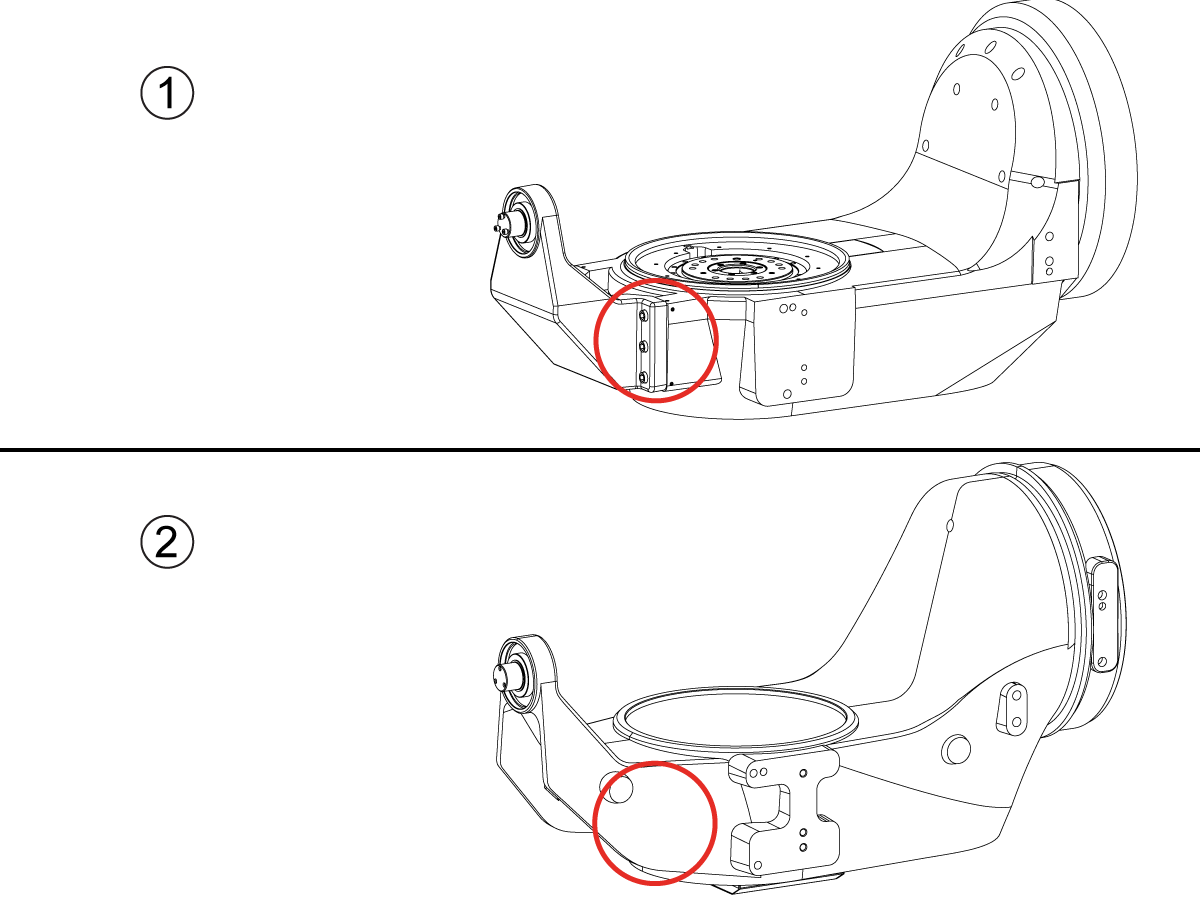
How to identify the Multi-Piece and the Unibody trunnion   

1) Multi-Piece trunnion:    UMC machines built approximetely before 11/2022 will have this configuration.

2) Unibody trunnion:    UMC machines built approximetely after 11/2022 will have this configuration.

1

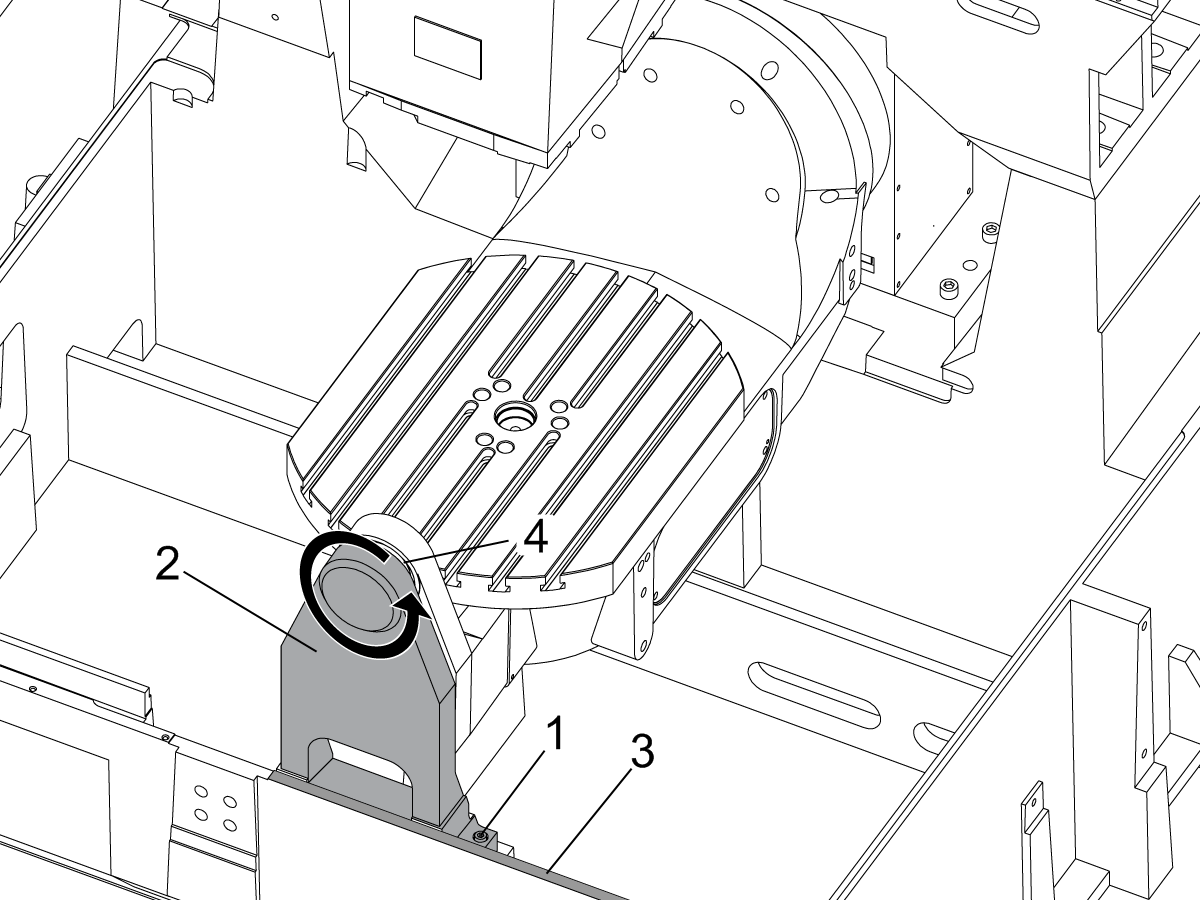
Remove the A-frame trunnion support:

Remove the bolts [1] that secure the A-frame trunnion support [2] to the base and take out the shims between A-frame support and the base.

Rotate the A-frame support [2] counter-clockwise to clear the edge of the base [3].

Pull the A-frame support off the bearings.

 Note: The A-frame support might vacuum lock on the bearings. Use the zip-tie to pry the seal [4] open.

 Caution: To lift the trunnion support, get the aid of another person. The support weighs 85 lbs (39 kg).

2

Measure the B- axis of rotation parallelism to the Y-Z plane:

For a machine with a Classic Haas Control, change Parameter 151:20 (B axis CHK TRAVL LIM) to 0.

For a machine with a Next Generation Control, change Parameter 6.021 (B axis CHK TRAVL LIM) to FALSE.

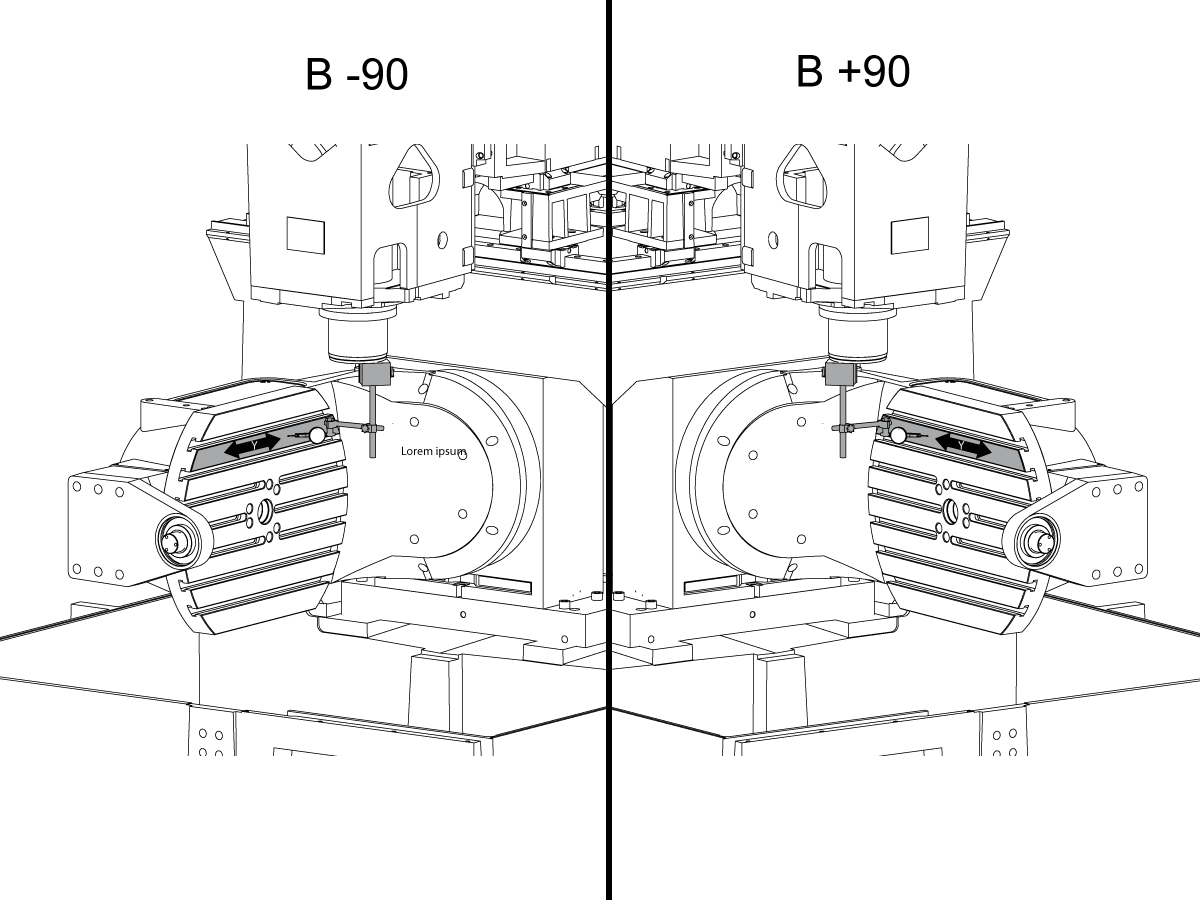
Measure the parallelism of the platter to the Y-Z plane with the B axis at 90° and then the B axis at -90° as shown in the picture.

Position the Y-Axis in the following starting position:

UMC-500: Y=0, Sweep 15”, 3rd T-Slot Land from the top.

UMC-750/1500-Duo: Y=-1.0, Sweep 18", 3rd T-Slot Land from the Top .

UMC-1250: Y=-1.0, Sweep 28", 3rd T-Slot Land from the Top.

UMC-500PP: Y=-4.0, Sweep 7".

UMC-750PP: Y=-2”, Sweep 15".

UMC-1000PP: Y=-4”, Sweep 15".

Compare the results at B 90° and B-90°. The results should be...

  • Symmetric against the Y-Z plane, positive or negative direction
  • Less than 0.0010"/20"

If the results are symmetric against Y-Z plane, and are less than 0.0010"/20 inches: Go to Step 5.

If the results are symmetric against Y-Z plane, but are more than 0.0010"/20 inches: Go to Step 4.

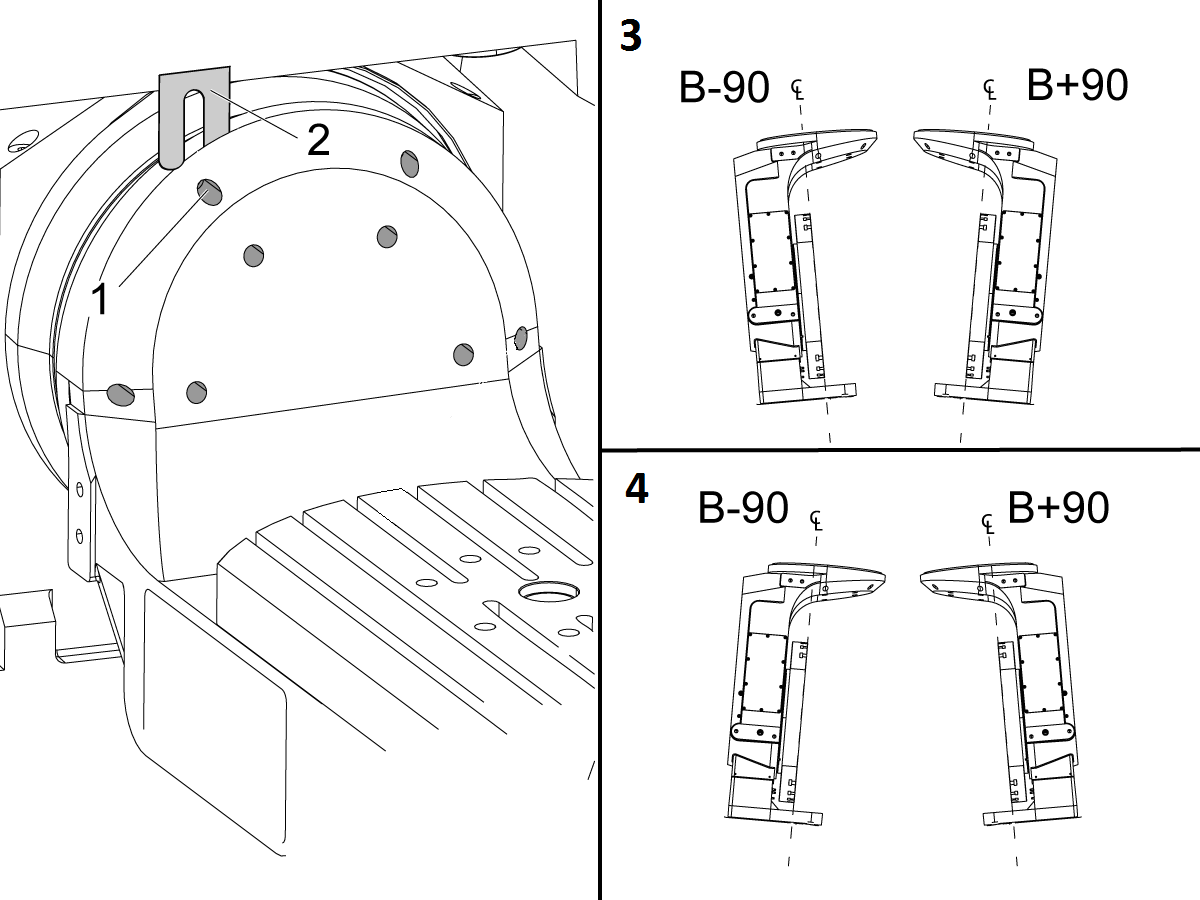
 Warning: If the results [3] are not symmetric against the Y-Z plane, the B axis rotary needs to be aligned: Go to Step 3.

3

Align the B axis of rotation parallel to the Y-Z plane:

Loosen the (6) bolts [1] that secure the B axis rotary to the base casting.

 Note: Keep the bolts sufficiently snug to control the adjustments.

Adjust the front and rear setscrews [2] until the measurements taken in Step 2 are symmetric against the Y-Z plane.

Torque the (6) bolts [1]. Refer to Haas Fastener Torque Specification.

Verify the measurements in Step 2 after the bolts have been torqued.

4

Align the C Axis of rotation perpendicular to the B Axis of rotation:

Remove the bottom C-Axis access cover.

Loosen the (12) bolts [1] that hold the C Axis body to the B Axis platter face.

Reach the bottom (4) bolts through the C Axis access port.

If the B Axis is symmetric in the positive direction [4], install horseshoe shims [2] of appropriate size behind the top (2) bolts.

If the B Axis is symmetric in the negative direction [5], install horseshoe shims [2] of appropriate size behind the bottom (2) bolts.

Torque the (12) bolts to 80 Ft-lbs (108 Nm).

Cut the excessive shim material off.

Verify the measurements in Step 2 after bolts are torqued.

5

Align the trunnion support shaft co-axial with the B Axis of rotation:

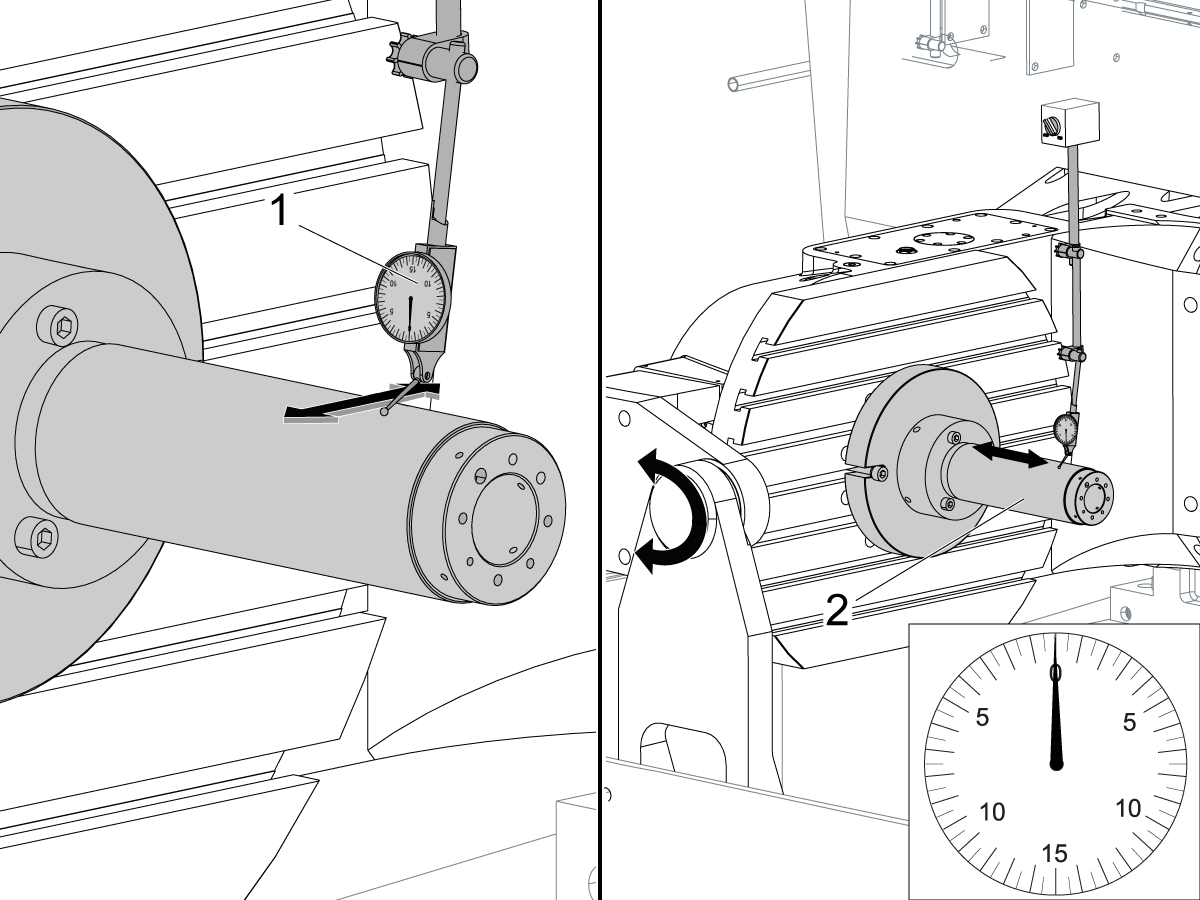
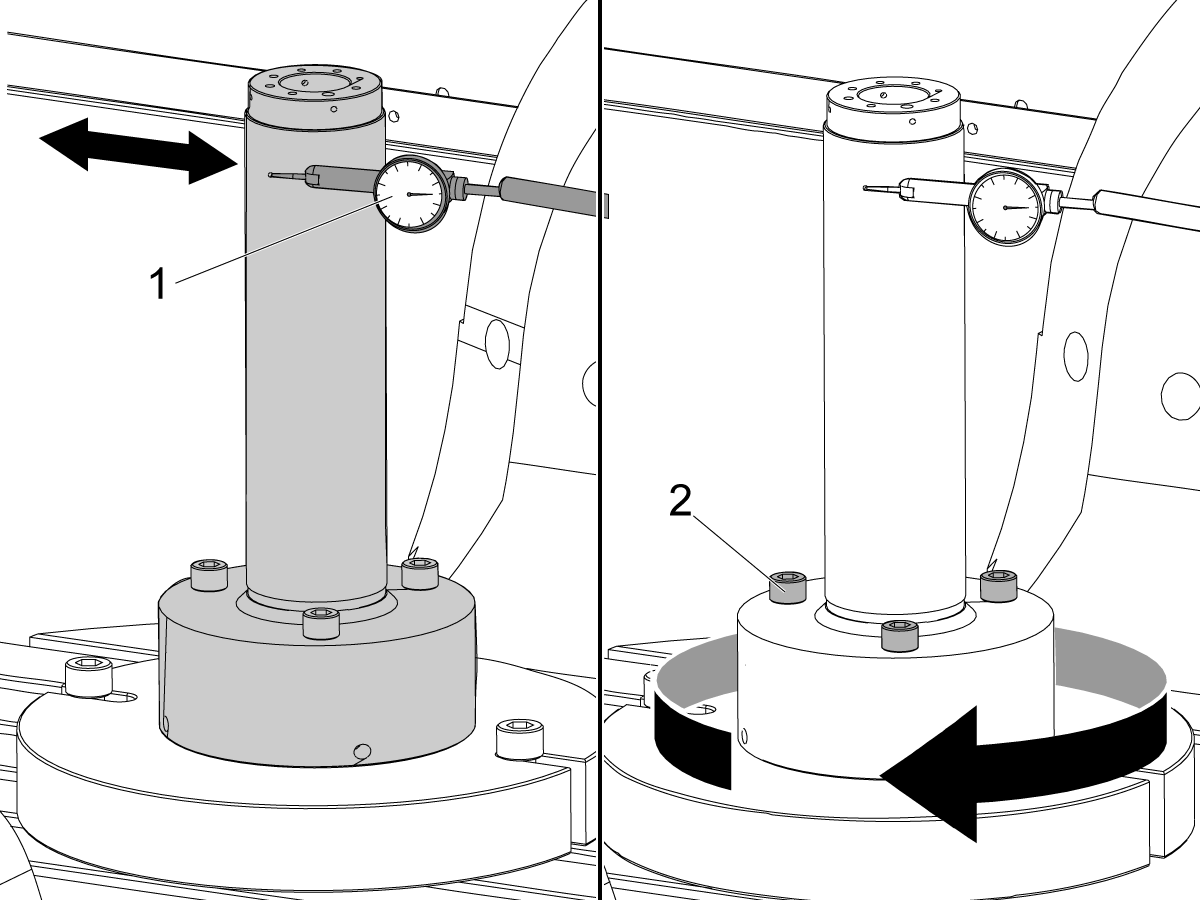
Setup (2) indicators on the outer race of the trunnion support bearing [2] as shown in the picture.

Mark the spot on the outer race where one of the indicator needles is contacting the surface.

After moving the B Axis to 90° or -90° you will align the marked spot with the needle again to exclude the bearing runout error from the measurements.

Take the readings when B is at 90° and B at -90°. Compare the readings. 

 Caution: The B axis brake needs to be clamped when taking the readings.

The deviation between the results when B is at 90° and at -90° needs to be less than 0.001" on each indicator.

 Note: The indicator on the side of the bearing will measure top to bottom alignment and the indicator on the top of the bearing will measure side to side alignment.

____

For models with a multi-piece trunnion

Loosen the (6) bolts [3] on the C Axis body support. Keep the bolts sufficiently snug to control adjustment.

Adjust the (8) set screws [4] until deviation between B at 90° and B at -90° is within 0.001".

Torque the (6) bolts [2] on the C Axis body support to 80 Ft-lbs (108 Nm).

Verify the alignment after the bolts have been torqued.

____

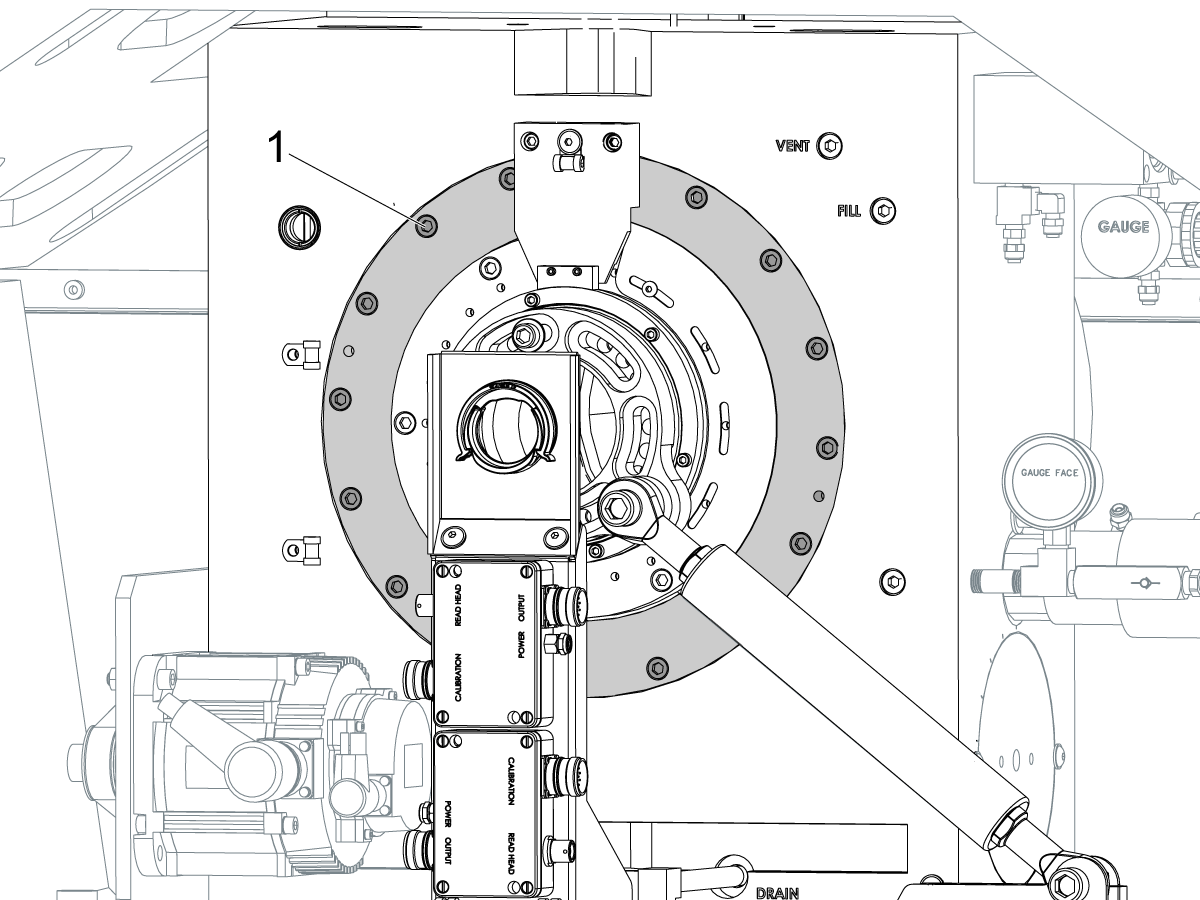
For models with a unibody trunnion

Jog rotary to B90. Set up an indicator on the highlighted surface as shown in the lower diagram .

Rotate B-axis 180 degrees (90 to -90).

Run out (NTE 0.010” TIR).

 Caution: If the measurement exceeds the tolerance then contact support.

6

Install and shim the A-frame trunnion support:

Move the B Axis to 90°.

Setup an indicator [1] against a machined surface of the C Axis body. Set the indicator to 0.

Use plastic zip ties [2] to pry the seal open while installing the A-frame support. This lets unwanted air and grease out of the assembly.

Install the A-frame trunnion support [3] over the bearings.

Remove the cable ties.

Turn the trunnion support clockwise until it is vertical.

 Note: The weight of the A-frame support will cause the trunnion to sag. The amount of sag is measured with the indicator that was previously setup on the side of the C Axis body.

____

For multi-piece trunnions

Adjust the shims [4] between the A-frame support and the base casting to remove the sag until indicator reads 0 again.

When the indicator reading is 0, torque the (4) bolts. Refer to Haas Fastener Torque Specification.

Verify the reading after bolts are torqued. Adjust the shims again if necessary until the indicator reads 0.

____

For models with unibody trunnion

Determine the amount of shim stock [4] needed to raise the Trunnion arm so the indicator reads 0.005".

The indicator [1] value will change once the support is torqued.

With indicator still in place:

  • Torque trunnion support bolts to appropriate values.
  • Check indicator to make sure it reads between the range of

Trunnion arm raised (0.005” to  0.010”).

 Note: For unibody trunnions, the shim location may also be used to correct the C-axis to X-Y plane perpendicularity instead of shimming the saddle trucks.

 Caution: Use equal amount of shims on each side of the A-frame support. Unequal shims will cause the A-frame support to pull the trunnion to the side.

Verify the B Axis of rotation alignment to the Y-Z plane (Step 2). Loosen the bolts and tap the A-frame support side to side if necessary to correct the B axis to Y-Z plane alignment.

7

Set C-axis perpendicular to X/Y plane:

Move the axes to

UMC-750's........X= -10.5" & Y=0."

UMC-1000's......X=-17.0" & Y=-0."

Zero an indicator [1], on a Ground Block [2], 1/2" off the edge at the rear of the platter (Mag-Base on Spindle), with C at 0 Degrees

Rotate C-Axis to 180°.

Move Y axis, and ground block, in Y Axis negative direction until you are 1/2" away from platter edge, and take the perpendicularity measurement

Adjust the shims until the average error is within 0.0005" end to end.

 Note: For unibody trunnions, the shim location under the bearing support may also be used to correct the C-axis to X-Y plane perpendicularity instead of shimming the saddle truck.

Caution: Shim either two front trucks or two rear trucks with the equal shim.

Note: Shim one truck at the time to maintain the X to Y squareness.

Verify the measurements after all bolts are torqued.

Verify the X to Y alignment in Step 2.

8

Set the tool change offsets:

B-axis tool change offset [1]

For Classic Haas Controls, change Parameter 213. 

For Next Generation Controls, go to: Settings>Rotary Tab>Highlight the rotary and press [INSERT], or change Parameter 6.078 (B TOOL CHANGE OFFSET) to set the trunnion (B Axis) parallel to the X Axis.

For models with multipiece trunnion

(NTE 0.001/10"; NTE 0.0020" overall)

For models with unibody trunnion

(NTE 0.0005/10"; NTE 0.0010" overall)

___

C-axis tool change offset [2]

For Classic Haas Controls change Parameter 523.

For Next Generation Control go to: Settings>Rotary Tab> Highlight the rotary and press [INSERT], or change Parameter 7.078 (C TOOL CHANGE OFFSET) to set the table T-slot (C Axis) parallel to the X Axis

For models with multipiece trunnion

(NTE 0.001/10"; NTE 0.0020" overall)

For models with unibody trunnion

(NTE 0.0005/10"; NTE 0.0010" overall)

9

Check C-axis perpendicularity to X/Y plane:

Align the indicator centered over the C-axis bore with the Y-axis at -10.

Jog positive in the Y-axis and align the indicator over the center of the last section of the platter and make a mark at this spot with a washable marker.

Insert 1-2-3 block as shown and set the indicator to zero.

Remove the block and rotate the platter 90 degrees, following the marked spot with the indicator.

Insert block back between the indicator and platter. Note reading.

Repeat the previous two steps, taking readings with the platter at 180, 270 and 360 degrees.

Multi-piece trunnion:  (NTE 0.0005")

Unibody trunnion: (NTE 0.001")

10

Measure the intersection of the B and C axis:

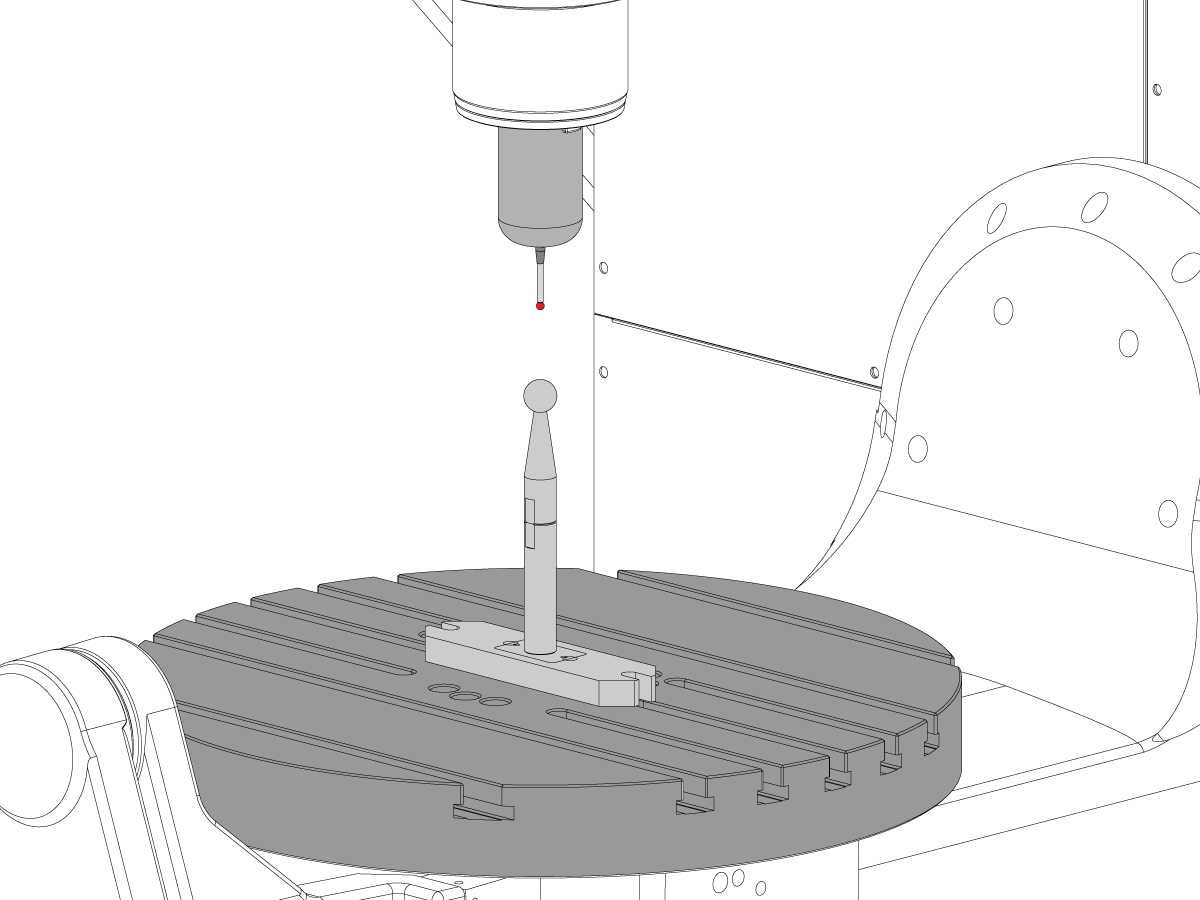
Follow the linked instruction manual to complete this step.

B-Axis and C-Axis intersection Adjustment

11

Align the B-Axis brake disk:

 Note: Do not do this step if you are working on a SS machine.

Operate this code in MDI mode to unclamp the brake:

M11;

Loosen all of the brake disc bolts [1] and torque them to 5 Ft-lbs (7 Nm).

Operate this code in MDI mode to clamp the brake:

M10;

Wait 10 seconds.

Torque the bolts. Refer to Haas Fastener Torque Specifications.

Ponastavite parameter/nastavitev na prvotno tovarniško vrednost

Parameter 1314 za CHC/nastavitev 254 za NGC ponastavite nazaj na tovarniško vrednost. (Ko spremenite vrednost, ponastavite napajanje stroja.)

Izravnajte in kalibrirajte WIPS. Brezžični intuitivni sistem tipala (WIPS) - kalibracija

Nastavite rotacijske ničelne točke stroja. 

  • UMC-750 - nastavitve offsetov MRZP WIPS - CHC
  • UMC-750 - nastavitve offsetov MRZP WIPS - NGC

Izpolnite celotno poročilo o pregledu:

  • Inšpekcijsko poročilo za EA0420 UMC-500
  • Inšpekcijsko poročilo za EA0373 UMC-750
  • Inšpekcijsko poročilo za EA0418 UMC-1000

Kopijo inšpekcijskega poročila pustite pri stroju.

Če ste zamenjali sklop B- in C-osi, izvedite korak UMC-750 - stičišče B-osi in C-osi - poravnava

8.2 Poravnava - Označitev con

Recently Updated

UMC poravnava - Označitev con


AD0490

Označevanje con

1

Zvit X osi

  • Najprej pritrdite orodje T-2192 na stran vretena.
  • Za merjenje X-Roll držite naslednje položaje osi Y in Z:
    • UMC 500 (Y, Z): -8, -8
    • UMC 750 (Y, Z): -10, -10
    • UMC 1000 (Y, Z): -12, -12
  • Izmerite zvit X-osi (NTE 0,0005" / 10")


2

Osi B do vzporednosti osi Y

  • Ničelna vrnitev B in osi C.
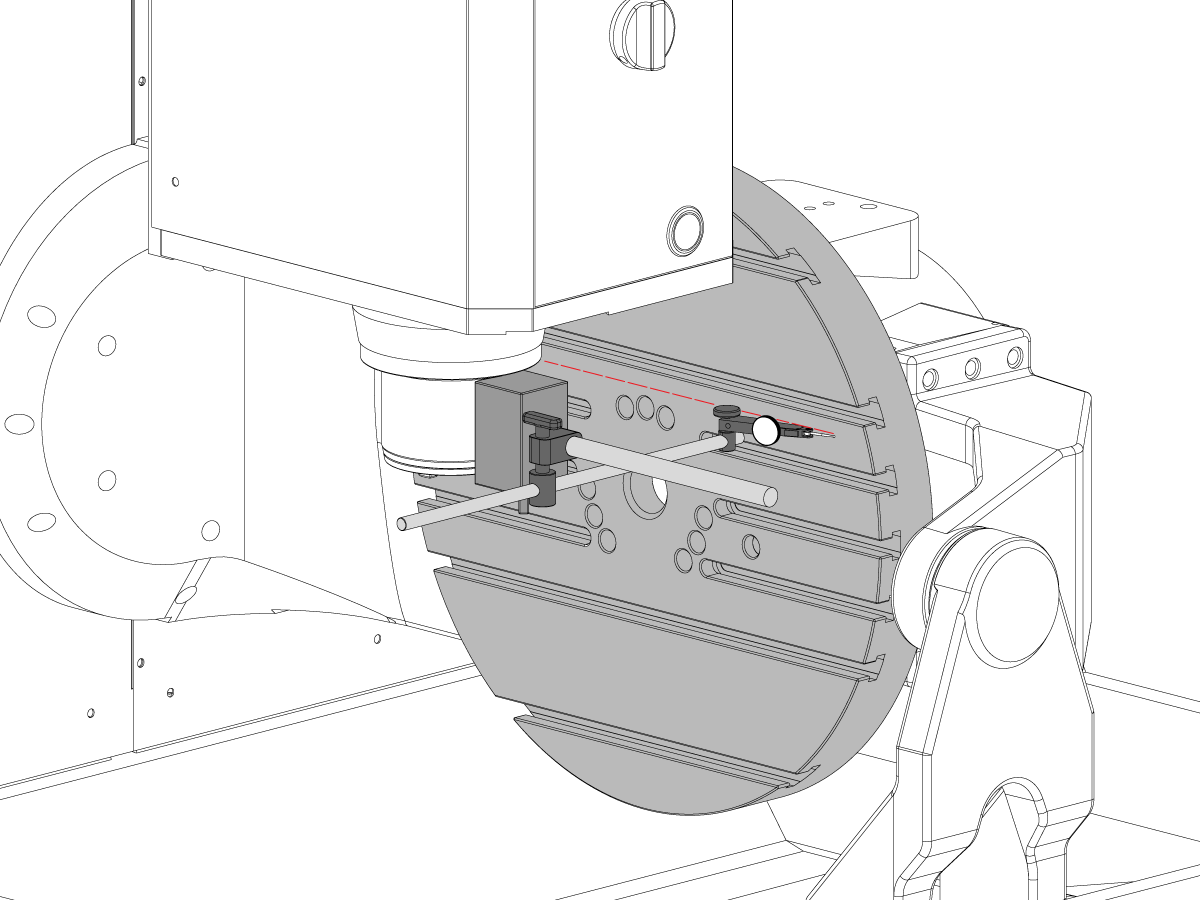
  • Izmerite iztekanje plošč na Y-osi (NTE: 0,0008" / 10" 0,0012" / 15")
  • Nato izmerite to isto površino z B-osjo pri -90 ° in + 90 °  (NTE: 0,0008" / 10" 0,0012" / 15")
  • Pri UMC 500 in 750 izmerite celotno dolžino krožnika
  • Za UMC 1000 odmaknite 2 "od roba plošče in nato merite čez 20"

3

Pravokostnost osi Y do osi X

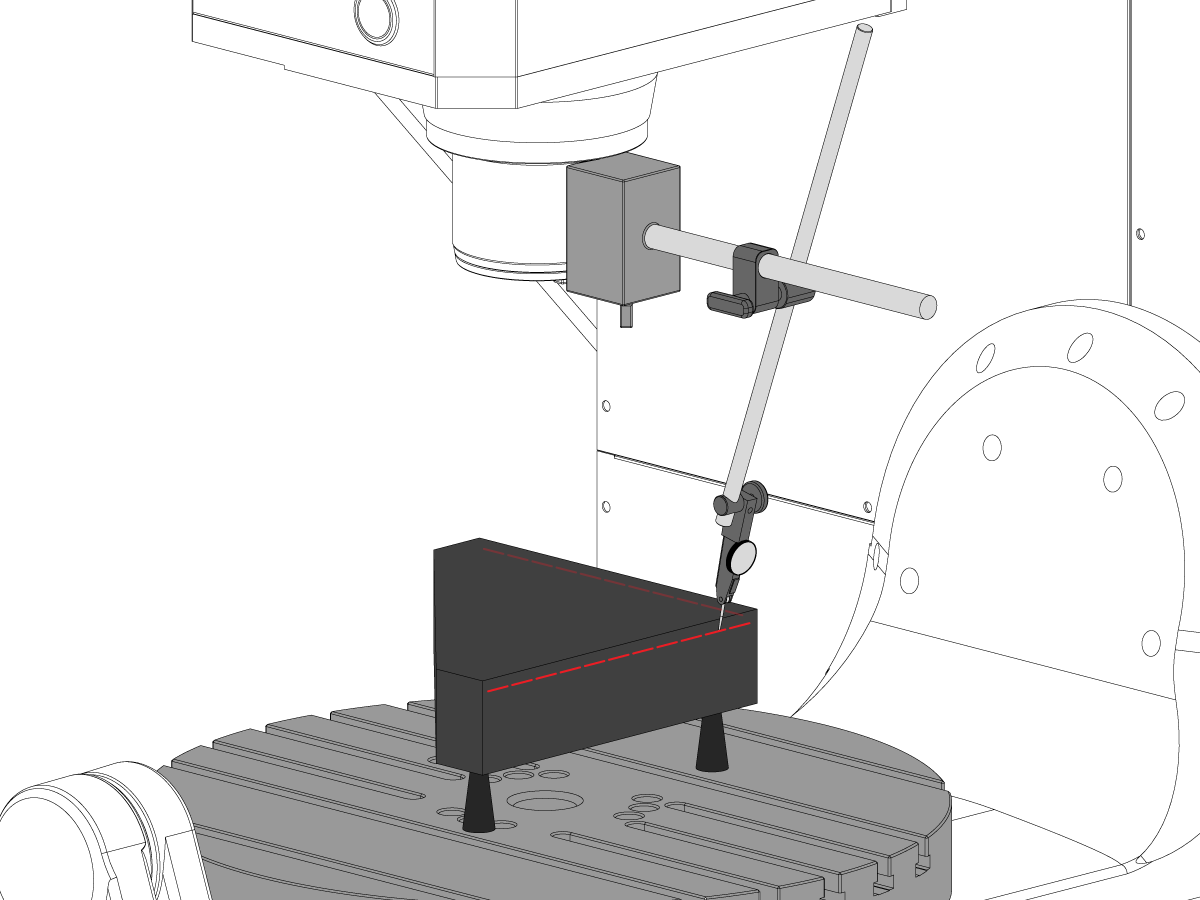
  • S pritrdilnimi vijaki naredite zgornjo površino granita vzporedno z ravnino XY (NTE: 0,0002")
  • Nato preverite, ali je Y kvadrat na X (NTE 0,0005" / 10")

4

Pravokostnost osi X na os Z

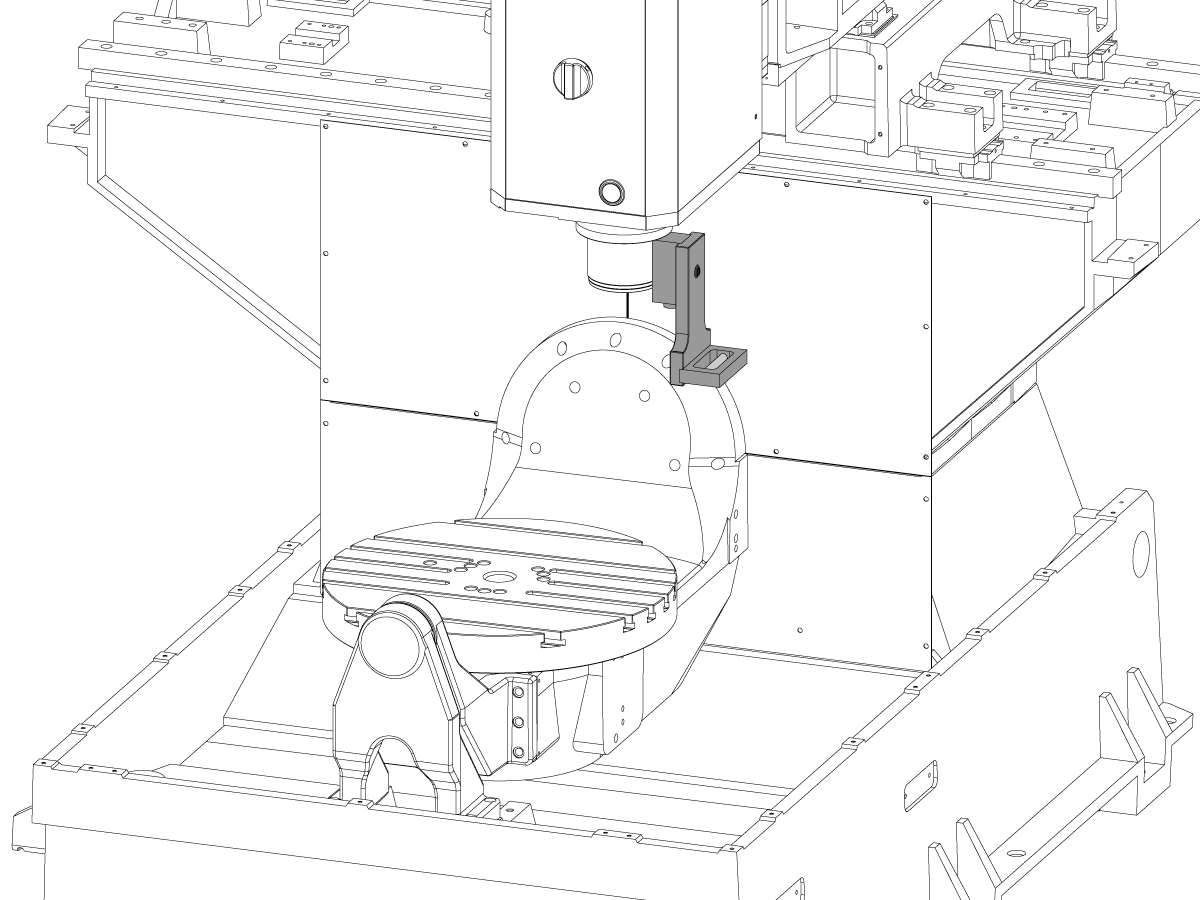
  • Granitni in natančni valj postavite na ploščo v prikazani orientaciji
  • S pritrdilnimi vijaki nastavite zgornjo površino cilindra vzporedno z ravnino XY (NTE 0,0002")
  • Lokacije vretena XY za ta korak:
    • UMC 500, X = -6, Y = -8
    • UMC 750, X = -10, Y = -10
    • UMC 1000, X = -17, Y = -12
  • Z začetni položaj za to meritev:
    • UMC 500, Zstart = Ztop - 2 ”
    • UMC 750, Zstart = Ztop - 5 ”
    • UMC 1000, Zstart = Ztop - 7 ”
  • Ztop je meja premika osi Z v pozitivni smeri (navzgor)
  • Iz Zstart, merite 10 "vzdolž valja

5

Pravokostnost osi Y do osi Z

  • Granitni in natančni valj postavite na ploščo v prikazani orientaciji
  • S pritrdilnimi vijaki nastavite zgornjo površino cilindra vzporedno z ravnino XY (NTE 0,0002")
  • Lokacije vretena XY za ta korak:
    • UMC 500, X = -6, Y = -8
    • UMC 750, X = -10, Y = -10
    • UMC 1000, X = -17, Y = -12
  • Z začetni položaj za to meritev:
    • UMC 500, Zstart = Ztop - 2 ”
    • UMC 750, Zstart = Ztop - 5 ”
    • UMC 1000, Zstart = Ztop - 7 ”
  • Ztop je meja premika osi Z v pozitivni smeri (navzgor)
  • Od Zstart-a merite navzdol 10 ”vzdolž valja

6

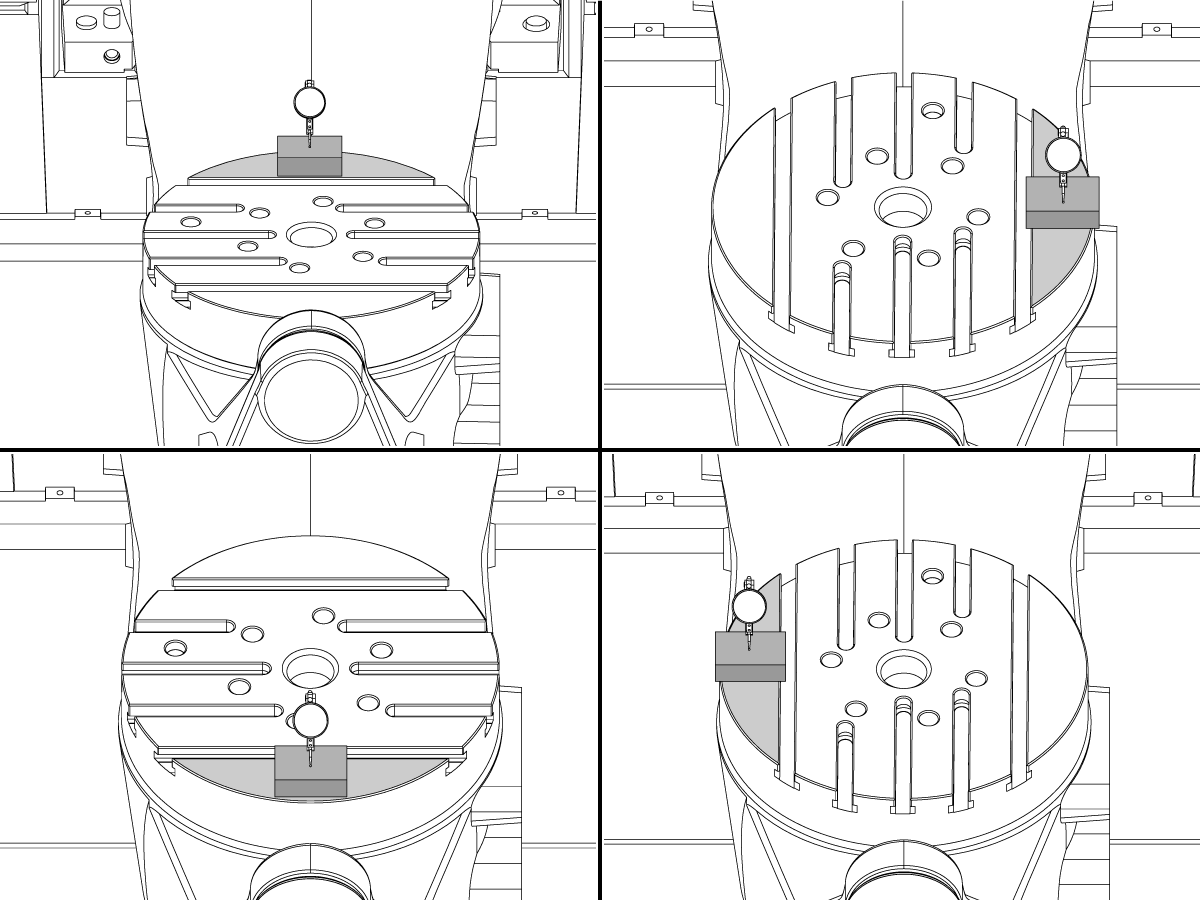
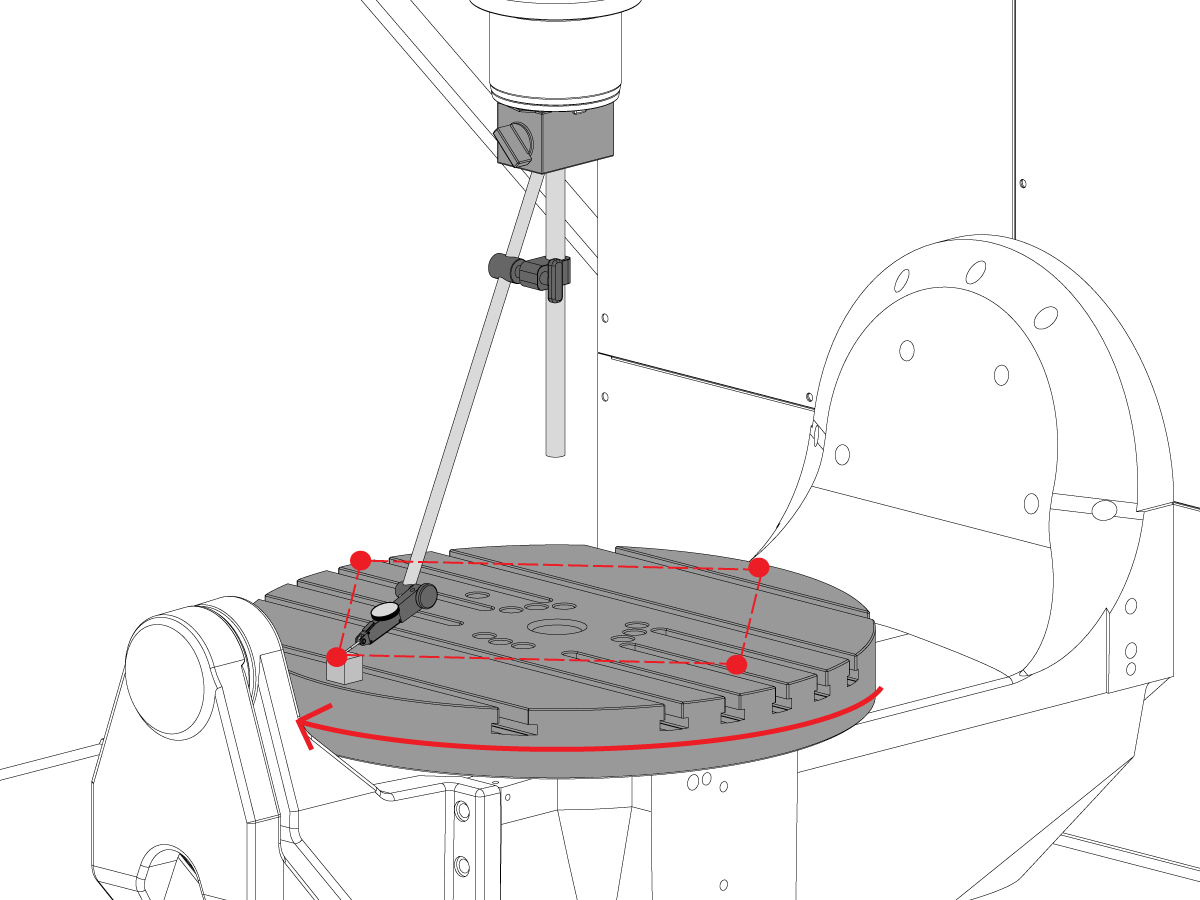
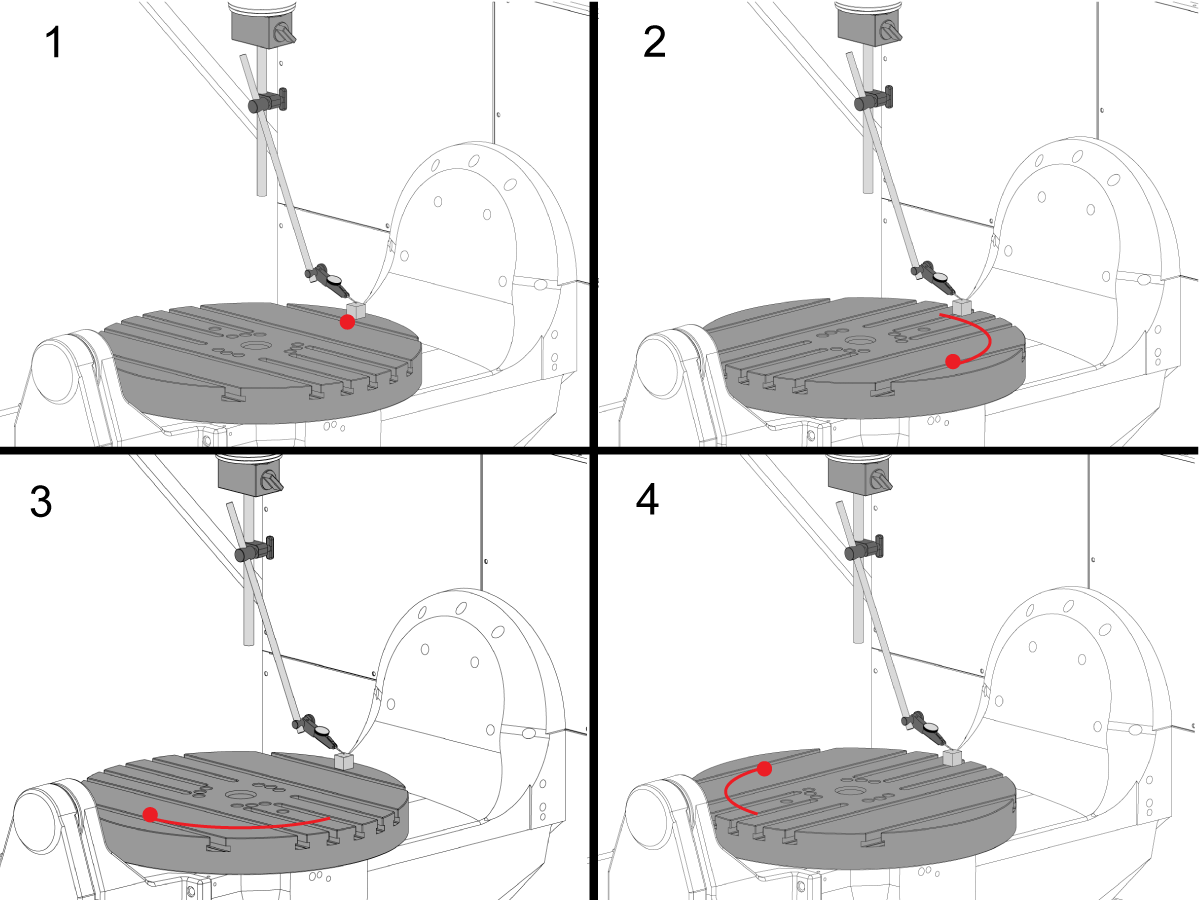
Pravokostnost osi C na ravnino XY

  • Postavite mag podstavek na vreteno, da se ne more vrteti z vreteno.
  • Na rob plošče postavite natančno zaporo bloka natančnosti v položaj 12 ur. 
  • V tem položaju ničelni kazalnik na bloku merilnika.
  • Zavrtite os C  90 ° 
  • Nato vreteno vstavite na osi X in Y, da sledite bloku guage in opravite meritev iste točke na plošči. Vrtenje vretena ne sme biti
  • Ponovite to še dvakrat za skupno 4 položaje, na razdalji 90 °, na robu palete, kot je prikazano. 
  • Razlika med meritvami položaja 12 in 6 ur določa ploskev vzdolž osi X (NTE 0,0005")
  • Razlika med 3 in 9 urnimi sponkami določa ravnost vzdolž osi Y (NTE 0,0005")

7

Platform Face Runout

OPOMBA: Zavora C-Axis je za ta korak izključena

  • Na rob plošče postavite natančno zaporo bloka natančnosti v položaj 12 ur. 
  • V tem položaju ničelni kazalnik na bloku merilnika.
  • Zavrtite os C  90 °, toda blok držite na položaju 12 ur
  • Izvedite meritev z vrha merilnega bloka
  • Ponovite to še dvakrat za skupno 4 položaje, na razdalji 90 °, na robu palete, kot je prikazano. 
  • Upoštevajte skupno navedeno iztekanje. (NTE 0,001")

8

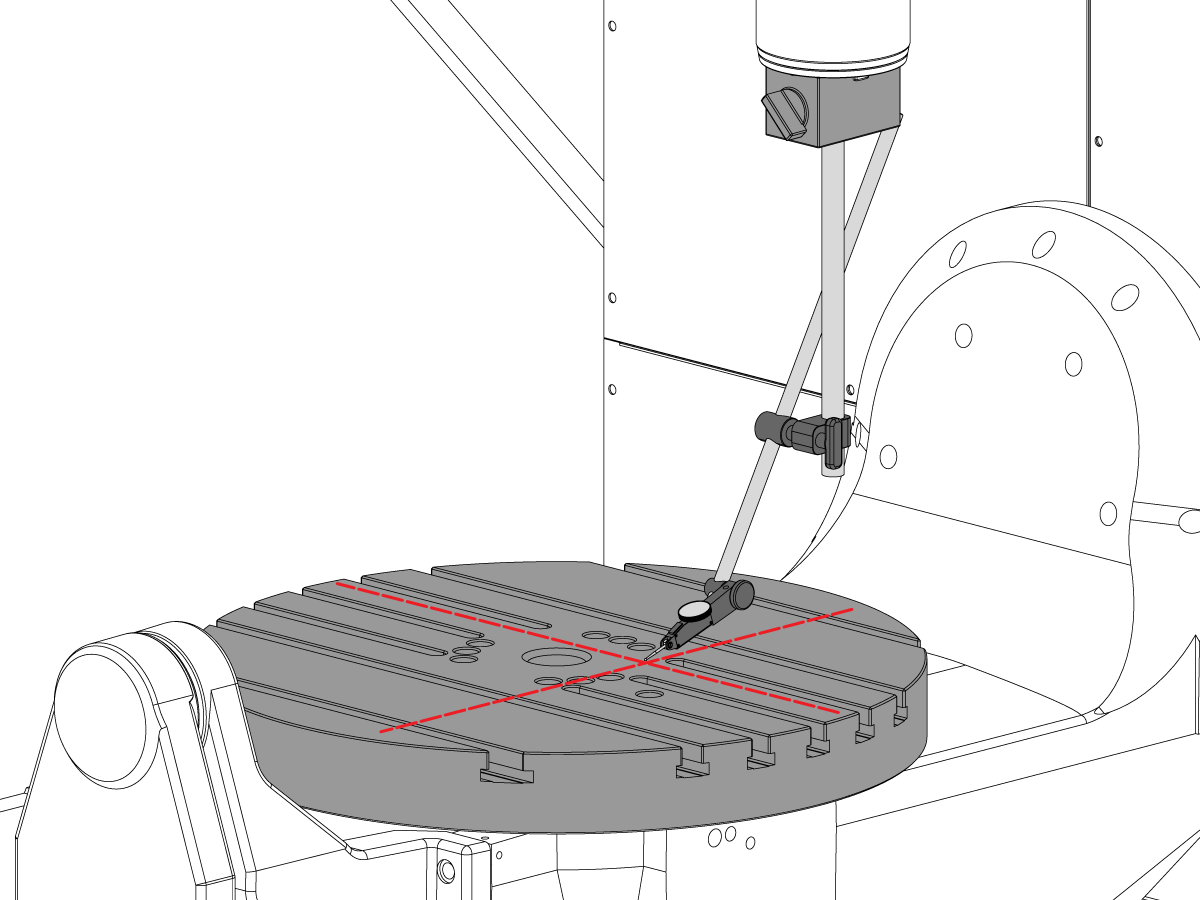
Vzporednost površine plošč in ravnine XY

  • Zero vrnite os C, tako da bodo T-reži potekali vzporedno z osjo X
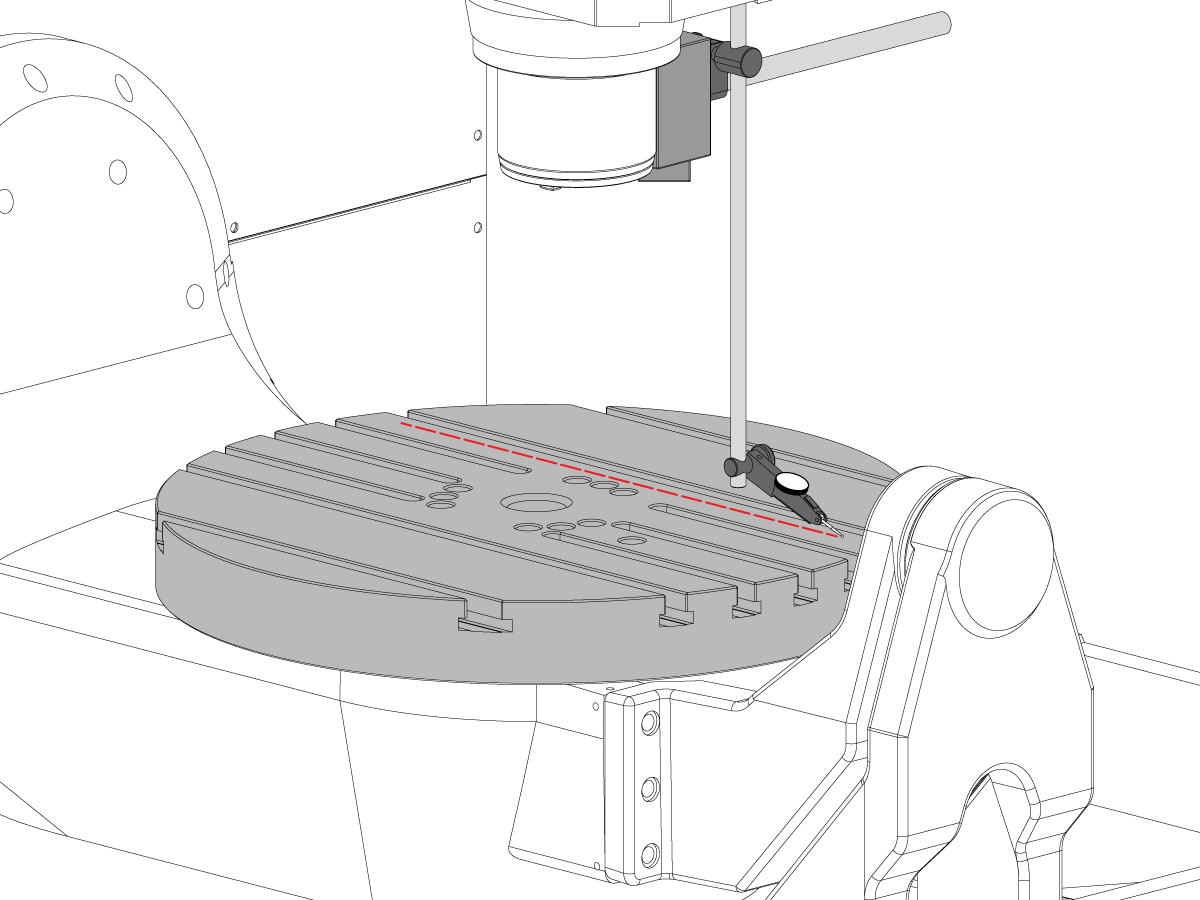
  • Postavite indikatorski vrh na krožnik in potisnite v osi X vzdolž plošče, da bi našli paralelizem plošče na osi X (NTE 0,001 ”/ 10" 0,0015" / 15")
  • Naslednji tek na osi Y vzdolž plošče, da bi našli paralelizem plošče Y-osi Y (NTE 0,001 ”/ 10" 0,0015" / 15")

9

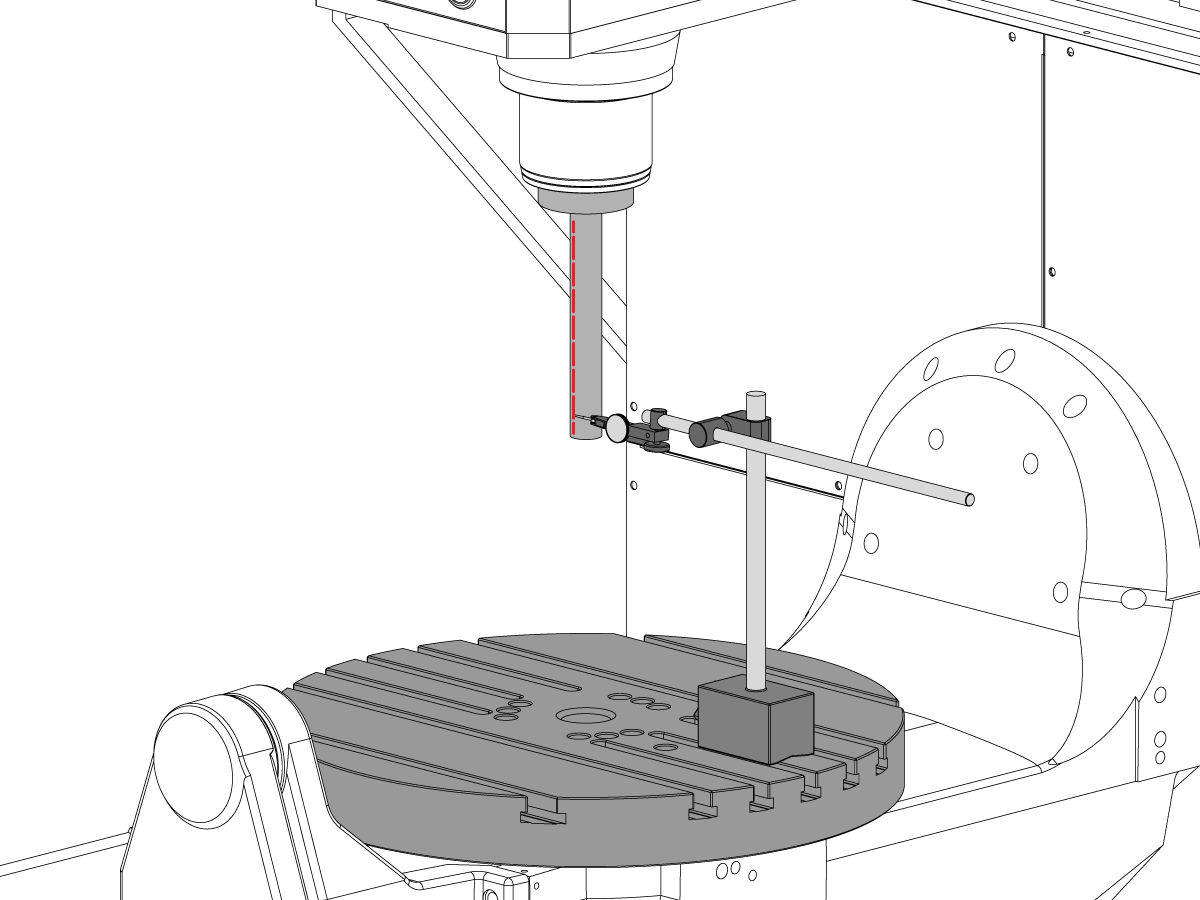
Vretena Izvedba

  • Vreteno centrirajte nad izvrtino C-osi.
  • Mag podstavek postavite na mizo in vstavite testno vrstico.
  • Preverite izpust vretena na dnu preskusne palice (NTE 0,0005" TIR)
  • Preverite vreteno 6" navzdol od podnožja preskusne palice (0,001 NTE)" TIR)

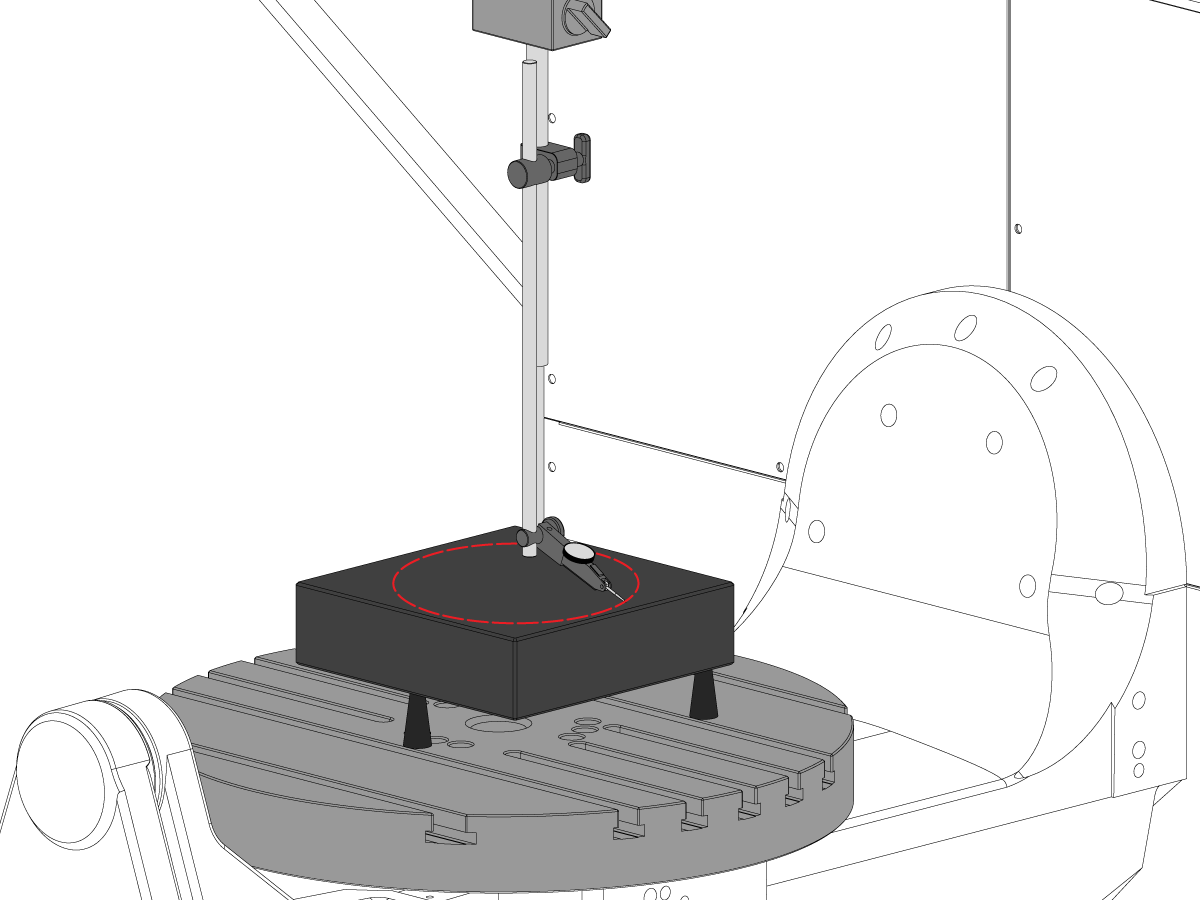
10

Vretena Središčna vzporednost do osi Z

  • S pritrdilnimi vijaki naredite granit vzporedno s ravnino XY v prikazani orientaciji (NTE: 0,0002")
  • Vreteno centrirajte preko izvrtine plošče na osi C
  • Pomesti v 10" premer krog
  • Posnemite XZ TIR  (NTE 0,0005")
  • Posneti YZ TIR  (NTE 0,0005")

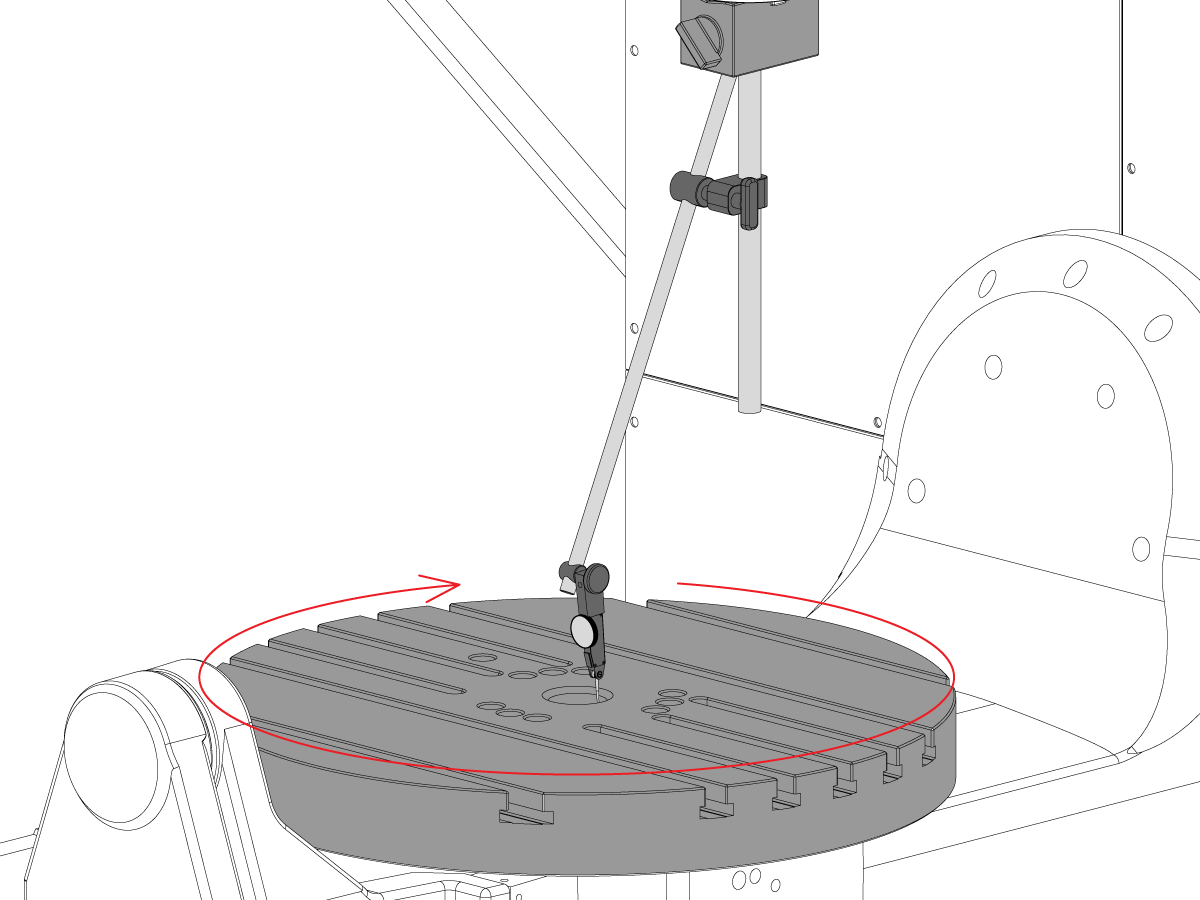
11

Koncentričnost izvrtine C-osi

  • Postavite indikator kot kažejo in C-os 360 ° jog
  • Zabeležite TIR natančnosti izvrtine (0,002 NTE)")

12

Strojna rotacijska ničla

  • Z makro programom in sistemom sonde VQC preverite vrednosti za parametre Coldfire ali nastavitve NGC, prikazane spodaj:
    • 255 - MRZP X OFFSET
    • 256 - MRZP Y OFFSET
    • 257 - MRZP Z OFFSET
    • 254 - 5 RAZPRODANO TOČKO ROTARY CENTER OSI
  • Za celotno navodilo MRZP glejte Haas MRZP WIPS Nastavitev odmika procedure

8.3 Geometrija - Odpravljanje težav

Recently Updated

UMC - Geometrija - Odpravljanje težav


TG0151

Pregled

Pred odpravljanjem težav z natančnostjo ali geometrijo na UMC-750 mora tehnik podrobno razumeti naslednje osnove:

  • Kako izravnati in poravnati vrtljive osi na UMC
  • Kako ponovno poravnati vse osi stroja
  • Kako izvesti umerjanje začetne položajne točke rotacijske ničelne točke stroja (MRZP) in podrobno razumevanje povezanih parametrov in njihovega vpliva na stroj
  • Razumevanje zmogljivosti strojev za natančnost in sposobnost logične analize geometrijskih težav
  • Poravnava sečišča osi B in C

Težavo z geometrijo ali natančnostjo stroja UMC-750 je treba obravnavati sistematično in v pravilnem zaporedju. Naslednje informacije je treba dosledno upoštevati in to v ustreznem zaporedju.

Ključnega pomena je, da je bil stroj pred kakršno koli oceno ali prilagoditvijo geometrije stroja preverjen glede pravilne ravni in poravnave vrtljivih osi s strojem

Številne napake so lahko vzrok za trk stroja ali težave bodisi z orodnimi aplikacijami bodisi s programiranjem. Ne poskušajte spremeniti geometrije stroja, brez da bi preverili splošno raven in geometrijo stroja v skladu s Poročilom o pregledu. To vključuje preverjanje Machine Rotary Zero Point (MRZP).

V primeru trka so na stroju 4 drsni spoji. Ta območja so glava vretena do podstavka, od podstavka do sedla, sedlo do mostu in trunion do opore truniona.

 Opomba: nobenega od teh spojev ne smete nikoli podlagati s podložnim lističem. Trk stroja nikoli ne sme spremeniti števila podložnih lističev, ki so zahtevani v stroju po tovarniških nastavitvah.

Dobro si je zapomniti, da je linearna natančnost stroja 0,0004/10" in kotna natančnost +/- 15 arc-sec. Te tolerance se lahko hitro seštevajo.

Temeljito je treba preveriti, ali je obdelovalna aplikacija smiselna in v okviru zmogljivosti vpenjanja in orodja stroja.

Ocenite stanje stroja

Ugotovite, ali se je v stroju že primeril trk. Preglejte zgodovino alarmov; poiščite fizične poškodbe ploščatega jekla, mize, glave vretena itd. Ne glede na to, kako "neznaten" je bil trk, bo to vplivalo na geometrijo stroja. Če je v stroju prišlo do trka, je treba opraviti popoln pregled geometrije stroja

Ocenite splošno stanje vpenjanja kosov in stanje orodja za rezkanje.

Pridobite popolno varnostno kopijo stroja in poročilo o napaki.

Preverite nivo in geometrijo stroja

Preverite, ali je stroj izravnan in ali je rotacijska os poravnana s strojem

 Opomba: zdaj še ne poskušajte prilagoditi geometrije stroja, razen nastavitve nog za izravnavo.

Če stroj ni v izravnan ali rotacijski element ni poravnan, ponastavite izravnavo in poravnajte rotacijski element.

Opravite celoten pregled geometrije, pri čemer za vsako os preverite vrsto in smer morebitnih napak.

Analizirajte poročilo o pregledu.

Če kateri koli od odsekov poročila o pregledu ni v okviru tolerance, je treba stroj ponovno poravnati.

Preglejte aplikacijo

Zberite naslednje podatke o obdelovancu, vpenjanju obdelovanca in orodju:

  • Katere lastnosti niso v okviru tolerance, obseg in smer napake
  • Ali je obdelovanec strojno obdelan s pomočjo 5-osnega, 3+2-osnega ali 3-osnega stroja?
  • Preglejte obdelovanec in pristop k strojni obdelavi
  • Ali je mogoče katero koli napako v natančnosti kosa zmanjšati s spremembo načina strojne obdelave?
  • Ali so težave prihaja zaradi ponovljivosti, velikosti ali geometrijske težave?
  • Ali program uporablja TCPC ali DWO?
  • Ali v tabelah za kompenzacijo dolžine obstajajo kakšne vrednosti?

8.4 Aplikacije – Odpravljanje težav

Recently Updated

UMC - Aplikacije - Vodnik za odpravljanje težav


TG0150

Dostop

Da pridobite Navodila za odpravljanje težav z aplikacijami na UMC:

Sledite povezavi Dokumenti in programska oprema | HBC

ali

Prijavite se na HBC.HAASCNC.COM

OPOMBA: Na te spletne strani se lahko prijavijo samo certificirani servisni tehniki podjetja Haas.

Izberite zavihek Servis.

Pojdite v razdelek »Pripomočki« in izberite razdelek »Dokumenti in programska oprema«.

Izberite mapo »Aplikacije«.

8.5 UMC-750 - Kontrolni seznam kompleta podložnih lističev

Recently Updated

UMC-750 - Kontrolni seznam kompleta podložnih lističev


AD0131

Uvod

To je kontrolni seznam kompletov podložnih lističev za naslednji komplet:

  • 93-2236 LOANER, komplet PODLOŽNIH LISTIČEV ZA UMC-750

Kontrolni seznam: Podložni listič-distančnik-steber

Debelina Št. dela Količina v kompletu RABLJENI
.02100 20-9358A 2  
0.2105 20-9359A 2  
.02110 20-9383A 2  
0.2115 20-9365A 2  
0.2120 20-9384A 2  
0.2125 20-9385A 2  
0.2130 20-9368A 2  
0.2135 20-9369A 2  
0.2140 20-9386A 2  
0.2145 20-9371A 2  
0.2150 20-9372A 2  
0.2155 20-9387A 2  
0.2160 20-9374A 2  
0.2165 20-9375A 2  
0.2170 20-9376A 2  
0.2175 20-9377A 2  
0.2180 20-9378A 2  
0.2185 20-9379A 2  
0.2190 20-9380A 2  
0.2195 20-9381A 2  
0.2200 20-9382A 2  

Opomba: Samo lastniki kompletov: Navedite debelino podložnih lističev, ko naročite nove. Na primer 20-9382 0,2145

Kontrolni seznam: Ščitniki za podložne lističe

Debelina Št. dela Količina v kompletu RABLJENI
0.0010 59-0240 2  
0.0020 59-0241 2  
0.0030 59-0242 2  

Kontrolni seznam: Podložni listič-distančnik-steber

Debelina Št. dela Količina v kompletu RABLJENI
0.2130 20-6282A 2  
0.2135 20-6283A 2  
0.2140 20-6284A 2  
0.2145 20-6285A 2  
0.2150 20-6286A 2  
0.2155 20-6287A 2  
0.2160 20-6288A 2  
0.2165 20-6289A 2  
0.2170 20-6290A
2  
0.2175 20-6291A 2  
0.2180 20-6294A 2  
0.2185 20-6295A 2  
0.2190 20-6292A 2  
0.2195 20-6293A 2  
0.2200 20-6296A 2  
0.2205 20-6297A 2  
0.2210 20-6277A 2  
0.2215 20-6279A 2  
0.2220 20-6278A 2  
0.2225 20-6298A 2  
0.2230 20-6281A 2  

Opomba: Samo lastniki kompletov: Navedite debelino podložnih lističev, ko naročite nove. Na primer 20-6290A 0,2080

ZABELEŽITE, KATERI PODLOŽNI LISTIČNI SO BILI ODSTRANJENI IZ KOMPLETA V UPORABLJENEM STEBRU.

VRNITE KONTROLNI SEZNAM S KOMPLETOM PODLOŽNIH LISTIČEV.

VRNITE ORIGINALNE PODLOŽNE LISTIČNE V ZABOJU.

8.6 Uravnavanje sečišča B/C osi - Poravnava

Uvod

Ta postopek vam pokaže, kako izmeriti in poravnati sečišče B- in C-osi.  Preden poskusite s tem postopkom, preverite, ali je stroj poravnan s poravnavo UMC-750.

Zatem morate poravnati B- in C-osi po tem, ko:

  • Zamenjajte B in C-osi
  • ali izpolnite a UMC inšpekcijsko poročilo in poiščite težavo

5-osna razdalja rotacijskega centra določa razliko med rotacijskimi centri vrtenja: Rotacijske ničelne točke stroja (MRZP) C-osi in MRZP B-osi v X-osi.

Možno je, da med MRZP C-osi in B-osi ni razlike.

  • Klasično krmilje Haas (CHC) Parameter 1314 -Rotary Axes Center Deviation in X
  • Krmilje naslednje generacije (NGC) Nastavitev 254 - 5 Axis Rotary Center Distance

Potrebovali boste naslednja orodja:

  • T-2195A UMC Aligment Bar Adapter
  • T-2113 Alignment bar
  • Toplotna pištola in rokavice, odporne na toploto

Poravnava osi B na osi XYZ

How to identify the Multi-Piece and the Unibody trunnion   

1) Multi-Piece trunnion:    UMC machines built approximetely before 11/2022 will have this configuration.

2) Unibody trunnion:    UMC machines built approximetely after 11/2022 will have this configuration.

1

Remove the A-frame trunnion support:

Remove the bolts [1] that secure the A-frame trunnion support [2] to the base and take out the shims between A-frame support and the base.

Rotate the A-frame support [2] counter-clockwise to clear the edge of the base [3].

Pull the A-frame support off the bearings.

 Note: The A-frame support might vacuum lock on the bearings. Use the zip-tie to pry the seal [4] open.

 Caution: To lift the trunnion support, get the aid of another person. The support weighs 85 lbs (39 kg).

2

Measure the B- axis of rotation parallelism to the Y-Z plane:

For a machine with a Classic Haas Control, change Parameter 151:20 (B axis CHK TRAVL LIM) to 0.

For a machine with a Next Generation Control, change Parameter 6.021 (B axis CHK TRAVL LIM) to FALSE.

Measure the parallelism of the platter to the Y-Z plane with the B axis at 90° and then the B axis at -90° as shown in the picture.

Position the Y-Axis in the following starting position:

UMC-500: Y=0, Sweep 15”, 3rd T-Slot Land from the top.

UMC-750/1500-Duo: Y=-1.0, Sweep 18", 3rd T-Slot Land from the Top .

UMC-1250: Y=-1.0, Sweep 28", 3rd T-Slot Land from the Top.

UMC-500PP: Y=-4.0, Sweep 7".

UMC-750PP: Y=-2”, Sweep 15".

UMC-1000PP: Y=-4”, Sweep 15".

Compare the results at B 90° and B-90°. The results should be...

  • Symmetric against the Y-Z plane, positive or negative direction
  • Less than 0.0010"/20"

If the results are symmetric against Y-Z plane, and are less than 0.0010"/20 inches: Go to Step 5.

If the results are symmetric against Y-Z plane, but are more than 0.0010"/20 inches: Go to Step 4.

 Warning: If the results [3] are not symmetric against the Y-Z plane, the B axis rotary needs to be aligned: Go to Step 3.

3

Align the B axis of rotation parallel to the Y-Z plane:

Loosen the (6) bolts [1] that secure the B axis rotary to the base casting.

 Note: Keep the bolts sufficiently snug to control the adjustments.

Adjust the front and rear setscrews [2] until the measurements taken in Step 2 are symmetric against the Y-Z plane.

Torque the (6) bolts [1]. Refer to Haas Fastener Torque Specification.

Verify the measurements in Step 2 after the bolts have been torqued.

4

Align the C Axis of rotation perpendicular to the B Axis of rotation:

Remove the bottom C-Axis access cover.

Loosen the (12) bolts [1] that hold the C Axis body to the B Axis platter face.

Reach the bottom (4) bolts through the C Axis access port.

If the B Axis is symmetric in the positive direction [4], install horseshoe shims [2] of appropriate size behind the top (2) bolts.

If the B Axis is symmetric in the negative direction [5], install horseshoe shims [2] of appropriate size behind the bottom (2) bolts.

Torque the (12) bolts to 80 Ft-lbs (108 Nm).

Cut the excessive shim material off.

Verify the measurements in Step 2 after bolts are torqued.

5

Align the trunnion support shaft co-axial with the B Axis of rotation:

Setup (2) indicators on the outer race of the trunnion support bearing [2] as shown in the picture.

Mark the spot on the outer race where one of the indicator needles is contacting the surface.

After moving the B Axis to 90° or -90° you will align the marked spot with the needle again to exclude the bearing runout error from the measurements.

Take the readings when B is at 90° and B at -90°. Compare the readings. 

 Caution: The B axis brake needs to be clamped when taking the readings.

The deviation between the results when B is at 90° and at -90° needs to be less than 0.001" on each indicator.

 Note: The indicator on the side of the bearing will measure top to bottom alignment and the indicator on the top of the bearing will measure side to side alignment.

____

For models with a multi-piece trunnion

Loosen the (6) bolts [3] on the C Axis body support. Keep the bolts sufficiently snug to control adjustment.

Adjust the (8) set screws [4] until deviation between B at 90° and B at -90° is within 0.001".

Torque the (6) bolts [2] on the C Axis body support to 80 Ft-lbs (108 Nm).

Verify the alignment after the bolts have been torqued.

____

For models with a unibody trunnion

Jog rotary to B90. Set up an indicator on the highlighted surface as shown in the lower diagram .

Rotate B-axis 180 degrees (90 to -90).

Run out (NTE 0.010” TIR).

 Caution: If the measurement exceeds the tolerance then contact support.

6

Install and shim the A-frame trunnion support:

Move the B Axis to 90°.

Setup an indicator [1] against a machined surface of the C Axis body. Set the indicator to 0.

Use plastic zip ties [2] to pry the seal open while installing the A-frame support. This lets unwanted air and grease out of the assembly.

Install the A-frame trunnion support [3] over the bearings.

Remove the cable ties.

Turn the trunnion support clockwise until it is vertical.

 Note: The weight of the A-frame support will cause the trunnion to sag. The amount of sag is measured with the indicator that was previously setup on the side of the C Axis body.

____

For multi-piece trunnions

Adjust the shims [4] between the A-frame support and the base casting to remove the sag until indicator reads 0 again.

When the indicator reading is 0, torque the (4) bolts. Refer to Haas Fastener Torque Specification.

Verify the reading after bolts are torqued. Adjust the shims again if necessary until the indicator reads 0.

____

For models with unibody trunnion

Determine the amount of shim stock [4] needed to raise the Trunnion arm so the indicator reads 0.005".

The indicator [1] value will change once the support is torqued.

With indicator still in place:

  • Torque trunnion support bolts to appropriate values.
  • Check indicator to make sure it reads between the range of

Trunnion arm raised (0.005” to  0.010”).

 Note: For unibody trunnions, the shim location may also be used to correct the C-axis to X-Y plane perpendicularity instead of shimming the saddle trucks.

 Caution: Use equal amount of shims on each side of the A-frame support. Unequal shims will cause the A-frame support to pull the trunnion to the side.

Verify the B Axis of rotation alignment to the Y-Z plane (Step 2). Loosen the bolts and tap the A-frame support side to side if necessary to correct the B axis to Y-Z plane alignment.

7

Set C-axis perpendicular to X/Y plane:

Move the axes to

UMC-750's........X= -10.5" & Y=0."

UMC-1000's......X=-17.0" & Y=-0."

Zero an indicator [1], on a Ground Block [2], 1/2" off the edge at the rear of the platter (Mag-Base on Spindle), with C at 0 Degrees

Rotate C-Axis to 180°.

Move Y axis, and ground block, in Y Axis negative direction until you are 1/2" away from platter edge, and take the perpendicularity measurement

Adjust the shims until the average error is within 0.0005" end to end.

 Note: For unibody trunnions, the shim location under the bearing support may also be used to correct the C-axis to X-Y plane perpendicularity instead of shimming the saddle truck.

Caution: Shim either two front trucks or two rear trucks with the equal shim.

Note: Shim one truck at the time to maintain the X to Y squareness.

Verify the measurements after all bolts are torqued.

Verify the X to Y alignment in Step 2.

8

Set the tool change offsets:

B-axis tool change offset [1]

For Classic Haas Controls, change Parameter 213. 

For Next Generation Controls, go to: Settings>Rotary Tab>Highlight the rotary and press [INSERT], or change Parameter 6.078 (B TOOL CHANGE OFFSET) to set the trunnion (B Axis) parallel to the X Axis.

For models with multipiece trunnion

(NTE 0.001/10"; NTE 0.0020" overall)

For models with unibody trunnion

(NTE 0.0005/10"; NTE 0.0010" overall)

___

C-axis tool change offset [2]

For Classic Haas Controls change Parameter 523.

For Next Generation Control go to: Settings>Rotary Tab> Highlight the rotary and press [INSERT], or change Parameter 7.078 (C TOOL CHANGE OFFSET) to set the table T-slot (C Axis) parallel to the X Axis

For models with multipiece trunnion

(NTE 0.001/10"; NTE 0.0020" overall)

For models with unibody trunnion

(NTE 0.0005/10"; NTE 0.0010" overall)

9

Check C-axis perpendicularity to X/Y plane:

Align the indicator centered over the C-axis bore with the Y-axis at -10.

Jog positive in the Y-axis and align the indicator over the center of the last section of the platter and make a mark at this spot with a washable marker.

Insert 1-2-3 block as shown and set the indicator to zero.

Remove the block and rotate the platter 90 degrees, following the marked spot with the indicator.

Insert block back between the indicator and platter. Note reading.

Repeat the previous two steps, taking readings with the platter at 180, 270 and 360 degrees.

Multi-piece trunnion:  (NTE 0.0005")

Unibody trunnion: (NTE 0.001")

10

Measure the intersection of the B and C axis:

Follow the linked instruction manual to complete this step.

B-Axis and C-Axis intersection Adjustment

11

Align the B-Axis brake disk:

 Note: Do not do this step if you are working on a SS machine.

Operate this code in MDI mode to unclamp the brake:

M11;

Loosen all of the brake disc bolts [1] and torque them to 5 Ft-lbs (7 Nm).

Operate this code in MDI mode to clamp the brake:

M10;

Wait 10 seconds.

Torque the bolts. Refer to Haas Fastener Torque Specifications.

Nastavitev orodja na sečišču B- in C-osi

1

Install the B Axis and C Axis intersection tool:

Jog the C Axis to 0°.

Push [EMERGENCY STOP].

Clean the table.

Guide the shaft of the adapter [1] while you slowly lower it into the center bore.

Attach the adapter to the table with (2) screws [4] and (2) T-nuts.

Attach the alignment bar [2] to the adapter with (3) screws [3].

Snug the (3) screws to allow for adjustments in the next step.

2

Align the B/C intersection tool with the C Axis:

Put an indicator on the front side of the alignment bar near the base.

Release the [EMERGENCY STOP]. Push [RESET] to clear any alarms.

Jog across the tool in the X Axis to find the high spot.

Set the indicator to 0.

Jog the C Axis 360°.

Lightly tap the base with a rubber mallet to adjust the radial error on the alignment bar.

Note: Adjust the alignment bar to half of the measured error, because you are measuring the diameter error.

Jog the C Axis 360°.

When correctly adjusted the radial error is less than 0.0002" (0.005 mm).

3

Check the B/C intersection:

Center the indicator [1] on the front side of the alignment bar near the top of the cylinder.

Jog across the tool in the X Axis to find the high spot.

Zero the indicator.

Jog the C Axis 360°.

Turn the (3) screws [2] on the alignment bar to adjust the runout.

Jog the C Axis 360°.

When correctly adjusted the radial error is less than 0.0002" (0.005 mm).

Repeat Step 2 and verify the alignment did not change.

Prilagoditev križanja B-osi na C-os

1

For a machine with a Classic Haas Control change:

  • Parameter 151:20 (B-axis CHK TRAVL LIM) to 0.
  • Parameter 1314 (ROTARY AXIS CENTER DEVIATION IN X) to 0.

For a machine with a Next Generation Control change:

  • Parameter 6.021 (B-axis CHK TRAVL LIM) to FALSE.
  • Setting 254 (5-Axis Rotary Center Distance) to 0.

Push [ZERO RETURN]. Then push [ALL].

Jog the B-axis to -90°.

Note: The rotary positions are for reference only.

Put an indicator [1] on top of the alignment bar.

Jog in the Y-axis to find the high point.

Set the indicator to 0.

Jog across the alignment bar in the X-axis [2].

Jog the B-axis to adjust the alignment bar parallel to the X plane.

Set the indicator to 0.

Jog the Y-axis to 0.

Caution: Make sure the indicator assembly is clear of the B-axis movement.

 Caution: Do not move the Z-axis.

2

Jog the B-axis to +90°.

 Caution: Make sure the indicator assembly is clear of the B-axis movement.

Jog the Y-axis [1] to find the high point on the alignment bar.

Note: Do not set the indicator to 0.

Jog across the alignment bar in the X-axis.

Jog the B-axis to adjust the alignment bar parallel [2] to the X plane.

When the alignment bar is parallel to the X plane, the indicator reading is the change needed in the Z-Axis (∆Z=indicator reading).

Record the value shown on the indicator. In this example the indicator now shows 0.0015". ∆Z is 0.0015".

3

Do these calculations to get the value for CHC Parameter 1314 or NGC Setting 254. (In this example the difference in readings for the B-C intersection (∆Z) is 0.0015".):

  • ∆Z / 2 x 10,000 = CHC Parameter 1314 / NGC Setting 254
  • 0.0015 / 2 = 0.00075
  • Round down to 4 decimal places: 0.00075 = 0.0007 (NGC Setting 254)
  • 0.0007 x 10,000 = 7 (CHC Parameter 1314)

Set Parameter CHC Parameter 1314 (Rotary Axes Center Deviation in X) or NGC Setting 254 (5-Axis Rotary Center Distance), to the calculated value.

In this example, set parameter CHC Parameter 1314 to 7 or NGC Setting 254 to 0.0007.

Cycle the power to save CHC Parameter 1314 or NGC Setting 254.

Repeat Steps 1-3 to verify that the value for ∆Z is less than 0.0002" (0.005 mm).

4

Jog the B-Axis to the home position.

Set Parameter 151:20 (B-Axis CK Travel Limit) to 1.

Make sure the MRZP offsets are correct.

Calibrate WIPS per Wireless Intuitive Probe System (WIPS) - Calibration.

Complete an inspection report. Refer to UMC-750 Inspection Report.

Recently Viewed Items

You Have No Recently Viewed Items Yet

Povratne informacije
Haas Logo

HAAS dobavljena cena

Ta cena vključuje stroške pošiljanja, izvozne in uvozne dajatve ter vse druge stroške, ki nastanejo med pošiljanjem na lokacijo v Franciji, dogovorjeno z vami kot kupcem. Za dostavo CNC produkta Haas se ne sme zaračunati nobenih drugih obveznih stroškov.

BODITE OBVEŠČENI O NAJNOVEJŠIH NASVETIH IN TEHNOLOGIJI PODJETJA HAAS…

Prijavite se zdaj!   

HAAS TOOLING SPREJEMA NASLEDNJE:

  • Servis in podpora
  • Lastniki
  • Zahteva za servis
  • Priročniki za operaterja
  • Deli Haas
  • Zahteva za popravilo delilnika
  • Navodila za prednamestitev
  • Orodja za nakupovanje
  • Sestavi in preveri ceno novega Haas
  • Razpoložljiv inventar
  • Cenik Haas
  • Financiranje CNCA
  • O podjetju Haas
  • Izjava o dostopnosti
  • Izjava DNSH
  • Skladnost z izvoznimi predpisi
  • Zaposlitev
  • Certifikati in varnost
  • Kontaktirajte nas
  • Zgodovina
  • Pogoji in določbe
  • Pogoji in določbe Haas Tooling
  • Zasebnost
  • Garancija
  • Skupnost Haas
  • Certifikacijski program Haas
  • Motošport Haas
  • Fundacija Gena Haas
  • Haas skupnost za tehnično izobraževanje
  • Dogodki
  • Pridružite se pogovoru
  • Facebook
  • X
  • Flickr
  • YouTube
  • LinkedIn
  • Instagram
  • TikTok
© 2026 Haas Automation, Inc – Orodja CNC stroja

This site is protected by reCAPTCHA and the Google Privacy Policy and Terms of Service apply.

2800 Sturgis Rd., Oxnard, CA 93030 / Toll Free: 800-331-6746
Phone: 805-278-1800 / Fax: 805-278-2255