My Haas ようこそ、
!
Haas Tooling MyHaas/HaasConnect サインイン 登録 Haas Tooling MyHaas/HaasConnect サインアウト ようこそ、 使用中の機械 最新の活動 見積 アカウント ユーザー サインアウト
販売代理店を検索
  1. 言語を選択
    1. English
    2. Deutsch
    3. Español - España
    4. Español - México
    5. Français
    6. Italiano
    7. Português
    8. Český
    9. Dansk
    10. Nederlands
    11. Magyar
    12. Polski
    13. Svenska
    14. Türkçe
    15. 中文
    16. Suomi
    17. Norsk
    18. الإنجليزية
    19. български
    20. Hrvatski
    21. Ελληνικά
    22. Română
    23. Slovenský
    24. Slovenščina
    25. 한국어
    26. 日本語
    27. Українська
  • 機械 Main Menu
    • 立型マシニングセンター
      立型マシニングセンター
      立型マシニングセンター すべて表示
      • 立型マシニングセンター
      • VFシリーズ
      • ユニバーサル機械
      • VRシリーズ
      • VP-5 プリズマティック
      • パレットチェンジ VMCs
      • 小型ミル
      • 金型機
      • 高速ドリルセンター
      • ドリル/ タップ/ ミルシリーズ
      • ツールルームミル
      • Pocket Mill
      • 小型ミル
      • ガントリーシリーズ
      • SRシートルーター
      • 超大型VMCS
      • ダブルコラムミル
    • 多軸制御ソリューション
      多軸制御ソリューション
      多軸制御ソリューション すべて表示
      • 多軸制御ソリューション
      • Y軸旋盤
      • 5軸ミル
    • 旋盤
      旋盤
      旋盤 すべて表示
      • 旋盤
      • STシリーズ
      • デュアルスピンドル
      • ボックスウェイシリーズ
      • ツールルーム旋盤
      • チャッカー旋盤
      • Haasバー送り機
      • Haasバー送り機 V2
      • Haasバー送り機 12
    • 横型マシニングセンター
      横型マシニングセンター
      横型マシニングセンター すべて表示
      • 横型マシニングセンター
      • 50テーパー
      • 40テーパー
    • ロータリーとインデクサ
      ロータリーとインデクサ
      ロータリーとインデクサ すべて表示
      • ロータリーとインデクサ
      • 回転テーブル
      • インデクサ
      • 5軸ロータリー
      • 超大型ロータリー
    • オートメーション システム
      オートメーション システム
      オートメーション システム すべて表示
      • オートメーション システム
      • ミルの自動化
      • 旋盤の自動化
      • オートパーツローダー
      • 自動化モデル
    • デスクトップ機械
      デスクトップ機械
      デスクトップ機械 すべて表示
      • デスクトップ機械
      • デスクトップミル
      • デスクトップ旋盤
      • コントロールシミュレーター、スタンダード
      • コントロールシミュレーター、プレミアム
    • 工場機器
      工場機器
      工場機器 すべて表示
      • 工場機器
      • ニーミル
      • Haas手動旋盤
      • Haasソー
    • 製造機械
      製造機械
      製造機械 すべて表示
      • 製造機械
      • レーザー切断機械
      • CNCプレスブレーキ
    • クイックリンク 特殊シリーズ  特殊シリーズ 
      EUシリーズ EUシリーズ 構築と価格 | 価格表 構築と価格 | 価格表 在庫のある機械 在庫のある機械 最新情報 最新情報 初めてのCNC 初めてのCNC
      ショッピングツール
      • Haas オンライン見積もり
      • 価格表
      • 在庫状況
      • CNCAローン
      問い合わせる

      HAAS ファクトリーアウトレット(HFO)がご質問にお応えし、最適なオプションをご案内します。

      CONTACT YOUR DISTRIBUTOR >
  • オプション Main Menu
    • Product Image スピンドル
      スピンドル
      スピンドル すべて表示
      • スピンドル
    • Product Image ツールチェンジャー
      ツールチェンジャー
      ツールチェンジャー すべて表示
      • ツールチェンジャー
    • Product Image 第4軸 | 第5軸
      第4軸 | 第5軸
      第4軸 | 第5軸 すべて表示
      • 第4軸 | 第5軸
    • Product Image タレットと回転工具
      タレットと回転工具
      タレットと回転工具 すべて表示
      • タレットと回転工具
    • Product Image 検査
      検査
      検査 すべて表示
      • 検査
    • Haas切粉およびクーラントの管理 チップおよびクーラントの管理
      チップおよびクーラントの管理
      チップおよびクーラントの管理 すべて表示
      • チップおよびクーラントの管理
    • Haas制御 Haas制御
      Haas制御
      Haas制御 すべて表示
      • Haas制御
    • Product Image 生産オプション
      生産オプション
      生産オプション すべて表示
      • 生産オプション
    • Product Image ツーリングおよび固定具
      ツーリングおよび固定具
      ツーリングおよび固定具 すべて表示
      • ツーリングおよび固定具
    • Product Image 保持具
      保持具
      保持具 すべて表示
      • 保持具
    • Product Image 5軸ソリューション
      5軸ソリューション
      5軸ソリューション すべて表示
      • 5軸ソリューション
      • 5 Easy Steps to 5-Axis
    • Product Image 自動化
      自動化
      自動化 すべて表示
      • 自動化
    • クイックリンク 特殊シリーズ  特殊シリーズ 
      EUシリーズ EUシリーズ 構築と価格 | 価格表 構築と価格 | 価格表 在庫のある機械 在庫のある機械 最新情報 最新情報 初めてのCNC 初めてのCNC
      ショッピングツール
      • Haas オンライン見積もり
      • 価格表
      • 在庫状況
      • CNCAローン
      問い合わせる

      HAAS ファクトリーアウトレット(HFO)がご質問にお応えし、最適なオプションをご案内します。

      CONTACT YOUR DISTRIBUTOR >
  • Why Haas Main Menu
      Haasの特徴を見る
    • Haasである理由
    • MyHaas
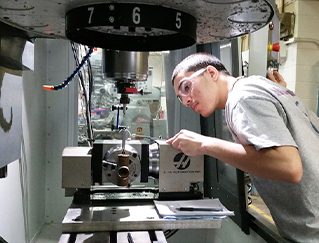
    • トレーニングコミュニティ
    • インダストリー4.0
    • Haas認定
    • お客様の声
  • サービス Main Menu
      Haas Service へようこそ
      サービス ホーム オペレーターマニュアル 手順 トラブルシューティング ガイド 予防メンテナンス Haasの部品 Haas Tooling ビデオ
  • ビデオ Main Menu
  • Main Menu
    • すべて表示
      • Financing
    • すべて表示
      • Showroom Inventory
    • クイックリンク 特殊シリーズ  特殊シリーズ 
      EUシリーズ EUシリーズ 構築と価格 | 価格表 構築と価格 | 価格表 在庫のある機械 在庫のある機械 最新情報 最新情報 初めてのCNC 初めてのCNC
      ショッピングツール
      • Haas オンライン見積もり
      • 価格表
      • 在庫状況
      • CNCAローン
      問い合わせる

      HAAS ファクトリーアウトレット(HFO)がご質問にお応えし、最適なオプションをご案内します。

      CONTACT YOUR DISTRIBUTOR >
My Haas ようこそ、
!
Haas Tooling MyHaas/HaasConnect サインイン 登録 Haas Tooling MyHaas/HaasConnect サインアウト ようこそ、 使用中の機械 最新の活動 見積 アカウント ユーザー サインアウト
販売代理店を検索
  1. 言語を選択
    1. English
    2. Deutsch
    3. Español - España
    4. Español - México
    5. Français
    6. Italiano
    7. Português
    8. Český
    9. Dansk
    10. Nederlands
    11. Magyar
    12. Polski
    13. Svenska
    14. Türkçe
    15. 中文
    16. Suomi
    17. Norsk
    18. الإنجليزية
    19. български
    20. Hrvatski
    21. Ελληνικά
    22. Română
    23. Slovenský
    24. Slovenščina
    25. 한국어
    26. 日本語
    27. Українська
×

検索結果

Web Pages

画像

    • <
    • 1
    • >

8 - UMC - Geometry and Alignment

UMCシリーズ-サービスマニュアル


  • UMC-スピンドル
  • 1 - UMC - 概要
  • 2 - UMC - 仕様
  • 3 -UMC-400/500/750 - 設置
  • 4 - UMC-1000/1250 - 取り付け
  • 5 - UMC-1500-DUO/1600H - 取り付け
  • 6 - UMC - アンカーリング
  • 7 - UMC - 操作
  • 8 - UMC - ジオメトリと調整
  • 9 - UMC - MRZPおよびセーフゾーン
  • 10 - UMC - B/C - 回転軸
  • 11 - UMC - ツールチェンジャー
  • 12 - UMC - チップ取出しとクーラント
  • 13 - UMC - 電気制御
  • 14 - UMC - 潤滑
  • 15 - UMC - メンテナンス
  • 16 - UMC - パレットプール
  • 17-UMC-油圧保持具
  • 18 - UMC - 空圧式保持具

Go To :

  • 8.1 ジオメトリガイド
  • 8.2 調整 - 表示ゾーン
  • 8.3 ジオメトリ - トラブルシューティング
  • 8.4 アプリケーション - トラブルシューティング
  • 8.5 UMC-750 - シムキットチェックリスト
  • 8.6 B/C - 軸の交差 - 調整

8.1 ジオメトリガイド

Recently Updated

形状ガイド - UMCシリーズ


Introduction

  1. スピンドルヘッド
  2. ラム
  3. サドル
  4. ブリッジ
  5. ベース
  6. C軸回転
  7. B軸回転

開始する前に、該当パラメータの工場設定値または以下の設定の値を記録します。調整中にこれをゼロに設定し、終了時に元の値にリセットする必要があります。値は正になる場合も負になる場合もあります。

  • クラシックHaas制御(CHC) パラメータ1314(Rotary Axes Center Deviation in X)
  • 次世代制御(NGC)設定254(5 Axis Rotary Center Distance)

必要な工具とキット:

  • T-2193A -UMC-750 SPINDLE HEAD ALIGNMENT PIN *
  • T-2181 - CNC DUAL LEVELING TOOL
  • T-2192 - LEVELING ADAPTER UMC-750
  • 93-2236 - SHIM KIT FOR UMC-750*

リンクをクリックして、UMC-750のレベリングと整列ビデオをご覧ください。

*  :プリリブートシリーズでのみ使用されます。 

Level the Machine

1

機械の高さ設定:

X軸とY軸を原点に移動します。

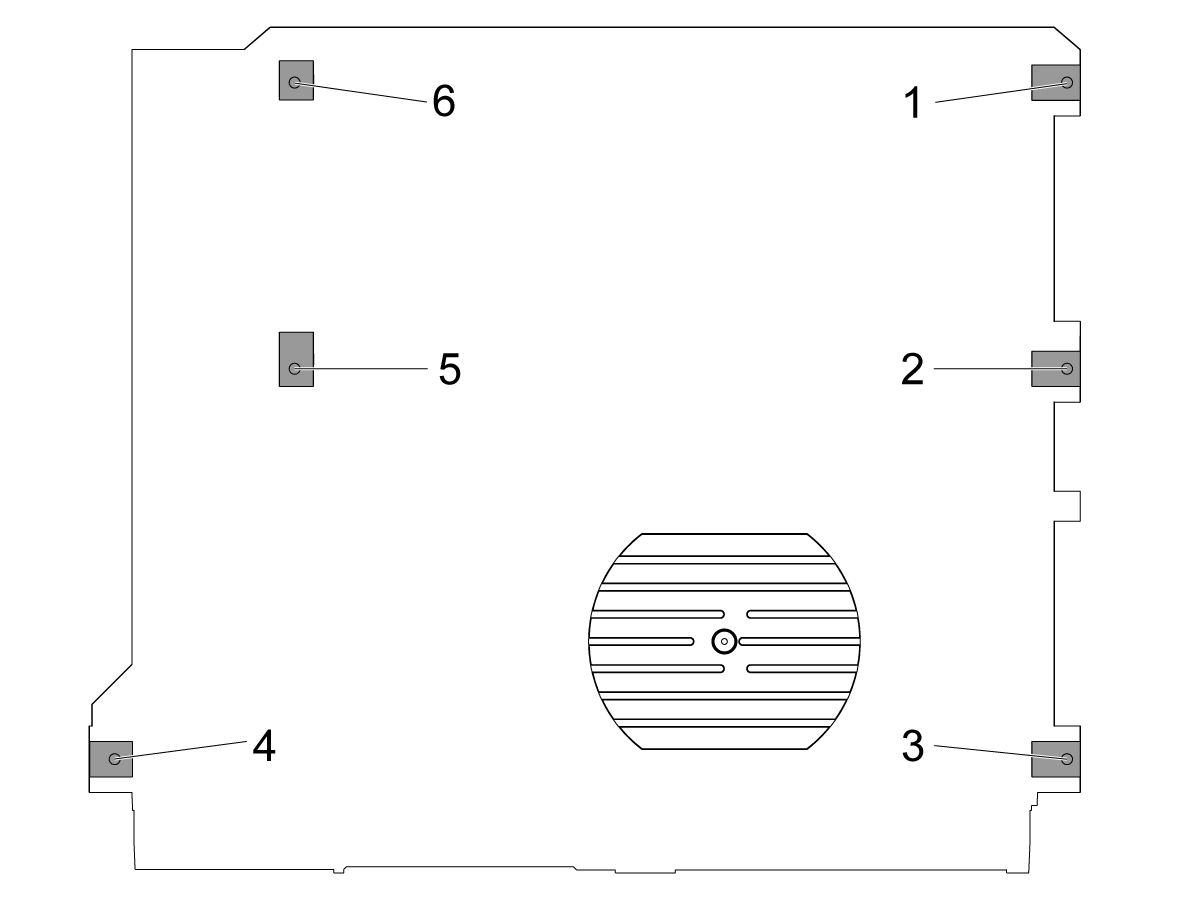
中央の水平調整ねじ[2および5]を緩めて、それらに荷重がかからないようにします。

床から3"(76.2mm)の高さで4隅の水平調整ねじ上に機械を設置します。

2

機械の大まかなレベリング:

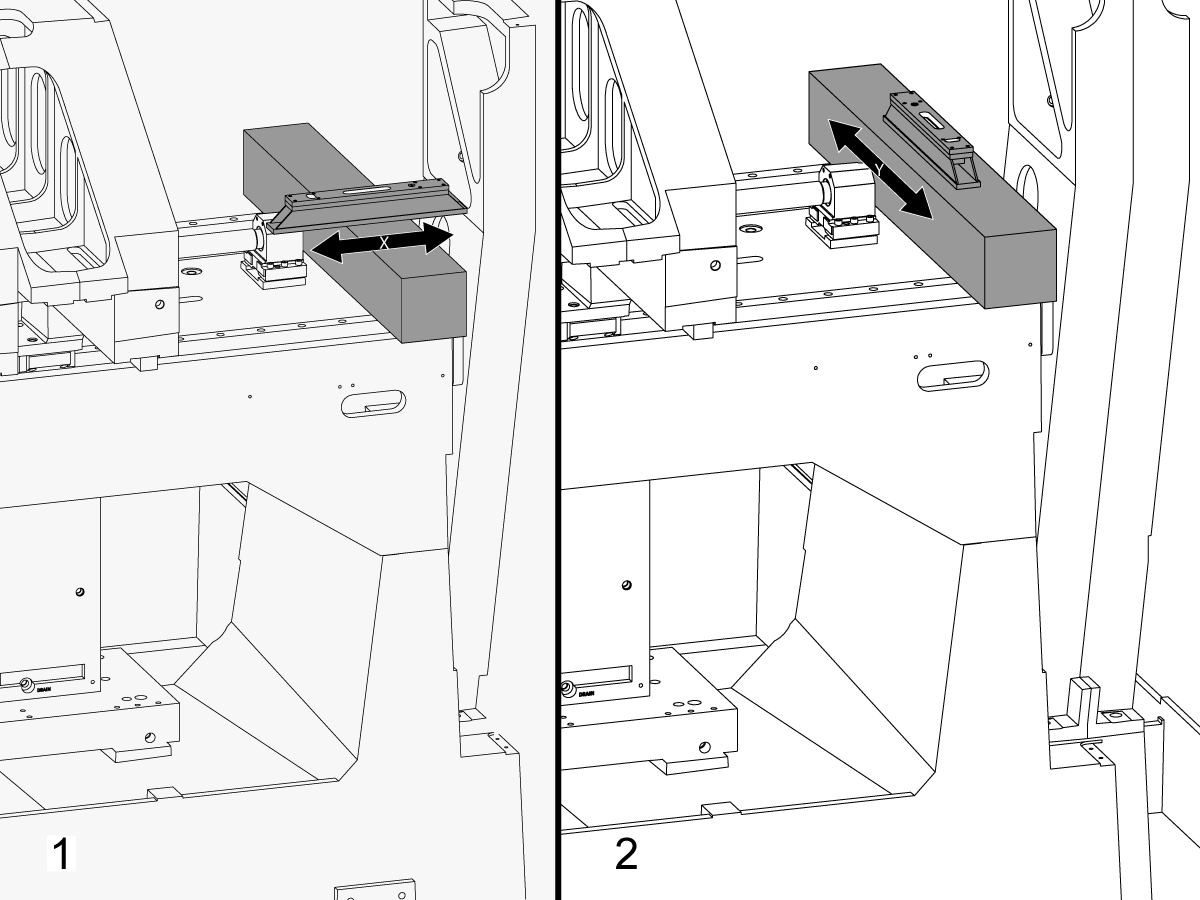
水平調整ねじ#4を上に向けます。

X軸ボールスクリューベアリングサポート付近のX軸リニアガイド全体にグラナイトを配置します。

X軸[1]に平行なグラナイトの上に機械工のレベルをセットアップします。

X軸で機械が水平になるまで、水平調整ねじ#6を調節します。

X軸[2]に垂直なグラナイトの上に機械工のレベルをセットアップします。

Y軸で機械が水平になるまで、水平調整ねじ#3を調節します。

水平調節パッドと接触するまで、水平調整ねじ#4を下方に回します。

3

X軸回転の調整:

T-2192とT-2181を組み立てます。

Y軸を移動の中央に移動します。

T-2192をスピンドルの側面に置きます。

T-2181のバブルが読み取り可能な範囲内にあることを確認してください。

そうでない場合は、T-2192を磁気ベースに固定しているボルトを緩め、必要に応じてアダプターを動かします。

X軸を左右にジョグして、X軸の回転を測定します。原点、中央、そして移動終了点で測定を行います。

原点での測定値と移動終了点の測定値にずれがなくなるまで、水平調整ねじ#4を調整します。

注記: T-2181のバブルは、バイアルの中央にある必要はありません。読み取り可能な範囲内にある必要があるだけです。

4

中央の水平調節ねじの設定:

水平調節パッドと接触するまで中央の水平調節ねじを下方に回し、続いてさらに45°回します。

X軸の回転を確認します。中央の水平調整ねじを調節して、X軸の回転を是正します。

X Axis to Y Axis Alignment

1

X軸の動きに平行なサドル面の整列:

X軸をジョグして、サドル[1]の前面の加工面全体をスイープします。

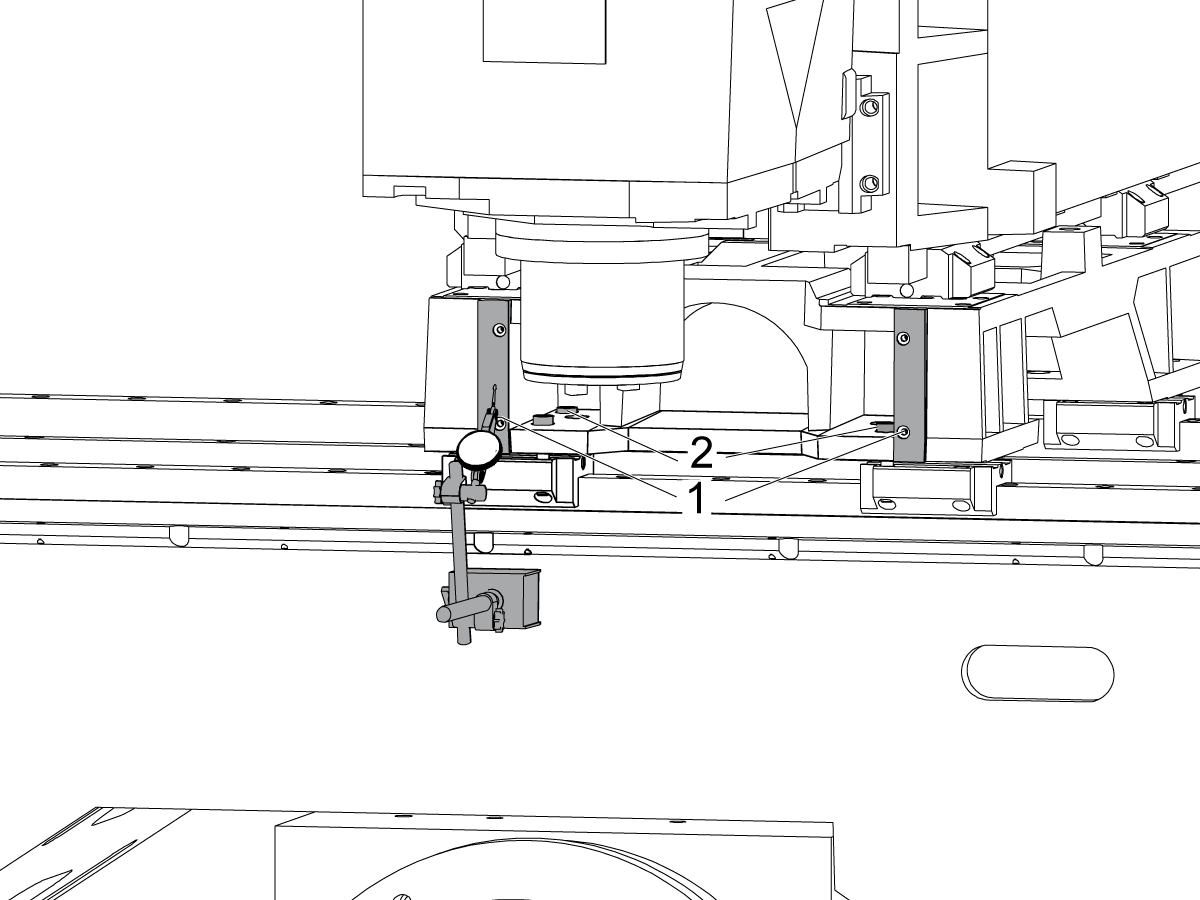
サドルをX軸トラックに固定しているボルトを緩め[2]、必要に応じてX軸の動きに平行なサドルの面を0.001インチ以内に整列させます 。

ボルトにトルクをかけます。 Haas ファスナートルク仕様をご参照ください。

2

Y軸をX軸に対して垂直に整列:

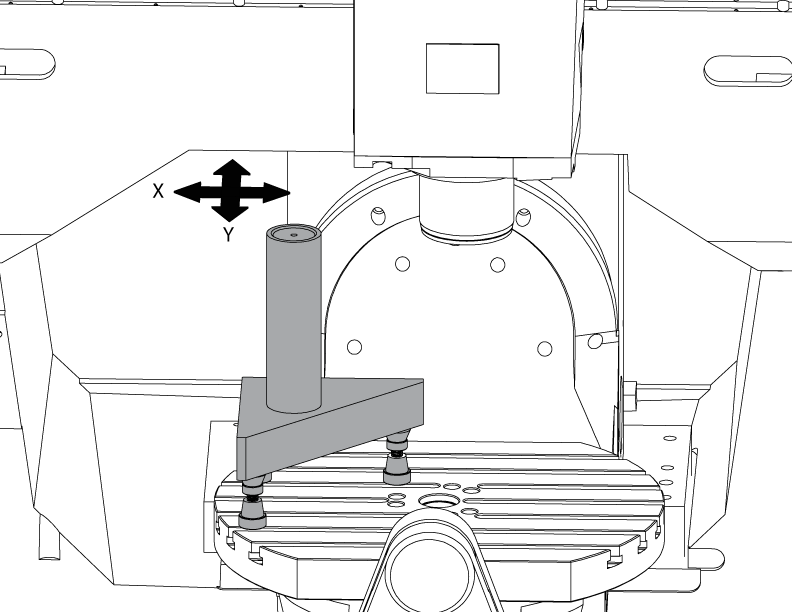
機械工ジャッキのC軸プラッタの左側にある直角測定用グラナイトをセットアップします。

直角測定用グラナイトの裏側をX軸に平行に設定します。NTE 0.0001"/10"

X軸とY軸に沿って、直角測定用グラナイトの上部をスイープします。

直角測定用グラナイトの上面がX-Y平面NTE 0.0005"に平行になるまで機械工ジャッキを調節します。

グラナイトの裏側がX軸に平行であることを確認します。NTE 0.0001"/10".

Y軸のトラックをサドルに固定しているボルトを緩め、Y軸をX軸に対して垂直になるように整列させます。NTE 0.0005"/10"

ボルトにトルクをかけます。 Haas ファスナートルク仕様をご参照ください。

ボルトを締め、Y軸がX軸NTE 0.0005"/10"に垂直であることを確認します。

Z Axis to the X-Y Plane Alignment

1

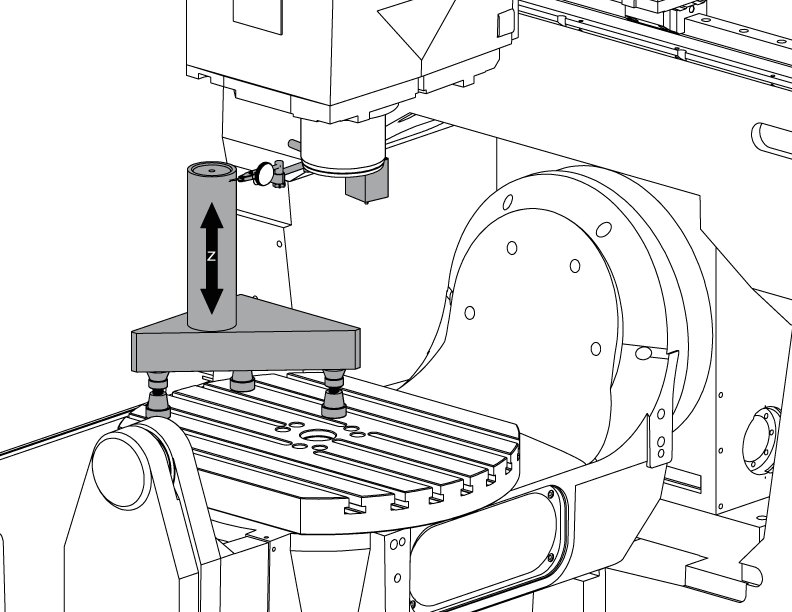
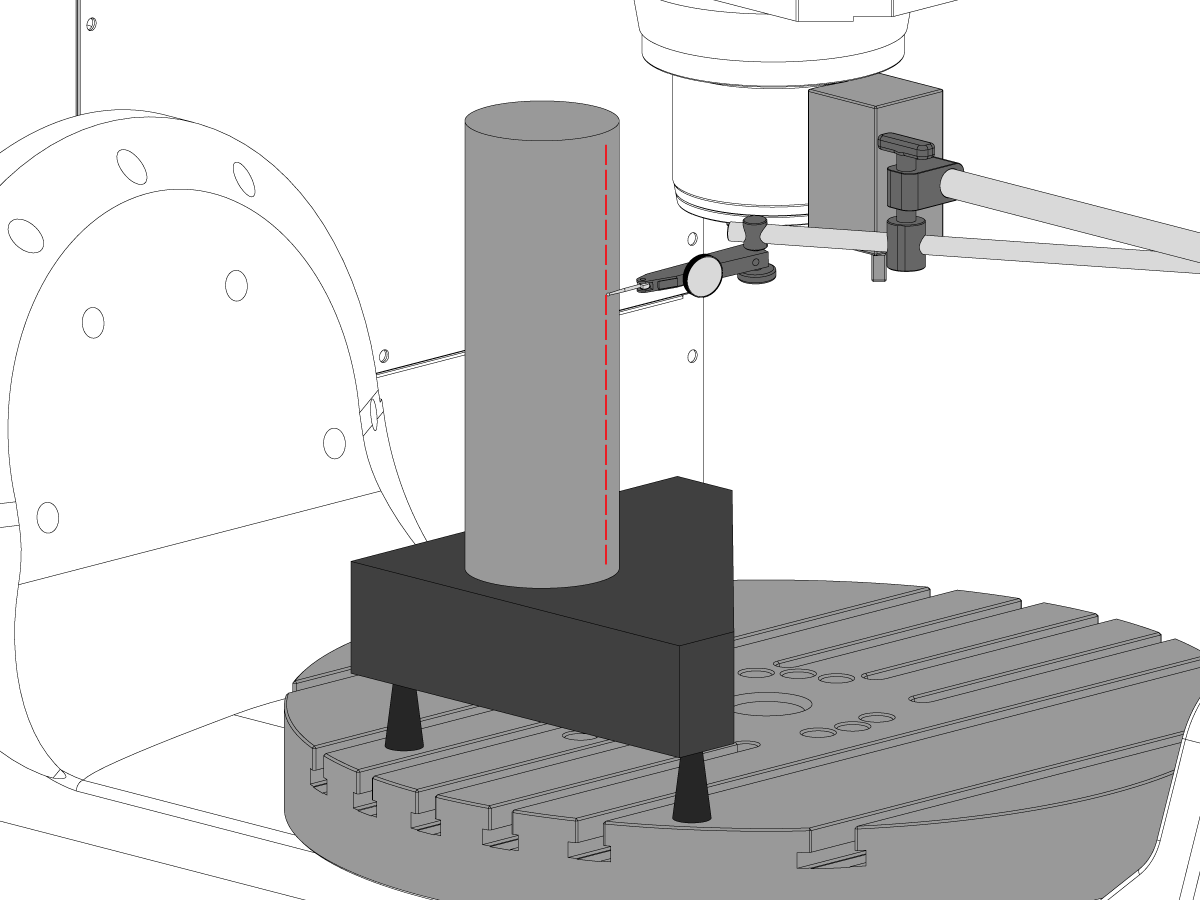
シリンダーをセットアップします。

写真のようにトライストーンの上にシリンダーを置きます。

機械工ジャッキを回してシリンダーの上面をX-Y面NTE 0.0001"に平行に整列させます。

機械を次の位置までジョグします。

  • UMC-750はX -7.000"、Y -10.000"
  • UMC-750SSはX -10.000"、Y-10.000"

2

Z軸をX軸に対して垂直に整列:

Z軸トラックの上部コーナーボルトの1つをT-2193A *に交換し、それを中心にしてスピンドルヘッドを回転させます。

Z軸に沿ってシリンダーの側面を示します。

Z軸トラックをラムに固定しているボルトを緩めます。

スピンドルヘッドを左右に振ってZ軸をX軸NTE 0.0005"/10"に垂直に調整します。

ボルトにトルクをかけます。 Haas ファスナートルク仕様をご参照ください。

ボルトを締め、Z軸がX軸に垂直であることを確認します。

調整が終わったら、T-2193A*をボルトに交換します

*  :プリリブートシリーズでのみ使用されます。 

3

Z軸をY軸に対して垂直に整列:

Z軸に沿ってシリンダーの前面を示します。

Z軸トラックとラムの間にシムを挿入し、Z軸をY軸NTE 0.0005"/10"に垂直になるように整列させます。

注意:上の2つのトラックまたは下の2つのトラックのいずれかに同等のシムを挿入します。

ボルトにトルクをかけます。 Haas ファスナートルク仕様をご参照ください。

ボルトを締め、Z軸がY軸とX軸に垂直であることを確認します。

4

Y軸とZ軸のボールナットハウジングの整列とトルク:

ボールナットをハウジングに固定しているボルト、ならびにハウジングを鋳物に固定しているボルトを緩めます。

まずボールナットハウジングを鋳物に固定しているボルトを締め、次にボールナットをハウジングに固定しているボルトを緩めます。

ジョグロック機能を使用して、移動全量にわたって軸を前後に動かします。

注意:手動ハンドルや高速動作は使用しないでください。

ボルトにトルクをかけます。 Haas ファスナートルク仕様をご参照ください。

Y軸ナットハウジングには、ラムを機械の前方に向けてジョグすることにより、機械の後方でアクセスできます。

Z軸ナットハウジングには、スピンドルヘッドを完全に下にジョグすることにより、機械の前面からアクセスできます。

注意:Z軸ボールナットハウジングにアクセスするには、スピンドルモーターシュラウドを取り外す必要があります。

Tram the Spindle to the X-Y Plane

1

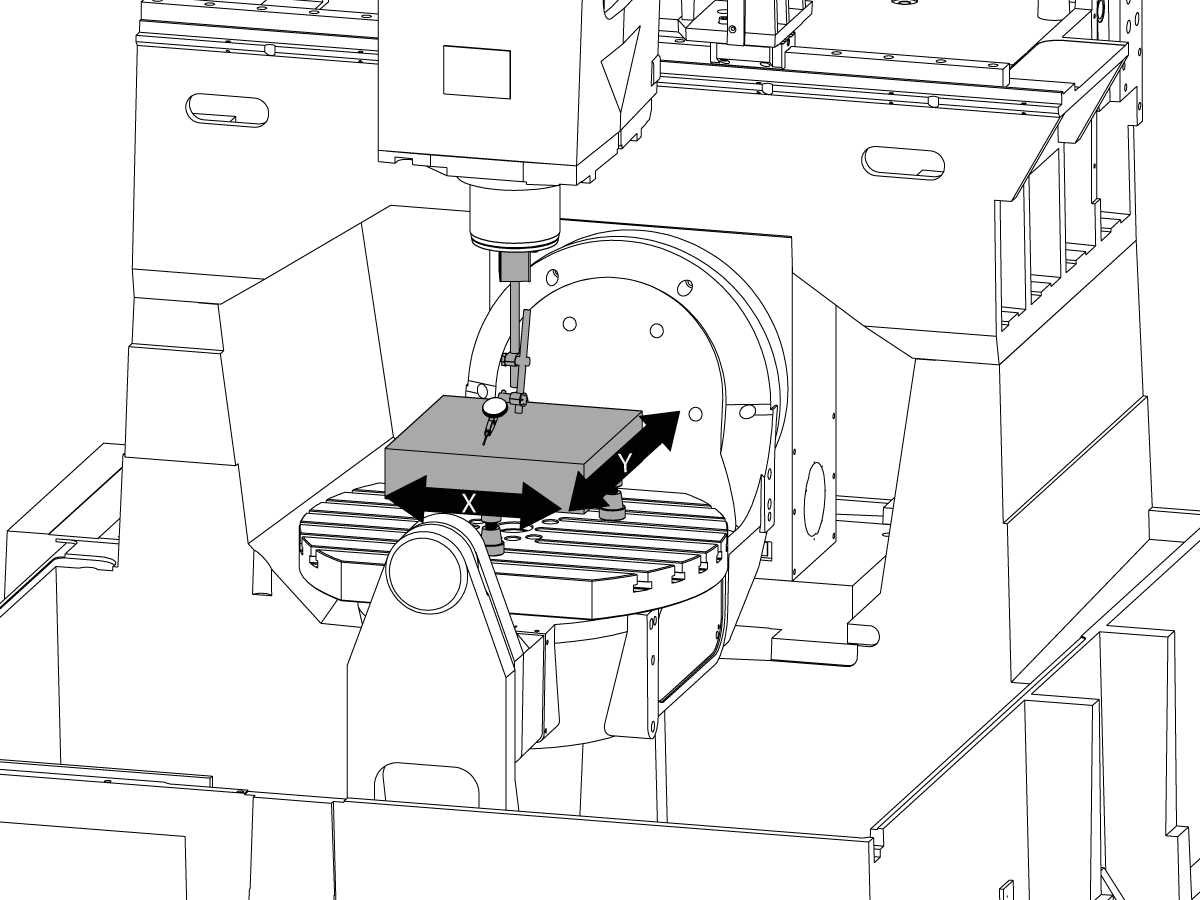
グラナイトのセットアップ:

写真に示されているように、機械工ジャッキとグラナイトをC軸プラッタの中央にセットアップします。

機械工ジャッキの高さをNTE 0.0001"に調節することにより、グラナイトの上面がX-Y面に平行になるように整列させます。

スピンドルをプラッタの中心に配置します。

2

スピンドルをX-Y面に移動:

スピンドルシャフトにインジケータを取り付けます。

90°回転するごとグラナイトの上で測定を行います。

スピンドルヘッドのベースプレートの6本のボルトを緩めます。

スピンドルヘッドの鋳物とベースプレートの間にシムを追加または除去して、スピンドルをX-Y面NTE 0.0005"/10"に移動します。

注意:厚さが異なるシム[1]を使用して、ベースプレートの角度を変えます。

スイープが仕様の範囲内である場合は、6本のボルトを締めます。 Haas ファスナートルク仕様をご参照ください。

ボルトを締め、スピンドルトラムを確認します。

B Axis to XYZ Axes Alignment

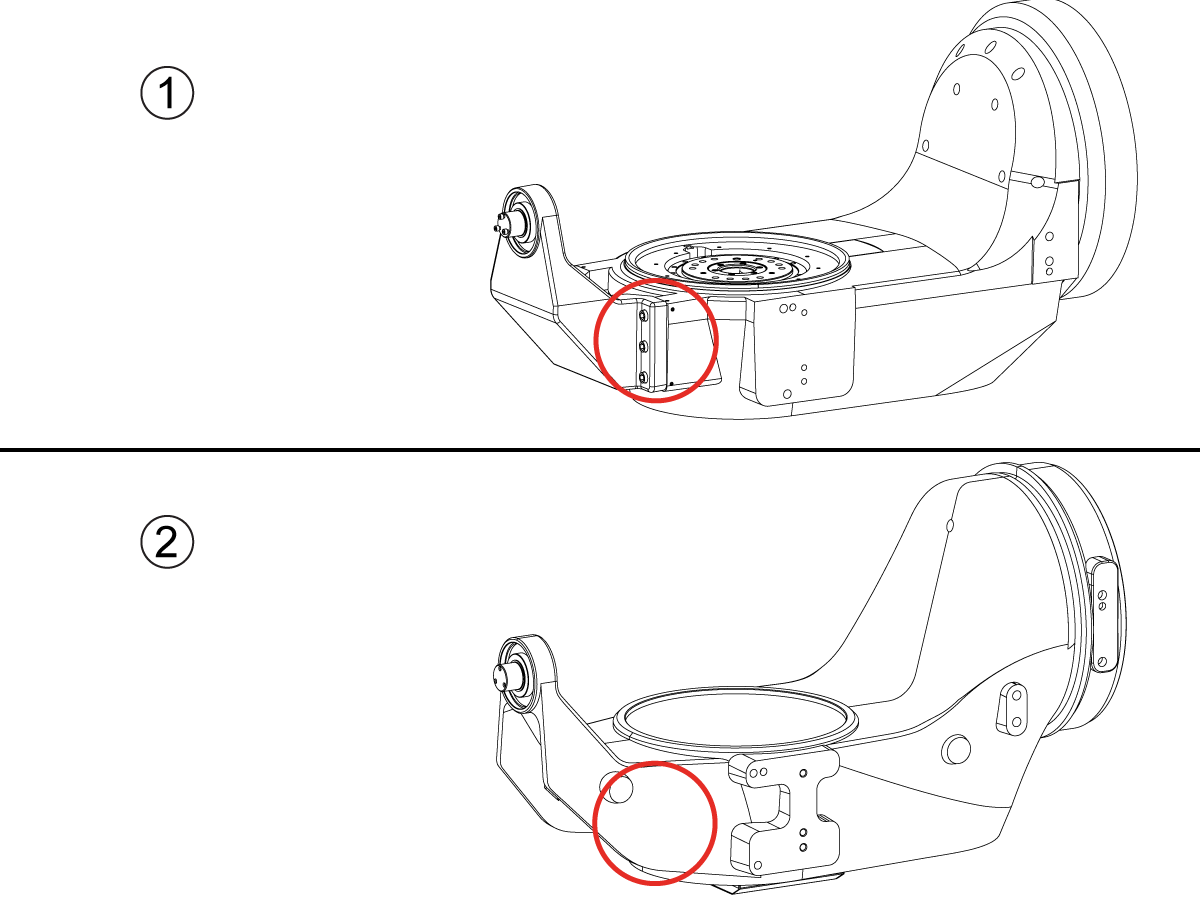
How to identify the Multi-Piece and the Unibody trunnion   

1) Multi-Piece trunnion:    UMC machines built approximetely before 11/2022 will have this configuration.

2) Unibody trunnion:    UMC machines built approximetely after 11/2022 will have this configuration.

1

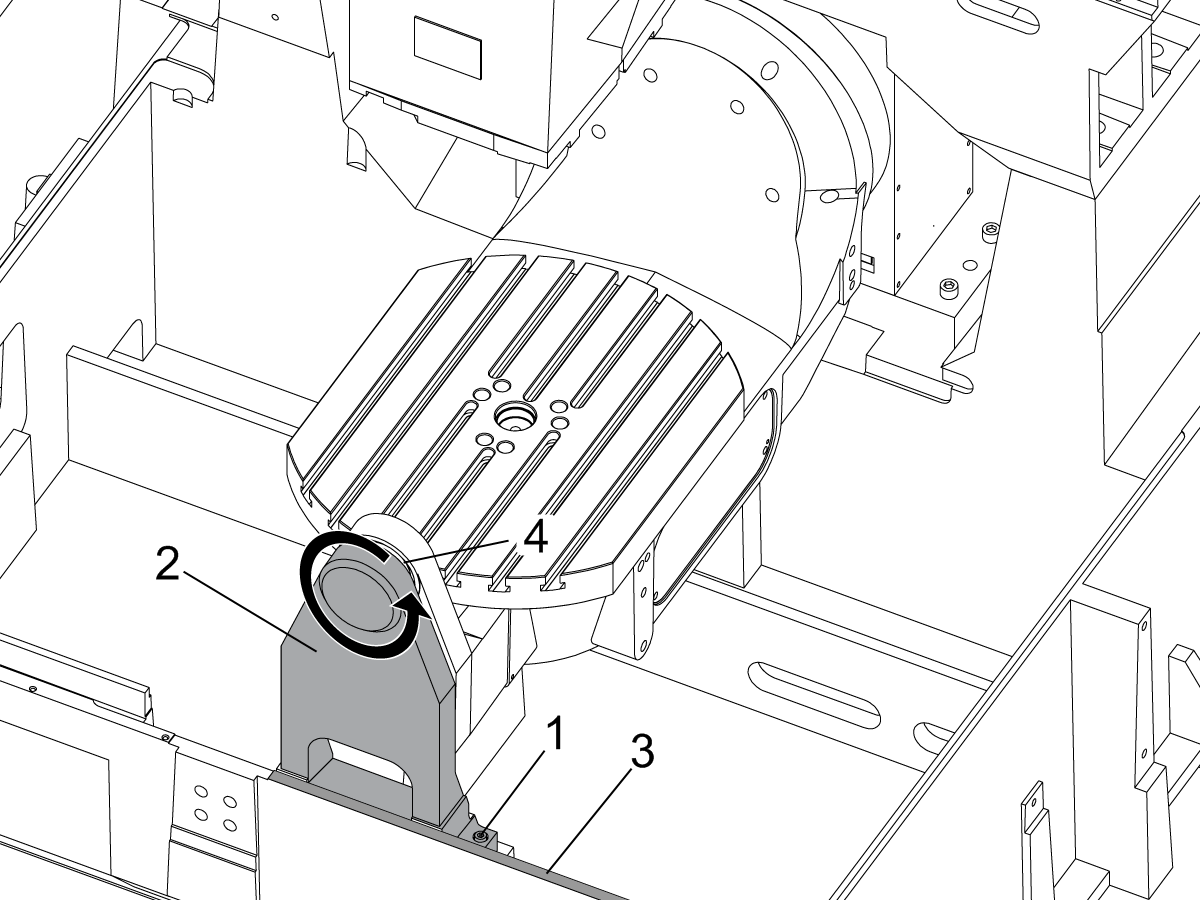
Remove the A-frame trunnion support:

Remove the bolts [1] that secure the A-frame trunnion support [2] to the base and take out the shims between A-frame support and the base.

Rotate the A-frame support [2] counter-clockwise to clear the edge of the base [3].

Pull the A-frame support off the bearings.

 Note: The A-frame support might vacuum lock on the bearings. Use the zip-tie to pry the seal [4] open.

 Caution: To lift the trunnion support, get the aid of another person. The support weighs 85 lbs (39 kg).

2

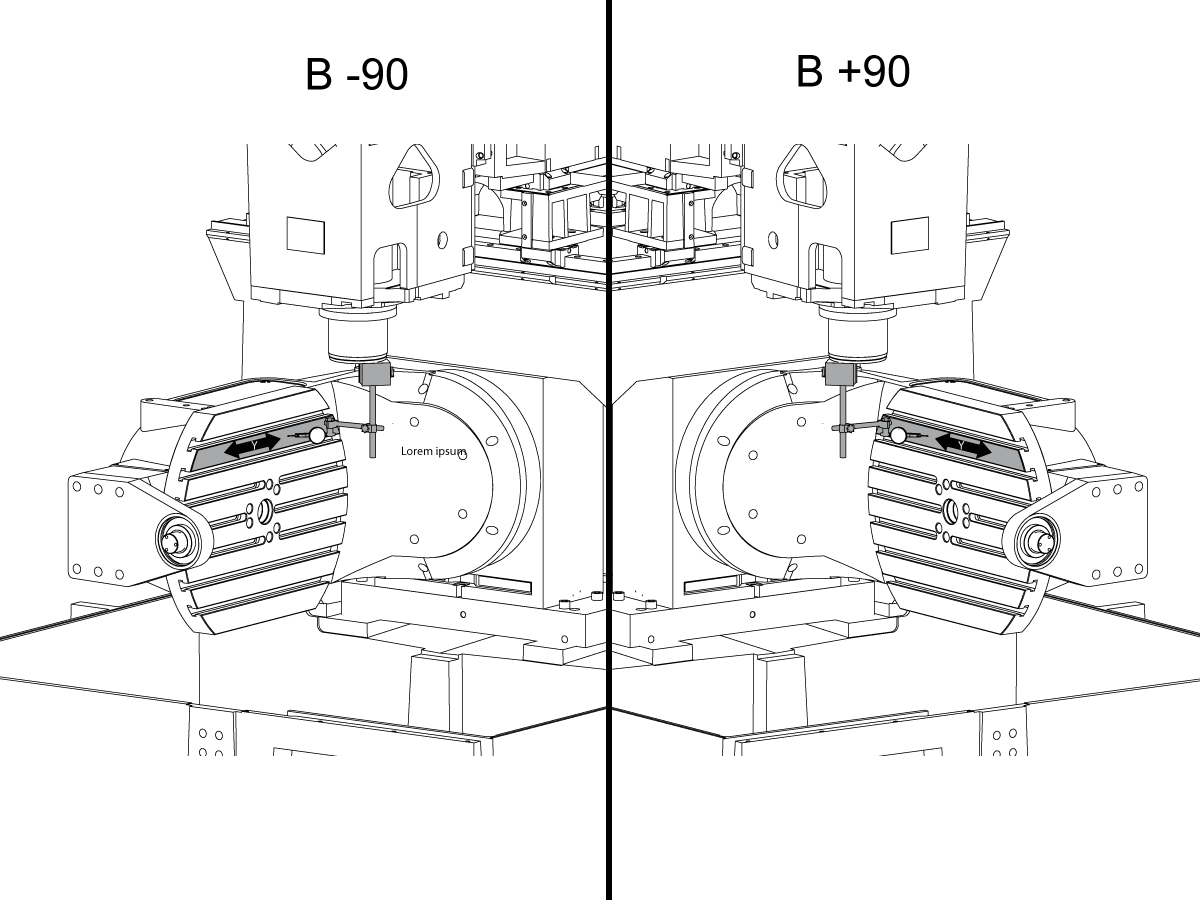
Measure the B- axis of rotation parallelism to the Y-Z plane:

For a machine with a Classic Haas Control, change Parameter 151:20 (B axis CHK TRAVL LIM) to 0.

For a machine with a Next Generation Control, change Parameter 6.021 (B axis CHK TRAVL LIM) to FALSE.

Measure the parallelism of the platter to the Y-Z plane with the B axis at 90° and then the B axis at -90° as shown in the picture.

Position the Y-Axis in the following starting position:

UMC-500: Y=0, Sweep 15”, 3rd T-Slot Land from the top.

UMC-750/1500-Duo: Y=-1.0, Sweep 18", 3rd T-Slot Land from the Top .

UMC-1250: Y=-1.0, Sweep 28", 3rd T-Slot Land from the Top.

UMC-500PP: Y=-4.0, Sweep 7".

UMC-750PP: Y=-2”, Sweep 15".

UMC-1000PP: Y=-4”, Sweep 15".

Compare the results at B 90° and B-90°. The results should be...

  • Symmetric against the Y-Z plane, positive or negative direction
  • Less than 0.0010"/20"

If the results are symmetric against Y-Z plane, and are less than 0.0010"/20 inches: Go to Step 5.

If the results are symmetric against Y-Z plane, but are more than 0.0010"/20 inches: Go to Step 4.

 Warning: If the results [3] are not symmetric against the Y-Z plane, the B axis rotary needs to be aligned: Go to Step 3.

3

Align the B axis of rotation parallel to the Y-Z plane:

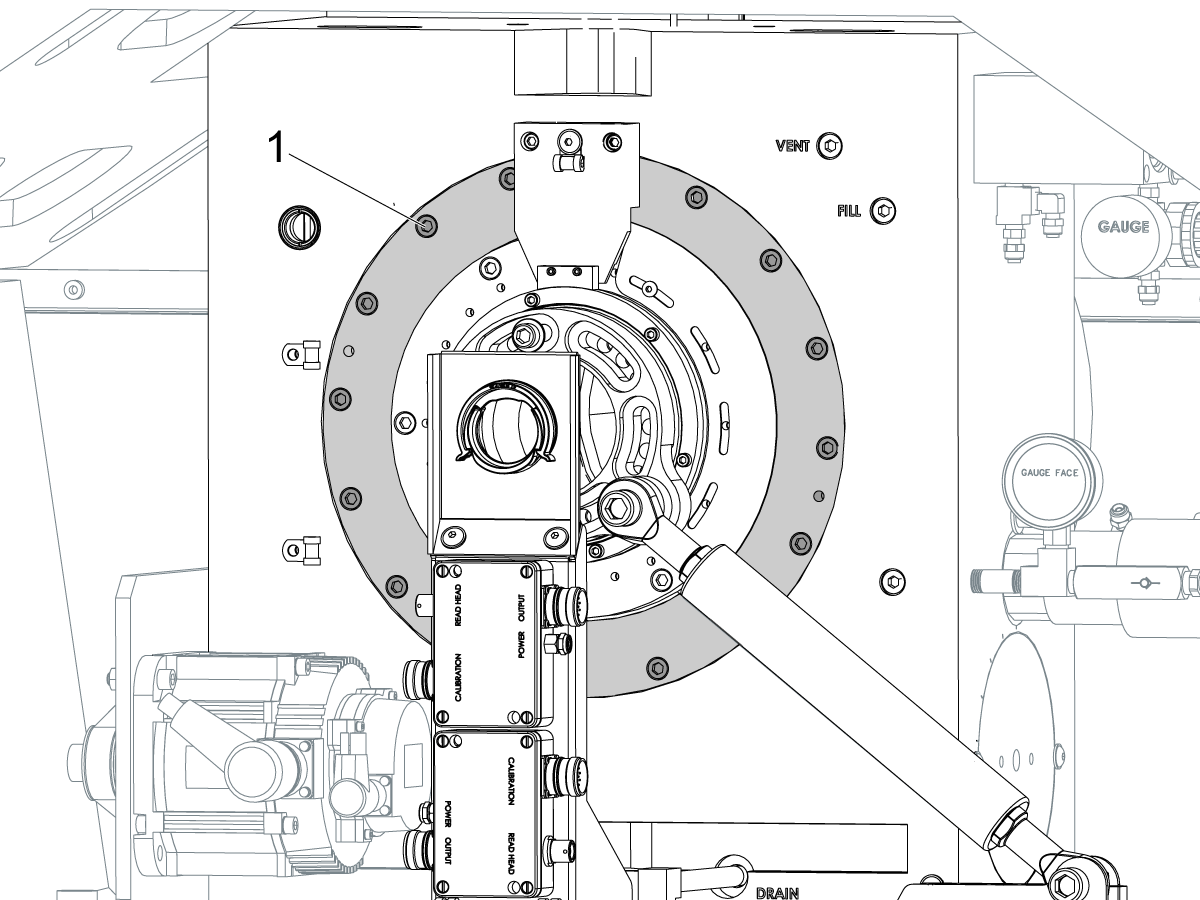
Loosen the (6) bolts [1] that secure the B axis rotary to the base casting.

 Note: Keep the bolts sufficiently snug to control the adjustments.

Adjust the front and rear setscrews [2] until the measurements taken in Step 2 are symmetric against the Y-Z plane.

Torque the (6) bolts [1]. Refer to Haas Fastener Torque Specification.

Verify the measurements in Step 2 after the bolts have been torqued.

4

Align the C Axis of rotation perpendicular to the B Axis of rotation:

Remove the bottom C-Axis access cover.

Loosen the (12) bolts [1] that hold the C Axis body to the B Axis platter face.

Reach the bottom (4) bolts through the C Axis access port.

If the B Axis is symmetric in the positive direction [4], install horseshoe shims [2] of appropriate size behind the top (2) bolts.

If the B Axis is symmetric in the negative direction [5], install horseshoe shims [2] of appropriate size behind the bottom (2) bolts.

Torque the (12) bolts to 80 Ft-lbs (108 Nm).

Cut the excessive shim material off.

Verify the measurements in Step 2 after bolts are torqued.

5

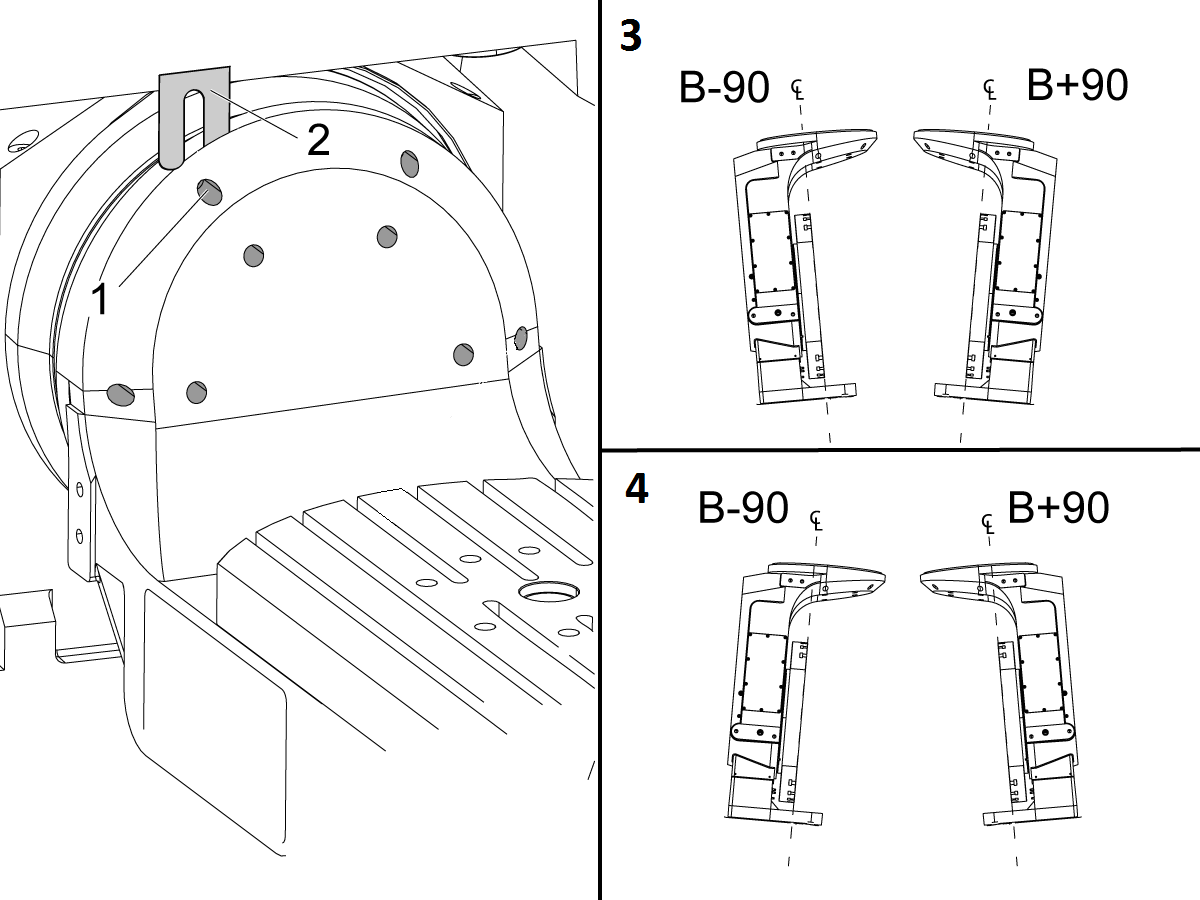
Align the trunnion support shaft co-axial with the B Axis of rotation:

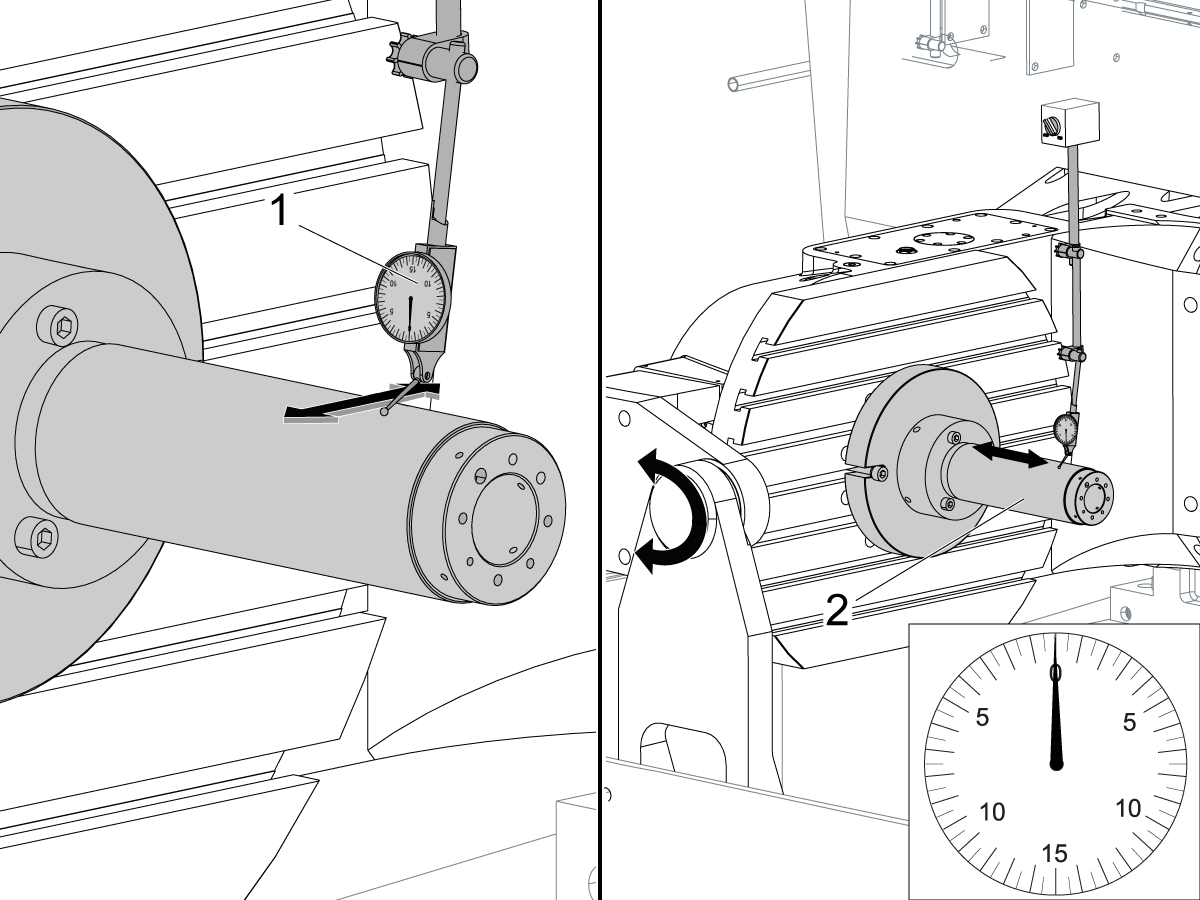
Setup (2) indicators on the outer race of the trunnion support bearing [2] as shown in the picture.

Mark the spot on the outer race where one of the indicator needles is contacting the surface.

After moving the B Axis to 90° or -90° you will align the marked spot with the needle again to exclude the bearing runout error from the measurements.

Take the readings when B is at 90° and B at -90°. Compare the readings. 

 Caution: The B axis brake needs to be clamped when taking the readings.

The deviation between the results when B is at 90° and at -90° needs to be less than 0.001" on each indicator.

 Note: The indicator on the side of the bearing will measure top to bottom alignment and the indicator on the top of the bearing will measure side to side alignment.

____

For models with a multi-piece trunnion

Loosen the (6) bolts [3] on the C Axis body support. Keep the bolts sufficiently snug to control adjustment.

Adjust the (8) set screws [4] until deviation between B at 90° and B at -90° is within 0.001".

Torque the (6) bolts [2] on the C Axis body support to 80 Ft-lbs (108 Nm).

Verify the alignment after the bolts have been torqued.

____

For models with a unibody trunnion

Jog rotary to B90. Set up an indicator on the highlighted surface as shown in the lower diagram .

Rotate B-axis 180 degrees (90 to -90).

Run out (NTE 0.010” TIR).

 Caution: If the measurement exceeds the tolerance then contact support.

6

Install and shim the A-frame trunnion support:

Move the B Axis to 90°.

Setup an indicator [1] against a machined surface of the C Axis body. Set the indicator to 0.

Use plastic zip ties [2] to pry the seal open while installing the A-frame support. This lets unwanted air and grease out of the assembly.

Install the A-frame trunnion support [3] over the bearings.

Remove the cable ties.

Turn the trunnion support clockwise until it is vertical.

 Note: The weight of the A-frame support will cause the trunnion to sag. The amount of sag is measured with the indicator that was previously setup on the side of the C Axis body.

____

For multi-piece trunnions

Adjust the shims [4] between the A-frame support and the base casting to remove the sag until indicator reads 0 again.

When the indicator reading is 0, torque the (4) bolts. Refer to Haas Fastener Torque Specification.

Verify the reading after bolts are torqued. Adjust the shims again if necessary until the indicator reads 0.

____

For models with unibody trunnion

Determine the amount of shim stock [4] needed to raise the Trunnion arm so the indicator reads 0.005".

The indicator [1] value will change once the support is torqued.

With indicator still in place:

  • Torque trunnion support bolts to appropriate values.
  • Check indicator to make sure it reads between the range of

Trunnion arm raised (0.005” to  0.010”).

 Note: For unibody trunnions, the shim location may also be used to correct the C-axis to X-Y plane perpendicularity instead of shimming the saddle trucks.

 Caution: Use equal amount of shims on each side of the A-frame support. Unequal shims will cause the A-frame support to pull the trunnion to the side.

Verify the B Axis of rotation alignment to the Y-Z plane (Step 2). Loosen the bolts and tap the A-frame support side to side if necessary to correct the B axis to Y-Z plane alignment.

7

Set C-axis perpendicular to X/Y plane:

Move the axes to

UMC-750's........X= -10.5" & Y=0."

UMC-1000's......X=-17.0" & Y=-0."

Zero an indicator [1], on a Ground Block [2], 1/2" off the edge at the rear of the platter (Mag-Base on Spindle), with C at 0 Degrees

Rotate C-Axis to 180°.

Move Y axis, and ground block, in Y Axis negative direction until you are 1/2" away from platter edge, and take the perpendicularity measurement

Adjust the shims until the average error is within 0.0005" end to end.

 Note: For unibody trunnions, the shim location under the bearing support may also be used to correct the C-axis to X-Y plane perpendicularity instead of shimming the saddle truck.

Caution: Shim either two front trucks or two rear trucks with the equal shim.

Note: Shim one truck at the time to maintain the X to Y squareness.

Verify the measurements after all bolts are torqued.

Verify the X to Y alignment in Step 2.

8

Set the tool change offsets:

B-axis tool change offset [1]

For Classic Haas Controls, change Parameter 213. 

For Next Generation Controls, go to: Settings>Rotary Tab>Highlight the rotary and press [INSERT], or change Parameter 6.078 (B TOOL CHANGE OFFSET) to set the trunnion (B Axis) parallel to the X Axis.

For models with multipiece trunnion

(NTE 0.001/10"; NTE 0.0020" overall)

For models with unibody trunnion

(NTE 0.0005/10"; NTE 0.0010" overall)

___

C-axis tool change offset [2]

For Classic Haas Controls change Parameter 523.

For Next Generation Control go to: Settings>Rotary Tab> Highlight the rotary and press [INSERT], or change Parameter 7.078 (C TOOL CHANGE OFFSET) to set the table T-slot (C Axis) parallel to the X Axis

For models with multipiece trunnion

(NTE 0.001/10"; NTE 0.0020" overall)

For models with unibody trunnion

(NTE 0.0005/10"; NTE 0.0010" overall)

9

Check C-axis perpendicularity to X/Y plane:

Align the indicator centered over the C-axis bore with the Y-axis at -10.

Jog positive in the Y-axis and align the indicator over the center of the last section of the platter and make a mark at this spot with a washable marker.

Insert 1-2-3 block as shown and set the indicator to zero.

Remove the block and rotate the platter 90 degrees, following the marked spot with the indicator.

Insert block back between the indicator and platter. Note reading.

Repeat the previous two steps, taking readings with the platter at 180, 270 and 360 degrees.

Multi-piece trunnion:  (NTE 0.0005")

Unibody trunnion: (NTE 0.001")

10

Measure the intersection of the B and C axis:

Follow the linked instruction manual to complete this step.

B-Axis and C-Axis intersection Adjustment

11

Align the B-Axis brake disk:

 Note: Do not do this step if you are working on a SS machine.

Operate this code in MDI mode to unclamp the brake:

M11;

Loosen all of the brake disc bolts [1] and torque them to 5 Ft-lbs (7 Nm).

Operate this code in MDI mode to clamp the brake:

M10;

Wait 10 seconds.

Torque the bolts. Refer to Haas Fastener Torque Specifications.

Set Parameter/Setting Back to Factory Values

CHCのパラメータ1314/NGCの設定254を工場出荷時の設定値に戻します。(値を変更した後、機械の電源を入れ直します。)

WIPSを整列させ校正します。直感型ワイヤレスプローブシステム(WIPS) - 校正

マシンロータリーゼロポイントを設定します。

  • UMC-750 - MRZP WIPSオフセット設定 - CHC
  • UMC-750 - MRZP WIPSオフセット設定 - NGC

次の検査レポートの全項目に記入します。

  • EA0420 UMC-500検査レポート
  • EA0373 UMC-750検査レポート
  • EA0418 UMC-1000検査レポート

検査レポートの写しを機械に残します。

B軸とC軸のアセンブリを交換した場合は、UMC-750 - B軸とC軸の交点 - 整列を実行します

8.2 調整 - 表示ゾーン

Recently Updated

UMC整列表示ゾーン


AD0490

Indicating Zones

1

X 軸ロール

  • まず、ツール T-2192 をスピンドルの側面に取り付けます。
  • X ロール測定の場合、次の Y 軸と Z 軸の位置を保持します。
    • UMC 500(Y、Z):-8、-8
    • UMC 750(Y、Z):-10、-10
    • UMC 1000(Y、Z):-12、-12
  • X 軸ロール(NTE 0.0005" / 10")を測定します。


2

B 軸から Y 軸への平行度

  • B 軸と C 軸をゼロリターンします。
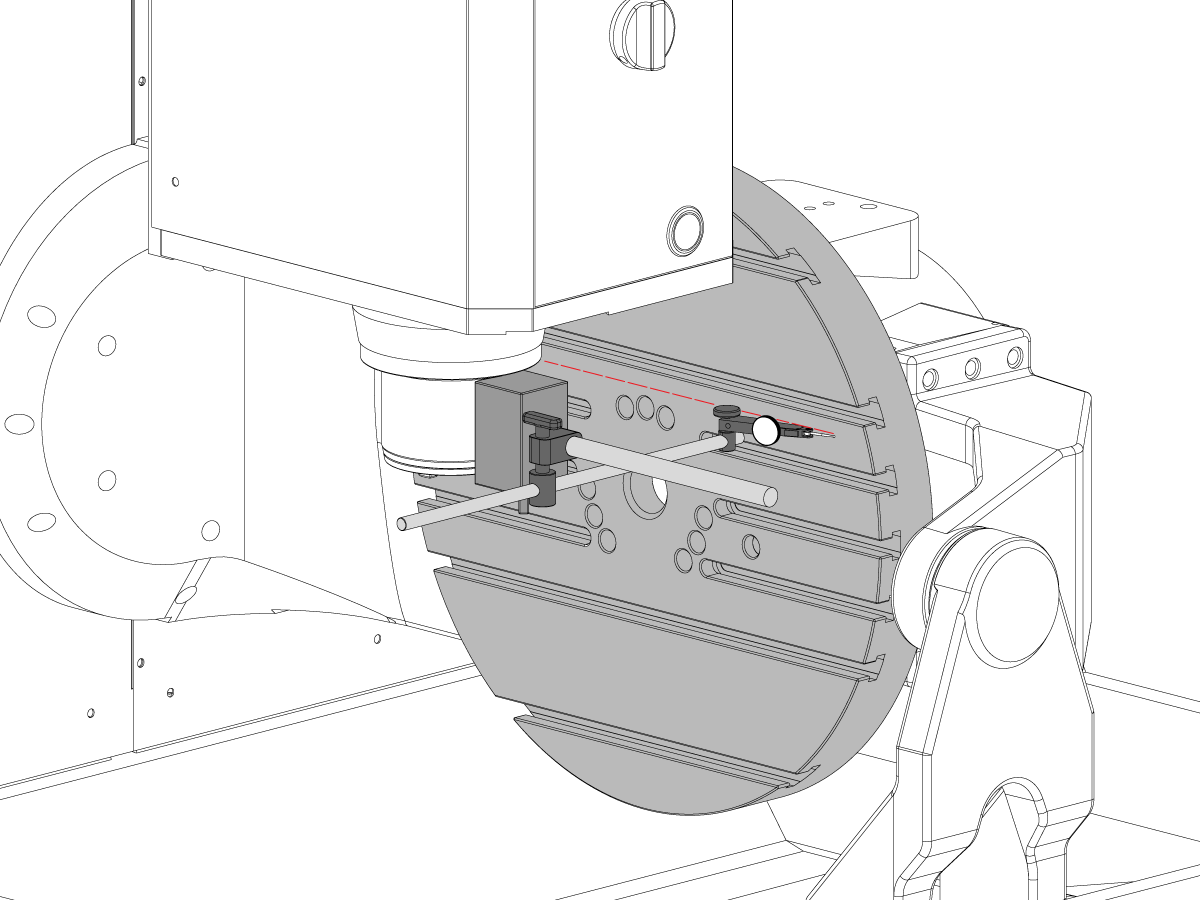
  • Y 軸でプラッタのランアウト(NTE:0.0008" / 10" 0.0012" / 15")を測定します。
  • 次に、この同じ表面を B 軸で -90°と+ 90°の両方で測定します。  (NTE:0.0008" / 10" 0.0012" / 15")
  • UMC 500 および 750 の場合、プラッタの全長を測定します。
  • UMC 1000の場合、プラッタの端から 2 インチオフセットし、20 インチにわたって測定します。

3

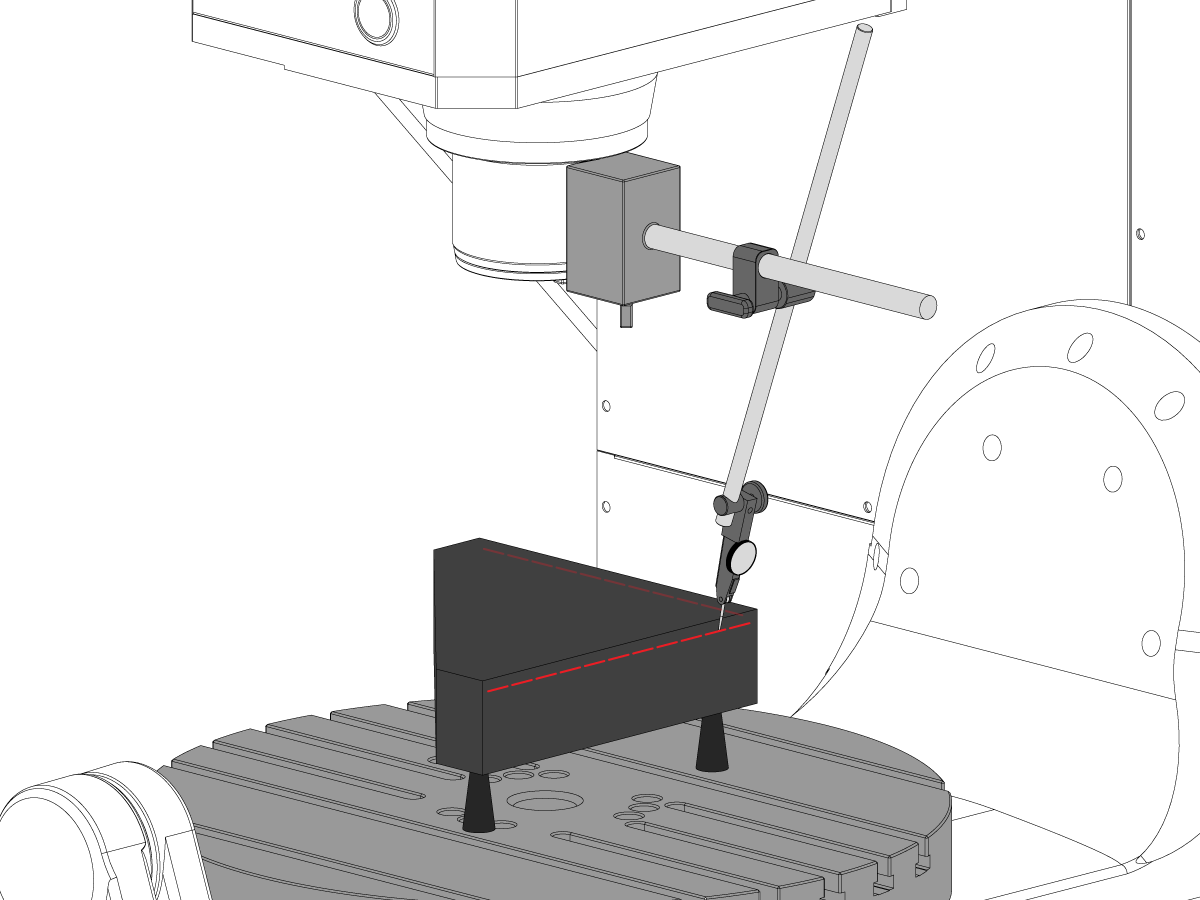
Y 軸の X 軸に対する垂直性

  • ジャックスクリューを使用して、グラナイトの上面を XY 面に平行にします(NTE:0.0002")。
  • 次に、Y が X に直角になっているかチェックします(NTE 0.0005" / 10")。

4

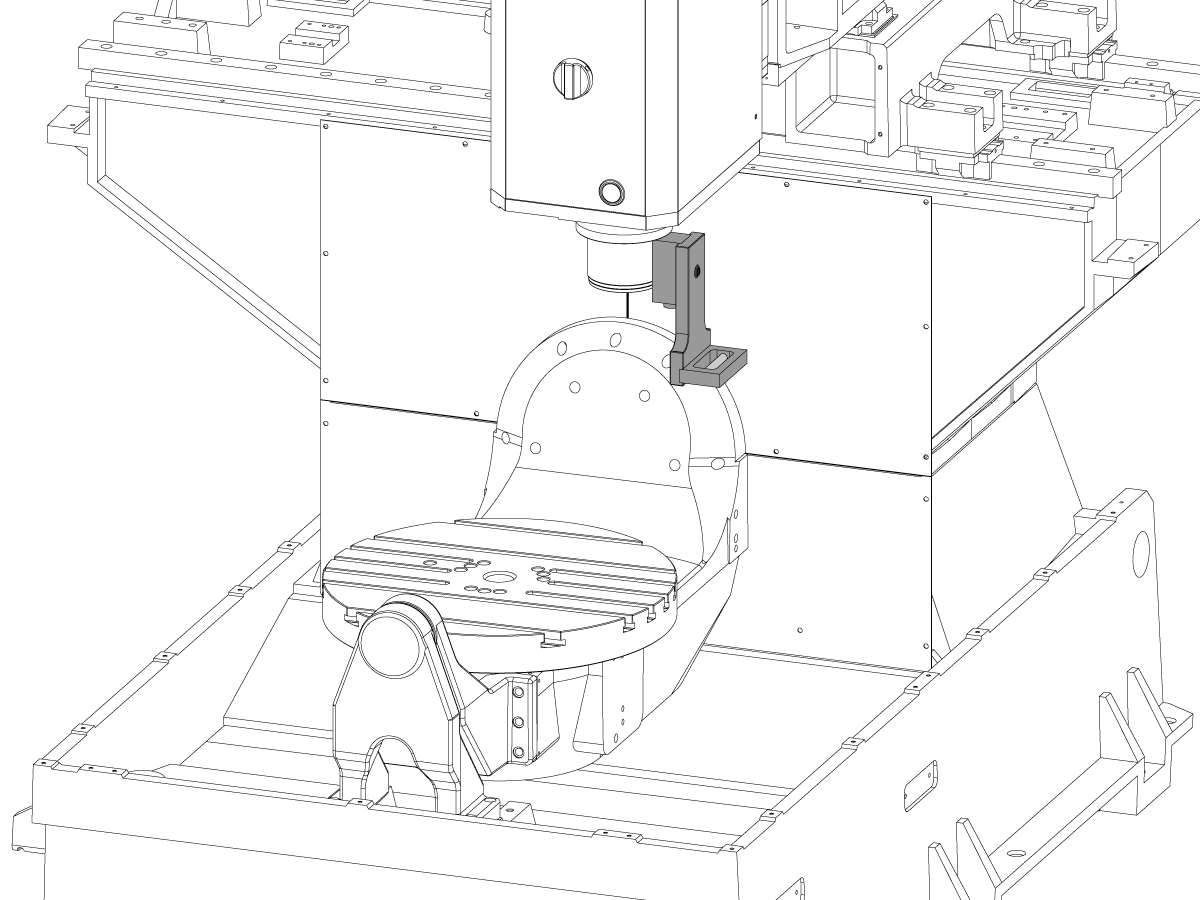
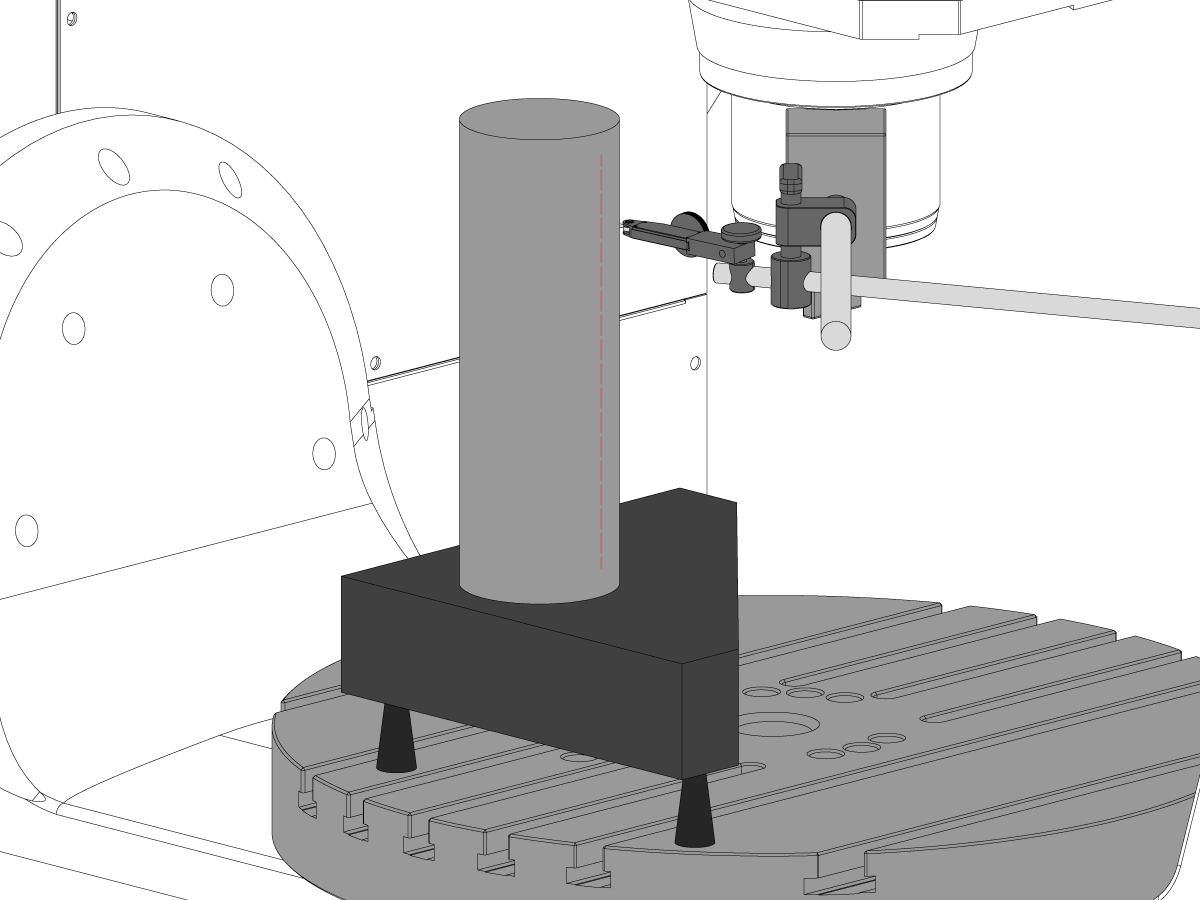
X 軸の Z 軸に対する垂直性

  • グラナイトと精密シリンダーを図の向きでプラッタに置きます
  • ジャックスクリューを使用して、グラナイトの上面を XY 面に平行に設定します(NTE:0.0002")。
  • この手順の XY スピンドルの場所:
    • UMC 500、X = -6、Y = -8
    • UMC 750、X = -10、Y = -10
    • UMC 1000、X = -17、Y = -12
  • この測定の Z 開始位置:
    • UMC 500、Z開始 = Z トップ – 2 インチ
    • UMC 750、Z開始 = Z トップ – 5 インチ
    • UMC 1000、Z開始 = Z トップ – 7 インチ
  • Z トップは、正方向(上)の Z 軸移動の限界です。
  • Z 開始から、シリンダーに沿って 10 インチ下に向かって測定します。

5

Y 軸と Z 軸の垂直性

  • グラナイトと精密シリンダーを図の向きでプラッタに置きます
  • ジャックスクリューを使用して、グラナイトの上面を XY 面に平行に設定します(NTE:0.0002")。
  • この手順の XY スピンドルの場所:
    • UMC 500、X = -6、Y = -8
    • UMC 750、X = -10、Y = -10
    • UMC 1000、X = -17、Y = -12
  • この測定の Z 開始位置:
    • UMC 500、Z 開始  = Z トップ – 2 インチ
    • UMC 750、Z 開始  = Z トップ – 5 インチ
    • UMC 1000、Z 開始  = Z トップ – 7 インチ
  • Z トップ は、正方向(上)の Z 軸移動の限界です。
  • Z 開始から、シリンダーに沿って 10 インチ下に向かって測定します。

6

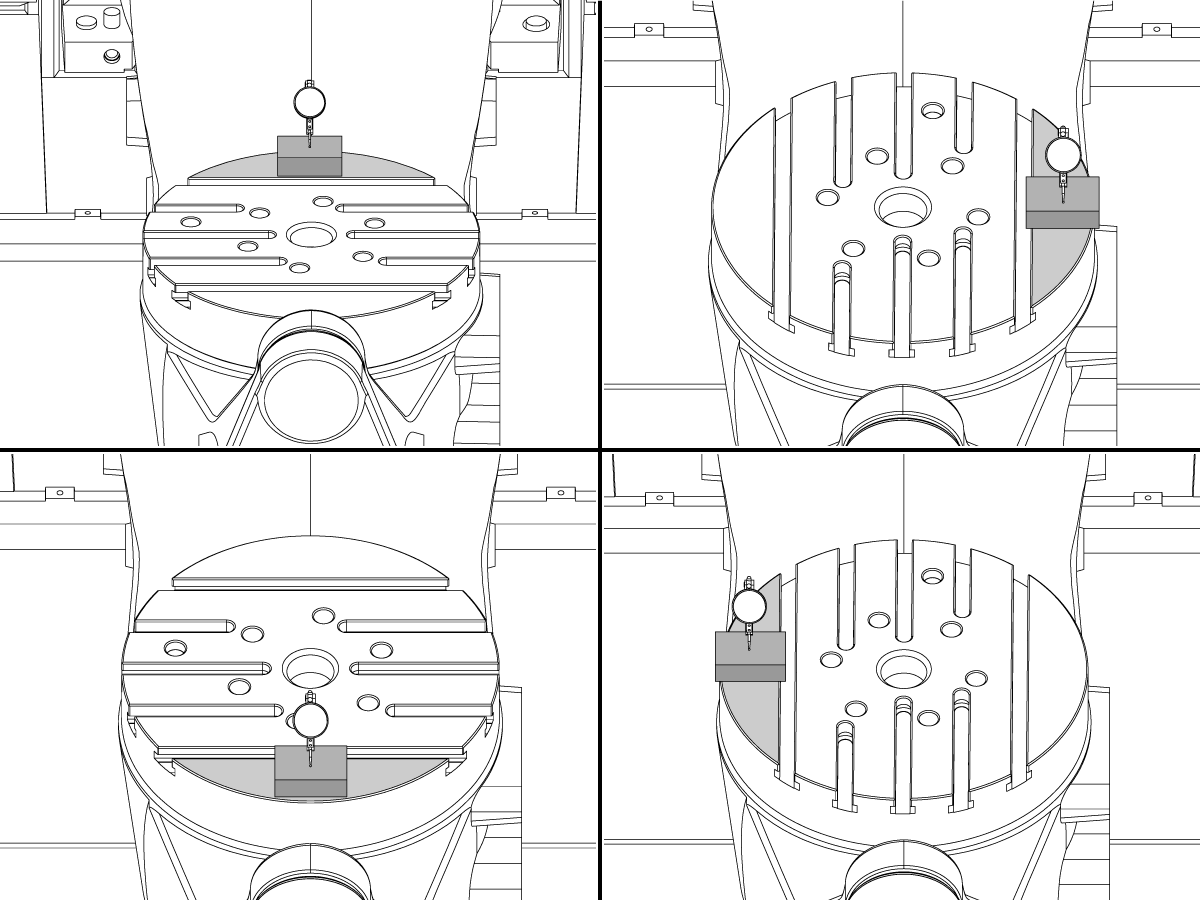
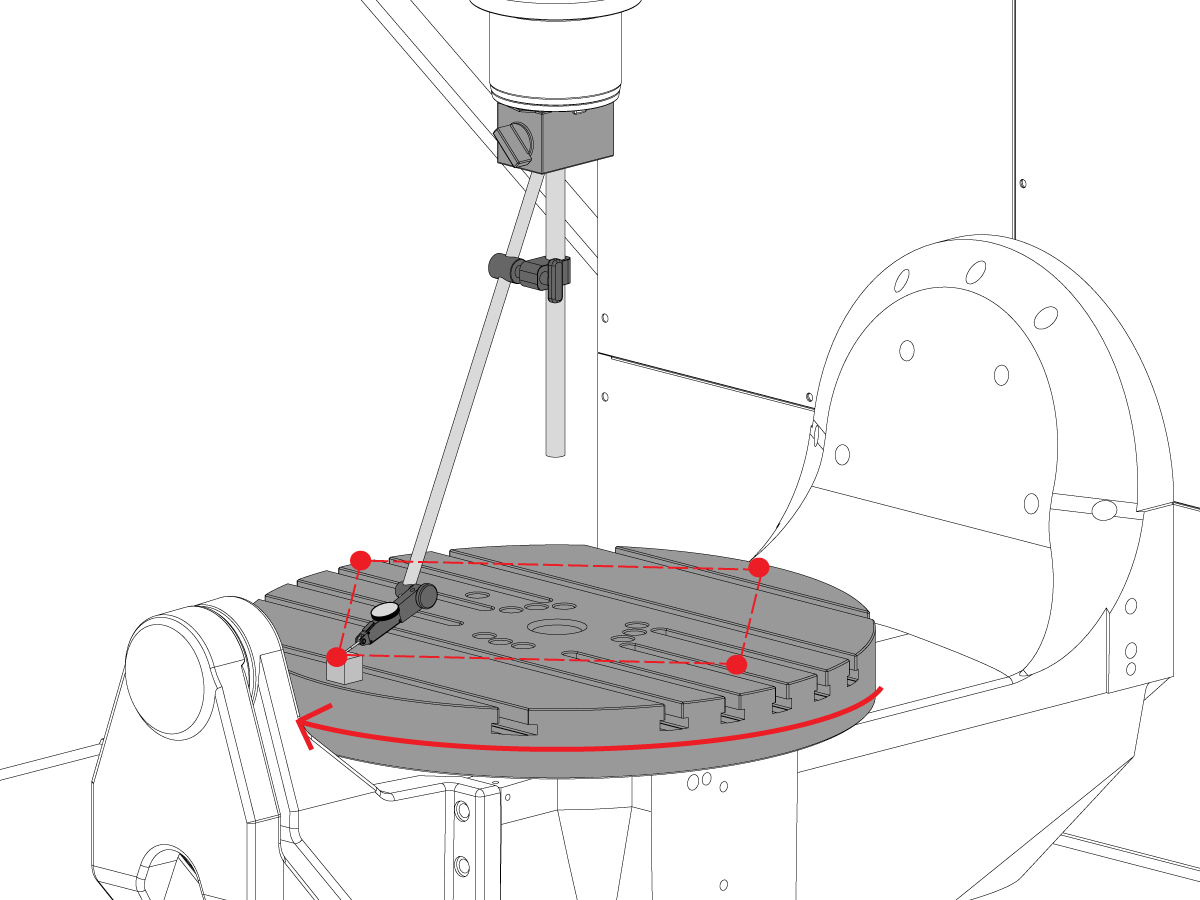
XY 面に対する C 軸の垂直性

  • マグベースをスピンドル上に再配置して、スピンドルと一緒に回転できないようにします。
  • プラッタの端の 12 時の位置に精密ゲージブロックを配置します。 
  • この位置でゲージブロックのインジケーターチップをゼロにします。
  • C 軸を 90° 回転します。
  • 次に、スピンドルを X 軸と Y 軸でジョグしてゲージブロックの後を追い、プラッタ上の同じ点を測定します。スピンドルの回転は発生しないはずです。
  • 図のように、パレットの端で 90 度離れた合計 4 つの位置でこれをさらに 2 回繰り返します。 
  • 12 時と 6 時の位置の測定値の違いにより、X軸に沿った面度(NTE 0.0005")が決まります。
  • 3 時と 9 時の位置の測定値の違いにより、Y 軸に沿った 面度(NTE 0.0005")が決まります。

7

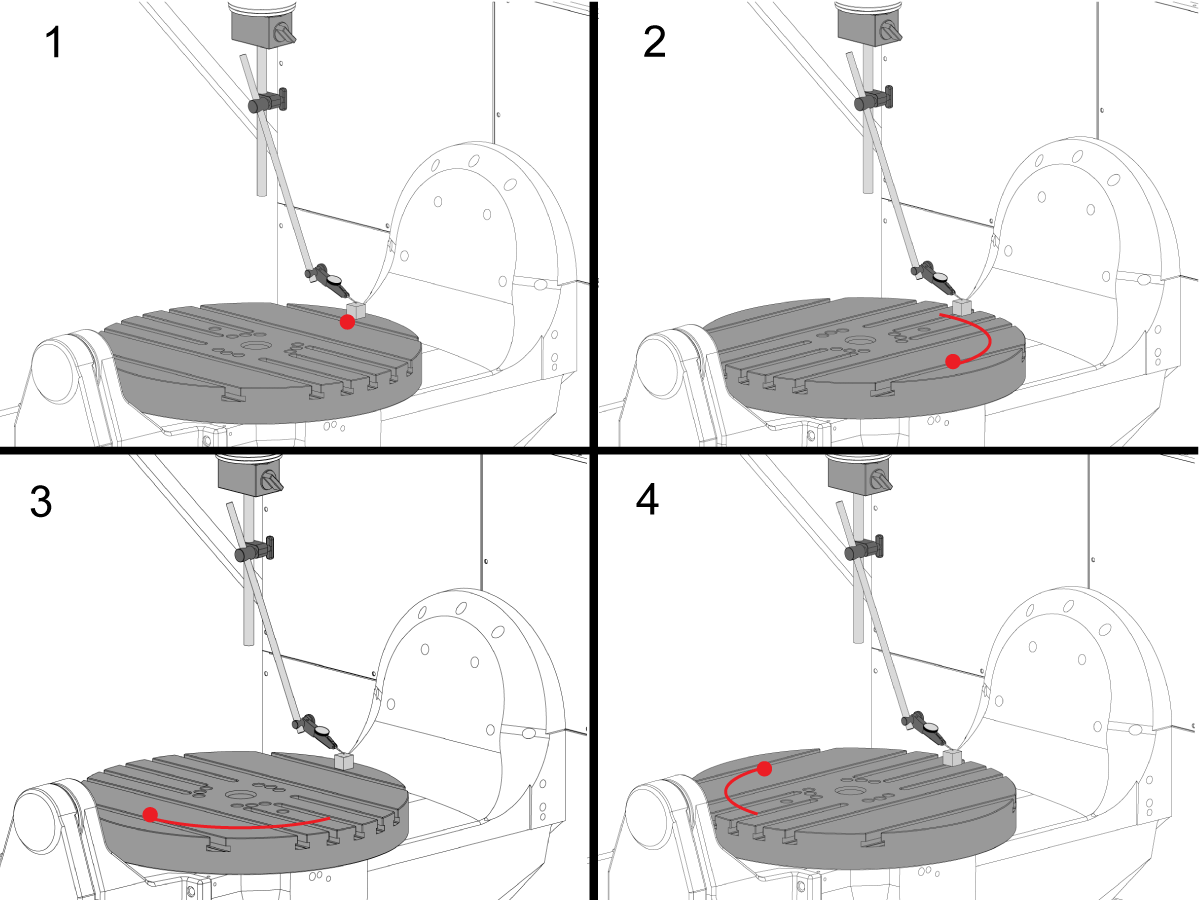
プラッタ面のランアウト

注意:この手順では C 軸ブレーキはオフです

  • プラッタの端の 12 時の位置に精密ゲージブロックを配置します。 
  • この位置でゲージブロックのインジケーターチップをゼロにします。
  • C 軸を  90°回転します。但し、ゲージブロックを 12 時の位置を維持します。
  • ゲージブロックの上部から測定します
  • 図のように、パレットの端で 90 度離れた合計 4 つの位置でこれをさらに 2 回繰り返します。 
  • 合計表示ランアウトを書き留めます。(NTE 0.001")

8

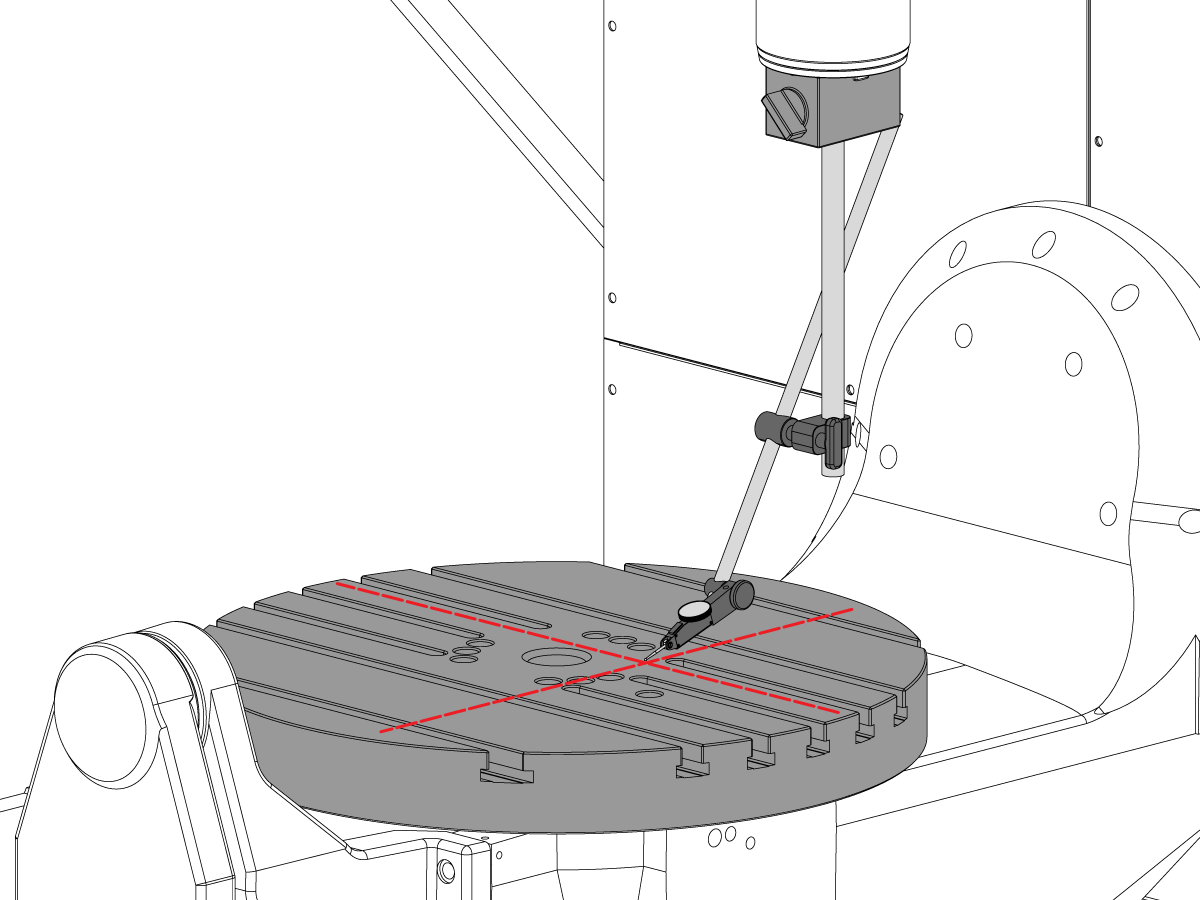
プラッタ面と XY 面の平行度

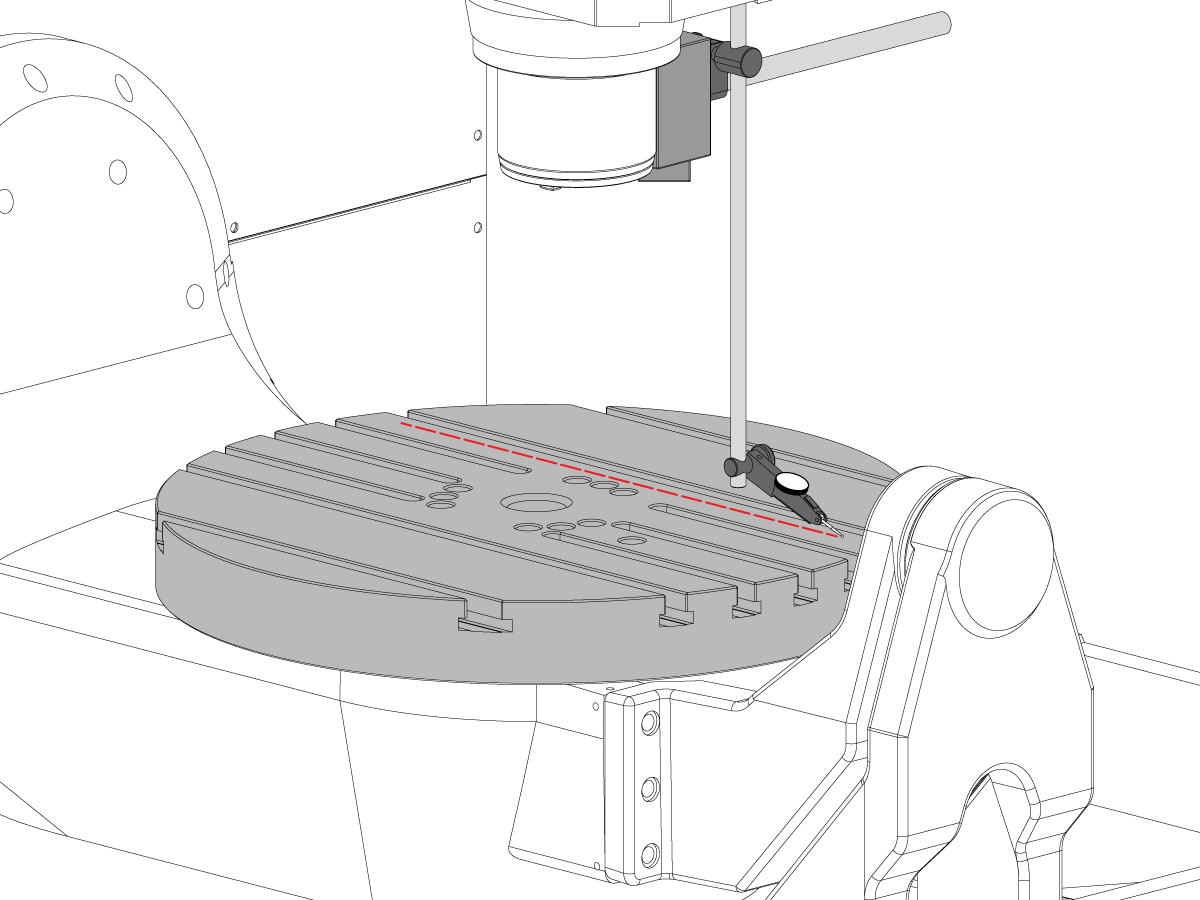
  • T スロットが X 軸と平行になるように C 軸をゼロリターンします。
  • インジケーターの先端をプラッタの上に置き、プラッタに沿って X 軸をジョグして、X 軸プラッタの平行度(NTE 0.001” / 10" 0.0015" / 15")を見つけます。
  • 次に、プラッタに沿って Y 軸をジョグして、Y 軸のプラッタの平行度(NTE 0.001インチ/ 10" 0.0015" / 15")を見つけます。

9

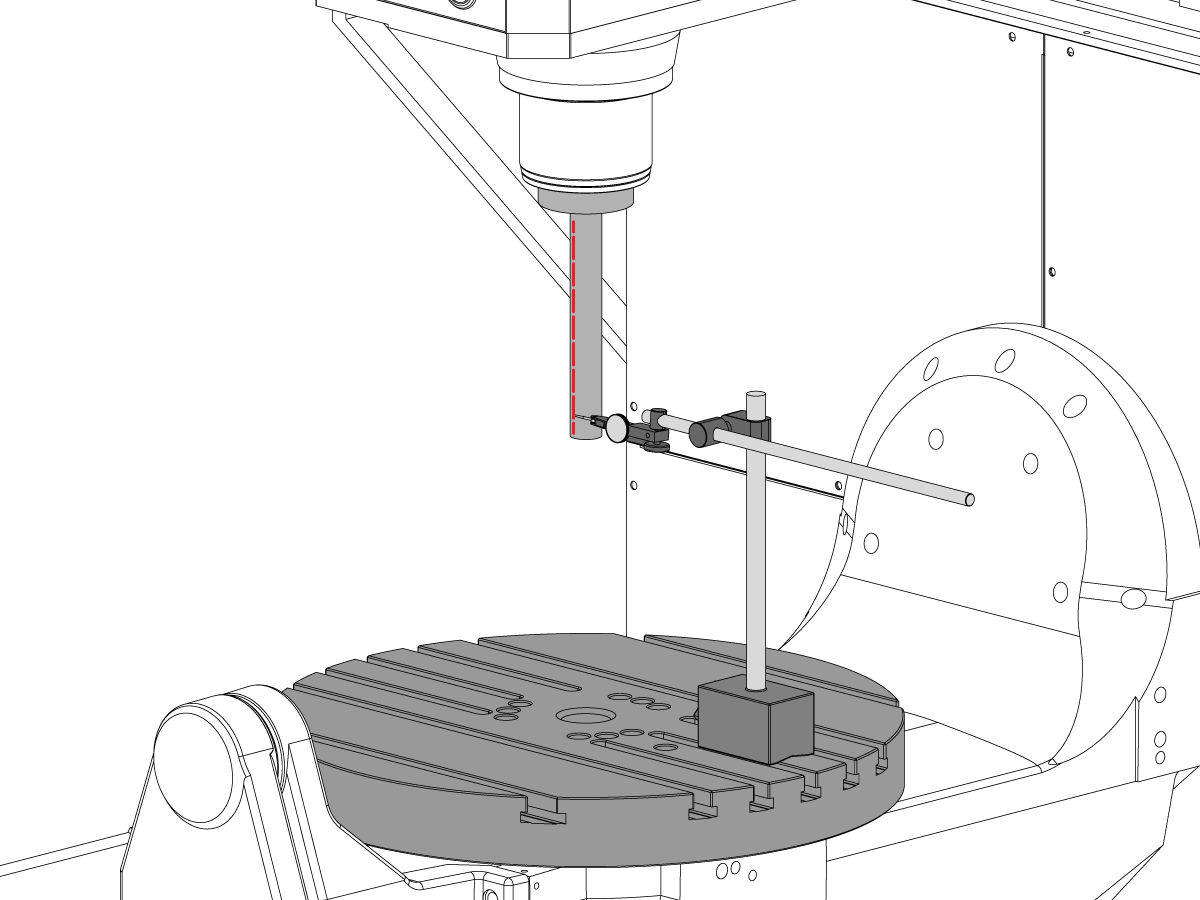
スピンドルのランアウト

  • スピンドルを C 軸のボーリングの中心に合わせます。
  • マグベースをテーブルに置き、テストバーを挿入します。
  • テストバーのベースでスピンドルのランアウト(NTE 0.0005" TIR)をチェックします。
  • テストバーのベースから 6" 下でスピンドルのランアウト(NTE 0.001" TIR)をチェックします。

10

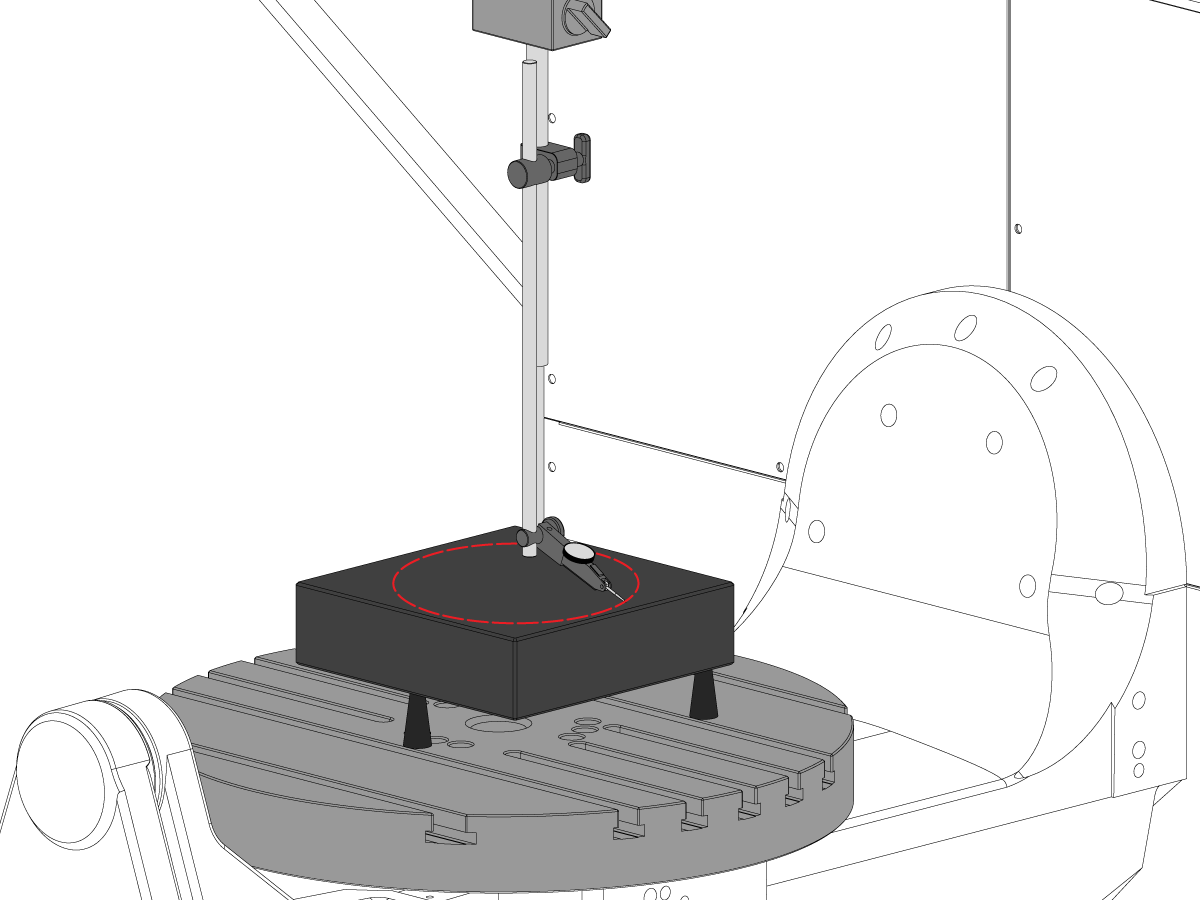
スピンドル中心線の Z 軸との平行度

  • ジャックスクリューを使用して、グラナイトを 図の向きで(NTE:0.0002") XY 面に平行にします。
  • スピンドルを C 軸のボーリングの中心に合わせます。
  • 10" の直径の円でスイープします。
  • XZ TIR (NTE 0.0005")を記録します。
  • YZ TIR (NTE 0.0005")を記録します。

11

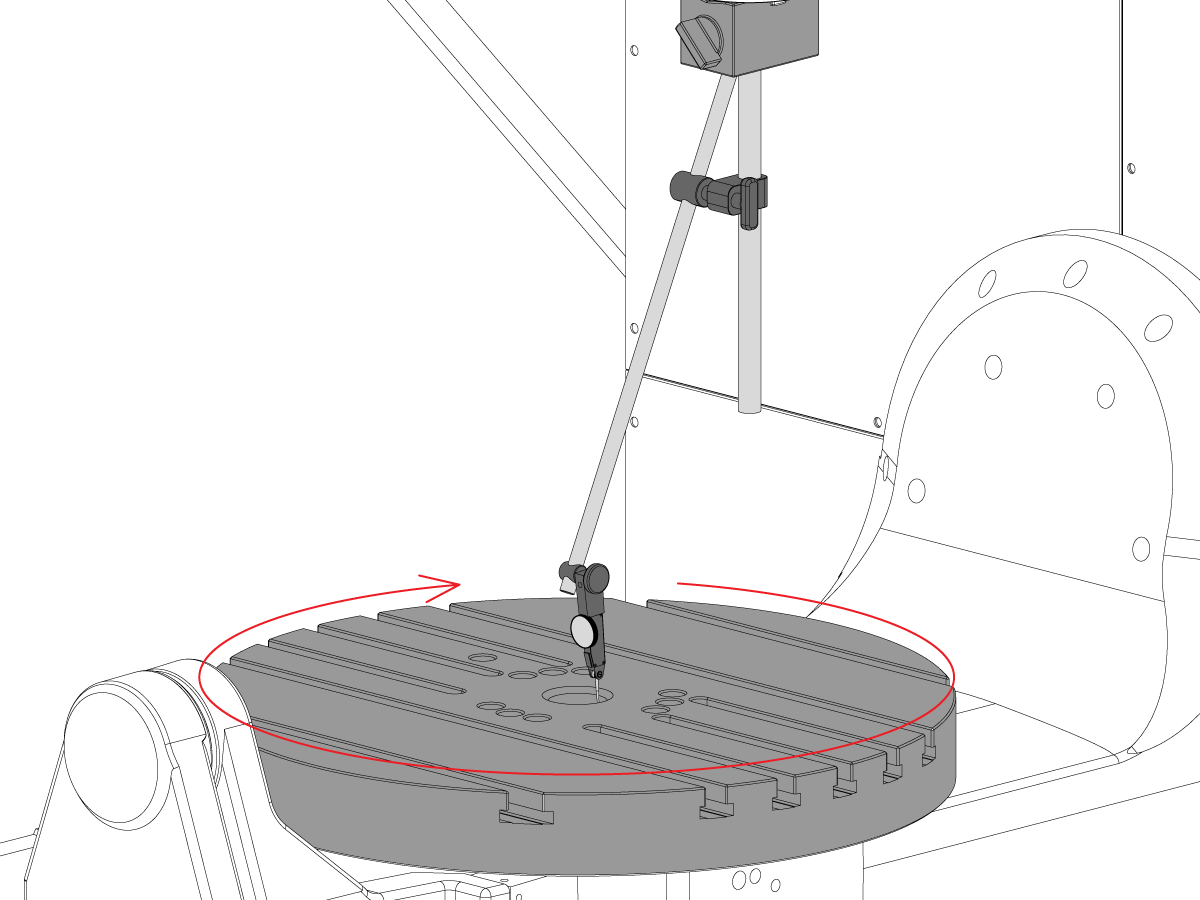
C 軸ボーリングの同心度

  • 図のようにインジケーターを配置し、C 軸を 360 度ジョグします。
  • 精密ボーリングの TIR(NTE 0.002")を記録します。

12

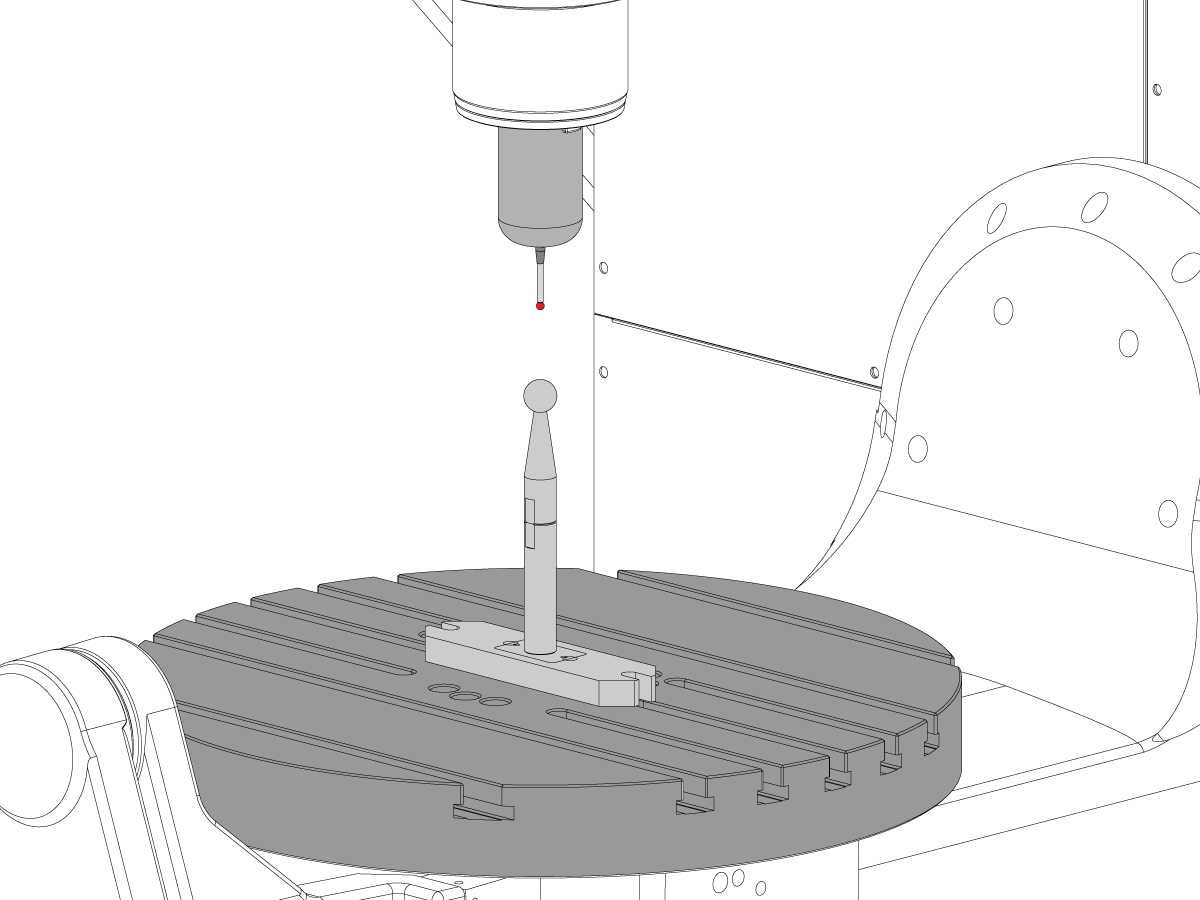
機械ロータリーゼロポイント

  • VQC マクロプログラムとプローブシステムを使用して、以下に示す Coldfire パラメータまたは NGC 設定の値を確認します。
    • 255 - MRZP X オフセット
    • 256 - MRZP Y オフセット
    • 257 - MRZP Z オフセット
    • 254 - 5 軸ロータリー中心距離
  • MRZP の完全な説明については、Haas MRZP WIPS オフセット設定 手順
  • をご参照ください。

8.3 ジオメトリ - トラブルシューティング

Recently Updated

UMC - ジオメトリ - トラブルシューティングガイド


TG0151

Overview

UMC-750の精度または幾何学的配置の問題をトラブルシューティングする前に、技術者は次の基本を完全に理解している必要があります。

  • UMCの回転軸を水平にして位置合わせする方法
  • 機械のすべての軸を再調整する方法
  • MRZP校正を実行する方法、および関連するパラメータとその機械への影響についての十分な理解
  • 機械の精度機能と幾何学的配置問題を推論する能力の理解
  • BからC軸の交差整列

UMC-750の機械の幾何学的配置または精度の問題は、体系的に適切な順序で対処する必要があります。以下の情報を厳守し、順番どおりに実行してください。

機械形状を評価または調整する前に、回転軸が機械に適切に水平に配置されているかどうか、機械の確認作業をすることが非常に重要です。

多くのエラーは、ツールのアプリケーションやプログラミングの問題を伴う機械のクラッシュや問題が発生したことが原因である可能性があります。検査報告書に従ってマシン全体のレベリングとジオメトリを十分に確認することなく、検査レポートによるマシンのジオメトリを変更しないでください。これには、Machine Rotary Zero Point (MRZP)の確認も含まれます。

クラッシュが発生した場合、機械には4つのスリップジョイントがあります。スピンドルヘッドからラム、ラムからサドル、サドルからブリッジ、トラニオンからトラニオンのサポートまでの4つの部分です。

 注意: これらのジョイントのいずれもシムを入れるべきではありません。機械がクラッシュしても、機械に必要なシムの量が工場出荷時の設定から変わることはありません。

機械の線形精度が0.0004/10"で、角度精度が+/- 15アーク秒でことを覚えておくことが重要です。これらの許容誤差はすぐに大きくなります。

機械加工アプリケーションが合理的で、加工、固定および工作能力の範囲内であるかどうかを判断するために、あらゆる努力を尽くす必要があります。

Assess Machine Condition

機械が以前にクラッシュしたかどうかを確認します。アラーム履歴を確認します。板金、テーブル、スピンドルヘッドなどの物理的な損傷を点検します。どんなに"軽度の"クラッシュでも、機械の幾何学的配置に影響します。機械が以前にクラッシュしている場合、機械の幾何学的配置のフル検査を実施する必要があります。

パーツ固定具の全体的な状態と切削工具の状態を評価します。

機械バックアップとエラーに関するフルレポートを取得します。

Verify Machine Level and Geometry

機械が水平状態で、回転軸が機械に対して適切な位置にあることを確認します。

 注意: このとき、水平調整脚を調整する以外に、機械の幾何学的配置の調整を行わないでください。

機械が水平状態でない、あるいは、回転軸が機械に対して適切な位置にない場合は、水平調整と回転軸のアライメントをリセットします。

XおよびY軸のエラーの大きさと方向に注意して、幾何学的配置のフル検査を実行します。

検査レポートを分析します。

検査レポートのいずれかのセクションが許容範囲外である場合、機械を再調整する必要があります。

Review application

部品、保持具、および工具に関する次の情報を収集します。

  • どの機能がエラーの許容値、大きさ、方向から逸脱しているか
  • 部品は5軸、3 + 2軸、または3軸を使用して加工されたか?
  • 部品と加工アプローチを確認する
  • 加工アプローチを変更することで、部品精度誤差を最小限に抑えることができるか?
  • 問題は再現性の問題、大きさの問題、または幾何学的配置の問題のどれか?
  • プログラムはTCPCまだはDWOのどちらを使用しているか?
  • 補正テーブルに値はあるか?

8.4 アプリケーション - トラブルシューティング

Recently Updated

UMC - アプリケーション - トラブルシューティングガイド


TG0150

How to Access

UMCアプリケーションのトラブルシューティングガイドを取得するには:

次のリンク先:ドキュメントとソフトウェア| HBCへ移動してください

または

HBC.HAASCNC.COMにログインします

注意:Haas認定サービス技術者のみがこのサイトにログインできます。

Service(サービス)タブを選択します。

Utilities(ユーティリティ)から、Documents and Software(ドキュメントとソフトウェア)を選択します。

Applications(アプリケーション)フォルダを選択します。

8.5 UMC-750 - シムキットチェックリスト

Recently Updated

UMC-750 - シムキットチェックリスト


AD0131

Introduction

これは、次のキットのシムキットチェックリストです。

  • 93-2236 LOANER, SHIM KIT FOR UMC-750

Checklist: Shim-Spacer-Column

厚さ 部品番号 キットの数量 中古
0.02100 20-9358A 2  
0.2105 20-9359A 2  
0.02110 20-9383A 2  
0.2115 20-9365A 2  
0.2120 20-9384A 2  
0.2125 20-9385A 2  
0.2130 20-9368A 2  
0.2135 20-9369A 2  
0.2140 20-9386A 2  
0.2145 20-9371A 2  
0.2150 20-9372A 2  
0.2155 20-9387A 2  
0.2160 20-9374A 2  
0.2165 20-9375A 2  
0.2170 20-9376A 2  
0.2175 20-9377A 2  
0.2180 20-9378A 2  
0.2185 20-9379A 2  
0.2190 20-9380A 2  
0.2195 20-9381A 2  
0.2200 20-9382A 2  

注意:

 キットの所有者のみ:交換品を注文するときは、シムの厚さを指定してください。例:20-9382 0.2145

Checklist: Horshoe Shims

厚さ 部品番号 キットの数量 中古
0.0010 59-0240 2  
0.0020 59-0241 2  
0.0030 59-0242 2  

Checklist: Shim-Spacer-Column-Large

厚さ 部品番号 キットの数量 中古
0.2130 20-6282A 2  
0.2135 20-6283A 2  
0.2140 20-6284A 2  
0.2145 20-6285A 2  
0.2150 20-6286A 2  
0.2155 20-6287A 2  
0.2160 20-6288A 2  
0.2165 20-6289A 2  
0.2170 20-6290A
2  
0.2175 20-6291A 2  
0.2180 20-6294A 2  
0.2185 20-6295A 2  
0.2190 20-6292A 2  
0.2195 20-6293A 2  
0.2200 20-6296A 2  
0.2205 20-6297A 2  
0.2210 20-6277A 2  
0.2215 20-6279A 2  
0.2220 20-6278A 2  
0.2225 20-6298A 2  
0.2230 20-6281A 2  

注意: 

キットの所有者のみ:交換品を注文するときは、シムの厚さを指定してください。例:20-6290A 0.2080

使用されたコラムのキットからどのシムが取り外されたか記録します。

シムキットと共にチェックリストを返送してください。

元のシムをクレートの中に戻します。

8.6 B/C - 軸の交差 - 調整

Introduction

この手順では、B軸とC軸の交点を測定して位置合わせする方法を示します。 この手順を試す前に、UMC-750レベリングに従って機械が水平であることを確認してください .

次のいずれかの後にB軸とC軸を位置合わせする必要があります。

  • B軸とC軸を置き換える
  • またはUMC検査報告を作成し、問題に気づく

5軸回転中心距離は、回転の回転中心間の差を定義します。X軸のC軸機械ロータリーゼロポイント(MRZP)およびB軸MRZP。

C軸とB軸のMRZPに違いがない可能性があります。

  • クラシックHaas制御(CHC):パラメータ1314 - Rotary Axes Center Deviation in X
  • 次世代制御(NGC):設定254 - 5 Axis Rotary Center Distance

次のツールが必要です。

  • T-2195A UMC Aligment Bar Adapter
  • T-2113 Alignment bar
  • ヒートガンと耐熱手袋

B Axis to XYZ Axes Alignment

How to identify the Multi-Piece and the Unibody trunnion   

1) Multi-Piece trunnion:    UMC machines built approximetely before 11/2022 will have this configuration.

2) Unibody trunnion:    UMC machines built approximetely after 11/2022 will have this configuration.

1

Remove the A-frame trunnion support:

Remove the bolts [1] that secure the A-frame trunnion support [2] to the base and take out the shims between A-frame support and the base.

Rotate the A-frame support [2] counter-clockwise to clear the edge of the base [3].

Pull the A-frame support off the bearings.

 Note: The A-frame support might vacuum lock on the bearings. Use the zip-tie to pry the seal [4] open.

 Caution: To lift the trunnion support, get the aid of another person. The support weighs 85 lbs (39 kg).

2

Measure the B- axis of rotation parallelism to the Y-Z plane:

For a machine with a Classic Haas Control, change Parameter 151:20 (B axis CHK TRAVL LIM) to 0.

For a machine with a Next Generation Control, change Parameter 6.021 (B axis CHK TRAVL LIM) to FALSE.

Measure the parallelism of the platter to the Y-Z plane with the B axis at 90° and then the B axis at -90° as shown in the picture.

Position the Y-Axis in the following starting position:

UMC-500: Y=0, Sweep 15”, 3rd T-Slot Land from the top.

UMC-750/1500-Duo: Y=-1.0, Sweep 18", 3rd T-Slot Land from the Top .

UMC-1250: Y=-1.0, Sweep 28", 3rd T-Slot Land from the Top.

UMC-500PP: Y=-4.0, Sweep 7".

UMC-750PP: Y=-2”, Sweep 15".

UMC-1000PP: Y=-4”, Sweep 15".

Compare the results at B 90° and B-90°. The results should be...

  • Symmetric against the Y-Z plane, positive or negative direction
  • Less than 0.0010"/20"

If the results are symmetric against Y-Z plane, and are less than 0.0010"/20 inches: Go to Step 5.

If the results are symmetric against Y-Z plane, but are more than 0.0010"/20 inches: Go to Step 4.

 Warning: If the results [3] are not symmetric against the Y-Z plane, the B axis rotary needs to be aligned: Go to Step 3.

3

Align the B axis of rotation parallel to the Y-Z plane:

Loosen the (6) bolts [1] that secure the B axis rotary to the base casting.

 Note: Keep the bolts sufficiently snug to control the adjustments.

Adjust the front and rear setscrews [2] until the measurements taken in Step 2 are symmetric against the Y-Z plane.

Torque the (6) bolts [1]. Refer to Haas Fastener Torque Specification.

Verify the measurements in Step 2 after the bolts have been torqued.

4

Align the C Axis of rotation perpendicular to the B Axis of rotation:

Remove the bottom C-Axis access cover.

Loosen the (12) bolts [1] that hold the C Axis body to the B Axis platter face.

Reach the bottom (4) bolts through the C Axis access port.

If the B Axis is symmetric in the positive direction [4], install horseshoe shims [2] of appropriate size behind the top (2) bolts.

If the B Axis is symmetric in the negative direction [5], install horseshoe shims [2] of appropriate size behind the bottom (2) bolts.

Torque the (12) bolts to 80 Ft-lbs (108 Nm).

Cut the excessive shim material off.

Verify the measurements in Step 2 after bolts are torqued.

5

Align the trunnion support shaft co-axial with the B Axis of rotation:

Setup (2) indicators on the outer race of the trunnion support bearing [2] as shown in the picture.

Mark the spot on the outer race where one of the indicator needles is contacting the surface.

After moving the B Axis to 90° or -90° you will align the marked spot with the needle again to exclude the bearing runout error from the measurements.

Take the readings when B is at 90° and B at -90°. Compare the readings. 

 Caution: The B axis brake needs to be clamped when taking the readings.

The deviation between the results when B is at 90° and at -90° needs to be less than 0.001" on each indicator.

 Note: The indicator on the side of the bearing will measure top to bottom alignment and the indicator on the top of the bearing will measure side to side alignment.

____

For models with a multi-piece trunnion

Loosen the (6) bolts [3] on the C Axis body support. Keep the bolts sufficiently snug to control adjustment.

Adjust the (8) set screws [4] until deviation between B at 90° and B at -90° is within 0.001".

Torque the (6) bolts [2] on the C Axis body support to 80 Ft-lbs (108 Nm).

Verify the alignment after the bolts have been torqued.

____

For models with a unibody trunnion

Jog rotary to B90. Set up an indicator on the highlighted surface as shown in the lower diagram .

Rotate B-axis 180 degrees (90 to -90).

Run out (NTE 0.010” TIR).

 Caution: If the measurement exceeds the tolerance then contact support.

6

Install and shim the A-frame trunnion support:

Move the B Axis to 90°.

Setup an indicator [1] against a machined surface of the C Axis body. Set the indicator to 0.

Use plastic zip ties [2] to pry the seal open while installing the A-frame support. This lets unwanted air and grease out of the assembly.

Install the A-frame trunnion support [3] over the bearings.

Remove the cable ties.

Turn the trunnion support clockwise until it is vertical.

 Note: The weight of the A-frame support will cause the trunnion to sag. The amount of sag is measured with the indicator that was previously setup on the side of the C Axis body.

____

For multi-piece trunnions

Adjust the shims [4] between the A-frame support and the base casting to remove the sag until indicator reads 0 again.

When the indicator reading is 0, torque the (4) bolts. Refer to Haas Fastener Torque Specification.

Verify the reading after bolts are torqued. Adjust the shims again if necessary until the indicator reads 0.

____

For models with unibody trunnion

Determine the amount of shim stock [4] needed to raise the Trunnion arm so the indicator reads 0.005".

The indicator [1] value will change once the support is torqued.

With indicator still in place:

  • Torque trunnion support bolts to appropriate values.
  • Check indicator to make sure it reads between the range of

Trunnion arm raised (0.005” to  0.010”).

 Note: For unibody trunnions, the shim location may also be used to correct the C-axis to X-Y plane perpendicularity instead of shimming the saddle trucks.

 Caution: Use equal amount of shims on each side of the A-frame support. Unequal shims will cause the A-frame support to pull the trunnion to the side.

Verify the B Axis of rotation alignment to the Y-Z plane (Step 2). Loosen the bolts and tap the A-frame support side to side if necessary to correct the B axis to Y-Z plane alignment.

7

Set C-axis perpendicular to X/Y plane:

Move the axes to

UMC-750's........X= -10.5" & Y=0."

UMC-1000's......X=-17.0" & Y=-0."

Zero an indicator [1], on a Ground Block [2], 1/2" off the edge at the rear of the platter (Mag-Base on Spindle), with C at 0 Degrees

Rotate C-Axis to 180°.

Move Y axis, and ground block, in Y Axis negative direction until you are 1/2" away from platter edge, and take the perpendicularity measurement

Adjust the shims until the average error is within 0.0005" end to end.

 Note: For unibody trunnions, the shim location under the bearing support may also be used to correct the C-axis to X-Y plane perpendicularity instead of shimming the saddle truck.

Caution: Shim either two front trucks or two rear trucks with the equal shim.

Note: Shim one truck at the time to maintain the X to Y squareness.

Verify the measurements after all bolts are torqued.

Verify the X to Y alignment in Step 2.

8

Set the tool change offsets:

B-axis tool change offset [1]

For Classic Haas Controls, change Parameter 213. 

For Next Generation Controls, go to: Settings>Rotary Tab>Highlight the rotary and press [INSERT], or change Parameter 6.078 (B TOOL CHANGE OFFSET) to set the trunnion (B Axis) parallel to the X Axis.

For models with multipiece trunnion

(NTE 0.001/10"; NTE 0.0020" overall)

For models with unibody trunnion

(NTE 0.0005/10"; NTE 0.0010" overall)

___

C-axis tool change offset [2]

For Classic Haas Controls change Parameter 523.

For Next Generation Control go to: Settings>Rotary Tab> Highlight the rotary and press [INSERT], or change Parameter 7.078 (C TOOL CHANGE OFFSET) to set the table T-slot (C Axis) parallel to the X Axis

For models with multipiece trunnion

(NTE 0.001/10"; NTE 0.0020" overall)

For models with unibody trunnion

(NTE 0.0005/10"; NTE 0.0010" overall)

9

Check C-axis perpendicularity to X/Y plane:

Align the indicator centered over the C-axis bore with the Y-axis at -10.

Jog positive in the Y-axis and align the indicator over the center of the last section of the platter and make a mark at this spot with a washable marker.

Insert 1-2-3 block as shown and set the indicator to zero.

Remove the block and rotate the platter 90 degrees, following the marked spot with the indicator.

Insert block back between the indicator and platter. Note reading.

Repeat the previous two steps, taking readings with the platter at 180, 270 and 360 degrees.

Multi-piece trunnion:  (NTE 0.0005")

Unibody trunnion: (NTE 0.001")

10

Measure the intersection of the B and C axis:

Follow the linked instruction manual to complete this step.

B-Axis and C-Axis intersection Adjustment

11

Align the B-Axis brake disk:

 Note: Do not do this step if you are working on a SS machine.

Operate this code in MDI mode to unclamp the brake:

M11;

Loosen all of the brake disc bolts [1] and torque them to 5 Ft-lbs (7 Nm).

Operate this code in MDI mode to clamp the brake:

M10;

Wait 10 seconds.

Torque the bolts. Refer to Haas Fastener Torque Specifications.

B Axis to C Axis Intersection Tool Setup

B Axis to C Axis Intersection Adjustment

1

For a machine with a Classic Haas Control change:

  • Parameter 151:20 (B-axis CHK TRAVL LIM) to 0.
  • Parameter 1314 (ROTARY AXIS CENTER DEVIATION IN X) to 0.

For a machine with a Next Generation Control change:

  • Parameter 6.021 (B-axis CHK TRAVL LIM) to FALSE.
  • Setting 254 (5-Axis Rotary Center Distance) to 0.

Push [ZERO RETURN]. Then push [ALL].

Jog the B-axis to -90°.

Note: The rotary positions are for reference only.

Put an indicator [1] on top of the alignment bar.

Jog in the Y-axis to find the high point.

Set the indicator to 0.

Jog across the alignment bar in the X-axis [2].

Jog the B-axis to adjust the alignment bar parallel to the X plane.

Set the indicator to 0.

Jog the Y-axis to 0.

Caution: Make sure the indicator assembly is clear of the B-axis movement.

 Caution: Do not move the Z-axis.

2

Jog the B-axis to +90°.

 Caution: Make sure the indicator assembly is clear of the B-axis movement.

Jog the Y-axis [1] to find the high point on the alignment bar.

Note: Do not set the indicator to 0.

Jog across the alignment bar in the X-axis.

Jog the B-axis to adjust the alignment bar parallel [2] to the X plane.

When the alignment bar is parallel to the X plane, the indicator reading is the change needed in the Z-Axis (∆Z=indicator reading).

Record the value shown on the indicator. In this example the indicator now shows 0.0015". ∆Z is 0.0015".

3

Do these calculations to get the value for CHC Parameter 1314 or NGC Setting 254. (In this example the difference in readings for the B-C intersection (∆Z) is 0.0015".):

  • ∆Z / 2 x 10,000 = CHC Parameter 1314 / NGC Setting 254
  • 0.0015 / 2 = 0.00075
  • Round down to 4 decimal places: 0.00075 = 0.0007 (NGC Setting 254)
  • 0.0007 x 10,000 = 7 (CHC Parameter 1314)

Set Parameter CHC Parameter 1314 (Rotary Axes Center Deviation in X) or NGC Setting 254 (5-Axis Rotary Center Distance), to the calculated value.

In this example, set parameter CHC Parameter 1314 to 7 or NGC Setting 254 to 0.0007.

Cycle the power to save CHC Parameter 1314 or NGC Setting 254.

Repeat Steps 1-3 to verify that the value for ∆Z is less than 0.0002" (0.005 mm).

4

Jog the B-Axis to the home position.

Set Parameter 151:20 (B-Axis CK Travel Limit) to 1.

Make sure the MRZP offsets are correct.

Calibrate WIPS per Wireless Intuitive Probe System (WIPS) - Calibration.

Complete an inspection report. Refer to UMC-750 Inspection Report.

Recently Viewed Items

You Have No Recently Viewed Items Yet

フィードバック
Haas Logo

Haas納入価格

この価格には、送料、輸出入関税、保険、およびお客様が購入者として同意されたフランスの宛先への配送中に発生するその他の費用が含まれます。Haas CNC製品の配送に他の必須費用を追加することはできません。

HAASに関する最新の情報と技術についてご紹介しています。

今すぐサインアップして下さい!   

HAAS TOOLINGは以下を受け入れます。

  • サービスおよびサポート
  • オーナー
  • サービスのリクエスト
  • オペレーターマニュアル
  • Haasの部品
  • ロータリーテーブルの修理リクエスト
  • 設置準備ガイド
  • ショッピングツール
  • 新しいHaasオンライン見積もり
  • 在庫状況
  • Haas製品の価格表
  • CNCAローン
  • Haasについて
  • アクセシビリティステートメント
  • DNSHステートメント
  • 輸出コンプライアンス
  • 採用情報
  • 認証と安全性
  • お問い合わせ
  • 会社沿革
  • ご利用規約
  • Haas Tooling ご利用規約
  • プライバシー
  • 保証
  • Haasコミュニティ
  • Haas 認定プログラム
  • Haasモータースポーツ
  • Gene Haas基金
  • HAAS技術トレーニングコミュニティ
  • イベント
  • 会話に参加する
  • Facebook
  • X
  • Flickr
  • YouTube
  • LinkedIn
  • Instagram
  • TikTok
© 2026 Haas Automation, Inc – CNC工作機械

This site is protected by reCAPTCHA and the Google Privacy Policy および Terms of Service apply.

2800 Sturgis Rd., Oxnard, CA 93030 / Toll Free: 800-331-6746
Phone: 805-278-1800 / Fax: 805-278-2255