My Haas Welcome,
!
Haas Tooling MyHaas/HaasConnect Sign In Register Haas Tooling MyHaas/HaasConnect Sign Out Welcome, My Machines Latest Activity My Quotes My Account My Users Sign Out
Find Your Distributor
  1. Select Language
    1. English
    2. Deutsch
    3. Español - España
    4. Español - México
    5. Français
    6. Italiano
    7. Português
    8. Český
    9. Dansk
    10. Nederlands
    11. Magyar
    12. Polski
    13. Svenska
    14. Türkçe
    15. 中文
    16. Suomi
    17. Norsk
    18. الإنجليزية
    19. български
    20. Hrvatski
    21. Ελληνικά
    22. Română
    23. Slovenský
    24. Slovenščina
    25. 한국어
    26. 日本語
    27. Українська
  • machines Main Menu
    • Vertical Mills
      Vertical Mills
      Vertical Mills View All
      • Vertical Mills
      • VF Series
      • Universal Machines
      • VR Series
      • VP-5 Prismatic
      • Pallet-Changing VMCs
      • Mini Mills
      • Mold Machines
      • High-Speed Drill Centers
      • Drill/Tap/ Mill Series
      • Toolroom Mills
      • Pocket Mill
      • Compact Mills
      • Gantry Series
      • SR Sheet Routers
      • Extra-Large VMC
      • Double-Column Mills
      • 3+2 Positioning Machines
    • Multi-Axis Solutions
      Multi-Axis Solutions
      Multi-Axis Solutions View All
      • Multi-Axis Solutions
      • Y-Axis Lathes
      • 5-Axis Mills
    • Lathes
      Lathes
      Lathes View All
      • Lathes
      • ST Series
      • Dual-Spindle
      • Box Way Series
      • Toolroom Lathes
      • Chucker Lathe
      • Haas Bar Feeders
    • Horizontal Mills
      Horizontal Mills
      Horizontal Mills View All
      • Horizontal Mills
      • 50-Taper
      • 40-Taper
    • Rotaries & Indexers
      Rotaries & Indexers
      Rotaries & Indexers View All
      • Rotaries & Indexers
      • Rotary Tables
      • Indexers
      • 5-Axis Rotaries
      • Extra-Large Rotaries
    • Special Series
      Special Series
      Special Series View All
      • Special Series
      • EU_Series_Redirect
    • Automation Systems
      Automation Systems
      Automation Systems View All
      • Automation Systems
      • Mill Automation
      • Lathe Automation
      • Automatic Parts Loaders
      • Automation Models
    • Desktop Machines
      Desktop Machines
      Desktop Machines View All
      • Desktop Machines
      • Desktop Mill
      • Desktop Lathe
      • Control Simulator, Standard
      • Control Simulator, Premium
    • Shop Equipment
      Shop Equipment
      Shop Equipment View All
      • Shop Equipment
      • Knee Mill
      • Haas Manual Lathes
      • Haas Saws
    • Fabrication Machines
      Fabrication Machines
      Fabrication Machines View All
      • Fabrication Machines
      • Laser Cutting Machines
      • CNC Press Brakes
    • QUICK LINKS Special Series  Special Series 
      EU SERIES EU SERIES BUILD & PRICE | PRICE LIST BUILD & PRICE | PRICE LIST In-Stock Machines In-Stock Machines WHAT’S NEW WHAT’S NEW YOUR FIRST CNC YOUR FIRST CNC
      SHOPPING TOOLS
      • Build & Price a Haas
      • Price List
      • Available Inventory
      • CNCA Financing
      WANT TO TALK TO SOMEONE?

      A Haas Factory Outlet (HFO) can answer your questions, and walk you through your best options.

      CONTACT YOUR DISTRIBUTOR >
  • Options Main Menu
    • The Haas Control Value Option Packages
      Value Option Packages
      Value Option Packages View All
      • Value Option Packages
    • Product Image Spindles
      Spindles
      Spindles View All
      • Spindles
    • Product Image Tool Changers
      Tool Changers
      Tool Changers View All
      • Tool Changers
    • Product Image 4th- | 5th-Axis
      4th- | 5th-Axis
      4th- | 5th-Axis View All
      • 4th- | 5th-Axis
    • Product Image Turrets & Live Tooling
      Turrets & Live Tooling
      Turrets & Live Tooling View All
      • Turrets & Live Tooling
    • Product Image Probing
      Probing
      Probing View All
      • Probing
    • Haas Chip & Coolant Management Chip & Coolant Management
      Chip & Coolant Management
      Chip & Coolant Management View All
      • Chip & Coolant Management
    • The Haas Control The Haas Control
      The Haas Control
      The Haas Control View All
      • The Haas Control
    • Product Image Product Options
      Product Options
      Product Options View All
      • Product Options
    • Product Image Tooling & Fixturing
      Tooling & Fixturing
      Tooling & Fixturing View All
      • Tooling & Fixturing
    • Product Image Workholding
      Workholding
      Workholding View All
      • Workholding
    • Product Image 5-Axis Solutions
      5-Axis Solutions
      5-Axis Solutions View All
      • 5-Axis Solutions
      • 5 Easy Steps to 5-Axis
    • QUICK LINKS Special Series  Special Series 
      EU SERIES EU SERIES BUILD & PRICE | PRICE LIST BUILD & PRICE | PRICE LIST In-Stock Machines In-Stock Machines WHAT’S NEW WHAT’S NEW YOUR FIRST CNC YOUR FIRST CNC
      SHOPPING TOOLS
      • Build & Price a Haas
      • Price List
      • Available Inventory
      • CNCA Financing
      WANT TO TALK TO SOMEONE?

      A Haas Factory Outlet (HFO) can answer your questions, and walk you through your best options.

      CONTACT YOUR DISTRIBUTOR >
  • Why Haas Main Menu
      Discover the Haas Difference
    • Why Haas
    • MyHaas
    • Education Community
    • Industry 4.0
    • Haas Certification
    • Customer Testimonials
  • Service Main Menu
      Welcome to Haas Service
      SERVICE HOME Operator’s Manuals How-To Procedures Troubleshooting Guides Preventive Maintenance Haas Parts Haas Tooling Videos
  • Videos Main Menu
  • Main Menu
    • View All
    • View All
    • View All
    • View All
      • HTEC Curriculum Support
      • Haas Value Option Packages (VOP) Journey
    • View All
      • Haas 10 kg Cobot Package
      • Cobot Kits
      • DC-1 Drill Center
      • CNC Sales News
      • Do More With Your Haas
    • View All
    • View All
      • contact-us-test
      • 4 - AUTOMATION SYSTEMS
      • Carousel-V2
      • expert test
      • Demo_Day_Trident-test
      • Link Test
      • image-sale-tag-test
      • article-list-test
      • Haas 25 kg Robot Package
      • test-algolia-page
    • View All
    • View All
    • View All
    • View All
      • calc-test
    • View All
    • QUICK LINKS Special Series  Special Series 
      EU SERIES EU SERIES BUILD & PRICE | PRICE LIST BUILD & PRICE | PRICE LIST In-Stock Machines In-Stock Machines WHAT’S NEW WHAT’S NEW YOUR FIRST CNC YOUR FIRST CNC
      SHOPPING TOOLS
      • Build & Price a Haas
      • Price List
      • Available Inventory
      • CNCA Financing
      WANT TO TALK TO SOMEONE?

      A Haas Factory Outlet (HFO) can answer your questions, and walk you through your best options.

      CONTACT YOUR DISTRIBUTOR >
  • Haas Tooling Main Menu
  • Haas Service Parts Main Menu
My Haas Welcome,
!
Haas Tooling MyHaas/HaasConnect Sign In Register Haas Tooling MyHaas/HaasConnect Sign Out Welcome, My Machines Latest Activity My Quotes My Account My Users Sign Out
Find Your Distributor
  1. Select Language
    1. English
    2. Deutsch
    3. Español - España
    4. Español - México
    5. Français
    6. Italiano
    7. Português
    8. Český
    9. Dansk
    10. Nederlands
    11. Magyar
    12. Polski
    13. Svenska
    14. Türkçe
    15. 中文
    16. Suomi
    17. Norsk
    18. الإنجليزية
    19. български
    20. Hrvatski
    21. Ελληνικά
    22. Română
    23. Slovenský
    24. Slovenščina
    25. 한국어
    26. 日本語
    27. Українська
×

Search Results

Web Pages

Images

    • <
    • 1
    • >

10 - RPL - Operation

Haas Robot Pallet Loader - Operators / Service Manual


  • 0 - RPL - Table of Contents
  • 1 - RPL - Introduction
  • 2 - RPL - Legal Information
  • 3 - RPL - Safety
  • 4 - RPL - Zero Point Ready - Installation
  • 5 - RPL - Installation
  • 6 - RPL - Fence/Interlock Installation
  • 7 - RPL - Light Curtain Installation
  • 8 - RPL - DCS Setup
  • 9- RPL - Pallet Loader Setup
  • 10 - RPL - Operation
  • 11 - RPL - Maintenance
  • 12 - RPL - Troubleshooting

Go To :

  • 10.1 Set Pallet Shelf Grid
  • 10.2 Pallet Scheduling
  • 10.3 RPL Recovery

10.1 Set Pallet Shelf Grid

Recently Updated

Robot Pallet Loader - Set Pallet Shelf Grid


Revision A - 09/2025

Setup Pallet Shelf

1

The pallet shelf can be configured to have a unique number of rows and columns. 

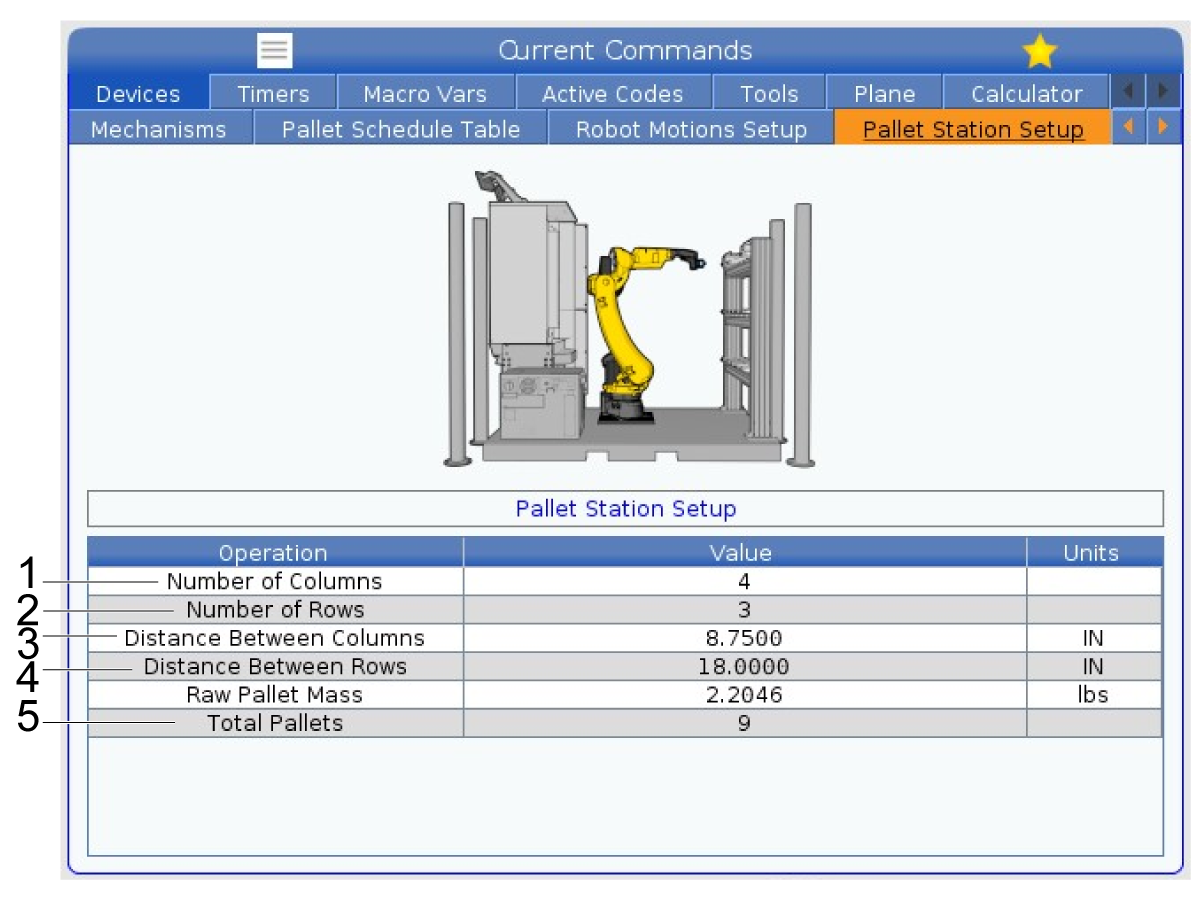
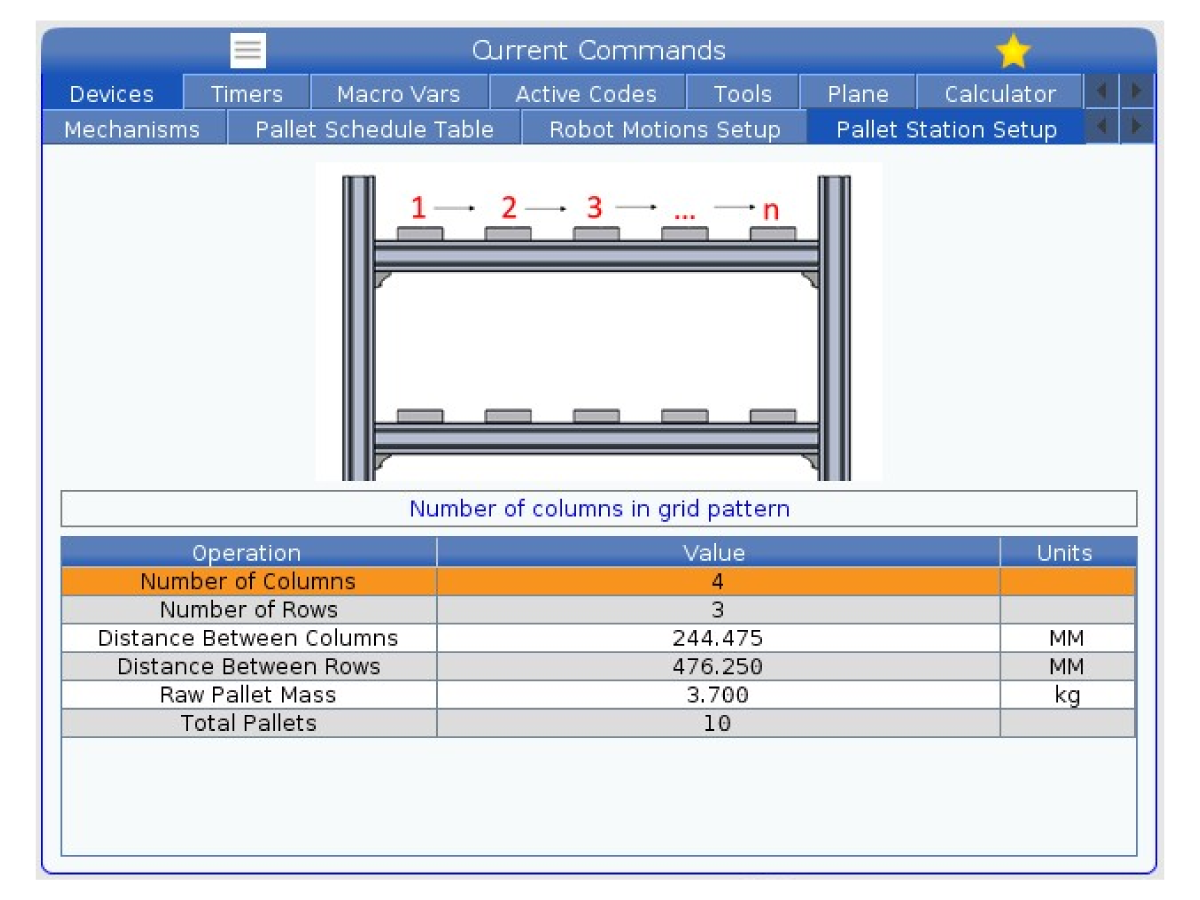
To set the shelf grid, navigate to the current commands page, and then Devices. Then move to the page called Pallet Station Setup [1] where you will see a window like the image.

See the next step for which parameters can be changed depending on the needed application.

Note: The RPL system comes with 4 pallets, and 3 pallet holders for the shelf. More pallets and holders can be ordered to add to the pallet system. See section 10.6 RPL Parts for more information on part numbers.

2

[1] Number of Racks - Sets the number of racks you have on your RPL.

Note: This field is only visible on software version 100.25.001.1100 of later.

This field comes set to 1 by default. If you have a dual rack RPL then you need to set this field to 2 so that the second rack options are populated in the template as shown in the image [2].

If you have the second rack option, change the template fields for both racks depending on the user's application.

3

[1] Number of Columns - Number of pallets on each shelf

[2] Number of Rows - Number of shelves being used

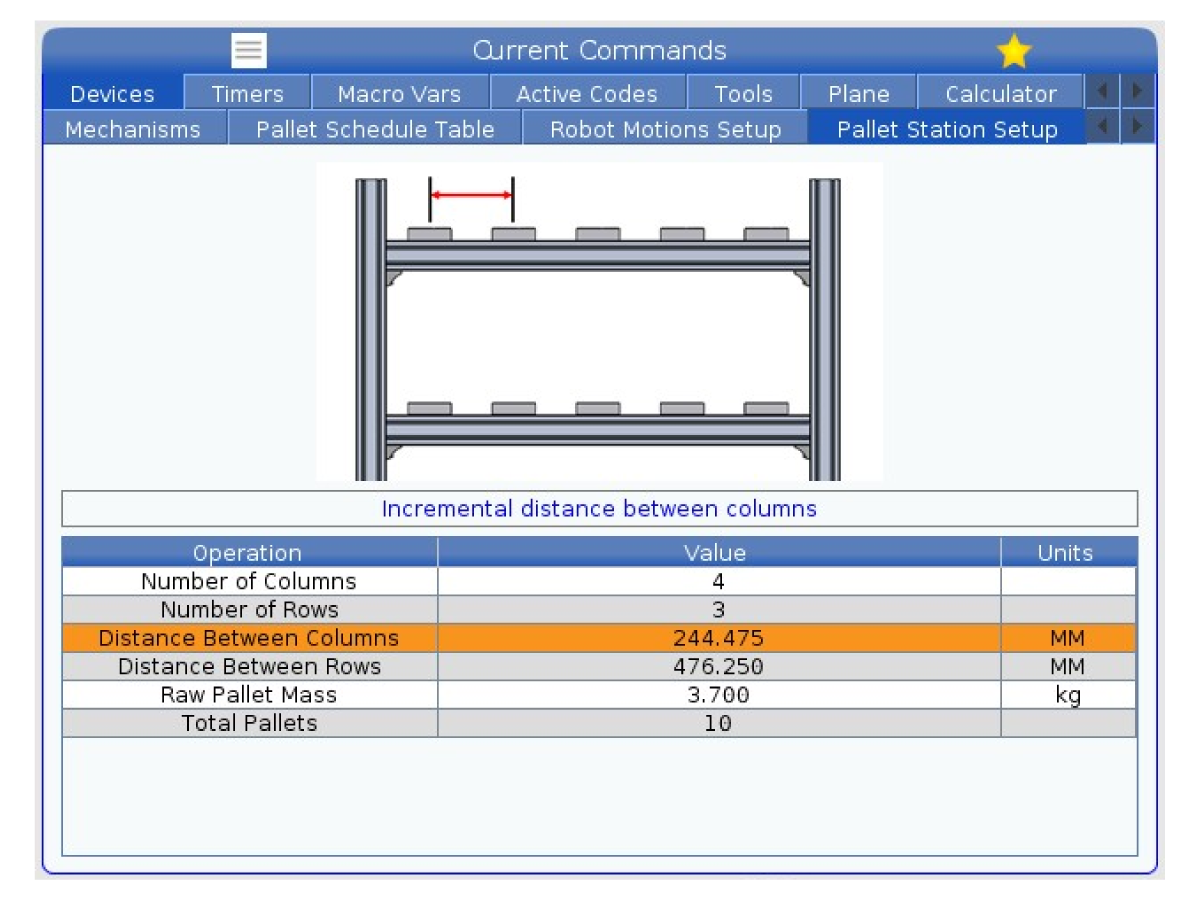
[3] Distance Between Columns - spacing between adjacent pallets

[4] Distance Between Rows - The vertical spacing between each shelf    

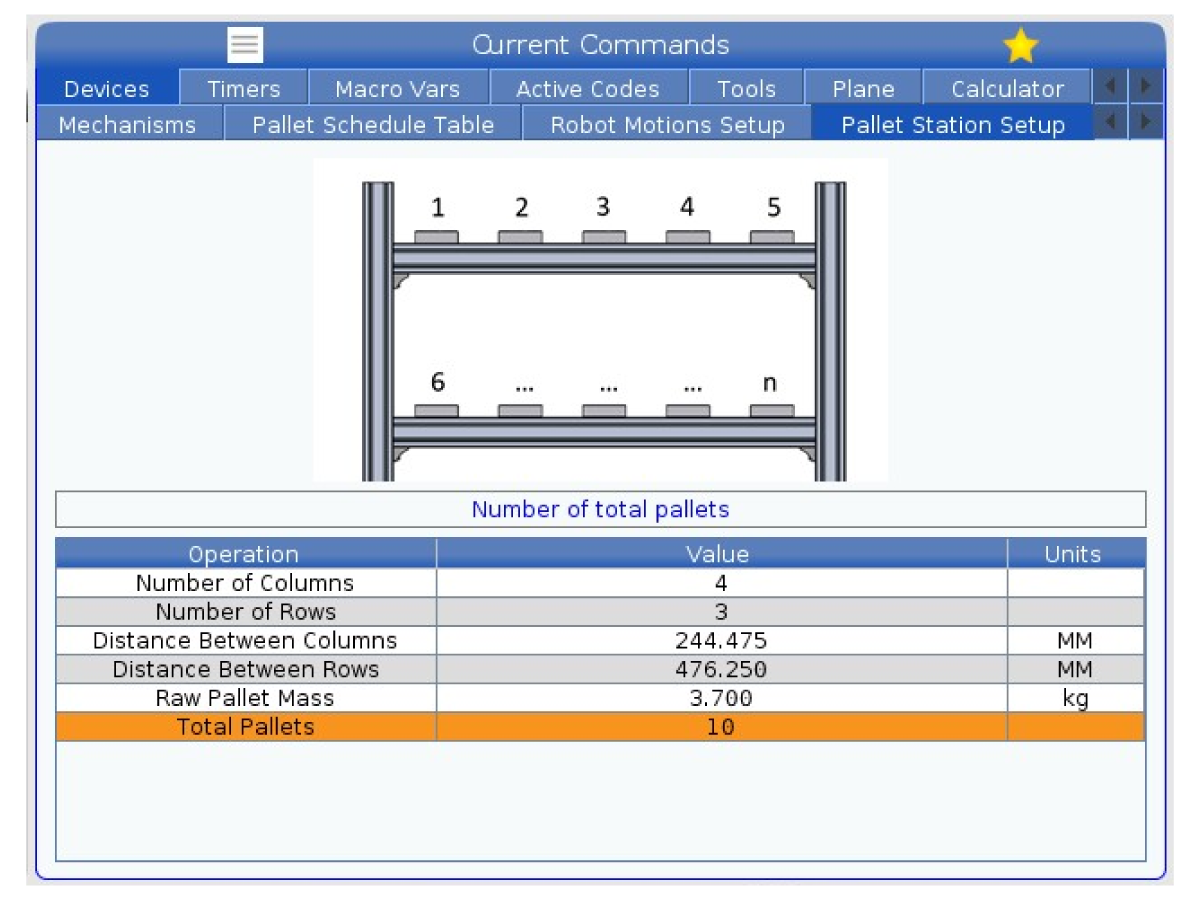
[5] Total Pallets - The number of pallets being used 

Note: The Raw Pallet Mass is 2.2046 lbs (1 Kg).

4

Number of Columns:

This value should be the number of pallets placed on a single shelf horizontally.

Note: It is not recommended to use more than 5 pallets on a single shelf. This value should be 5 or less.

5

Number of Rows:

This value should be the number of shelves being used on the pallet station.

Note: It is not recommended to use more than 3 shelves for this product. Using more than 3 shelves is not supported by Haas.

6

Distance Between Columns:

This is the distance between each adjacent pallet on a shelf. 

This distance is assumed to be consistent between each pallet. It is also assumed to be the same distance on each shelf being used. 

Note: See section 8.3 Shelf Alignment for information on how to check the alignment and spacing of the pallet shelf. The images on the control provide an example of the distance between pallet holders for this job.

Note: The leftmost pallet position is not determined by the Distance Between Columns value. The leftmost pallet will be 3.5 inches from the inside edge of the post to the left edge of the pallet holder.

For pallets to the right of the initial pallet, the distance would be from the left edge of the previous pallet to the left edge of the next pallet.

7

Distance Between Rows:

This is the distance between each shelf in the vertical position. 

This distance is assumed to be consistent between each row. It is also assumed to be the same distance between each shelf being used. 

Note: See section 8.3 Shelf Alignment for information on how to check the alignment and spacing of the pallet shelf. The images on the control provide an example of what distance value to check.

8

Total Number of Pallets:

The number of pallets can be any number.

The only requirement is that the pallets are placed starting from the left post and follow the distance between pallets.

Also, shelves need to be filled (to the number of columns parameter) starting with the top shelf before adding pallets to the lower shelves.

For example, if using 11 or more pallets, the top and middle shelf need to have 5 panels each before adding pallets to the lower shelf.

10.2 Pallet Scheduling

Recently Updated

Robot Pallet Loader - Pallet Scheduling


Pallet Loader - Operation

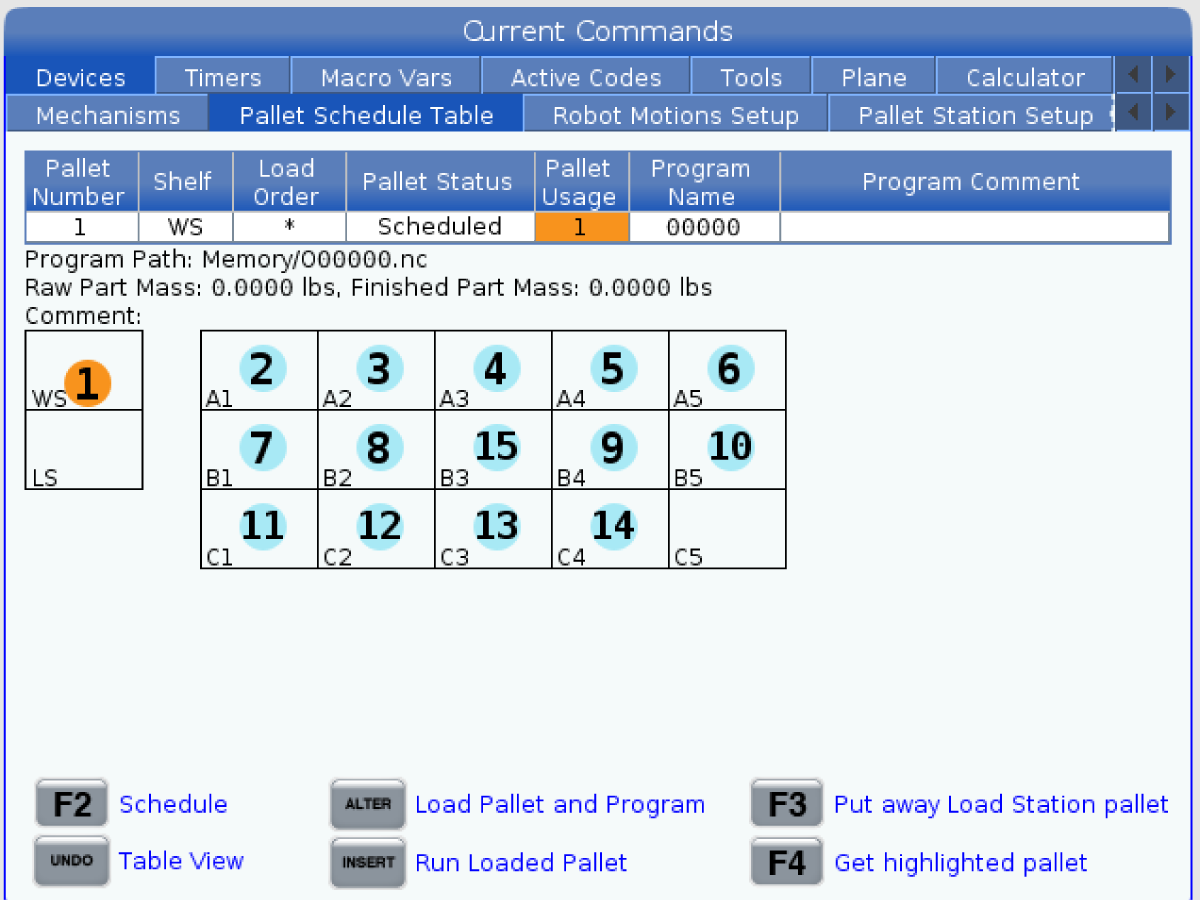
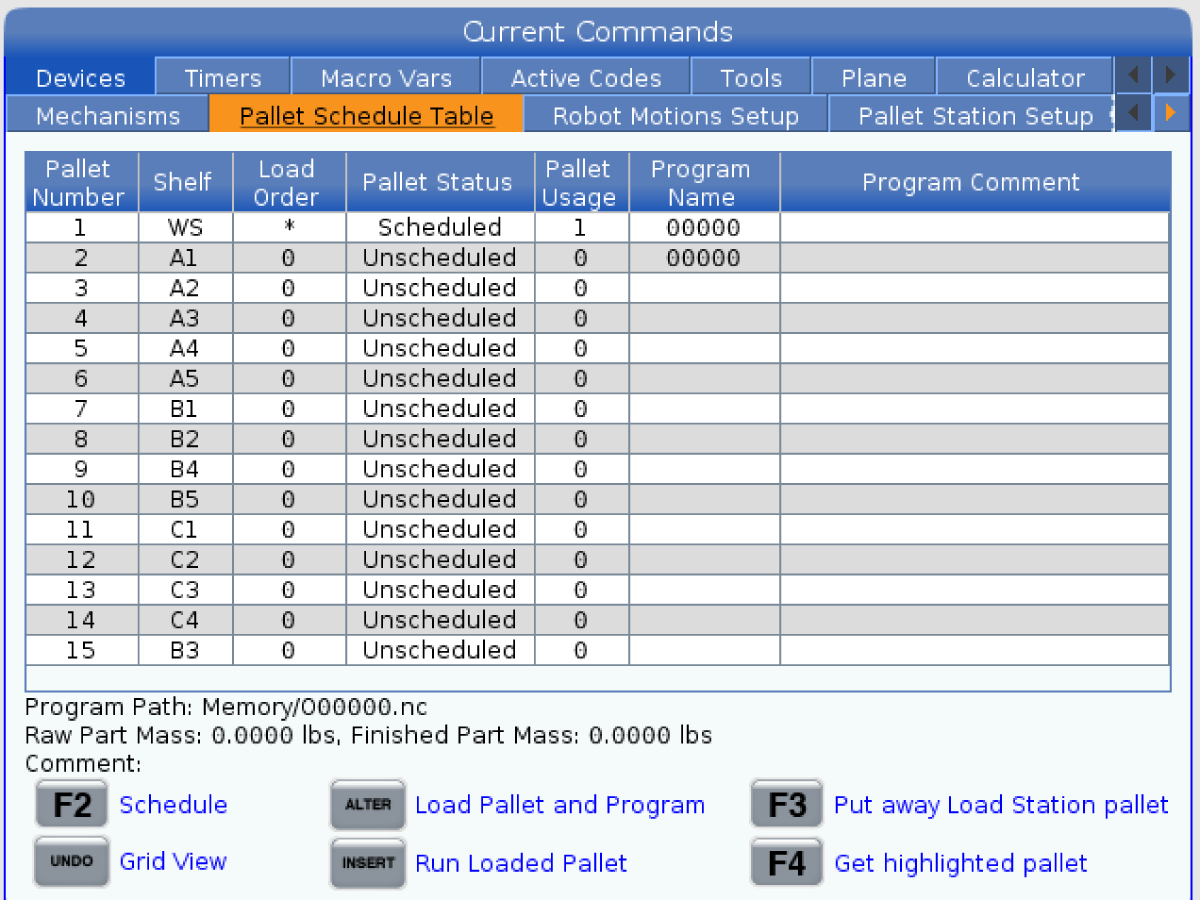
The CNC control tracks the pallets as they move from their shelf, to the ready position, to the machining area and then back. The Pallet Schedule Table (PST) is found within the current commands pages.

To access, press the [CURRENT COMMANDS] button and use the cursor arrows to navigate to Devices, then Pallet Schedule Table.

The PST screen contains information to assist the operator in loading/unloading pallets and allows the operator to specify part programs and pallet processing sequences.

 NOTE: Pallet exiting the machine work envelope may not return to the shelf it was taken from. The machine will go to the closest empty shelf starting with the shelf LS / Load Station.

Changing pallets with the Pallet Pool is done using the PST. Highlight a pallet shelf and press [ALTER] to load the pallet and associated program.

Run all the scheduled pallets by pressing [INSERT].

The program should have a M199 at the end of it to load the next schedule pallet and associated program when in Pallet Scheduler Mode. If running in MEMORY mode the M199 behaves like an M30.

The load order of the pallets is determined by the “Load Order” column in the PST. If you don’t wish to use Pallet Scheduler Mode to process your pallets you can still use the M50 Px command to load a specific pallet from inside your program.

To run the machine through all the scheduled pallets in Pallet Scheduler Mode call the first pallet into the machine. Press [INSERT] from the PST page. This will cause the M199 at the end of the program to behave like an M50 + M99. At the end of the program it will retrieve the next scheduled pallet and continue to run until all scheduled pallets are completed.

The Pallet Pool has a sub panel next to the load station, with an Emergency Stop button for safety, and a Part Ready button.

The Part Ready button is used to signal the lifter that the pallet in the load station is prepared and ready to enter the Pallet Pool. The load station door must be rotated closed for safety so that the lifter has access to the load station pallet.

Pallet Schedule Table

IMPORTANT: The video demonstrates the Pallet Schedule Table on a UMC-500 so there may be some difference in the screen layout, but the information still stands. 

The Pallet Schedule Table incorporates a number of features to help the user with their routine.

Load Order and Pallet Status: These two features work together to show which pallet is currently in the machining area. Enter a number for the load order and press [ENTER] on the Pallet Status field to select the pallet status. The choices are: 0: Unscheduled, 1: Scheduled, 2: Missing and 3: Completed.

Comment: To add a user comment to a pallet, highlight the pallet number field and press [ENTER]. A box will appear, type in the desired comment and press [ENTER].

Pallet Usage: This feature gives the number of times the specific pallet has been loaded into the machining area. Press [ORIGIN] button to clear the value.

Program Number: This detail shows which program number has been assigned to the pallet. To select a program, highlight the Program Name field then press [ENTER] and navigate to the program.

Program Comment: This area displays the comments that are written in the part program. This can only be changed by editing the comments in the program.

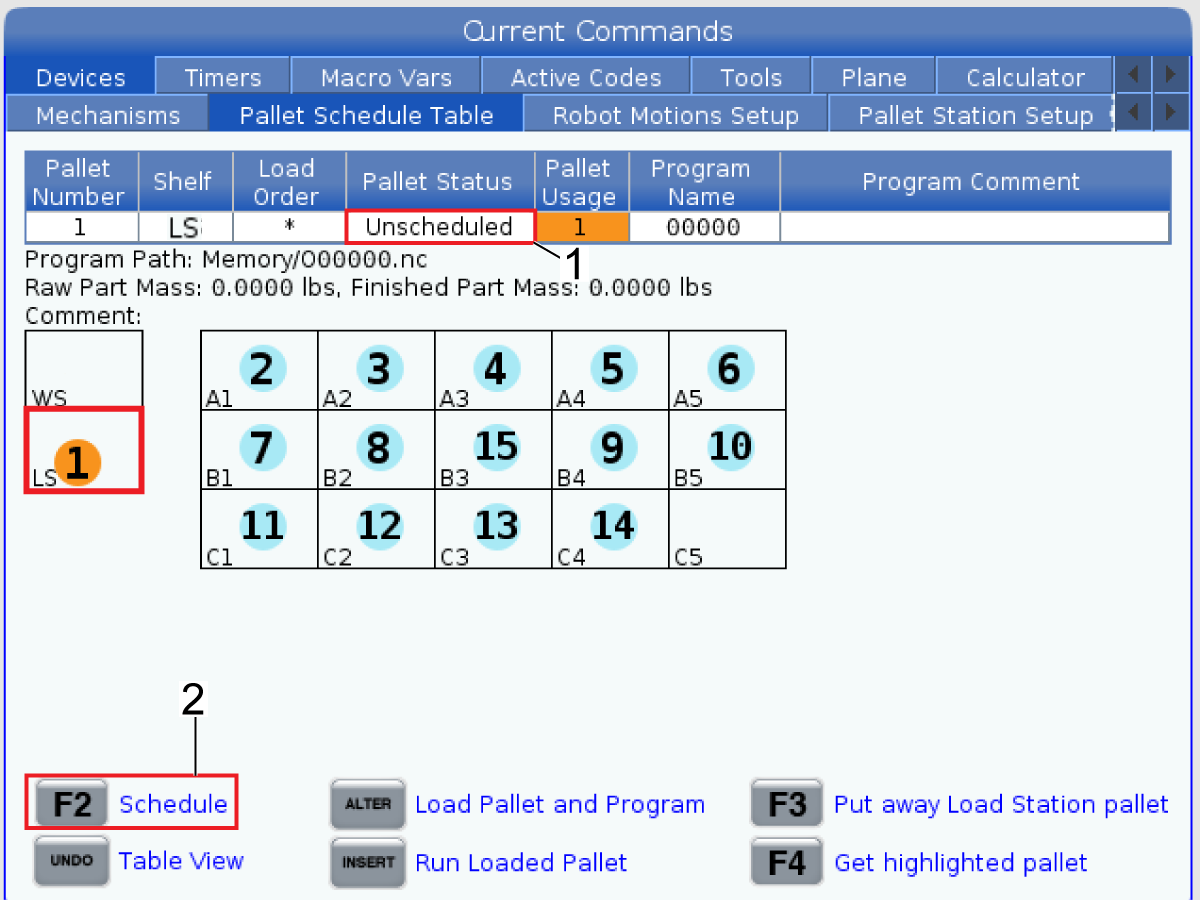
Note: There are two different views for the Pallet Schedule Table for Robot Pallet Loader machines, the top image shows the Grid View and the bottom image shows the Table View.

Command Prompts:

[ENTER] The function changes depending where the highlighter is located. It is used to enter a user comment, set a value in the field and to view options for the field.

[ALTER] Load Pallet and Program. This will load the selected pallet into the machine and call the assigned program to memory.

[INSERT] Run loaded program. This will start the machine running in Pallet Scheduler Mode. The machine will continue to run all scheduled pallets in the PST until they are completed. For more information on Pallet Scheduler Mode refer to M199 Pallet / Part Load or Program End in the M-code section.

[UNDO] Table View/Grid View. This toggles the Pallet Schedule Table view between Grid View and Table View.

[F2]Schedule Load Station pallet. This will set the status of the Load Station pallet to Scheduled.

[F3] Put away Load Station pallet. This will return the Load Station pallet to the pallet pool.

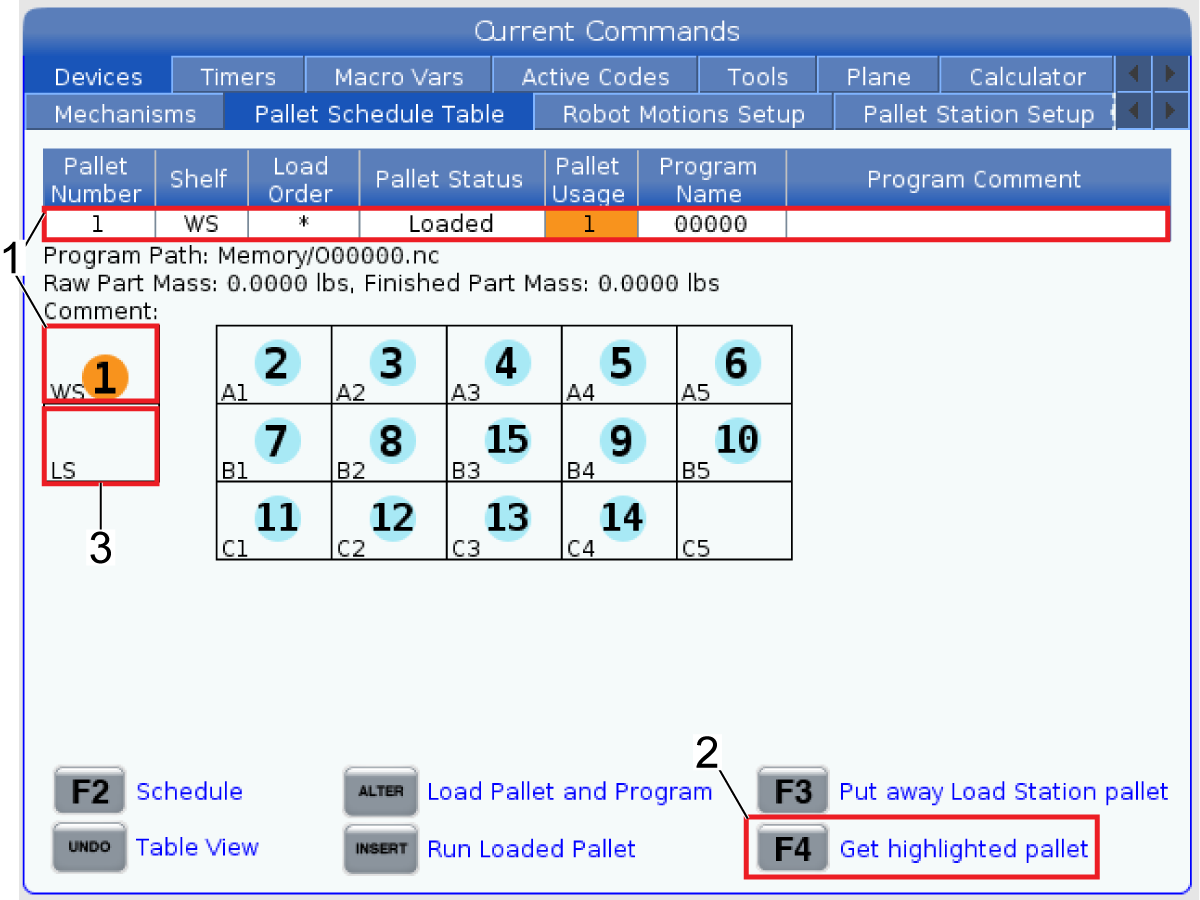
[F4] Get highlighted pallet. This will bring the selected pallet to the Load Station.

Using the Pallet Scheduling Table to Load Pallets

1

Load the pallets using the Pallet Schedule Table.

To reach the Pallet Schedule Table tab press [CURRENT COMMANDS] then go DEVICES > PALLET SCHEDULE TABLE. 

Schedule the pallets, to do this highlight the pallet status of the pallet [1] and press [F2] to schedule [2]. Repeat this process for the remaining pallets.

NOTE: The pallets must be scheduled in order to physically load the pallets to the station. After all pallets have been loaded the user can unschedule the pallets as needed. Unscheduling a pallet will tell the Pallet Pool not to pick up that pallet.

2

Start by physically place a pallet into the Load Station.

To load the pallets on the machine first press [E-STOP] then type LS into the shelf tab on pallet number 1 [2]. The screen should then show the pallet in LS station [1]. While pallet 1 is highlighted Press [F3] denoted as [3] so the RPL moves the pallet into the machine also known as the Work Station (WS) [5]

Press [UNDO] to switch to the Table View.

Next highlight the pallet 2 shelf tab [6] and change that to shelf LS, this will move the location of pallet 2 to the load station (LS). 

Physically load a pallet onto the load station, release the [E-STOP], and press [F3] denoted as [7] to put away the load station pallet 2 onto the empty shelf A1. 

Continue this process for the rest of the shelves.

3

To load a program for a specific pallet go to the Program Name tab [1] and press [ENTER].

A pop up menu will appear which will ask where to load your program from. Choose the file location, select the program you wish to run for that pallet and press [ENTER].

4

The program name and program comment will appear in its respective tab [1]. Continue loading programs for all other pallets this applies to. 

Pressing [ALTER] [2] will load the pallet and program as the name describes.

Pressing [INSERT] [3] will run the program of the pallet in shelf WS, the pallet status should also tell you what pallet number is loaded. 

5

Updated

To retrieve any given pallet choose the pallet number or the shelf [1], you should see the number of the pallet highlighted, press [F4] denoted as [2] and that should bring the highlighted pallet to the loading station (LS) [3]. 

NOTE: If there is a pallet in the load station when this process is commanded the pallet in the loading station will be loaded to an empty shelf in the pallet pool in order to move the highlighted pallet to position. 

Pallet Wash-Down Sequence

Use the special code M50P0 to extract a pallet without loading the next one to run a wash-down program to clean the receiver before loading the next pallet while in pallet mode.

Refer to the M50 M-Code help text for more info.

10.3 RPL Recovery

Recently Updated

Robot Pallet Loader - Recovery


Robot Pallet Loader - Recovery

If the Pallet Loader's cycle gets interrupted you must enter [RECOVER] mode to correct or complete the cycle.

Press the [RECOVER] button and press 2 for Pallet Changer. The recovery page will display the input and output values.

Pallet Changer Recovery Display:

  1. Pallet Pool Functions
  2. Pallet Pool Status
  3. Message Box 

Command Prompts:

[F1] Open/Close Slider Door. This will open/close the Auto Window on the machine. 

[F2] Clamp/Unclamp Pallet. This will clamp/unclamp the pallet in the machine from the receiver.

[F3]  Clamp/Unclamp Load Station Pallet. This will clamp/unclamp the load station.

[F4] Robot Frames. This will toggle between the different robot frames.

[ALTER] Clamp/Unclamp Gripper.  This will clamp/unclamp the gripper.

[ORIGIN] Attempt Auto Recovery. This will attempt to automatically move the robot to the ready position facing the machine. Auto recovery will not complete unless J1 of the robot is within 20 degrees of the ready position.

[RECOVER] Exit to Pallet Schedule Table. This will go back to the Pallet Schedule Table.

Recently Viewed Items

You Have No Recently Viewed Items Yet

Feedback
Haas Logo

Haas Delivered Price

This price includes shipping cost, export and import duties, insurance, and any other expenses incurred during shipping to a location in France agreed with you as a buyer. No other mandatory costs can be added to the delivery of a Haas CNC Product.

KEEP UP WITH THE LATEST HAAS TIPS AND TECHNOLOGY...

Sign up now!   

HAAS TOOLING ACCEPTS THE FOLLOWING:

  • Service & Support
  • Owners
  • Request Service
  • Operator Manuals
  • Haas Parts
  • Rotary Repair Request
  • Pre-Install Guides
  • Shopping Tools
  • Build & Price a New Haas
  • Available Inventory
  • The Haas Price List
  • CNCA Financing
  • About Haas
  • Accessibility Statement
  • DNSH Statement
  • Export Compliance
  • Careers
  • Certifications & Safety
  • Contact Us
  • History
  • Terms & Conditions
  • Haas Tooling Terms & Conditions
  • Privacy
  • Warranty
  • Haas Community
  • Haas Certification Program
  • Haas Motorsports
  • Gene Haas Foundation
  • Haas Technical Education Community
  • Events
  • Join the Conversation
  • Facebook
  • X
  • Flickr
  • YouTube
  • LinkedIn
  • Instagram
  • TikTok
© 2026 Haas Automation, Inc – CNC Machine Tools

This site is protected by reCAPTCHA and the Google Privacy Policy and Terms of Service apply.

2800 Sturgis Rd., Oxnard, CA 93030
Toll Free: (888) 817-4446 / Fax: 805-278-8554