My Haas 환영합니다,
!
Haas Tooling MyHaas/HaasConnect 로그인 등록 Haas Tooling MyHaas/HaasConnect 로그아웃 환영합니다, 내 기계 최근 활동 내 견적 내 계정 내 사용자 로그아웃
담당 대리점 찾기
  1. 언어 선택
    1. English
    2. Deutsch
    3. Español - España
    4. Español - México
    5. Français
    6. Italiano
    7. Português
    8. Český
    9. Dansk
    10. Nederlands
    11. Magyar
    12. Polski
    13. Svenska
    14. Türkçe
    15. 中文
    16. Suomi
    17. Norsk
    18. الإنجليزية
    19. български
    20. Hrvatski
    21. Ελληνικά
    22. Română
    23. Slovenský
    24. Slovenščina
    25. 한국어
    26. 日本語
    27. Українська
  • 기계 Main Menu
    • 수직 밀
      수직 밀
      수직 밀 View All
      • 수직 밀
      • VF 시리즈
      • 유니버설 기계
      • VR 시리즈
      • VP-5 프리즈매틱
      • 팔레트 교환 VMC
      • 미니밀
      • 몰드 기계
      • 고속 드릴 센터
      • 드릴/탭/밀 시리즈
      • 툴룸 밀
      • Pocket Mill
      • 컴팩트 밀
      • 갠트리 시리즈
      • SR 시트 라우터
      • 초대형 VMC
      • 이중 컬럼 밀
    • 멀티 축 솔루션
      멀티 축 솔루션
      멀티 축 솔루션 View All
      • 멀티 축 솔루션
      • Y축 선반
      • 5축 밀
    • 선반
      선반
      선반 View All
      • 선반
      • ST 시리즈
      • 이중 스핀들
      • 박스 웨이 시리즈
      • 툴룸 선반
      • 척커 선반
      • 포켓 선반
      • Haas 봉재 이송장치
    • 수평 밀
      수평 밀
      수평 밀 View All
      • 수평 밀
      • 50-테이퍼
      • 40-테이퍼
    • 로터리 및 인덱서
      로터리 및 인덱서
      로터리 및 인덱서 View All
      • 로터리 및 인덱서
      • 로터리 테이블
      • 인덱서
      • 5축 로터리
      • 초대형 로터리
    • 자동화 시스템
      자동화 시스템
      자동화 시스템 View All
      • 자동화 시스템
      • 밀 자동화
      • 선반 자동화
      • 자동 공작물 적재장치
      • 자동화 모델
    • 데스크톱 기계
      데스크톱 기계
      데스크톱 기계 View All
      • 데스크톱 기계
      • 데스크톱 밀
      • 데스크톱 선반
      • 제어 시뮬레이터, 표준
      • 제어 시뮬레이터, 고급
    • 공장 장비
      공장 장비
      공장 장비 View All
      • 공장 장비
      • 니형 밀
      • Haas 수동 선반
      • Haas 톱
    • 제작 기계
      제작 기계
      제작 기계 View All
      • 제작 기계
      • 레이저 절삭 기계
      • CNC 프레스 브레이크
    • 빠른 링크 특별 시리즈  특별 시리즈 
      EU 시리즈 EU 시리즈 제작 및 가격 | 가격 목록 제작 및 가격 | 가격 목록 재고품 기계 재고품 기계 신제품 신제품 첫 CNC 첫 CNC
      공구 쇼핑
      • Haas 제품 제작 및 가격
      • 가격 목록
      • 사용 가능한 재고
      • CNCA 파이낸싱
      상담을 받고 싶으신가요?

      Haas Factory Outlet (HFO)은 고객님의 질문에 답변을 드리며 가장 좋은 선택지를 안내해 드립니다.

      CONTACT YOUR DISTRIBUTOR >
  • 옵션 Main Menu
    • Product Image 스핀들
      스핀들
      스핀들 View All
      • 스핀들
    • Product Image 공구 교환장치
      공구 교환장치
      공구 교환장치 View All
      • 공구 교환장치
    • Product Image 4 | 5축
      4 | 5축
      4 | 5축 View All
      • 4 | 5축
    • Product Image 터렛 및 라이브 툴링
      터렛 및 라이브 툴링
      터렛 및 라이브 툴링 View All
      • 터렛 및 라이브 툴링
    • Product Image 검사
      검사
      검사 View All
      • 검사
    • Haas 칩 및 절삭유 관리 칩 및 절삭유 관리
      칩 및 절삭유 관리
      칩 및 절삭유 관리 View All
      • 칩 및 절삭유 관리
    • Haas Control Haas Control
      Haas Control
      Haas Control View All
      • Haas Control
    • Product Image 제품 선택 사항
      제품 선택 사항
      제품 선택 사항 View All
      • 제품 선택 사항
    • Product Image 툴링 및 픽스처링
      툴링 및 픽스처링
      툴링 및 픽스처링 View All
      • 툴링 및 픽스처링
    • Product Image 워크홀딩
      워크홀딩
      워크홀딩 View All
      • 워크홀딩
    • Product Image 5축 솔루션
      5축 솔루션
      5축 솔루션 View All
      • 5축 솔루션
      • 5 Easy Steps to 5-Axis
    • Product Image 자동화
      자동화
      자동화 View All
      • 자동화
    • 빠른 링크 특별 시리즈  특별 시리즈 
      EU 시리즈 EU 시리즈 제작 및 가격 | 가격 목록 제작 및 가격 | 가격 목록 재고품 기계 재고품 기계 신제품 신제품 첫 CNC 첫 CNC
      공구 쇼핑
      • Haas 제품 제작 및 가격
      • 가격 목록
      • 사용 가능한 재고
      • CNCA 파이낸싱
      상담을 받고 싶으신가요?

      Haas Factory Outlet (HFO)은 고객님의 질문에 답변을 드리며 가장 좋은 선택지를 안내해 드립니다.

      CONTACT YOUR DISTRIBUTOR >
  • Why Haas Main Menu
      Haas의 차이를 알아보세요
    • Haas여야만 하는 이유
    • MyHaas
    • 교육 커뮤니티
    • Industry 4.0
    • Haas 인증
    • 고객 사용후기
  • 서비스 Main Menu
      Haas Service 에 오신 것을 환영합니다
      서비스 홈 조작자 설명서 방법 절차 문제해결 가이드 예방적 유지관리 Haas 부품 Haas Tooling 동영상
  • 동영상 Main Menu
My Haas 환영합니다,
!
Haas Tooling MyHaas/HaasConnect 로그인 등록 Haas Tooling MyHaas/HaasConnect 로그아웃 환영합니다, 내 기계 최근 활동 내 견적 내 계정 내 사용자 로그아웃
담당 대리점 찾기
  1. 언어 선택
    1. English
    2. Deutsch
    3. Español - España
    4. Español - México
    5. Français
    6. Italiano
    7. Português
    8. Český
    9. Dansk
    10. Nederlands
    11. Magyar
    12. Polski
    13. Svenska
    14. Türkçe
    15. 中文
    16. Suomi
    17. Norsk
    18. الإنجليزية
    19. български
    20. Hrvatski
    21. Ελληνικά
    22. Română
    23. Slovenský
    24. Slovenščina
    25. 한국어
    26. 日本語
    27. Українська
×

검색 결과

Web Pages

Images

    • <
    • 1
    • >

8 - UMC - Geometry and Alignment

UMC 시리즈 - 서비스 매뉴얼


  • UMC - 스핀들
  • 1 - UMC - 소개
  • 2 - UMC - 사양
  • 3 - UMC-400/500/750 - 설치
  • 4 - UMC-1000/1250 - 설치
  • 5 - UMC-1500-DUO/1600-H - 설치
  • 6 - UMC - 고정
  • 7 - UMC - 조작
  • 8 - UMC - 형상 및 정렬
  • 9 - UMC - MRZP 및 안전 지대
  • 10 - UMC - B/C - 회전축
  • 11 - UMC - 공구 교환장치
  • 12 - UMC - 칩 제거 및 절삭유
  • 13 - UMC - 전기 제어
  • 14 - UMC - 윤활
  • 15 - UMC - 유지보수
  • 16 - UMC - 팔레트 풀
  • 17 - UMC - 유압 공작물 고정
  • 18 - UMC - 공압 공작물 고정

Go To :

  • 8.1 형상 안내서
  • 8.2 정렬 - 표시 구역
  • 8.3 형상 - 문제 해결
  • 8.4 응용 장치 - 문제 해결
  • 8.5 UMC-750 - 쉼 키트 체크리스트
  • 8.6 B/C - 축 교차 - 정렬

8.1 형상 안내서

Recently Updated

형상 가이드 -UMC 시리즈


Introduction

  1. 스핀들 헤드
  2. 램
  3. 새들
  4. 브리지
  5. 베이스
  6. C축 회전
  7. B축 회전

시작하기 전에 공장 출하 설정인 아래의 파라미터 또는 설정 값을 기록하십시오. 조정하는 동안 이 값을 0으로 설정한 다음, 완료되면 원래 값으로 재설정해야 합니다. 값은 양수 또는 음수일 수 있습니다.

  • 기존의 Haas 제어(CHC) 파라미터 1314 (Rotary Axes Center Deviation in X)
  • 차세대 제어 (NGC) 설정 254 (5 Axis Rotary Center Distance)

필요한 툴링 및 키트 :

  • T-2193A - UMC-750 SPINDLE HEAD ALIGNMENT PIN *
  • T-2181 - CNC DUAL LEVELING TOOL
  • T-2192 - LEVELING ADAPTER UMC-750
  • 93-2236 - SHIM KIT FOR UMC-750 *

링크를 클릭하면  UMC-750 레벨링 및 정렬 비디오를 보실 수 있습니다.

*  : 사전 재부팅 시리즈에서만 사용됩니다. 

Level the Machine

1

기계 높이를 설정하십시오:

X 및 Y축을 원점 위치로 이동하십시오.

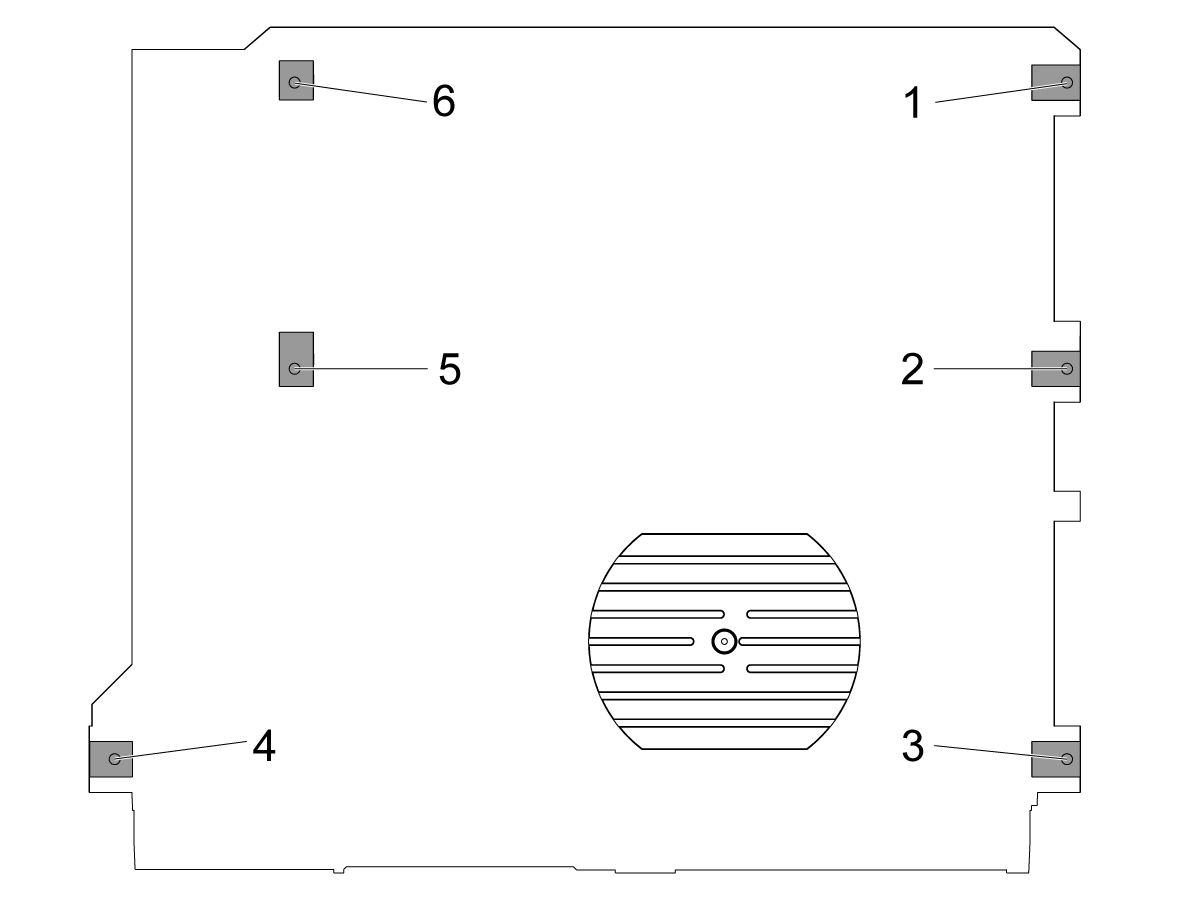
중간 수평 조절 나사[2와 5]를 풀어서 무게를 지탱하지 않도록 하십시오.

바닥 위 4개의 모서리 수평 조절 나사 3"(76.2 mm)에 기계를 놓습니다.

2

기계 황삭 수평 조절:

수평 조절 나사 #4를 돌립니다.

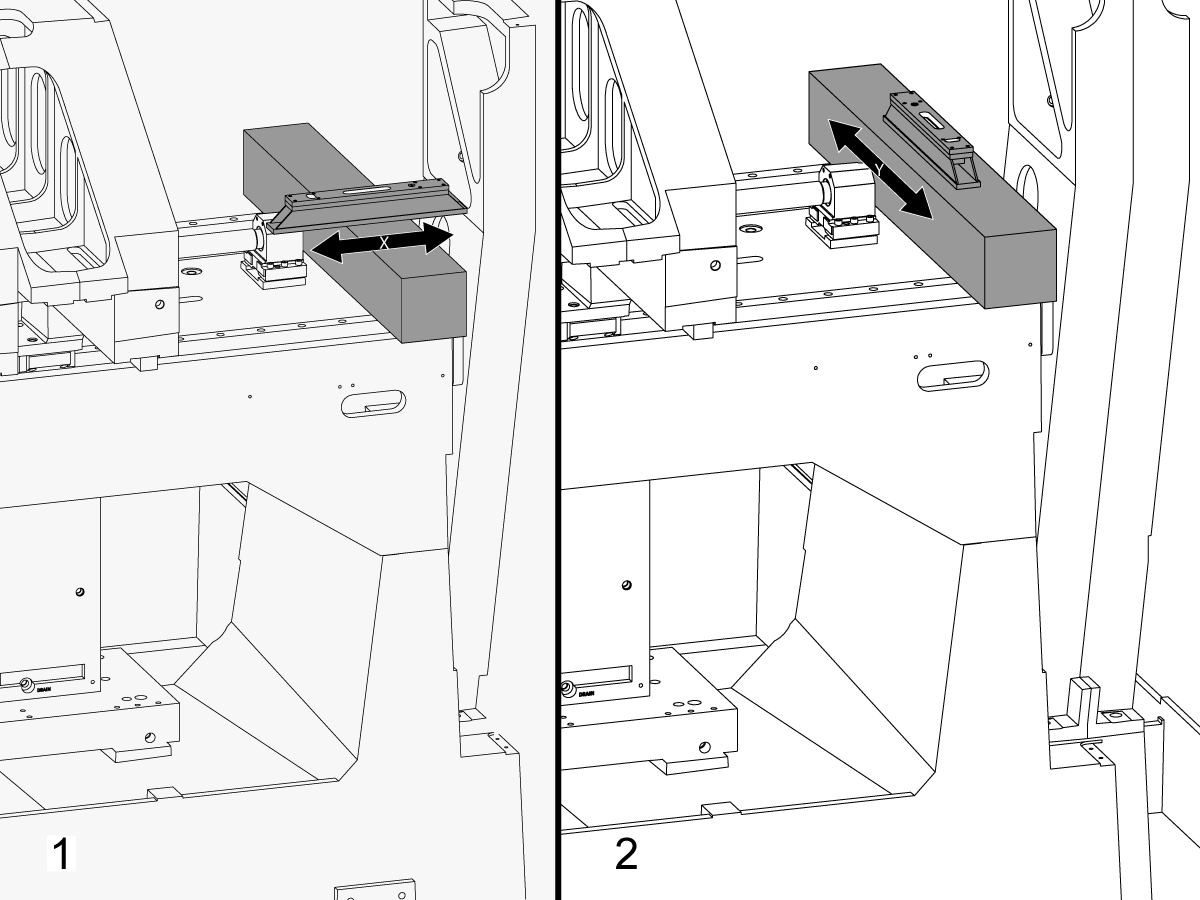
X축 볼스크루 베어링 지지대 근처의 X축 선형 가이드에 화강암을 놓습니다.

화강암 위에 X축과 평행하게 기계 수평을 설정합니다.[1]

기계가 X축 수평을 맞출 때까지 수평 조절 나사 #6을 조절하십시오.

화강암 위에 X축에 수직인 기공사 수평을 설정합니다.[2]

기계가 Y축에 수평이 될 때까지 수평 조절 나사 #3을 조절하십시오.

수평 조정 나사 #4가 수평 조절 패드에 닿을 때까지 아래로 돌립니다.

3

X축 롤 조절:

T-2192와 T-2181을 조립하십시오.

Y축을 이동거리 중간으로 이동합니다.

스핀들 측면에 T-2192를 놓습니다.

T-2181의 버블이 읽을 수 있는 범위 내에 있는지 확인하십시오.

그렇지 않은 경우, T-2192를 매그네틱 베이스에 고정시키는 볼트를 풀고 필요에 따라 어댑터를 이동하십시오.

X축을 좌우로 조그하고 X축 롤을 측정하십시오. 원점 위치, 중간 및 이동거리 끝에서 판독을 합니다.

원점 위치 판독값과 이동거리 끝의 판독값 사이에 편차가 없을 때까지 수평 조절 나사 #4를 조절하십시오.

참고: T-2181의 버블이 병 중간에 있을 필요는 없습니다. 판독 가능한 범위 내에만 있으면 됩니다.

4

중간 수평 조절 나사를 설정하십시오:

수평 조절 나사가 수평 조절 패드와 닿을 때까지 아래로 내린 다음, 45° 더 돌립니다.

X축 롤을 확인하십시오. 중간 수평 조절 나사를 조정하여 X축 롤을 수정하십시오.

X Axis to Y Axis Alignment

1

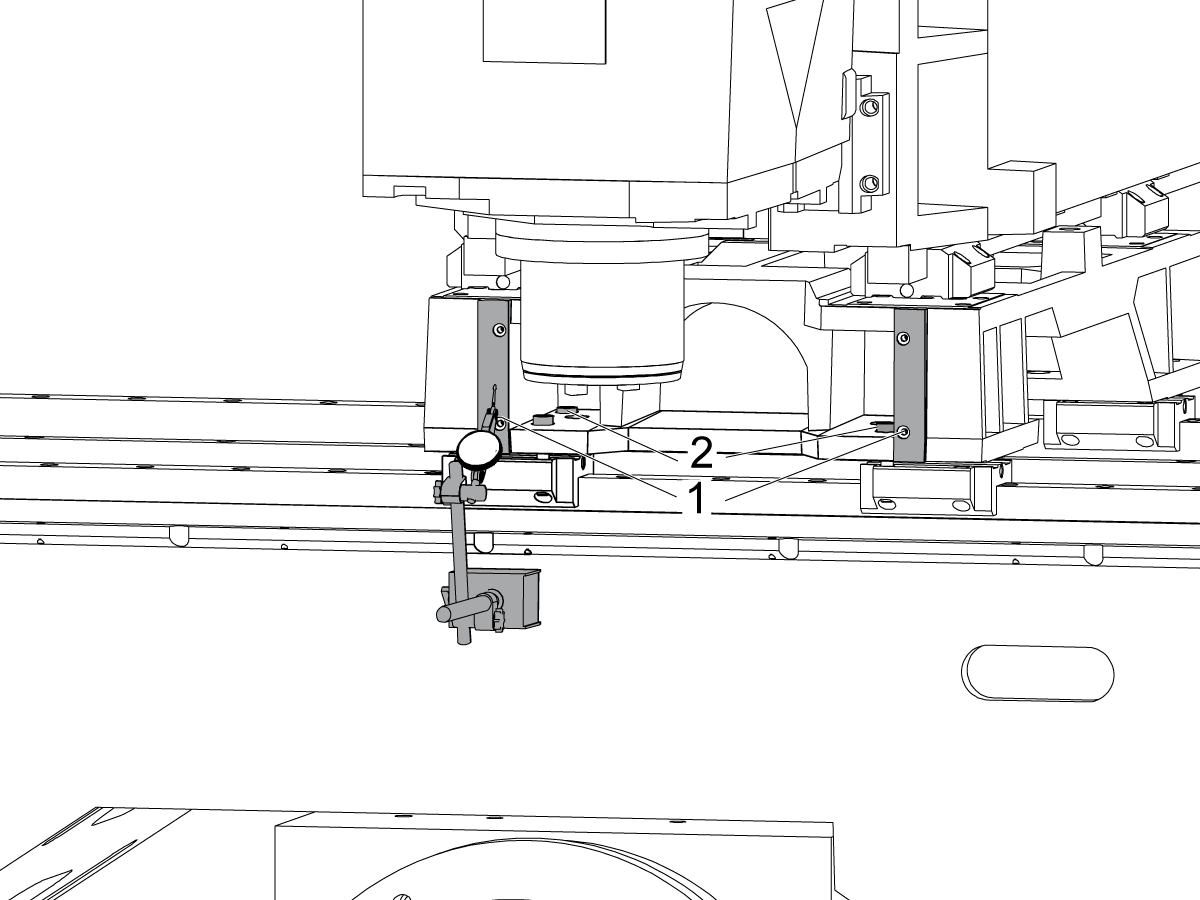
새들의 면삭을 X축 이동에 평행하게 정렬하십시오:

X축을 조그하여 새들[1] 앞면의 가공된 표면을 가로질러 스윕합니다 .

X축 트럭[2]에 새들을 고정시키는 볼트를 풀고, 필요한 경우 0.001" 내의 X축 이동에 평행하게 새들의 면삭을 정렬하십시오.

볼트를 조입니다.  Haas 패스너 토크 사양을 참조하십시오.

2

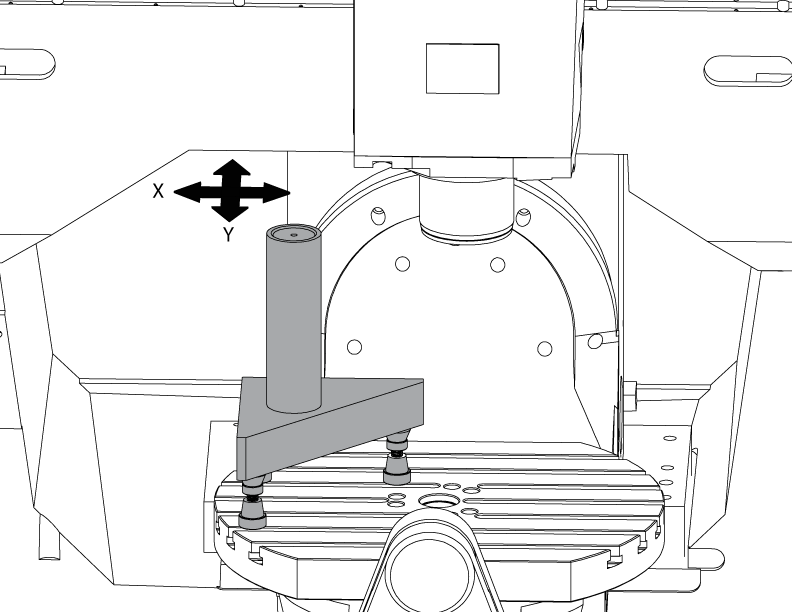
Y축을 X축에 수직으로 정렬합니다:

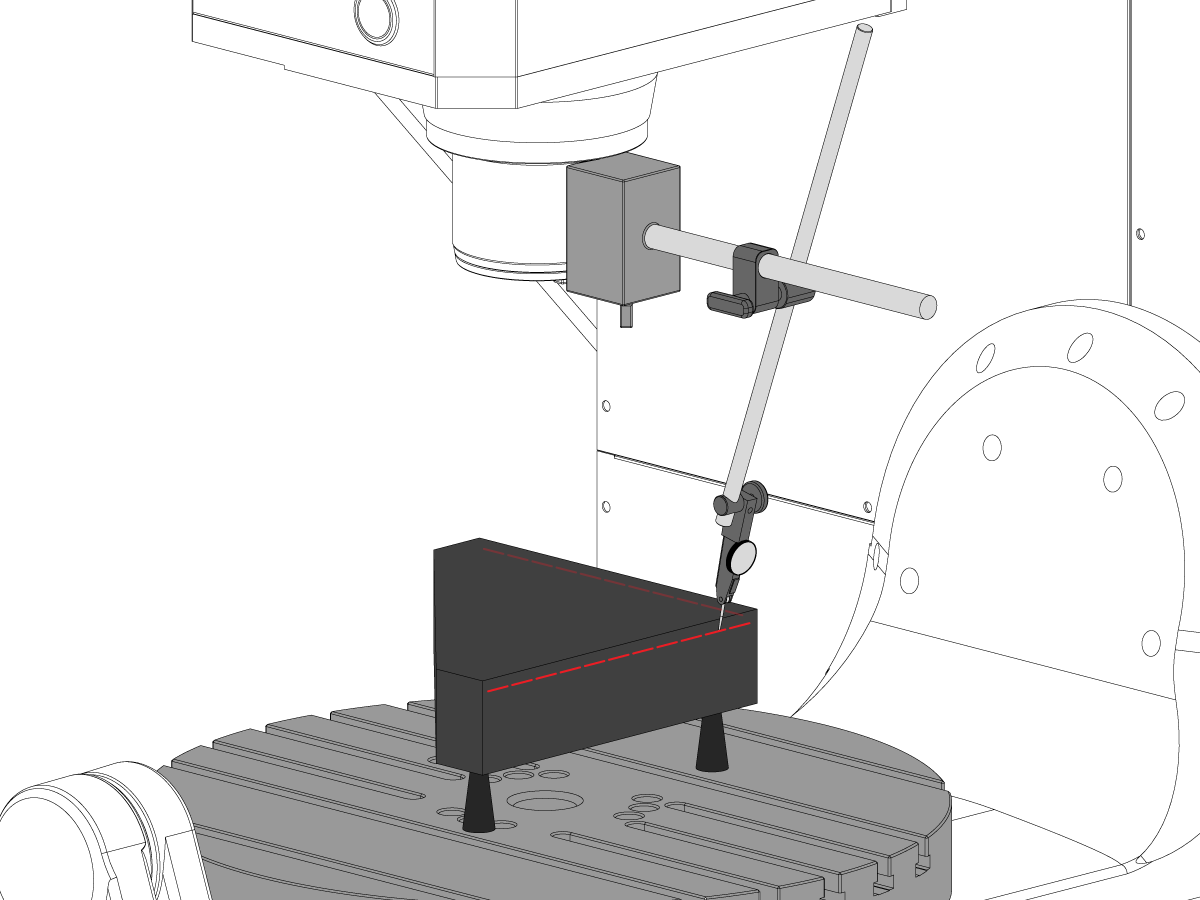
기공사 잭의 C축 플랫터 왼쪽에 3개의 정사각형 화강암을 설치합니다.

삼각 화강암의 뒷면을 X축과 평행하게 설정하십시오. NTE 0.0001"/10"

X 및 Y축을 따라 삼각 화강암의 상단을 스윕합니다.

삼각 화강암의 상단 표면이 X-Y 평면 NTE 0.0005"로 평행이 될 때까지 기공사 잭을 조정하십시오..

화강암의 뒷면이 X축과 평행한지 확인하십시오. NTE 0.0001"/10".

Y축 트럭을 새들에 고정시키는 볼트를 풀고 Y축을 X축에 수직으로 정렬하십시오. NTE 0.0005"/10"

볼트를 조입니다.  Haas 패스너 토크 사양을 참조하십시오.

볼트를 조인 후 Y축이 X축 NTE 0.0005"/10"에 수직인지 확인하십시오.

Z Axis to the X-Y Plane Alignment

1

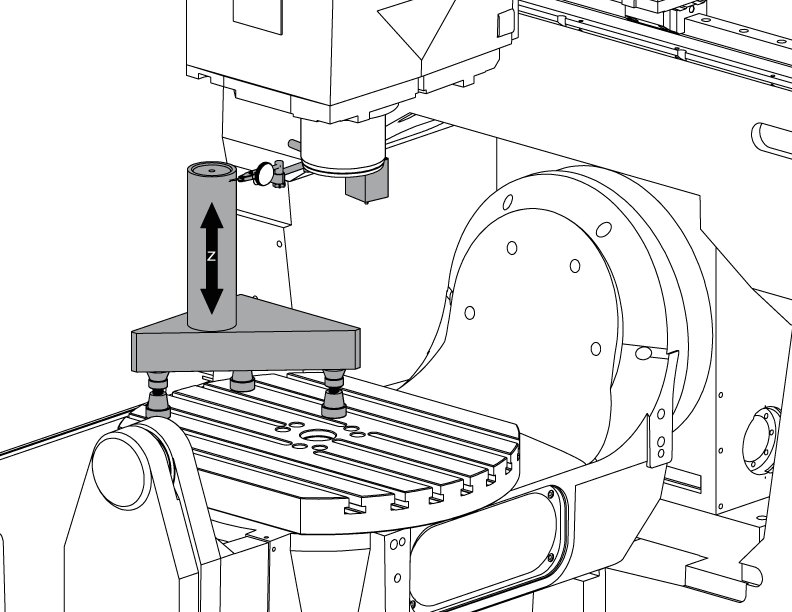
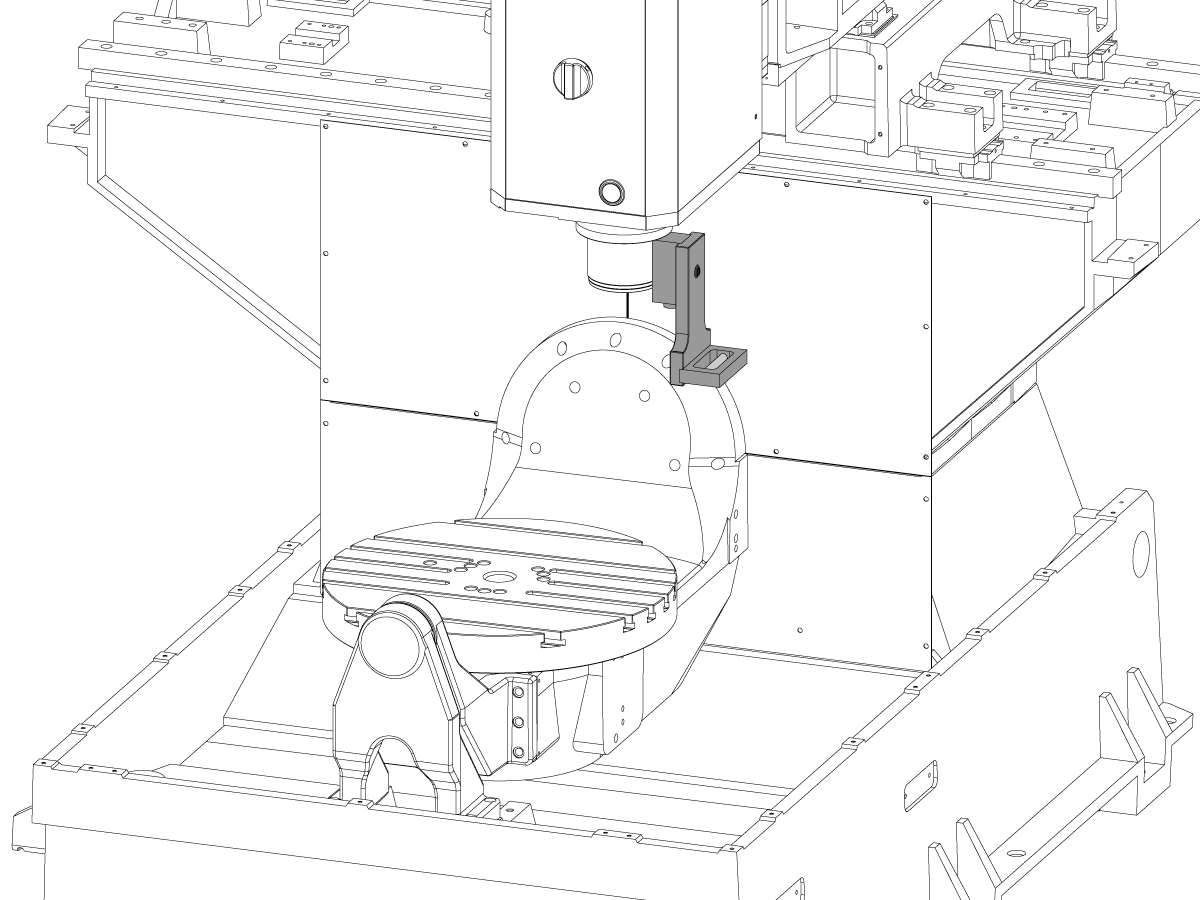
실린더를 설치하십시오.

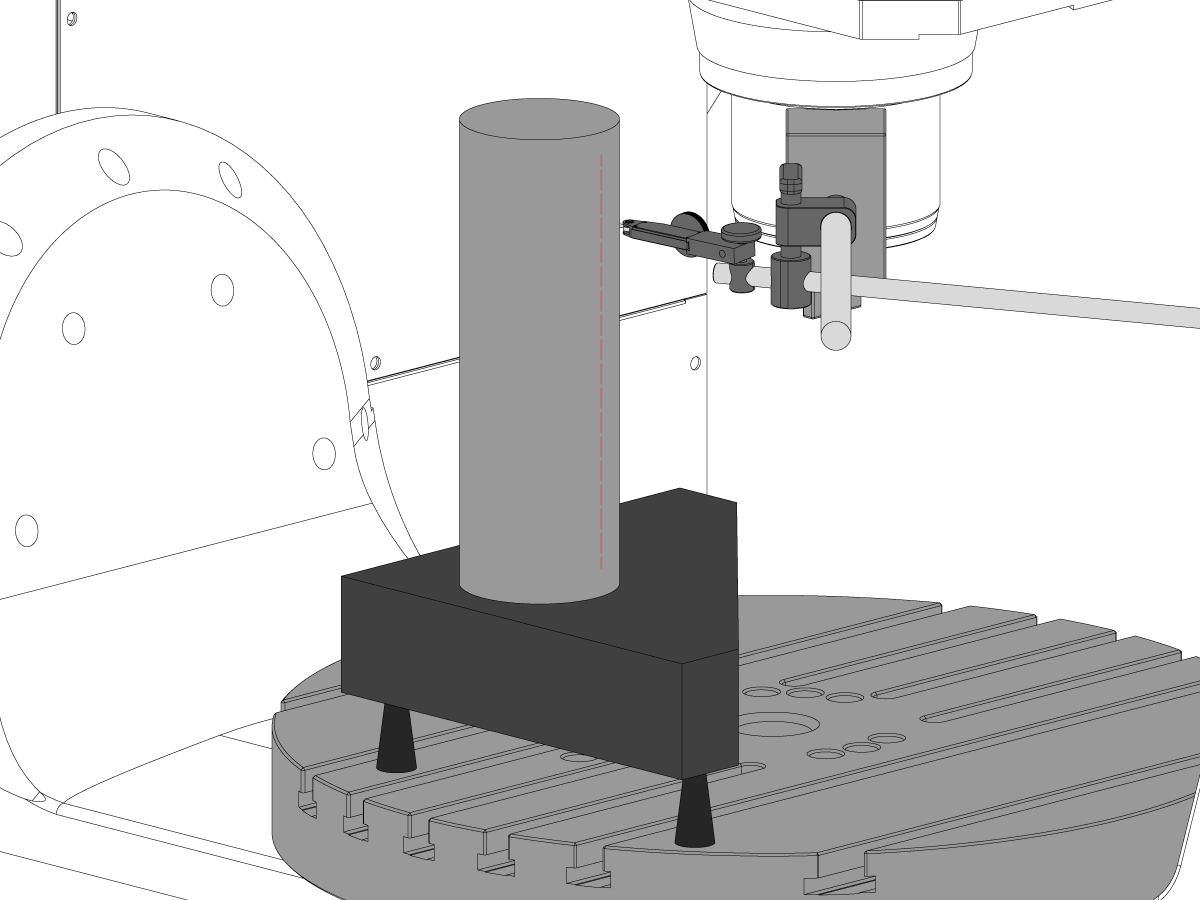
그림과 같이 삼각 절단석 위에 실린더를 놓습니다.

기공사 잭을 돌려서 실린더 상단 표면을 X-Y 평면 NTE 0.0001"에 평행하게 정렬합니다.

기계를 다음 위치로 조그하십시오:

  • UMC-750은 X -7.000", Y -10.000"로
  • UMC-750SS은 X -10.000", Y-10.000"로

2

Z축을 X축에 수직으로 정렬합니다:

Z축 트럭의 상단 모서리 볼트 중 하나를 T-2193A *로 교체하여 스핀들 헤드를 회전시킵니다.

Z축을 따라 실린더 측면을 표시합니다.

Z축 트럭을 램에 고정시키는 볼트를 푸십시오.

스핀들 헤드를 좌우로 돌리면서 Z축을 X축 NTE 0.0005"/10"에 수직으로 정렬합니다.

볼트를 조입니다.  Haas 패스너 토크 사양을 참조하십시오.

볼트를 조인 후, Z축이 X축에 수직인지 확인하십시오.

정렬이 완료되면, T-2193A *를 볼트로 교체하십시오

*  : 사전 재부팅 시리즈에서만 사용됩니다. 

3

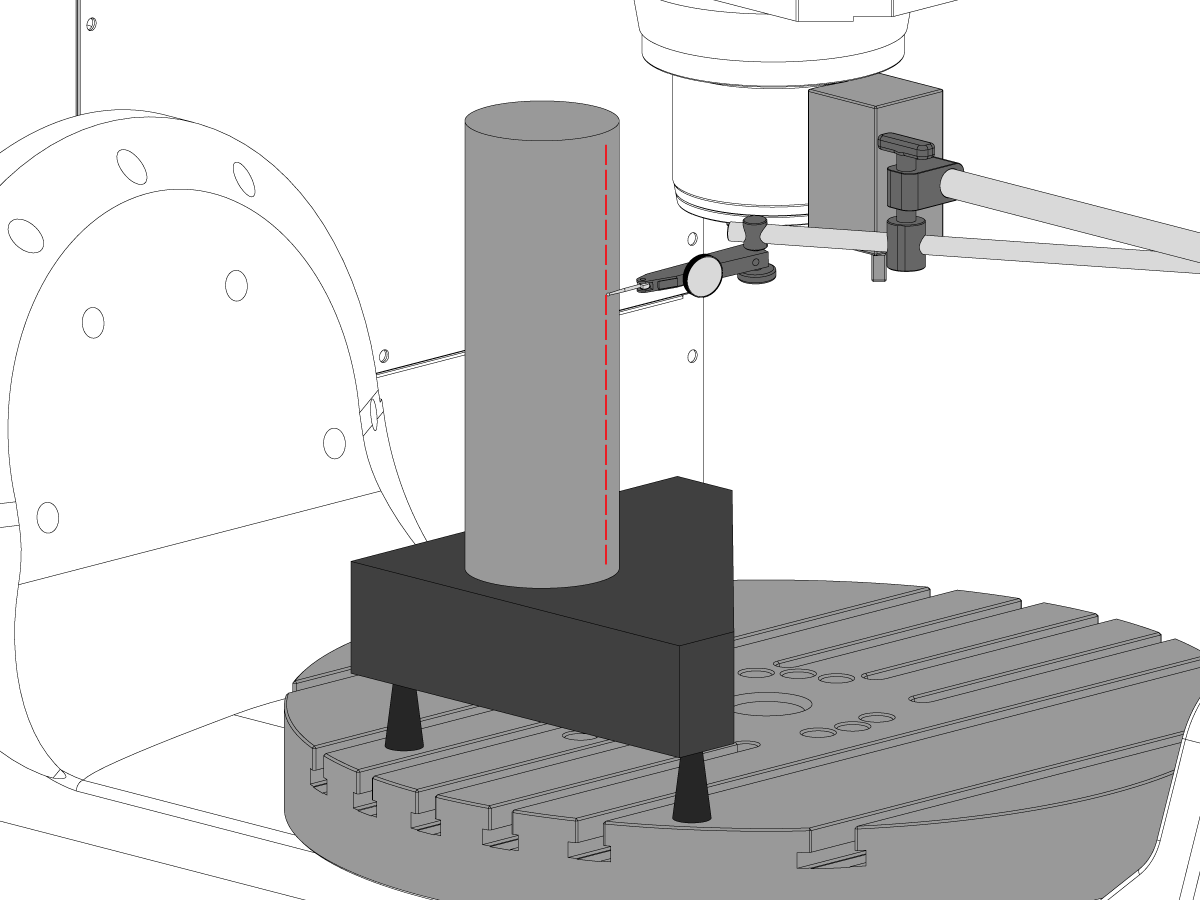
Z축을 Y축에 수직으로 정렬합니다:

Z축을 따라 실린더의 전면을 표시합니다.

Z축 트럭과 램 사이의 쉼으로 Z축을 Y축 NTE 0.0005"/10"에 수직으로 정렬하십시오.

참고: 동일한 쉼으로 트럭 두 개 상단 또는 하단을 쉼하십시오.

볼트를 조입니다.  Haas 패스너 토크 사양을 참조하십시오.

볼트를 조인 후, Z축이 Y 및 X축에 직각이 되는지 확인하십시오.

4

Y 및 Z축 볼넛 하우징을 정렬하고 토크하십시오:

볼넛을 하우징에 고정시키는 볼트와 하우징을 성형품에 고정시키는 볼트를 푸십시오.

볼넛 하우징을 성형품에 고정시키는 볼트를 먼저 조인 다음 볼넛을 하우징에 고정시키는 볼트를 조입니다.

조그 로크 기능을 사용하여 축을 앞뒤로 완전히 이동시킵니다.

참고: 핸드휠이나 급속 이동을 사용하지 마십시오.

볼트를 조입니다.  Haas 패스너 토크 사양을 참조하십시오.

Y축 너트 하우징은 램이 기계 전면을 향해 완전히 조그하면서 기계 후면에 접근할 수 있습니다.

Z축 너트 하우징은 스핀들 헤드가 완전히 아래로 조그된 상태에서 기계 전면에서 접근할 수 있습니다.

참고: Z축 볼넛 하우징에 접근하려면 스핀들 모터 슈라우드를 제거해야 합니다.

Tram the Spindle to the X-Y Plane

1

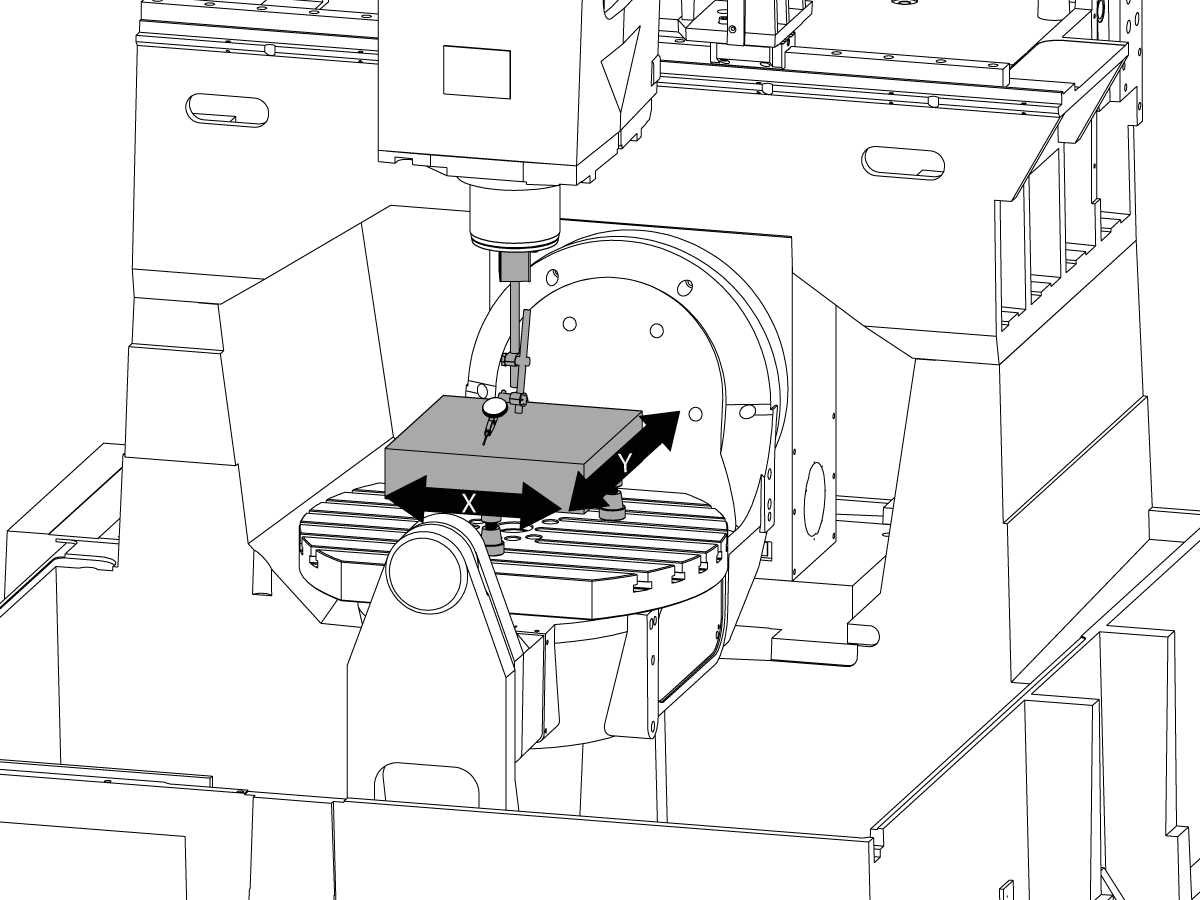
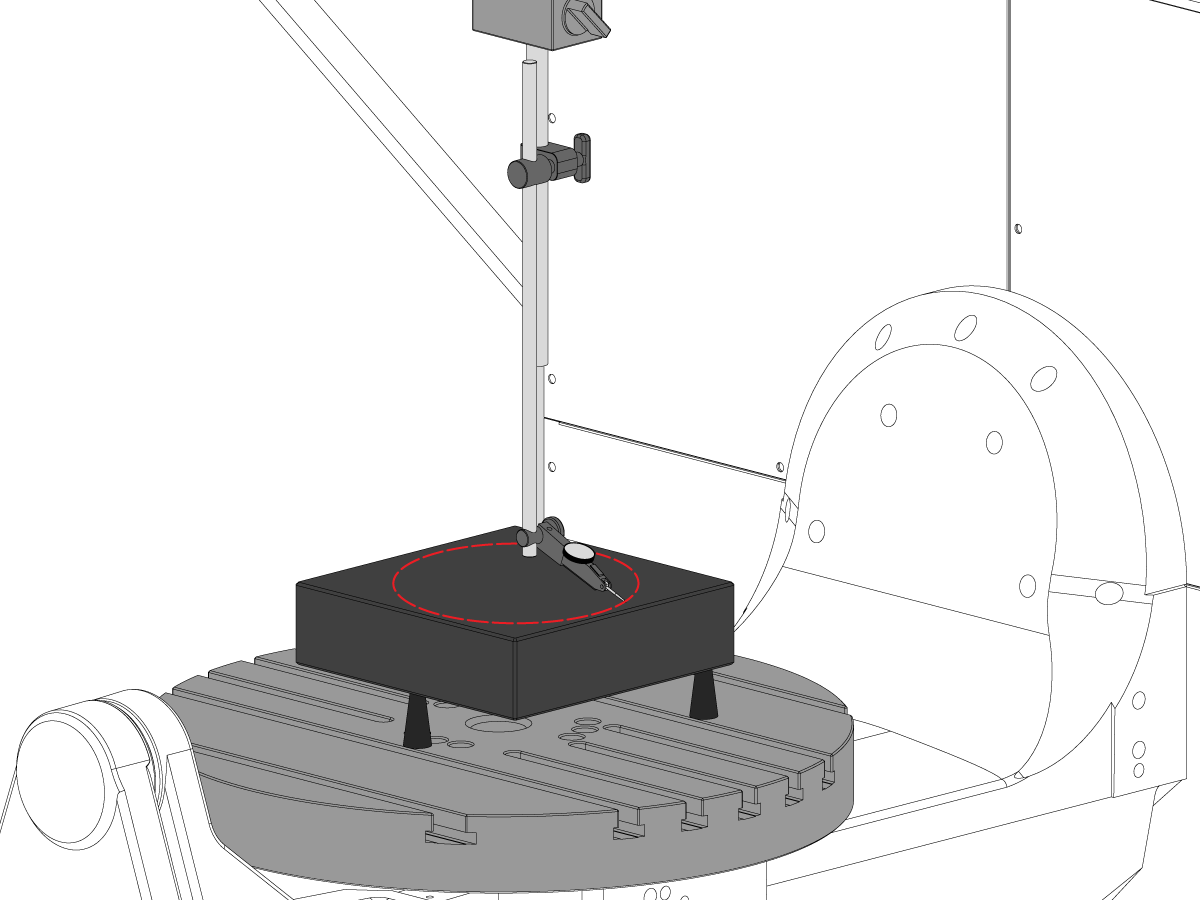
화강암을 설정하십시오:

그림과 같이 C축 플랫터의 중앙에 기공사 잭과 화강암을 설치하십시오.

기공사 잭 높이 NTE 0.0001"을 조절하여 화강암의 상단 표면을 X-Y 평면에 평행하게 정렬합니다.

스핀들을 플랫터 중앙에 놓습니다.

2

스핀들을 X-Y 평면으로 조정합니다:

스핀들 샤프트에 표시기를 놓습니다.

90° 회전할 때마다 화강암 위에서 측정하십시오.

스핀들 헤드용 베이스 플레이트에서 6개의 볼트를 풉니 다.

스핀들 헤드 캐스팅과 베이스 플레이트 사이에 쉼을 추가하거나 제거하여 스핀들을 X-Y 평면 NTE 0.0005"/10"로 옮깁니다.

참고: 베이스 플레이트의 각도를 변경하려면 두께가 다른 쉼[1]을 사용하십시오.

스윕이 사양 내에 있으면 6개의 볼트를 조이십시오.  Haas 패스너 토크 사양을 참조하십시오.

볼트를 조인 후 스핀들 조정을 확인하십시오.

B Axis to XYZ Axes Alignment

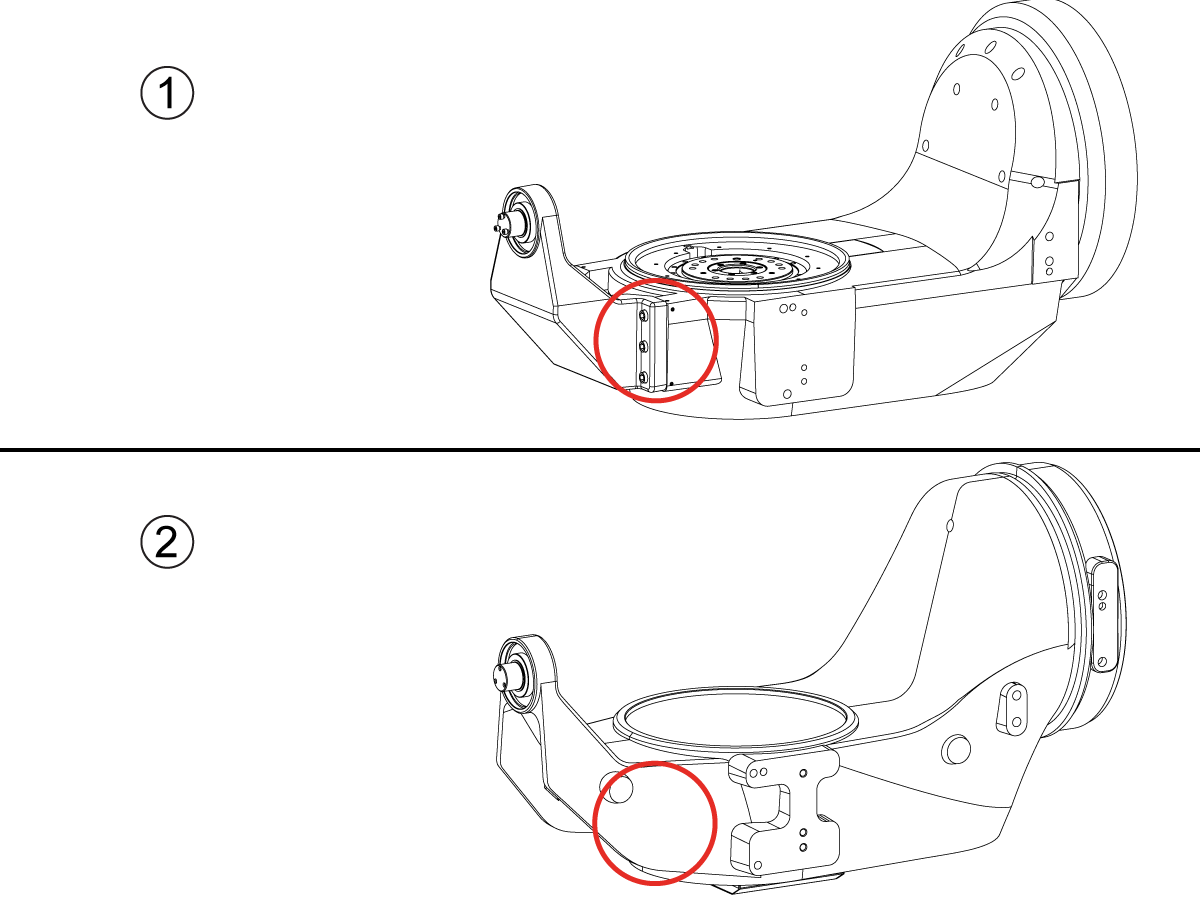
How to identify the Multi-Piece and the Unibody trunnion   

1) Multi-Piece trunnion:    UMC machines built approximetely before 11/2022 will have this configuration.

2) Unibody trunnion:    UMC machines built approximetely after 11/2022 will have this configuration.

1

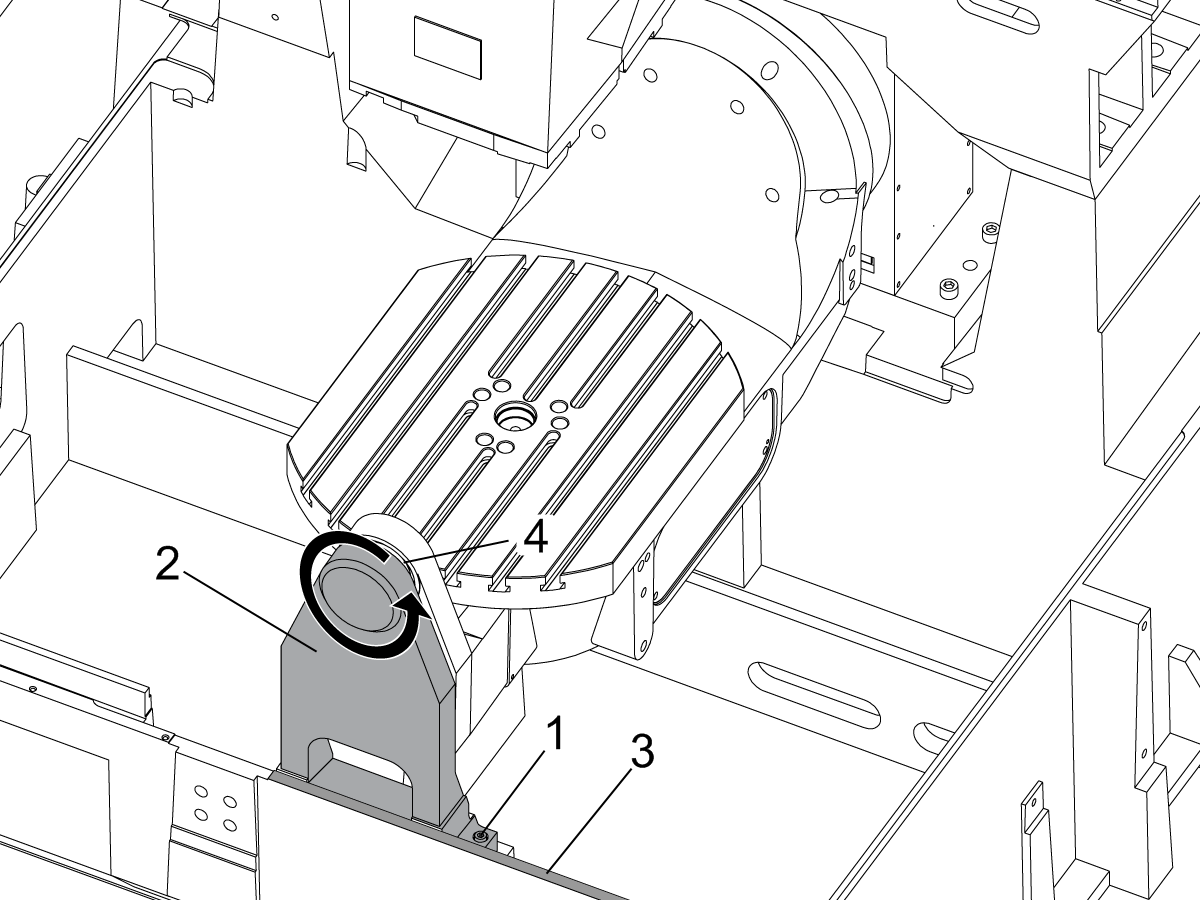
Remove the A-frame trunnion support:

Remove the bolts [1] that secure the A-frame trunnion support [2] to the base and take out the shims between A-frame support and the base.

Rotate the A-frame support [2] counter-clockwise to clear the edge of the base [3].

Pull the A-frame support off the bearings.

 Note: The A-frame support might vacuum lock on the bearings. Use the zip-tie to pry the seal [4] open.

 Caution: To lift the trunnion support, get the aid of another person. The support weighs 85 lbs (39 kg).

2

Measure the B- axis of rotation parallelism to the Y-Z plane:

For a machine with a Classic Haas Control, change Parameter 151:20 (B axis CHK TRAVL LIM) to 0.

For a machine with a Next Generation Control, change Parameter 6.021 (B axis CHK TRAVL LIM) to FALSE.

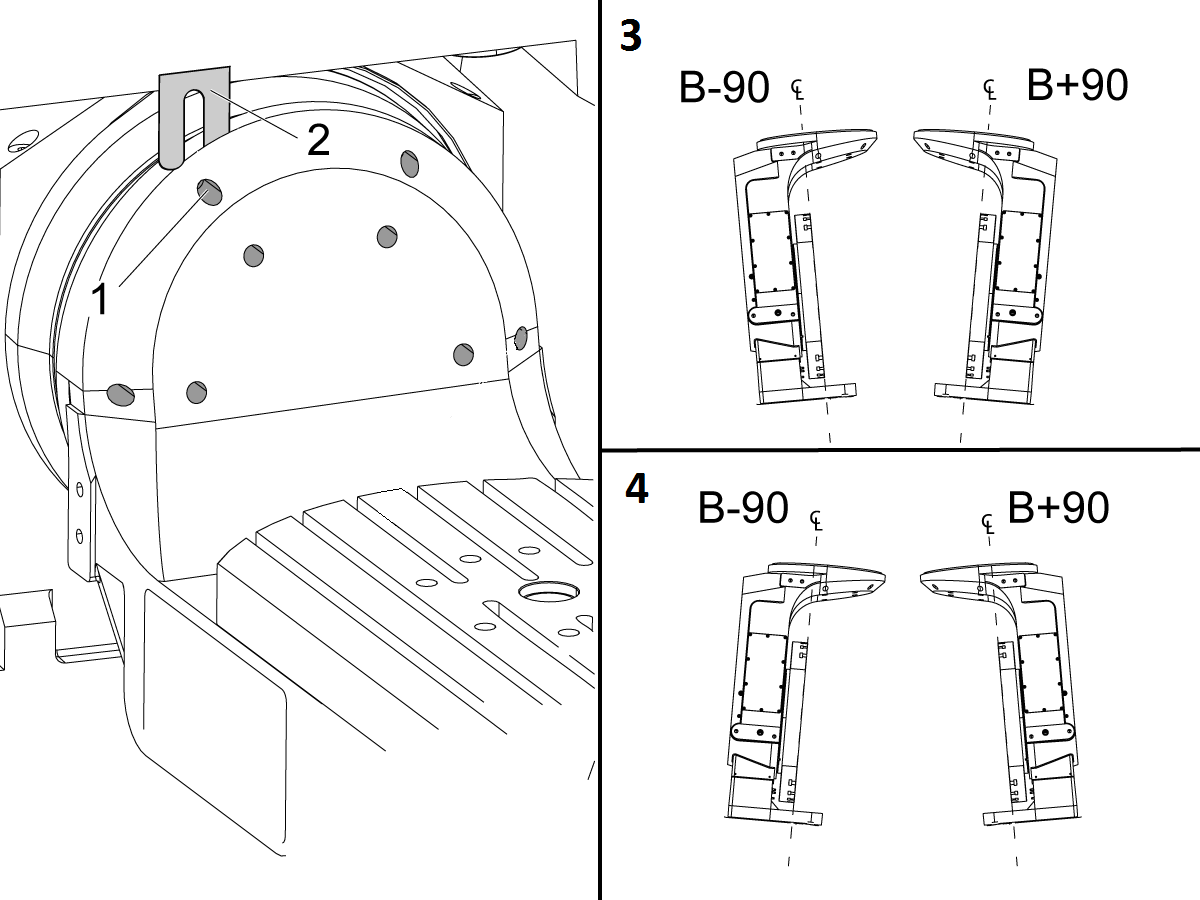
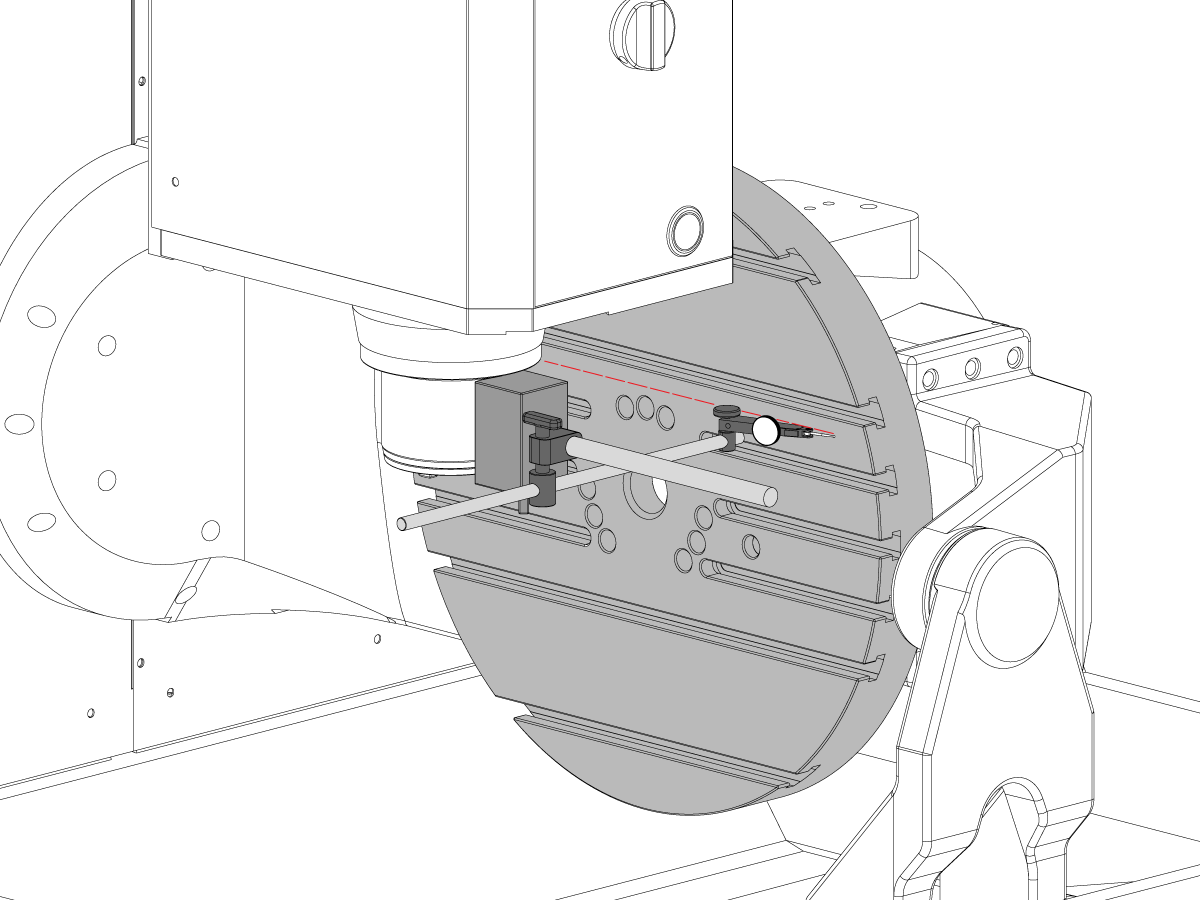
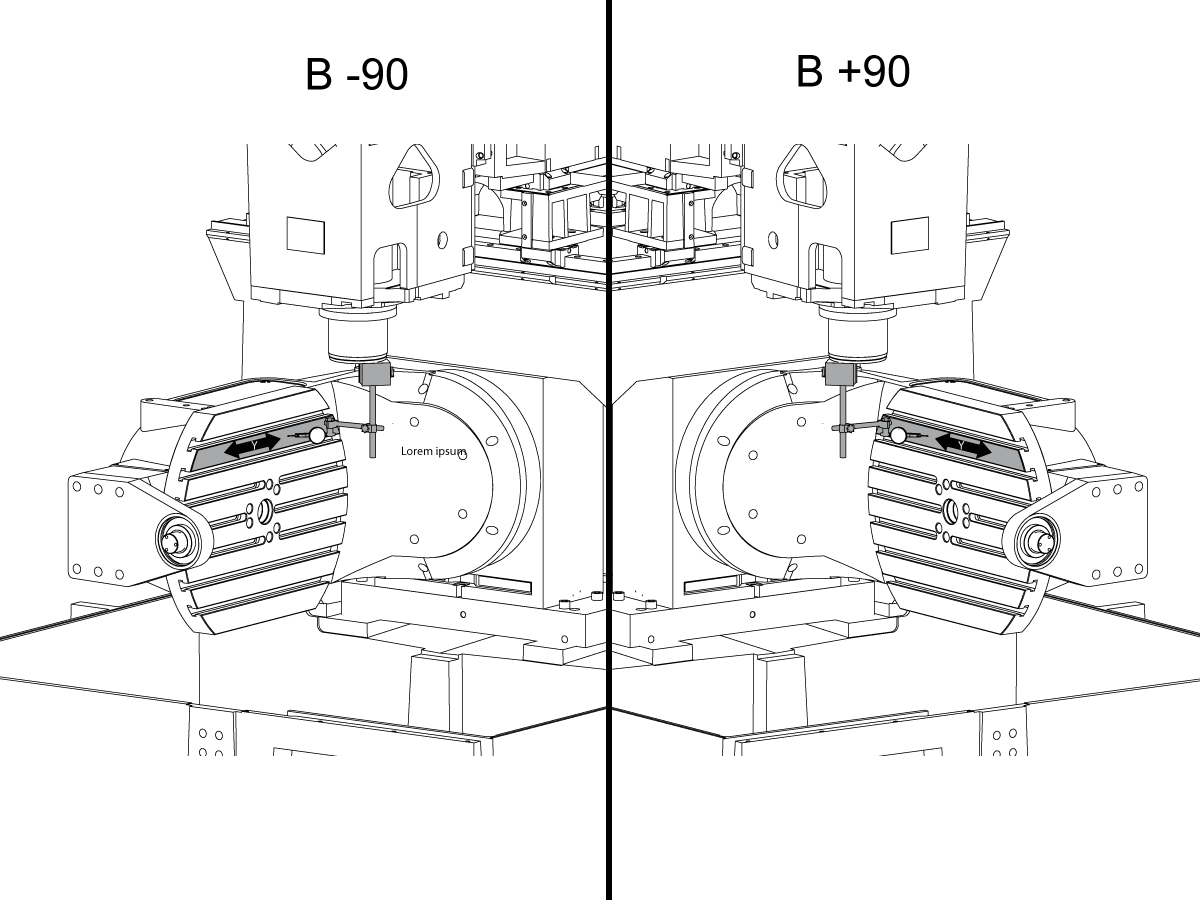
Measure the parallelism of the platter to the Y-Z plane with the B axis at 90° and then the B axis at -90° as shown in the picture.

Position the Y-Axis in the following starting position:

UMC-500: Y=0, Sweep 15”, 3rd T-Slot Land from the top.

UMC-750/1500-Duo: Y=-1.0, Sweep 18", 3rd T-Slot Land from the Top .

UMC-1250: Y=-1.0, Sweep 28", 3rd T-Slot Land from the Top.

UMC-500PP: Y=-4.0, Sweep 7".

UMC-750PP: Y=-2”, Sweep 15".

UMC-1000PP: Y=-4”, Sweep 15".

Compare the results at B 90° and B-90°. The results should be...

  • Symmetric against the Y-Z plane, positive or negative direction
  • Less than 0.0010"/20"

If the results are symmetric against Y-Z plane, and are less than 0.0010"/20 inches: Go to Step 5.

If the results are symmetric against Y-Z plane, but are more than 0.0010"/20 inches: Go to Step 4.

 Warning: If the results [3] are not symmetric against the Y-Z plane, the B axis rotary needs to be aligned: Go to Step 3.

3

Align the B axis of rotation parallel to the Y-Z plane:

Loosen the (6) bolts [1] that secure the B axis rotary to the base casting.

 Note: Keep the bolts sufficiently snug to control the adjustments.

Adjust the front and rear setscrews [2] until the measurements taken in Step 2 are symmetric against the Y-Z plane.

Torque the (6) bolts [1]. Refer to Haas Fastener Torque Specification.

Verify the measurements in Step 2 after the bolts have been torqued.

4

Align the C Axis of rotation perpendicular to the B Axis of rotation:

Remove the bottom C-Axis access cover.

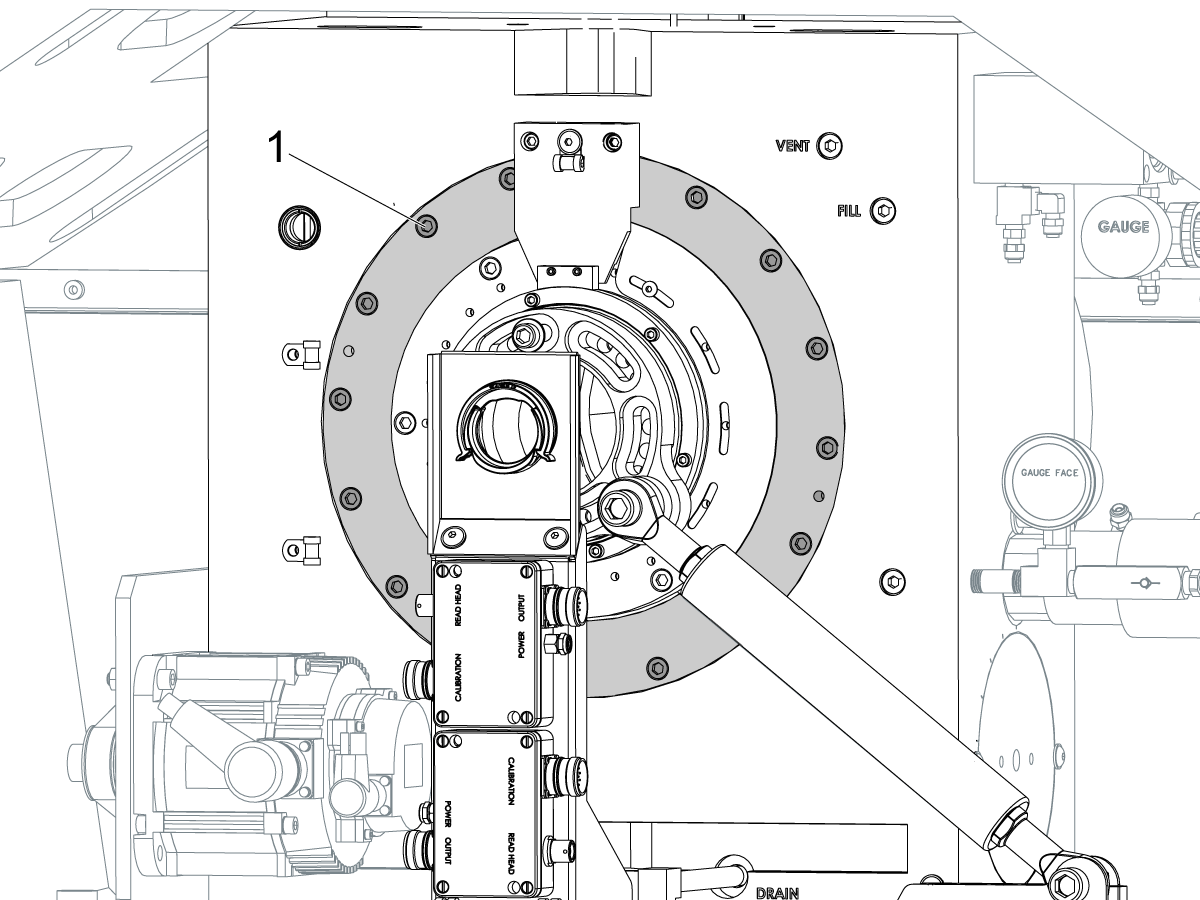
Loosen the (12) bolts [1] that hold the C Axis body to the B Axis platter face.

Reach the bottom (4) bolts through the C Axis access port.

If the B Axis is symmetric in the positive direction [4], install horseshoe shims [2] of appropriate size behind the top (2) bolts.

If the B Axis is symmetric in the negative direction [5], install horseshoe shims [2] of appropriate size behind the bottom (2) bolts.

Torque the (12) bolts to 80 Ft-lbs (108 Nm).

Cut the excessive shim material off.

Verify the measurements in Step 2 after bolts are torqued.

5

Align the trunnion support shaft co-axial with the B Axis of rotation:

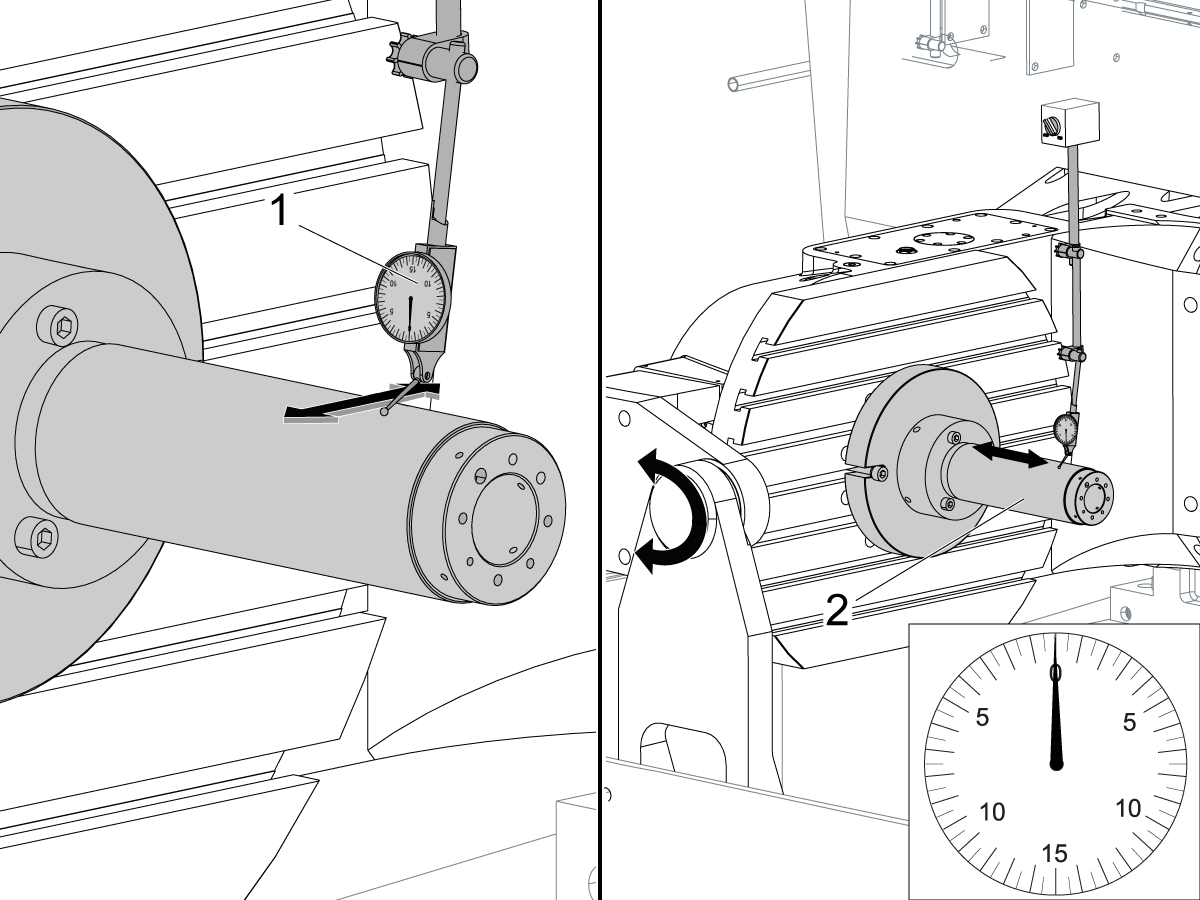
Setup (2) indicators on the outer race of the trunnion support bearing [2] as shown in the picture.

Mark the spot on the outer race where one of the indicator needles is contacting the surface.

After moving the B Axis to 90° or -90° you will align the marked spot with the needle again to exclude the bearing runout error from the measurements.

Take the readings when B is at 90° and B at -90°. Compare the readings. 

 Caution: The B axis brake needs to be clamped when taking the readings.

The deviation between the results when B is at 90° and at -90° needs to be less than 0.001" on each indicator.

 Note: The indicator on the side of the bearing will measure top to bottom alignment and the indicator on the top of the bearing will measure side to side alignment.

____

For models with a multi-piece trunnion

Loosen the (6) bolts [3] on the C Axis body support. Keep the bolts sufficiently snug to control adjustment.

Adjust the (8) set screws [4] until deviation between B at 90° and B at -90° is within 0.001".

Torque the (6) bolts [2] on the C Axis body support to 80 Ft-lbs (108 Nm).

Verify the alignment after the bolts have been torqued.

____

For models with a unibody trunnion

Jog rotary to B90. Set up an indicator on the highlighted surface as shown in the lower diagram .

Rotate B-axis 180 degrees (90 to -90).

Run out (NTE 0.010” TIR).

 Caution: If the measurement exceeds the tolerance then contact support.

6

Install and shim the A-frame trunnion support:

Move the B Axis to 90°.

Setup an indicator [1] against a machined surface of the C Axis body. Set the indicator to 0.

Use plastic zip ties [2] to pry the seal open while installing the A-frame support. This lets unwanted air and grease out of the assembly.

Install the A-frame trunnion support [3] over the bearings.

Remove the cable ties.

Turn the trunnion support clockwise until it is vertical.

 Note: The weight of the A-frame support will cause the trunnion to sag. The amount of sag is measured with the indicator that was previously setup on the side of the C Axis body.

____

For multi-piece trunnions

Adjust the shims [4] between the A-frame support and the base casting to remove the sag until indicator reads 0 again.

When the indicator reading is 0, torque the (4) bolts. Refer to Haas Fastener Torque Specification.

Verify the reading after bolts are torqued. Adjust the shims again if necessary until the indicator reads 0.

____

For models with unibody trunnion

Determine the amount of shim stock [4] needed to raise the Trunnion arm so the indicator reads 0.005".

The indicator [1] value will change once the support is torqued.

With indicator still in place:

  • Torque trunnion support bolts to appropriate values.
  • Check indicator to make sure it reads between the range of

Trunnion arm raised (0.005” to  0.010”).

 Note: For unibody trunnions, the shim location may also be used to correct the C-axis to X-Y plane perpendicularity instead of shimming the saddle trucks.

 Caution: Use equal amount of shims on each side of the A-frame support. Unequal shims will cause the A-frame support to pull the trunnion to the side.

Verify the B Axis of rotation alignment to the Y-Z plane (Step 2). Loosen the bolts and tap the A-frame support side to side if necessary to correct the B axis to Y-Z plane alignment.

7

Set C-axis perpendicular to X/Y plane:

Move the axes to

UMC-750's........X= -10.5" & Y=0."

UMC-1000's......X=-17.0" & Y=-0."

Zero an indicator [1], on a Ground Block [2], 1/2" off the edge at the rear of the platter (Mag-Base on Spindle), with C at 0 Degrees

Rotate C-Axis to 180°.

Move Y axis, and ground block, in Y Axis negative direction until you are 1/2" away from platter edge, and take the perpendicularity measurement

Adjust the shims until the average error is within 0.0005" end to end.

 Note: For unibody trunnions, the shim location under the bearing support may also be used to correct the C-axis to X-Y plane perpendicularity instead of shimming the saddle truck.

Caution: Shim either two front trucks or two rear trucks with the equal shim.

Note: Shim one truck at the time to maintain the X to Y squareness.

Verify the measurements after all bolts are torqued.

Verify the X to Y alignment in Step 2.

8

Set the tool change offsets:

B-axis tool change offset [1]

For Classic Haas Controls, change Parameter 213. 

For Next Generation Controls, go to: Settings>Rotary Tab>Highlight the rotary and press [INSERT], or change Parameter 6.078 (B TOOL CHANGE OFFSET) to set the trunnion (B Axis) parallel to the X Axis.

For models with multipiece trunnion

(NTE 0.001/10"; NTE 0.0020" overall)

For models with unibody trunnion

(NTE 0.0005/10"; NTE 0.0010" overall)

___

C-axis tool change offset [2]

For Classic Haas Controls change Parameter 523.

For Next Generation Control go to: Settings>Rotary Tab> Highlight the rotary and press [INSERT], or change Parameter 7.078 (C TOOL CHANGE OFFSET) to set the table T-slot (C Axis) parallel to the X Axis

For models with multipiece trunnion

(NTE 0.001/10"; NTE 0.0020" overall)

For models with unibody trunnion

(NTE 0.0005/10"; NTE 0.0010" overall)

9

Check C-axis perpendicularity to X/Y plane:

Align the indicator centered over the C-axis bore with the Y-axis at -10.

Jog positive in the Y-axis and align the indicator over the center of the last section of the platter and make a mark at this spot with a washable marker.

Insert 1-2-3 block as shown and set the indicator to zero.

Remove the block and rotate the platter 90 degrees, following the marked spot with the indicator.

Insert block back between the indicator and platter. Note reading.

Repeat the previous two steps, taking readings with the platter at 180, 270 and 360 degrees.

Multi-piece trunnion:  (NTE 0.0005")

Unibody trunnion: (NTE 0.001")

10

Measure the intersection of the B and C axis:

Follow the linked instruction manual to complete this step.

B-Axis and C-Axis intersection Adjustment

11

Align the B-Axis brake disk:

 Note: Do not do this step if you are working on a SS machine.

Operate this code in MDI mode to unclamp the brake:

M11;

Loosen all of the brake disc bolts [1] and torque them to 5 Ft-lbs (7 Nm).

Operate this code in MDI mode to clamp the brake:

M10;

Wait 10 seconds.

Torque the bolts. Refer to Haas Fastener Torque Specifications.

Set Parameter/Setting Back to Factory Values

CHC용 파라미터 1314/NGC용 설정 254을 공장 설정 값으로 설정합니다.(값을 변경한 후 기계의 동력을 껐다 켜십시오)

WIPS 무선 직관적 프로브 시스템(WIPS) 정렬 및 보정 - 보정

기계 회전 0점을 설정하십시오. 

  • UMC-750 - MRZP WIPS 오프셋 설정 - CHC
  • UMC-750 - MRZP WIPS 오프셋 설정 -  NGC

 완전한 검사 보고서 작성:

  • EA0420 UMC-500 검사 보고서
  • EA0373 UMC-750 검사 보고서
  • EA0418 UMC-1000 검사 보고서

검사 보고서 사본은 기계와 함께 보관하십시오.

B 및 C축 어셈블리를 교체한 경우,  UMC-750-B축 및 C축 교차-정렬

8.2 정렬 - 표시 구역

Recently Updated

UMC 정렬 표시 구역


AD0490

Indicating Zones

1

X축 롤

  • 먼저 공구 T-2192를 스핀들 측면에 부착하십시오.
  • X 롤 측정의 경우 다음 Y 및 Z축 위치를 유지하십시오.
    • UMC 500 (Y,Z): -8, -8
    • UMC 750 (Y,Z): -10, -10
    • UMC 1000 (Y,Z): -12, -12
  • X축 롤 측정(NTE 0.0005"/10")


2

B축 대 Y축 평행

  • B 및 C축 영점 복귀.
  • Y축에서 플랫터 런아웃 측정(NTE: 0.0008"/10" 0.0012"/15")
  • 그런 다음 -90°와 +90°에서 B축과 동일한 표면을 측정하십시오  (NTE: 0.0008"/10" 0.0012"/15")
  • UMC 500 및 750의 경우 플랫터의 전체 길이를 측정하십시오.
  • UMC 1000의 경우 플랫터 가장자리에서 2" 오프셋 후 20"를 가로질러 측정하십시오.

3

Y축 대 X 축 직각도

  • 재킷 스크류를 사용하여 화강암의 상단 표면을 XY 평면에 평행하게 만듭니다(NTE: 0.0002")
  • 다음으로 Y가 X에 수직인지 확인합니다(NTE 0.0005"/10")

4

Z축에 대해 X축의 직각도

  • 표시된 방향으로 플랫터에 화강암 및 정밀 실린더를 놓습니다.
  • 재킷 스크루를 사용하여 실린더 상단 표면을 XY- 평면(NTE 0.0002")과 평행하게 설정합니다.
  • 이 단계의 XY 스핀들 위치:
    • UMC 500, X = -6, Y = -8
    • UMC 750, X = -10, Y = -10
    • UMC 1000, X = -17, Y = -12
  • 이 측정의 Z 시작 위치:
    • UMC 500, Z시작 = Z위 – 2”
    • UMC 750, Z시작 = Z위 – 5”
    • UMC 1000, Z시작 = Z위 – 7”
  • Z위는 양의 방향(위)으로 Z축 이동거리 한계입니다.
  • Z시작에서, 실린더를 따라 10인치 아래로 측정

5

Z축에 대해 Y축의 직각도

  • 표시된 방향으로 플랫터에 화강암 및 정밀 실린더를 놓습니다.
  • 재킷 스크루를 사용하여 실린더 상단 표면을 XY- 평면(NTE 0.0002")과 평행하게 설정합니다.
  • 이 단계의 XY 스핀들 위치:
    • UMC 500, X = -6, Y = -8
    • UMC 750, X = -10, Y = -10
    • UMC 1000, X = -17, Y = -12
  • 이 측정의 Z 시작 위치:
    • UMC 500, Z시작 = Z위 – 2”
    • UMC 750, Z시작 = Z위 – 5”
    • UMC 1000, Z시작 = Z위 – 7”
  • Z위는  양의 방향(위)으로 Z축 이동거리 한계입니다.
  • Z시작에서, 실린더를 따라 10인치 아래로 측정

6

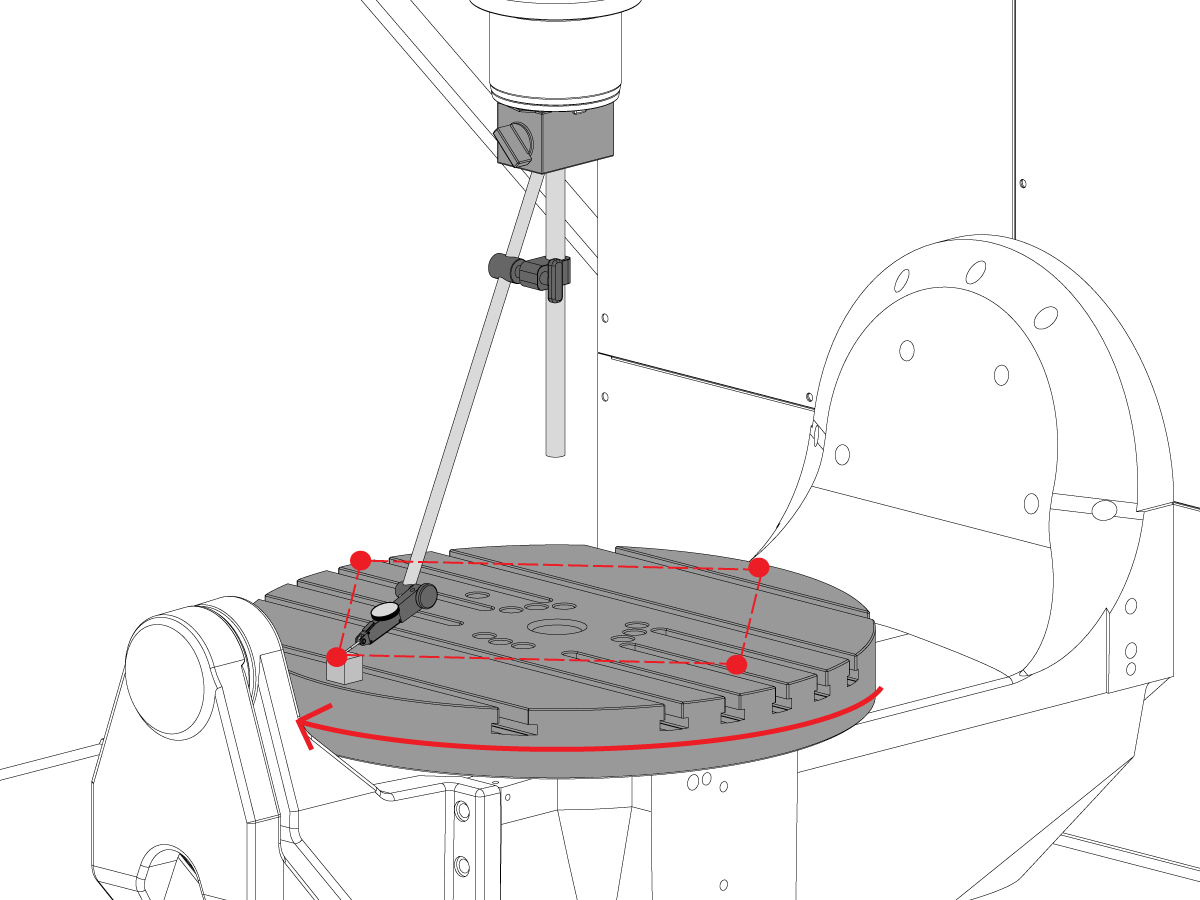
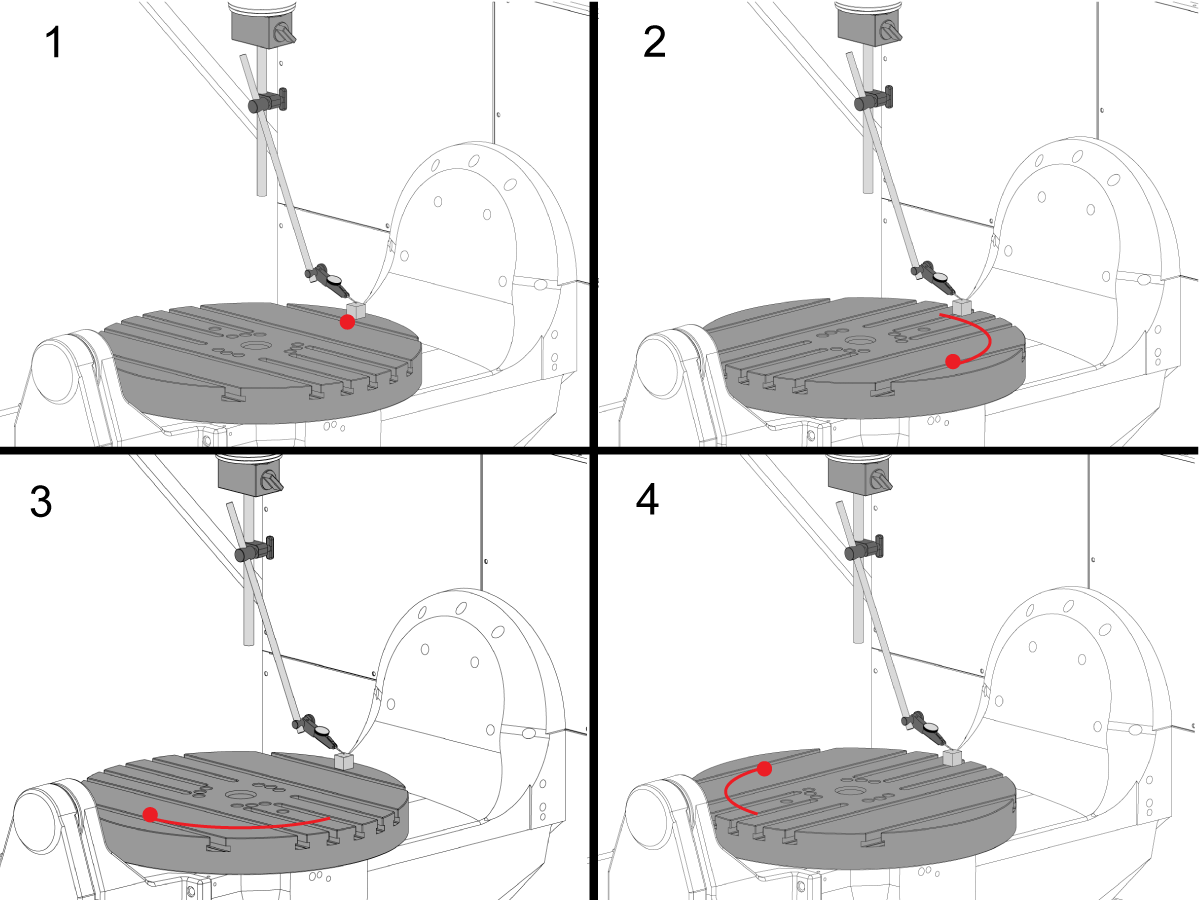
XY 평면에 대한 C축 직각도

  • 스핀들에서 매그 베이스를 재배치하여 스핀들과 함께 회전할 수 없도록 합니다.
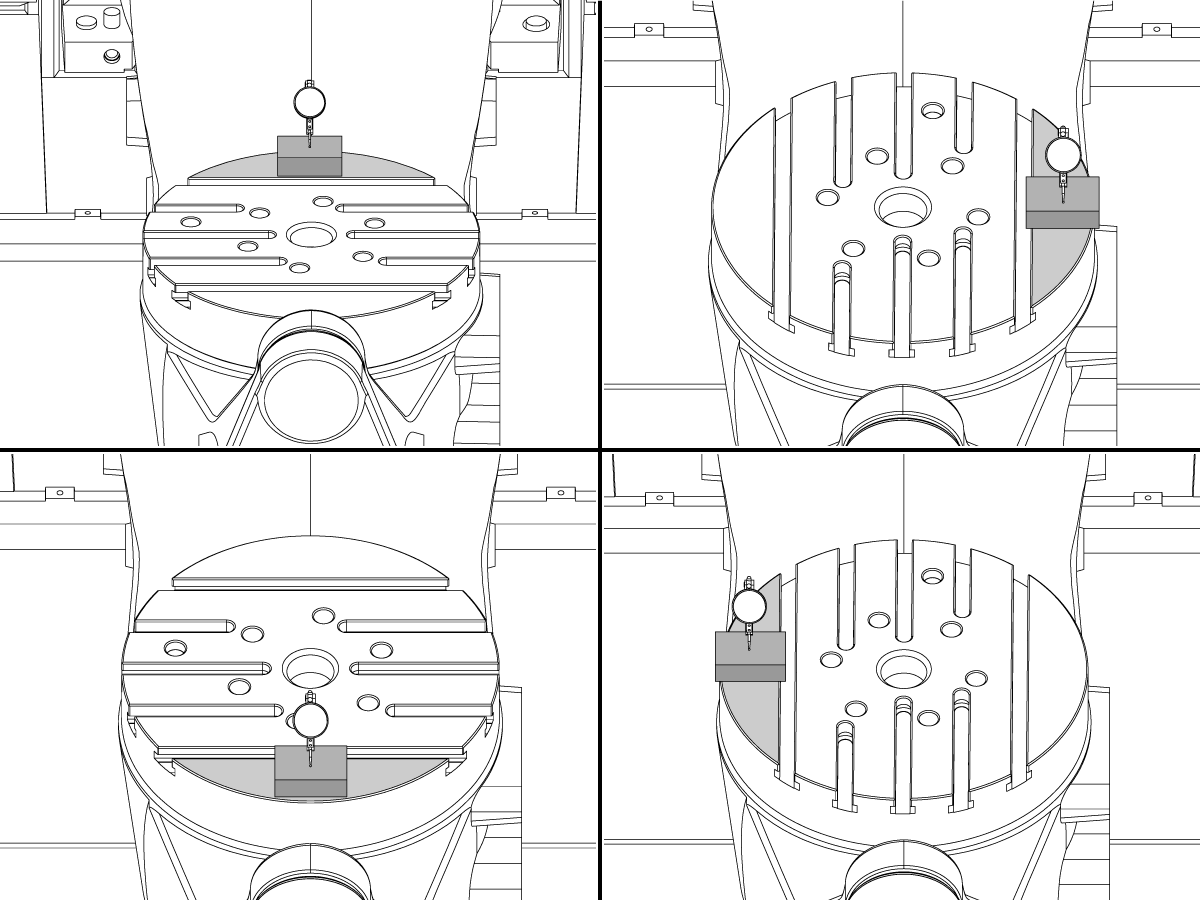
  • 12시 위치의 플랫터 가장자리에 정밀 게이지 블록을 놓습니다. 
  • 이 위치에서 게이지 블록의 표시기 팁을 제로화하십시오.
  • C축을 90° 로 회전합니다
  • 그런 다음 X 및 Y축에서 게이지 블록을 따르도록 스핀들을 조그하여 플랫터에서 동일한 지점을 측정합니다. 스핀들 회전이 없어야 합니다
  • 그림과 같이 팔레트 가장자리에서 90° 간격으로 총 4개의 위치에 대해 이 과정을 2회 더 반복하십시오. 
  • 12시 위치 측정과 6시 위치 측정의 차이는 X축을 따라 평탄도를 결정합니다(NTE 0.0005")
  • 3시 위치 측정과 9시 위치 측정의 차이는 Y축을 따라 평탄도를 결정합니다(NTE 0.0005")

7

플랫터 페이스 런아웃

참고: 이 단계에서 C축 브레이크가 꺼져 있습니다

  • 12시 위치의 플랫터 가장자리에 정밀 게이지 블록을 놓습니다. 
  • 이 위치에서 게이지 블록의 표시기 팁을 제로화하십시오.
  • C축을 90° 회전하지만, 게이지 블록을 12시 위치에 유지합니다
  • 게이지 블록의 상단에서 측정합니다
  • 그림과 같이 팔레트 가장자리에서 90° 간격으로 총 4개의 위치에 대해 이 과정을 2회 더 반복하십시오. 
  • 표시된 총 런아웃을 메모하십시오. (NTE 0.001")

8

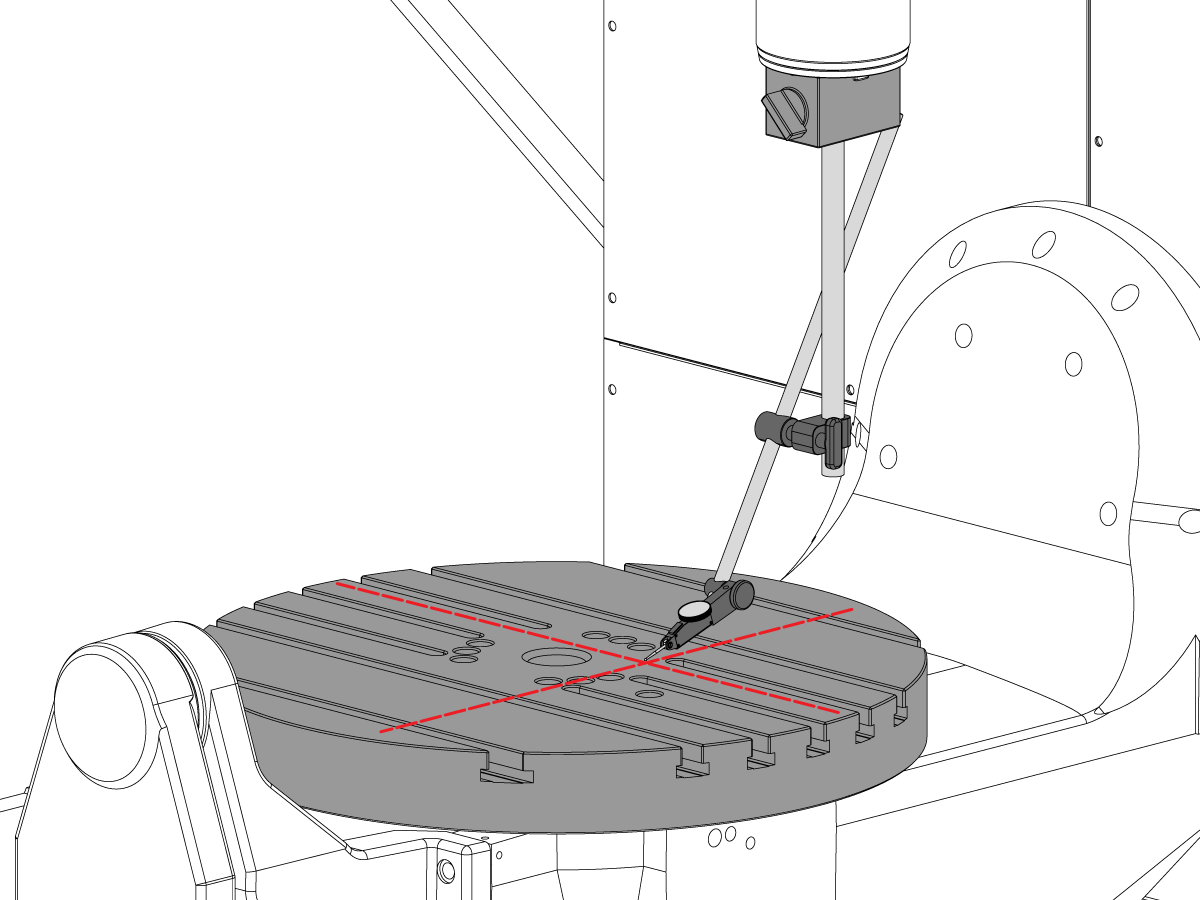
플랫터 표면과 XY 평면의 평행도

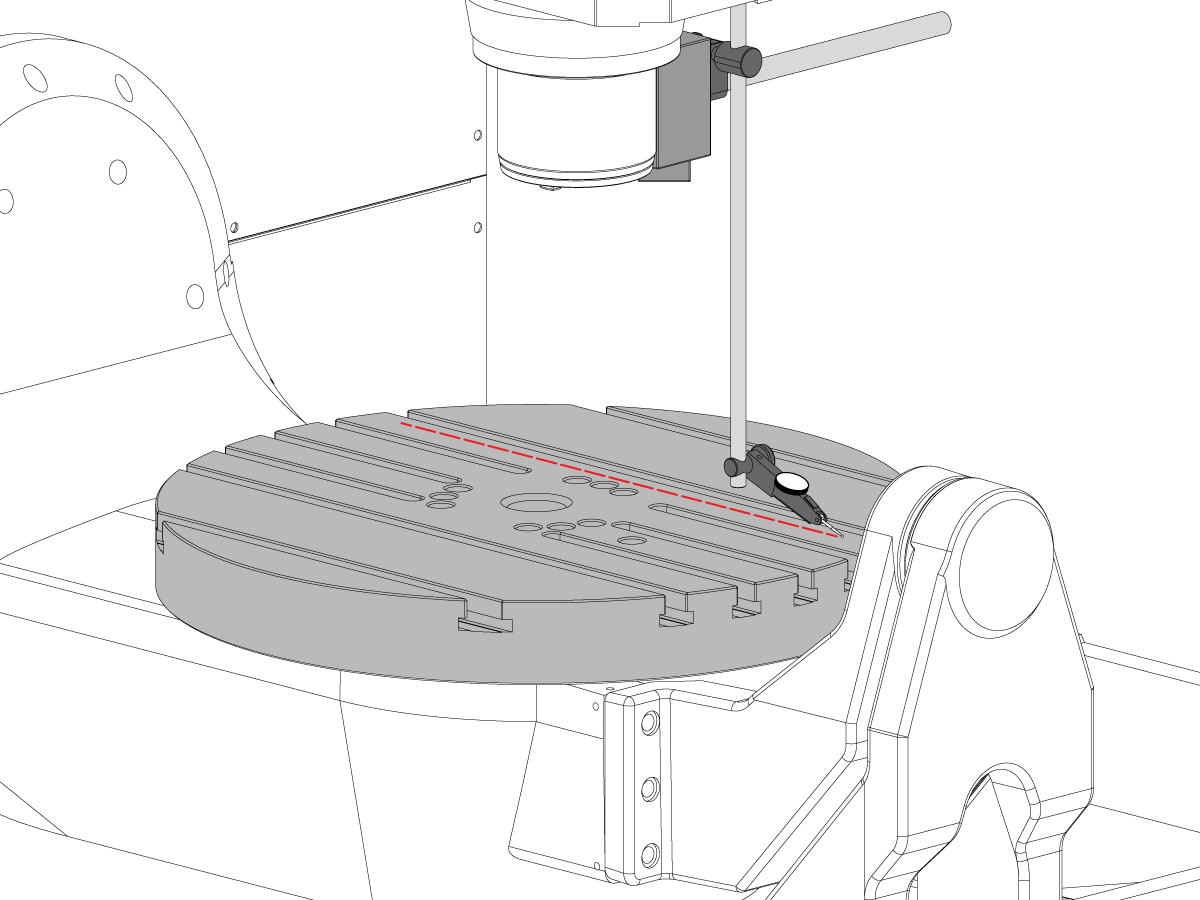
  • T-슬롯이 X축과 평행하게 작동하도록 C축을 영점 복귀합니다
  • 플랫터에 표시기 팁을 놓고 플랫터를 따라 X축으로 조그하여 X축 플랫터 평행도를 찾으십시오(NTE 0.001”/10"; 0.0015"/15")
  • 그런 다음 플랫터를 따라 Y축으로 조그하여 Y축 플랫터 평행도를 찾습니다(NTE 0.001”/10" 0.0015"/15")

9

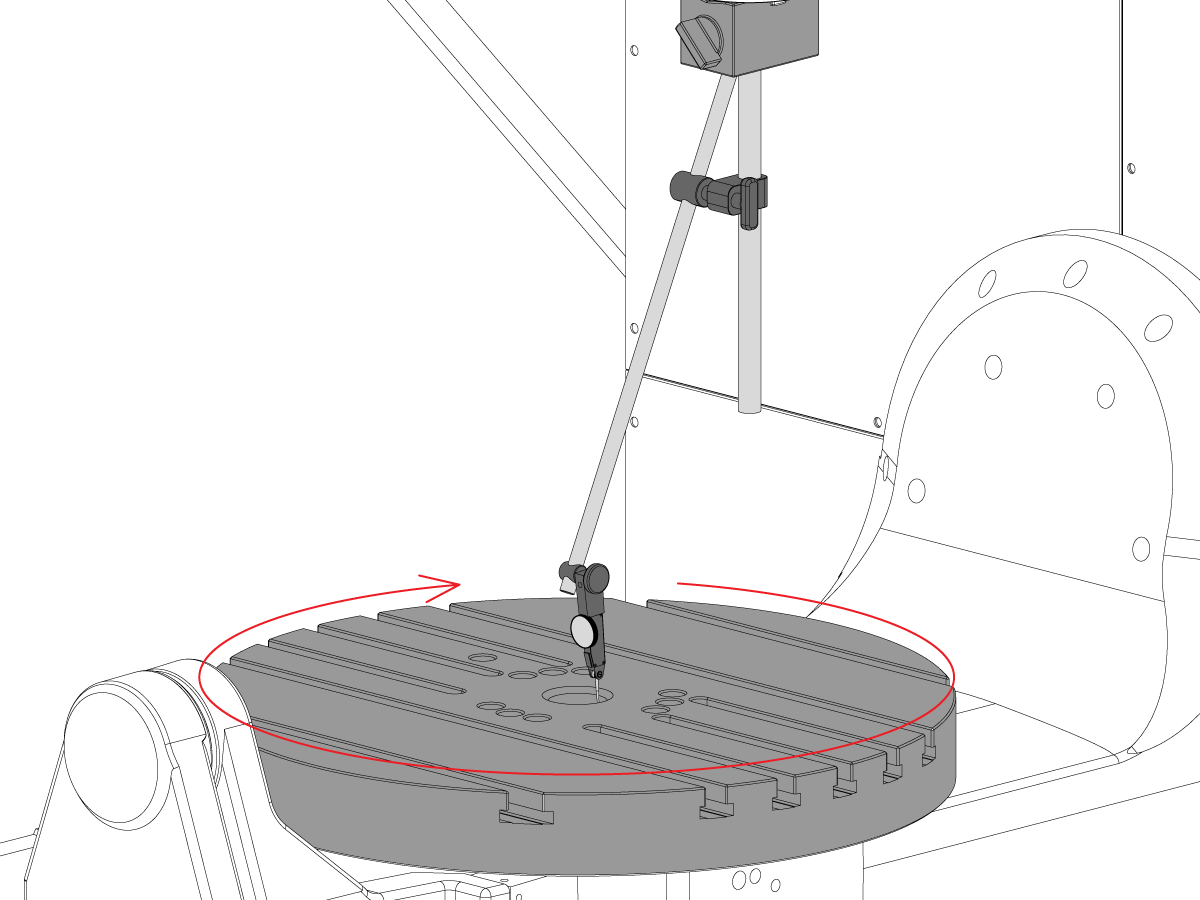
스핀들 런아웃

  • 스핀들을 C축 보어 위로 중앙에 놓습니다.
  • 매그 베이스를 테이블에 놓고 테스트 바를 삽입하십시오.
  • 테스트 바 베이스에서 스핀들 런아웃을 확인합니다(NTE 0.0005" TIR)
  • 테스트 바 베이스 6" 아래에서 스핀들 런아웃을 확인합니다(NTE 0.001" TIR)

10

스핀들 중심선과 Z축 간 평행도

  • 재킷 스크루를 사용하여 화강암을 XY 평면에 평행하게 만듭니다(NTE: 0.0002")
  • 스핀들을 C축 플랫터 보어 위로 중앙에 놓습니다
  • 10" 직경의 원으로 스윕합니다
  • XZ TIR (NTE 0.0005")을 기록합니다
  • YZ TIR (NTE 0.0005")을 기록합니다

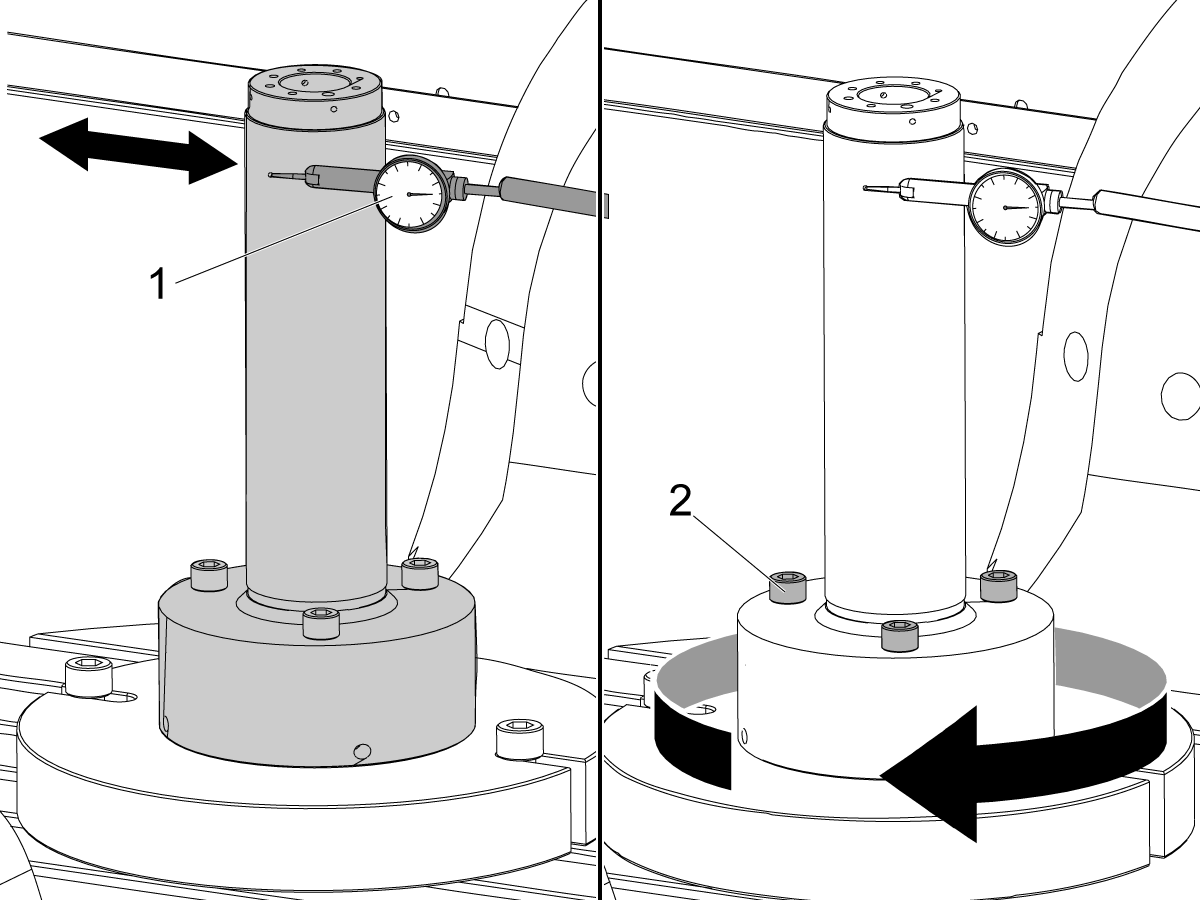
11

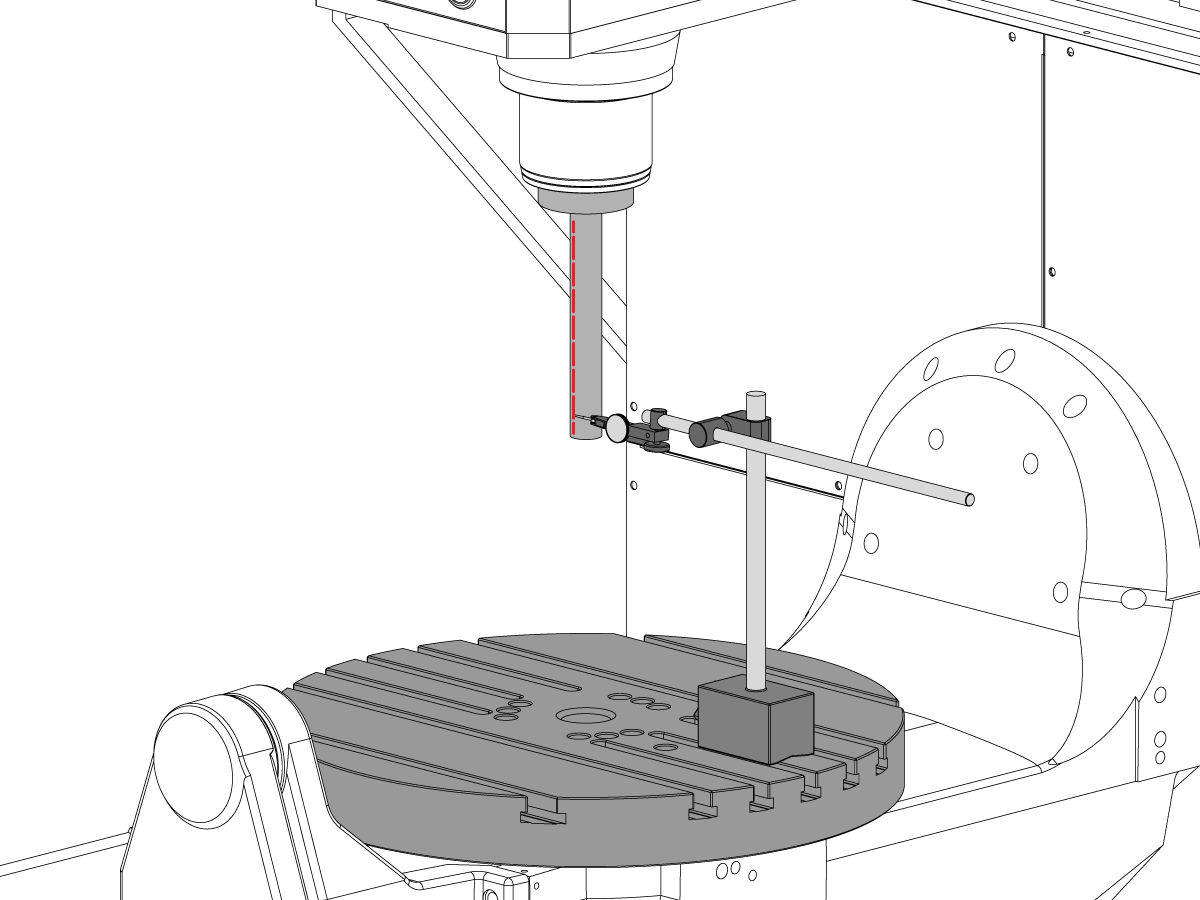
C축 보어의 동심도

  • 그림과 같이 표시기를 놓고 C축을 360° 조그합니다
  • 정밀 보어의 TIR(NTE 0.002")을 기록합니다

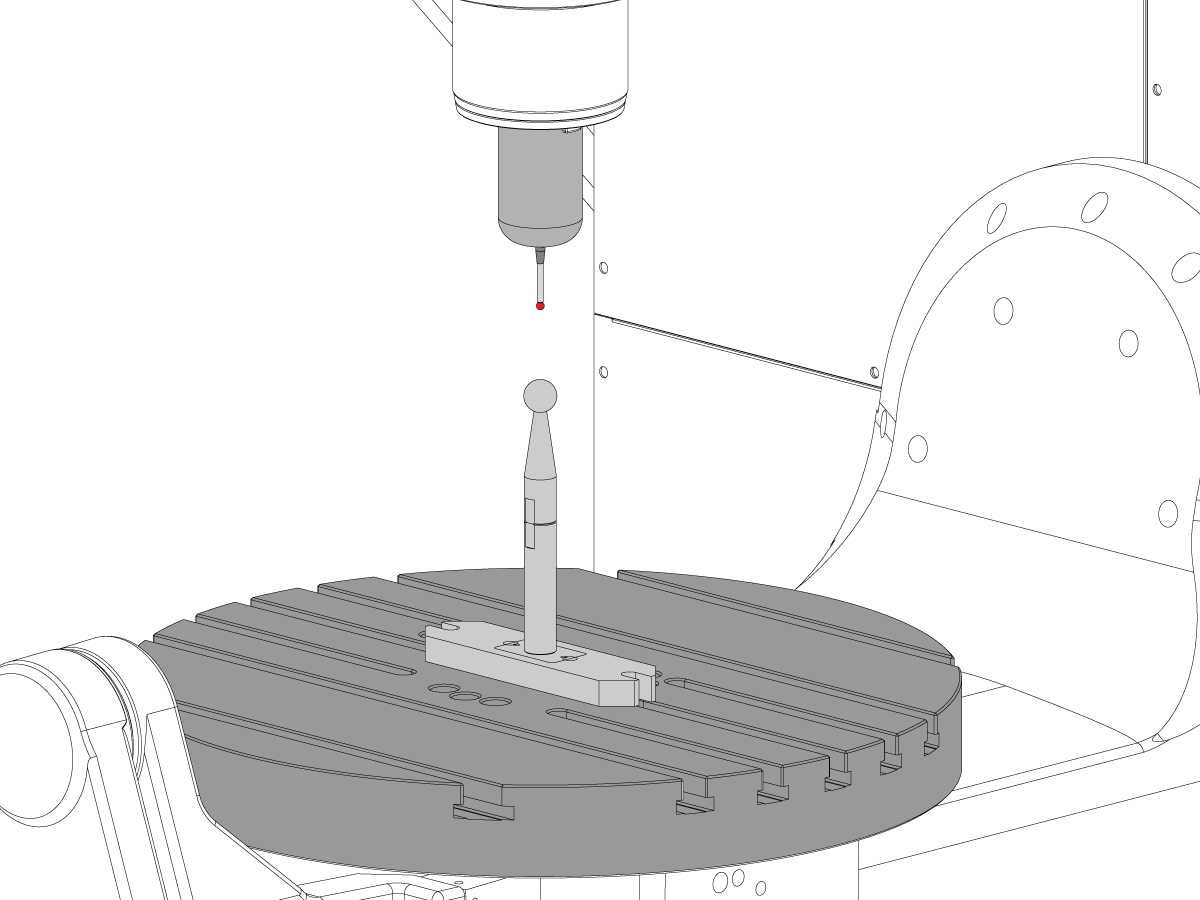
12

기계 회전 0점

  • VQC 매크로 프로그램 및 프로브 시스템을 사용하여 Coldfire 파라미터 또는 아래 표시된 NGC 설정 값을 확인하십시오.
    • 255 - MRZP X 오프셋
    • 256- MRZP Y 오프셋
    • 257- MRZP Z 오프셋
    • 254 - 5축 회전 중심 거리
  • 자세한 MRZP 지침은 Haas MRZP WIPS 오프셋 설정 절차를 를 참조하십시오

8.3 형상 - 문제 해결

Recently Updated

UMC - 형상 - 문제해결 안내서


TG0151

Overview

UMC-750 정확도 또는 형상 문제를 해결하기 전에 정비 담당자는 다음 기본 사항을 완전히 이해해야 합니다.

  • UMC의 회전축을 수평 및 정렬하는 방법
  • 기계의 모든축을 다시 정렬하는 방법
  • MRZP 보정을 수행하는 방법 및 관련 파라미터가 무엇인지 철저히 이해하고 기계에 미치는 영향
  • 기계 정확도 기능과 기하학적 문제를 통해 추론하는 능력에 대한 이해
  • B-C축 교차 정렬

UMC-750 기계 구조 또는 정확도 관련 문제는 체계적이고 적절한 순서로 접근해야 합니다. 다음 정보는 엄격하게 준수하고 순서대로 따라야 합니다.

기계 형상을 평가하거나 조정하기 전에 기계의 회전축과 기계의 올바른 레벨 및 정렬을 점검해야 합니다.

기계 오류나 툴링 응용 프로그램 또는 프로그래밍 문제로 인해 기계에 많은 오류가 발생했을 수 있습니다. 검사 보고서에 따라 기계의 전체 레벨과 형상을 완전히 확인하지 않고 기계 형상을 변경하지 마십시오. 여기에는 Machine Rotary Zero Point (MRZP)점검이 포함됩니다.

충돌 시 기계에 4개의 슬립 조인트가 있습니다. 이 영역은 스핀들 헤드를 램으로, 램을 안장으로, 안장을 브리지로, 트러 니언을 트러 니언 지지대로 향합니다.

 참고: 이 연결부 중 어느 것도 쉼되어서는 안됩니다. 기계 충돌은 절대로 공장 설정에서 기계에 필요한 쉼의 양을 변경해서는 안됩니다.

기계의 선형 정확도는 0.0004/10입니다." 각도 정확도는 +/- 15 arc입니다. 비서. 이러한 공차는 빠르게 누적될 수 있습니다.

가공 작업이 합리적인지, 기계 내에서, 고정 및 툴링 능력 내에 있는지 결정하기 위해 모든 노력을 다해야 합니다.

Assess Machine Condition

기계가 이전에 충돌했는지 확인하십시오. 알람 이력을 검토하십시오. 판금, 테이블, 스핀들 헤드 등의 물리적 손상을 찾으십시오. 아무리 "minor" 충돌은 기계의 형상에 영향을 미칩니다. 기계가 추락한 경우 기계 형상의 전체 검사를 수행해야 합니다.

부품 고정 장치의 전반적인 상태와 절삭 공구의 상태를 평가합니다.

전체 기계 백업 및 오류 보고서를받습니다.

Verify Machine Level and Geometry

기계가 수평이고 회전축이 기계와 정렬되어 있는지 확인하십시오

 참고: 이때 수평 피트를 조정하는 것 이외의 기계 형상을 조정하려고 시도하지 마십시오.

기계가 수평이 아니거나 회전가 정렬되지 않은 경우 레벨 및 회전 정렬을 재설정하십시오.

각 축에 대해 오류의 크기와 방향을 기록하여 전체 형상 검사를 수행하십시오.

검사 보고서를 분석하십시오.

검사 보고서의 섹션 중 하나라도 공차를 벗어나면 기계를 다시 정렬해야 합니다.

Review application

부품, 공작물 고정 및 툴링에 대한 다음 정보를 수집하십시오.

  • 허용 오차, 크기, 오류 방향을 벗어난 기능
  • 부품이 5축, 3 + 2축 또는 3축으로 가공됩니까?
  • 부품 및 가공 방법 검토
  • 가공 접근 방식을 변경하여 부품 정확도 오류를 최소화할 수 있습니까?
  • 문제가 반복 정밀도, 크기 문제 또는 기하학적 문제입니까?
  • 본 프로그램은 TCPC 또는 DWO를 사용합니까?
  • 보상 테이블에 값이 있습니까?

8.4 응용 장치 - 문제 해결

Recently Updated

UMC - 응용 장치 - 문제해결 안내서


TG0150

How to Access

UMC 응용 장치 문제 해결 안내서를 참조하려면:

이 링크(문서 및 소프트웨어 | HBC

)를 따라

또는

HBC.HAASCNC.COM

에 로그인합니다.

참고: Haas 공인 서비스 기술자만이 사이트에 로그인할 수 있습니다.

서비스 탭을 선택합니다.

유틸리티에서 문서 및 소프트웨어를 선택합니다.

응용 장치 폴더를 선택합니다.

8.5 UMC-750 - 쉼 키트 체크리스트

Recently Updated

UMC-750 - 심 키트 점검 목록


AD0131

Introduction

이는 다음 키트에 대한 심 키트 점검 목록입니다.

  • 93-2236 LOANER, SHIM KIT FOR UMC-750

Checklist: Shim-Spacer-Column

두께 공작물 # 키트의 수량 사용
.02100 20-9358A 2  
0.2105 20-9359A 2  
.02110 20-9383A 2  
0.2115 20-9365A 2  
0.2120 20-9384A 2  
0.2125 20-9385A 2  
0.2130 20-9368A 2  
0.2135 20-9369A 2  
0.2140 20-9386A 2  
0.2145 20-9371A 2  
0.2150 20-9372A 2  
0.2155 20-9387A 2  
0.2160 20-9374A 2  
0.2165 20-9375A 2  
0.2170 20-9376A 2  
0.2175 20-9377A 2  
0.2180 20-9378A 2  
0.2185 20-9379A 2  
0.2190 20-9380A 2  
0.2195 20-9381A 2  
0.2200 20-9382A 2  

참고: 키트 소유자만 해당: 교체품을 주문할 때 심 두께를 지정하십시오. 예: 20-9382 0.2145

Checklist: Horshoe Shims

두께 공작물 # 키트의 수량 사용
0.0010 59-0240 2  
0.0020 59-0241 2  
0.0030 59-0242 2  

Checklist: Shim-Spacer-Column-Large

두께 공작물 # 키트의 수량 사용
0.2130 20-6282A 2  
0.2135 20-6283A 2  
0.2140 20-6284A 2  
0.2145 20-6285A 2  
0.2150 20-6286A 2  
0.2155 20-6287A 2  
0.2160 20-6288A 2  
0.2165 20-6289A 2  
0.2170 20-6290A
2  
0.2175 20-6291A 2  
0.2180 20-6294A 2  
0.2185 20-6295A 2  
0.2190 20-6292A 2  
0.2195 20-6293A 2  
0.2200 20-6296A 2  
0.2205 20-6297A 2  
0.2210 20-6277A 2  
0.2215 20-6279A 2  
0.2220 20-6278A 2  
0.2225 20-6298A 2  
0.2230 20-6281A 2  

참고: 키트 소유자만 해당: 교체품을 주문할 때 심 두께를 지정하십시오. 예: 20-6290A 0.2080

사용된 컬럼의 키트에서 제거된 쉼을 기록합니다.

쉼 키트와 함께 체크 리스트를 반환하십시오.

상자에 원래 쉼을 반환하십시오.

8.6 B/C - 축 교차 - 정렬

Introduction

이 절차에서는 B축과 C축의 교차점을 측정하고 정렬하는 방법을 보여줍니다.  이 절차를 시도하기 전에 UMC-750 수평 조절에 따라 기계의 수평이 맞는지 확인하십시오.

다음 중 하나를 수행한 후 B축 및 C축을 정렬해야 합니다.

  • B축 및 C축을 교체합니다
  • 또는 UMC 검사 보고를 완료하고 문제를 찾습니다

5축 회전 중심 거리는 회전의 회전 중심점 간의 차이를 정의합니다. X축 내 C축 기계 회전 영점(MRZP) 및 B축 MRZP.

C축 및 B축 MRZP간에 차이가 없을 수도 있습니다..

  • 클래식 Haas 제어장치 (CHC): 파라미터 1314 - Rotary Axes Center Deviation in X
  • 차세대 제어장치(NGC): 설정 254 - 5 Axis Rotary Center Distance

다음 도구가 필요합니다.

  • T-2195A UMC Aligment Bar Adapter
  • T-2113 Alignment bar
  • 히트 건 및 내열 장갑

B Axis to XYZ Axes Alignment

How to identify the Multi-Piece and the Unibody trunnion   

1) Multi-Piece trunnion:    UMC machines built approximetely before 11/2022 will have this configuration.

2) Unibody trunnion:    UMC machines built approximetely after 11/2022 will have this configuration.

1

Remove the A-frame trunnion support:

Remove the bolts [1] that secure the A-frame trunnion support [2] to the base and take out the shims between A-frame support and the base.

Rotate the A-frame support [2] counter-clockwise to clear the edge of the base [3].

Pull the A-frame support off the bearings.

 Note: The A-frame support might vacuum lock on the bearings. Use the zip-tie to pry the seal [4] open.

 Caution: To lift the trunnion support, get the aid of another person. The support weighs 85 lbs (39 kg).

2

Measure the B- axis of rotation parallelism to the Y-Z plane:

For a machine with a Classic Haas Control, change Parameter 151:20 (B axis CHK TRAVL LIM) to 0.

For a machine with a Next Generation Control, change Parameter 6.021 (B axis CHK TRAVL LIM) to FALSE.

Measure the parallelism of the platter to the Y-Z plane with the B axis at 90° and then the B axis at -90° as shown in the picture.

Position the Y-Axis in the following starting position:

UMC-500: Y=0, Sweep 15”, 3rd T-Slot Land from the top.

UMC-750/1500-Duo: Y=-1.0, Sweep 18", 3rd T-Slot Land from the Top .

UMC-1250: Y=-1.0, Sweep 28", 3rd T-Slot Land from the Top.

UMC-500PP: Y=-4.0, Sweep 7".

UMC-750PP: Y=-2”, Sweep 15".

UMC-1000PP: Y=-4”, Sweep 15".

Compare the results at B 90° and B-90°. The results should be...

  • Symmetric against the Y-Z plane, positive or negative direction
  • Less than 0.0010"/20"

If the results are symmetric against Y-Z plane, and are less than 0.0010"/20 inches: Go to Step 5.

If the results are symmetric against Y-Z plane, but are more than 0.0010"/20 inches: Go to Step 4.

 Warning: If the results [3] are not symmetric against the Y-Z plane, the B axis rotary needs to be aligned: Go to Step 3.

3

Align the B axis of rotation parallel to the Y-Z plane:

Loosen the (6) bolts [1] that secure the B axis rotary to the base casting.

 Note: Keep the bolts sufficiently snug to control the adjustments.

Adjust the front and rear setscrews [2] until the measurements taken in Step 2 are symmetric against the Y-Z plane.

Torque the (6) bolts [1]. Refer to Haas Fastener Torque Specification.

Verify the measurements in Step 2 after the bolts have been torqued.

4

Align the C Axis of rotation perpendicular to the B Axis of rotation:

Remove the bottom C-Axis access cover.

Loosen the (12) bolts [1] that hold the C Axis body to the B Axis platter face.

Reach the bottom (4) bolts through the C Axis access port.

If the B Axis is symmetric in the positive direction [4], install horseshoe shims [2] of appropriate size behind the top (2) bolts.

If the B Axis is symmetric in the negative direction [5], install horseshoe shims [2] of appropriate size behind the bottom (2) bolts.

Torque the (12) bolts to 80 Ft-lbs (108 Nm).

Cut the excessive shim material off.

Verify the measurements in Step 2 after bolts are torqued.

5

Align the trunnion support shaft co-axial with the B Axis of rotation:

Setup (2) indicators on the outer race of the trunnion support bearing [2] as shown in the picture.

Mark the spot on the outer race where one of the indicator needles is contacting the surface.

After moving the B Axis to 90° or -90° you will align the marked spot with the needle again to exclude the bearing runout error from the measurements.

Take the readings when B is at 90° and B at -90°. Compare the readings. 

 Caution: The B axis brake needs to be clamped when taking the readings.

The deviation between the results when B is at 90° and at -90° needs to be less than 0.001" on each indicator.

 Note: The indicator on the side of the bearing will measure top to bottom alignment and the indicator on the top of the bearing will measure side to side alignment.

____

For models with a multi-piece trunnion

Loosen the (6) bolts [3] on the C Axis body support. Keep the bolts sufficiently snug to control adjustment.

Adjust the (8) set screws [4] until deviation between B at 90° and B at -90° is within 0.001".

Torque the (6) bolts [2] on the C Axis body support to 80 Ft-lbs (108 Nm).

Verify the alignment after the bolts have been torqued.

____

For models with a unibody trunnion

Jog rotary to B90. Set up an indicator on the highlighted surface as shown in the lower diagram .

Rotate B-axis 180 degrees (90 to -90).

Run out (NTE 0.010” TIR).

 Caution: If the measurement exceeds the tolerance then contact support.

6

Install and shim the A-frame trunnion support:

Move the B Axis to 90°.

Setup an indicator [1] against a machined surface of the C Axis body. Set the indicator to 0.

Use plastic zip ties [2] to pry the seal open while installing the A-frame support. This lets unwanted air and grease out of the assembly.

Install the A-frame trunnion support [3] over the bearings.

Remove the cable ties.

Turn the trunnion support clockwise until it is vertical.

 Note: The weight of the A-frame support will cause the trunnion to sag. The amount of sag is measured with the indicator that was previously setup on the side of the C Axis body.

____

For multi-piece trunnions

Adjust the shims [4] between the A-frame support and the base casting to remove the sag until indicator reads 0 again.

When the indicator reading is 0, torque the (4) bolts. Refer to Haas Fastener Torque Specification.

Verify the reading after bolts are torqued. Adjust the shims again if necessary until the indicator reads 0.

____

For models with unibody trunnion

Determine the amount of shim stock [4] needed to raise the Trunnion arm so the indicator reads 0.005".

The indicator [1] value will change once the support is torqued.

With indicator still in place:

  • Torque trunnion support bolts to appropriate values.
  • Check indicator to make sure it reads between the range of

Trunnion arm raised (0.005” to  0.010”).

 Note: For unibody trunnions, the shim location may also be used to correct the C-axis to X-Y plane perpendicularity instead of shimming the saddle trucks.

 Caution: Use equal amount of shims on each side of the A-frame support. Unequal shims will cause the A-frame support to pull the trunnion to the side.

Verify the B Axis of rotation alignment to the Y-Z plane (Step 2). Loosen the bolts and tap the A-frame support side to side if necessary to correct the B axis to Y-Z plane alignment.

7

Set C-axis perpendicular to X/Y plane:

Move the axes to

UMC-750's........X= -10.5" & Y=0."

UMC-1000's......X=-17.0" & Y=-0."

Zero an indicator [1], on a Ground Block [2], 1/2" off the edge at the rear of the platter (Mag-Base on Spindle), with C at 0 Degrees

Rotate C-Axis to 180°.

Move Y axis, and ground block, in Y Axis negative direction until you are 1/2" away from platter edge, and take the perpendicularity measurement

Adjust the shims until the average error is within 0.0005" end to end.

 Note: For unibody trunnions, the shim location under the bearing support may also be used to correct the C-axis to X-Y plane perpendicularity instead of shimming the saddle truck.

Caution: Shim either two front trucks or two rear trucks with the equal shim.

Note: Shim one truck at the time to maintain the X to Y squareness.

Verify the measurements after all bolts are torqued.

Verify the X to Y alignment in Step 2.

8

Set the tool change offsets:

B-axis tool change offset [1]

For Classic Haas Controls, change Parameter 213. 

For Next Generation Controls, go to: Settings>Rotary Tab>Highlight the rotary and press [INSERT], or change Parameter 6.078 (B TOOL CHANGE OFFSET) to set the trunnion (B Axis) parallel to the X Axis.

For models with multipiece trunnion

(NTE 0.001/10"; NTE 0.0020" overall)

For models with unibody trunnion

(NTE 0.0005/10"; NTE 0.0010" overall)

___

C-axis tool change offset [2]

For Classic Haas Controls change Parameter 523.

For Next Generation Control go to: Settings>Rotary Tab> Highlight the rotary and press [INSERT], or change Parameter 7.078 (C TOOL CHANGE OFFSET) to set the table T-slot (C Axis) parallel to the X Axis

For models with multipiece trunnion

(NTE 0.001/10"; NTE 0.0020" overall)

For models with unibody trunnion

(NTE 0.0005/10"; NTE 0.0010" overall)

9

Check C-axis perpendicularity to X/Y plane:

Align the indicator centered over the C-axis bore with the Y-axis at -10.

Jog positive in the Y-axis and align the indicator over the center of the last section of the platter and make a mark at this spot with a washable marker.

Insert 1-2-3 block as shown and set the indicator to zero.

Remove the block and rotate the platter 90 degrees, following the marked spot with the indicator.

Insert block back between the indicator and platter. Note reading.

Repeat the previous two steps, taking readings with the platter at 180, 270 and 360 degrees.

Multi-piece trunnion:  (NTE 0.0005")

Unibody trunnion: (NTE 0.001")

10

Measure the intersection of the B and C axis:

Follow the linked instruction manual to complete this step.

B-Axis and C-Axis intersection Adjustment

11

Align the B-Axis brake disk:

 Note: Do not do this step if you are working on a SS machine.

Operate this code in MDI mode to unclamp the brake:

M11;

Loosen all of the brake disc bolts [1] and torque them to 5 Ft-lbs (7 Nm).

Operate this code in MDI mode to clamp the brake:

M10;

Wait 10 seconds.

Torque the bolts. Refer to Haas Fastener Torque Specifications.

B Axis to C Axis Intersection Tool Setup

1

Install the B Axis and C Axis intersection tool:

Jog the C Axis to 0°.

Push [EMERGENCY STOP].

Clean the table.

Guide the shaft of the adapter [1] while you slowly lower it into the center bore.

Attach the adapter to the table with (2) screws [4] and (2) T-nuts.

Attach the alignment bar [2] to the adapter with (3) screws [3].

Snug the (3) screws to allow for adjustments in the next step.

2

Align the B/C intersection tool with the C Axis:

Put an indicator on the front side of the alignment bar near the base.

Release the [EMERGENCY STOP]. Push [RESET] to clear any alarms.

Jog across the tool in the X Axis to find the high spot.

Set the indicator to 0.

Jog the C Axis 360°.

Lightly tap the base with a rubber mallet to adjust the radial error on the alignment bar.

Note: Adjust the alignment bar to half of the measured error, because you are measuring the diameter error.

Jog the C Axis 360°.

When correctly adjusted the radial error is less than 0.0002" (0.005 mm).

3

Check the B/C intersection:

Center the indicator [1] on the front side of the alignment bar near the top of the cylinder.

Jog across the tool in the X Axis to find the high spot.

Zero the indicator.

Jog the C Axis 360°.

Turn the (3) screws [2] on the alignment bar to adjust the runout.

Jog the C Axis 360°.

When correctly adjusted the radial error is less than 0.0002" (0.005 mm).

Repeat Step 2 and verify the alignment did not change.

B Axis to C Axis Intersection Adjustment

1

For a machine with a Classic Haas Control change:

  • Parameter 151:20 (B-axis CHK TRAVL LIM) to 0.
  • Parameter 1314 (ROTARY AXIS CENTER DEVIATION IN X) to 0.

For a machine with a Next Generation Control change:

  • Parameter 6.021 (B-axis CHK TRAVL LIM) to FALSE.
  • Setting 254 (5-Axis Rotary Center Distance) to 0.

Push [ZERO RETURN]. Then push [ALL].

Jog the B-axis to -90°.

Note: The rotary positions are for reference only.

Put an indicator [1] on top of the alignment bar.

Jog in the Y-axis to find the high point.

Set the indicator to 0.

Jog across the alignment bar in the X-axis [2].

Jog the B-axis to adjust the alignment bar parallel to the X plane.

Set the indicator to 0.

Jog the Y-axis to 0.

Caution: Make sure the indicator assembly is clear of the B-axis movement.

 Caution: Do not move the Z-axis.

2

Jog the B-axis to +90°.

 Caution: Make sure the indicator assembly is clear of the B-axis movement.

Jog the Y-axis [1] to find the high point on the alignment bar.

Note: Do not set the indicator to 0.

Jog across the alignment bar in the X-axis.

Jog the B-axis to adjust the alignment bar parallel [2] to the X plane.

When the alignment bar is parallel to the X plane, the indicator reading is the change needed in the Z-Axis (∆Z=indicator reading).

Record the value shown on the indicator. In this example the indicator now shows 0.0015". ∆Z is 0.0015".

3

Do these calculations to get the value for CHC Parameter 1314 or NGC Setting 254. (In this example the difference in readings for the B-C intersection (∆Z) is 0.0015".):

  • ∆Z / 2 x 10,000 = CHC Parameter 1314 / NGC Setting 254
  • 0.0015 / 2 = 0.00075
  • Round down to 4 decimal places: 0.00075 = 0.0007 (NGC Setting 254)
  • 0.0007 x 10,000 = 7 (CHC Parameter 1314)

Set Parameter CHC Parameter 1314 (Rotary Axes Center Deviation in X) or NGC Setting 254 (5-Axis Rotary Center Distance), to the calculated value.

In this example, set parameter CHC Parameter 1314 to 7 or NGC Setting 254 to 0.0007.

Cycle the power to save CHC Parameter 1314 or NGC Setting 254.

Repeat Steps 1-3 to verify that the value for ∆Z is less than 0.0002" (0.005 mm).

4

Jog the B-Axis to the home position.

Set Parameter 151:20 (B-Axis CK Travel Limit) to 1.

Make sure the MRZP offsets are correct.

Calibrate WIPS per Wireless Intuitive Probe System (WIPS) - Calibration.

Complete an inspection report. Refer to UMC-750 Inspection Report.

Recently Viewed Items

You Have No Recently Viewed Items Yet

피드백
Haas Logo

Haas 납품 가격

이 가격에는 구매자인 귀사와 합의된 프랑스 국내 지역으로 배송 중에 발생하는 배송 비용, 수출 및 수입 관세, 보험료 및 그 외 모든 비용이 포함됩니다. Haas CNC 제품의 납품에는 그 외 의무 비용이 추가되지 않습니다.

최신 HAAS 팁 및 기술을 확인해 보세요…

지금 가입하기!   

HAAS TOOLING은 다음을 수용합니다.

  • 서비스 및 지원
  • 소유자
  • 서비스 요청
  • 조작자 설명서
  • Haas 부품
  • 로터리 수리 요청
  • 사전 설치 가이드
  • 공구 쇼핑
  • Haas 신규 제품 제작 및 가격
  • 사용 가능한 재고
  • Haas 가격 목록
  • CNCA 파이낸싱
  • Haas 소개
  • 접근성 선언문
  • DNSH 문
  • 수출 규제 준수
  • 채용
  • 인증 및 안전
  • 연락처
  • 이력
  • 이용약관
  • Haas Tooling 이용 약관
  • 개인정보 보호
  • 보증
  • Haas 커뮤니티
  • Haas 인증 프로그램
  • Haas Motorsports
  • Gene Haas 재단
  • Haas 기술 교육 커뮤니티
  • 이벤트
  • SNS 참여
  • Facebook
  • X
  • Flickr
  • YouTube
  • LinkedIn
  • Instagram
  • TikTok
© 2026 Haas Automation Inc. - CNC 공작 기계

This site is protected by reCAPTCHA and the Google Privacy Policy and Terms of Service apply.

2800 Sturgis Rd., Oxnard, CA 93030 / Toll Free: 800-331-6746
Phone: 805-278-1800 / Fax: 805-278-2255