My Haas Welcome,
!
Haas Tooling MyHaas/HaasConnect Sign In Register Haas Tooling MyHaas/HaasConnect Sign Out Welcome, My Machines Latest Activity My Quotes My Account My Users Sign Out
Find Your Distributor
  1. Select Language
    1. English
    2. Deutsch
    3. Español - ES
    4. Español - MX
    5. Français
    6. Italiano
    7. Português
    8. Český
    9. Dansk
    10. Nederlands
    11. Magyar
    12. Polski
    13. Svenska
    14. Türkçe
    15. 中文
    16. Suomi
    17. Norsk
    18. الإنجليزية
    19. български
    20. Hrvatski
    21. Ελληνικά
    22. Română
    23. Slovenský
    24. Slovenščina
    25. 한국어
    26. 日本語
    27. Українська
  • machines Main Menu
    • Vertical Mills
      Vertical Mills
      Vertical Mills View All
      • Vertical Mills
      • VF Series
      • Universal Machines
      • VR Series
      • VP-5 Prismatic
      • Pallet-Changing VMCs
      • Mini Mills
      • Mold Machines
      • High-Speed Drill Centers
      • Drill/Tap/ Mill Series
      • Toolroom Mills
      • Pocket Mill
      • Compact Mills
      • Gantry Series
      • SR Sheet Routers
      • Extra-Large VMC
      • Double-Column Mills
      • 3+2 Positioning Machines
    • Multi-Axis Solutions
      Multi-Axis Solutions
      Multi-Axis Solutions View All
      • Multi-Axis Solutions
      • Y-Axis Lathes
      • 5-Axis Mills
    • Lathes
      Lathes
      Lathes View All
      • Lathes
      • ST Series
      • Dual-Spindle
      • Box Way Series
      • Toolroom Lathes
      • Chucker Lathe
      • Pocket Lathe
      • Haas Bar Feeders
    • Horizontal Mills
      Horizontal Mills
      Horizontal Mills View All
      • Horizontal Mills
      • 50-Taper
      • 40-Taper
    • Rotaries & Indexers
      Rotaries & Indexers
      Rotaries & Indexers View All
      • Rotaries & Indexers
      • Rotary Tables
      • Indexers
      • 5-Axis Rotaries
      • Extra-Large Rotaries
    • Special Series
      Special Series
      Special Series View All
      • Special Series
      • EU_Series_Redirect
    • Automation Systems
      Automation Systems
      Automation Systems View All
      • Automation Systems
      • Mill Automation
      • Lathe Automation
      • Automatic Parts Loaders
      • Automation Models
    • Desktop Machines
      Desktop Machines
      Desktop Machines View All
      • Desktop Machines
      • Desktop Mill
      • Desktop Lathe
      • Control Simulator, Standard
      • Control Simulator, Premium
    • Shop Equipment
      Shop Equipment
      Shop Equipment View All
      • Shop Equipment
      • Knee Mill
      • Haas Manual Lathes
      • Haas Saws
    • Fabrication Machines
      Fabrication Machines
      Fabrication Machines View All
      • Fabrication Machines
      • Laser Cutting Machines
      • CNC Press Brakes
    • QUICK LINKS Special Series  Special Series 
      EU SERIES EU SERIES BUILD & PRICE | PRICE LIST BUILD & PRICE | PRICE LIST In-Stock Machines In-Stock Machines WHAT’S NEW WHAT’S NEW YOUR FIRST CNC YOUR FIRST CNC
      SHOPPING TOOLS
      • Build & Price a Haas
      • Price List
      • Available Inventory
      • CNCA Financing
      WANT TO TALK TO SOMEONE?

      A Haas Factory Outlet (HFO) can answer your questions, and walk you through your best options.

      CONTACT YOUR DISTRIBUTOR >
  • Options Main Menu
    • The Haas Control Value Option Packages
      Value Option Packages
      Value Option Packages View All
      • Value Option Packages
    • Product Image Spindles
      Spindles
      Spindles View All
      • Spindles
    • Product Image Tool Changers
      Tool Changers
      Tool Changers View All
      • Tool Changers
    • Product Image 4th- | 5th-Axis
      4th- | 5th-Axis
      4th- | 5th-Axis View All
      • 4th- | 5th-Axis
    • Product Image Turrets & Live Tooling
      Turrets & Live Tooling
      Turrets & Live Tooling View All
      • Turrets & Live Tooling
    • Product Image Probing
      Probing
      Probing View All
      • Probing
    • Haas Chip & Coolant Management Chip & Coolant Management
      Chip & Coolant Management
      Chip & Coolant Management View All
      • Chip & Coolant Management
    • The Haas Control The Haas Control
      The Haas Control
      The Haas Control View All
      • The Haas Control
    • Product Image Product Options
      Product Options
      Product Options View All
      • Product Options
    • Product Image Tooling & Fixturing
      Tooling & Fixturing
      Tooling & Fixturing View All
      • Tooling & Fixturing
    • Product Image Workholding
      Workholding
      Workholding View All
      • Workholding
    • Product Image 5-Axis Solutions
      5-Axis Solutions
      5-Axis Solutions View All
      • 5-Axis Solutions
      • 5 Easy Steps to 5-Axis
    • QUICK LINKS Special Series  Special Series 
      EU SERIES EU SERIES BUILD & PRICE | PRICE LIST BUILD & PRICE | PRICE LIST In-Stock Machines In-Stock Machines WHAT’S NEW WHAT’S NEW YOUR FIRST CNC YOUR FIRST CNC
      SHOPPING TOOLS
      • Build & Price a Haas
      • Price List
      • Available Inventory
      • CNCA Financing
      WANT TO TALK TO SOMEONE?

      A Haas Factory Outlet (HFO) can answer your questions, and walk you through your best options.

      CONTACT YOUR DISTRIBUTOR >
  • Why Haas Main Menu
      Discover the Haas Difference
    • Why Haas
    • MyHaas
    • Education Community
    • Industry 4.0
    • Haas Certification
    • Customer Testimonials
  • Service Main Menu
      Welcome to Haas Service
      SERVICE HOME Operator’s Manuals How-To Procedures Troubleshooting Guides Preventive Maintenance Haas Parts Haas Tooling Videos
  • Videos Main Menu
  • Main Menu
    • View All
    • View All
    • View All
    • View All
      • HTEC Curriculum Support
      • Haas Value Option Packages (VOP) Journey
    • View All
      • Haas 10 kg Cobot Package
      • Cobot Kits
      • DC-1 Drill Center
      • CNC Sales News
      • Do More With Your Haas
    • View All
    • View All
      • contact-us-test
      • 4 - AUTOMATION SYSTEMS
      • Carousel-V2
      • expert test
      • Demo_Day_Trident-test
      • Link Test
      • image-sale-tag-test
      • article-list-test
      • Haas 25 kg Robot Package
      • test-algolia-page
    • View All
    • View All
    • View All
    • View All
      • calc-test
    • View All
    • QUICK LINKS Special Series  Special Series 
      EU SERIES EU SERIES BUILD & PRICE | PRICE LIST BUILD & PRICE | PRICE LIST In-Stock Machines In-Stock Machines WHAT’S NEW WHAT’S NEW YOUR FIRST CNC YOUR FIRST CNC
      SHOPPING TOOLS
      • Build & Price a Haas
      • Price List
      • Available Inventory
      • CNCA Financing
      WANT TO TALK TO SOMEONE?

      A Haas Factory Outlet (HFO) can answer your questions, and walk you through your best options.

      CONTACT YOUR DISTRIBUTOR >
  • Haas Tooling Main Menu
  • Haas Service Parts Main Menu

My Haas Welcome,
!
Haas Tooling MyHaas/HaasConnect Sign In Register Haas Tooling MyHaas/HaasConnect Sign Out Welcome, My Machines Latest Activity My Quotes My Account My Users Sign Out
Find Your Distributor
  1. Select Language
    1. English
    2. Deutsch
    3. Español - ES
    4. Español - MX
    5. Français
    6. Italiano
    7. Português
    8. Český
    9. Dansk
    10. Nederlands
    11. Magyar
    12. Polski
    13. Svenska
    14. Türkçe
    15. 中文
    16. Suomi
    17. Norsk
    18. الإنجليزية
    19. български
    20. Hrvatski
    21. Ελληνικά
    22. Română
    23. Slovenský
    24. Slovenščina
    25. 한국어
    26. 日本語
    27. Українська
×

Search Results

Web Pages

Images

    • <
    • 1
    • >

PSUP PCB - Troubleshooting Guide - NGC - TG0003

Service Home PSUP PCB - Troubleshooting Guide - NGC - TG0003

PSUP PCB - Troubleshooting Guide - NGC - TG0003

Jump to Section Back to Top

18.2 PSUP PCB - Troubleshooting Guide - 15" LCD

Recently Updated Last updated: 10/06/2025

PSUP PCB - Troubleshooting Guide - 15" LCD


TG0003

Revision B - 02/2026

Introduction

  • Embeds the Power Fault Detect Module. Now standard on all machines equipped with the Next Generation Control.
  • Indicates the Status of the three phase power.
  • Low Voltage power indicator LEDs.
  • Circuit breaker open indicator circuit.
  • Added a ground fault detect circuit for the 115 VAC line.

Depending on the PSUP version, it may have two or three fuses for different circuits. The universal reference designator for a fuse is “F” or “FU”.

F1 is used to protect the ON/OFF circuit during a power spike or transient.

On PSUP N and newer, F2 is used on the input of the Bridge rectifier for the capacitor bank that is part of the PFDM. This fuse will open if:

1.   The bridge BR1 is shorted.

2.   If any of the alum electrolytic capacitors is shorted

3.   If the LVPS is shorted


Electrical Safety

 DANGER: Working with the electrical services required for CNC machines is extremely hazardous and can result in serious injury or death.

Before connecting line wires to the CNC:

  • Turn off all power to the machine at the source.
  • Perform a Lockout-Tagout (LOTO) procedure to ensure the power remains off during service.
  • Verify that power has been disconnected by using an AC voltage detector on all incoming lines.

If you are uncertain about how to safely disconnect power or perform LOTO procedures:

  • Do not proceed.
  • Contact qualified personnel or obtain appropriate assistance before continuing.

Failure to follow these precautions may result in electrical shock, equipment damage, or fatal injury.

 Danger: Before beginning any work inside the control cabinet, verify that the High Voltage indicator light on the 320V Power Supply / Vector Drive has been off for a minimum of five (5) minutes. This waiting period ensures that residual voltage has dissipated and reduces the risk of electric shock.

Certain service procedures involve high-risk electrical components and may pose serious injury or fatality hazards. Technicians must not attempt any procedure unless they have a complete understanding of the steps involved and the associated risks.

If there is any uncertainty regarding a procedure, contact your Haas Factory Outlet (HFO) to arrange for a qualified service technician.

Symptom Table

Symptom / Alarm Possible Cause Corrective Action
Alarm 552 TRIPPED CIRCUIT BREAKER There is an current overload or short-circuit detected at the power distribution PCB. One or more circuit breakers is not installed correctly. Check the Power Distribution PCB. Make sure the circuit breakers are properly seated.
The TSC jumper JP2 is missing. On machines without TSC/HPC circuit breaker jumper JP2 must be installed.
A short-circuit detected on CB3 coolant pump breaker, CB3 tripped.
  1. Check 240VAC cable from PSUP (P9) to I/O PCB (P30). Make sure that cable is not pinched. Make sure that cabled is wired correctly.
  2. Check the 240VAC cable from I/O (P29) to coolant pump amphenol. Make sure the cable is not pinched. Make sure that cable is wired correctly.
  3. Disconnect the connector from I/O PCB (P29) and check red and black wire to ground they should read open (O.L).
  4. Check for short-circuit on coolant pump/cable. Refer to the: Standard Coolant - System - Troubleshooting Guide
(Single-phase machines only), Alarm 552 TRIPPED CIRCUIT BREAKER occurs when the coolant pump gets commanded to turn on.

Note: The circuit breaker did not trip.

The 240 VAC input cable connected to the PSUP at P11 is not correct. Turn off the main breaker and disconnect 240 VAC input cable from the PSUP at P11 and swap the white and black wire positions on the cable.
Alarm 9101 RESETTABLE SOFTWARE ERROR One or more circuit breakers is turned OFF. Check the Power Distribution PCB. Find the cause of the short-circuit then turn the circuit breaker back on.

Alarm 175 GROUND FAULT DETECTED 

Alarm 9803 120VAC GROUND FAULT

Alarm 9804 240 VAC GROUND FAULT

There is a short circuit in one of the 115 / 230 VAC components. Spindle motor/cable and Axis motors/cables as well. Refer to the Next Generation Control - I/O PCB - Troubleshooting Guide.
Alarm 9902 GROUND FAULT One of the PSUP circuit breakers is not installed correctly. Check all the circuit breakers tabs to make sure they are installed inside the female tabs.

Alarm 840 INCOMING AC LINE VOLTAGE TOO LOW DURING POWER UP

or the AC Line Voltage gauge is not showing the correct reading.
There is a problem with the incoming voltage.  Check the incoming voltage and make sure the transformer taps are in the correct location. 
The voltage monitor circuit on the power card PCB is not outputting the correct reference voltage. Make sure the PFDM on PSUP PCB is putting the correct reference voltage to NGC Main PCB.
The Power Card was replaced with a REV - P but the patch file was not installed or the software upgraded. If the machine has a 4075-N and software version lower than 100.16.000.1040 you must install a patch to change parameter 2009 before you install the replacement PSUP PCB. Failure to do so will cause then machine to shut down immediately upon power up.

If you are replacing a 4075-P with a 4075-P no patch is required.

Refer to: Next Generation Control - Patch File Load/Uninstall

If you install the 4075-P or 4075-T on a machine with software lower than 100.16.000.1040 and did not applied the patch, you must do a clean software installation. Refer to

Next Generation Control - Software Download and Update - Clean Installation

Alarm 840 INCOMING AC LINE VOLTAGE TOO LOW DURING POWER UP

Alarm continues to appear after replacing the PSUP PCB with 4075- REV - P.
There is a defective component on the PSUP PCB - REV - P. Contact the service department for troubleshooting information.

The machine will not turn on. 

(The K1 contactor does not turn on.)

The F1 fuse is blown.

Check F1 fuse, check if JP1 jumper is installed.

JP1 jumper needs to be removed if the machine has a High Voltage service input (380-480 VAC).

Note: If the machine is a 240VAC and it has a 60HP vector drive, make sure a 2A CERAMIC FUSE is installed at F1.

There is problem with the power on/off circuit. Refer to: Next Generation Control - Power On/Off Circuit, Main Transformer - Troubleshooting Guide.

The machine will not turn on. 

(The K1 contactor turns on but there is no display).

There is a problem with low voltage power supply (LVPS) that is connected to the PSUP PCB.  Look at the 5V, 12V, LED lights on the PSUP PCB if they flash when turning on the machine, this means the LVPS has detected a short circuit.  Inspect the all the 5V, 12V and -12V outputs on the LVPS for a short circuit condition.  

Power Fault Detect Module (PFDM) Reference Voltage


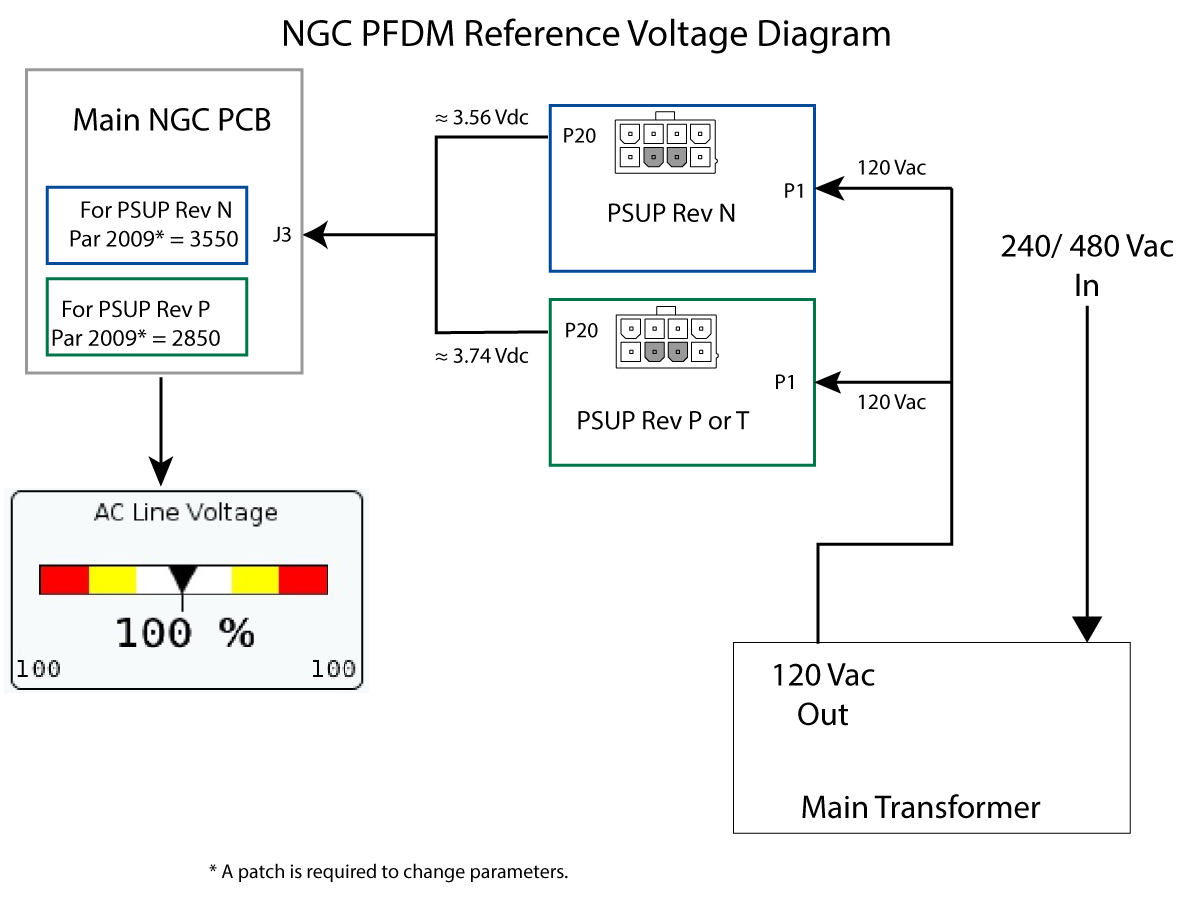
There is an embedded power fault detect monitor built-in to the NGC power card PCB. The circuit monitors the 115VAC output of the main transformer (TB 94, 95). This circuit produces a 0 - 5 VDC reference voltage to the main NGC PCB. This reference voltage varies in proportional to the incoming AC voltage. The variance in this voltage will cause the AC Line Voltage gauge to change. When the output of the transformer equals 120 VAC the control will show 100% AC LINE VOLTAGE. This gauge is located under DIAGNOSTIC / GAUGES. 

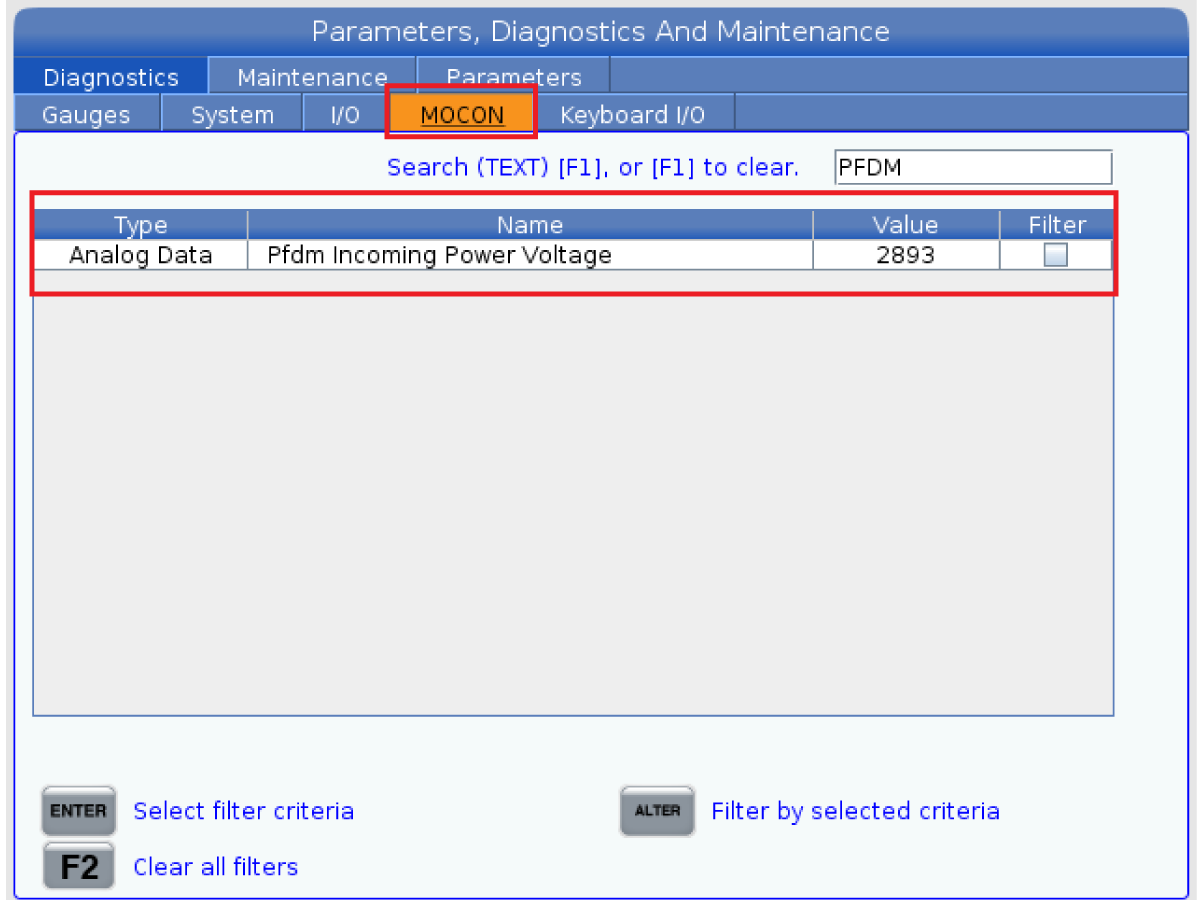
 Note: The data signal input from the PFDM can be viewed under the MOCON Tab listed as Pfdm Incoming Power Voltage.

Corrective Action:

  1. Measure the incoming AC voltage to the machine.
  2. Make sure the transformer taps are in the correct voltage range.
  3. Make sure the 115 VAC output cable from the transformer terminal block 94, 95 is properly connected to the power card at P1.

     Note: When the 115 VAC output of the transformer equals 120VAC the control will show 100% AC LINE VOLTAGE.

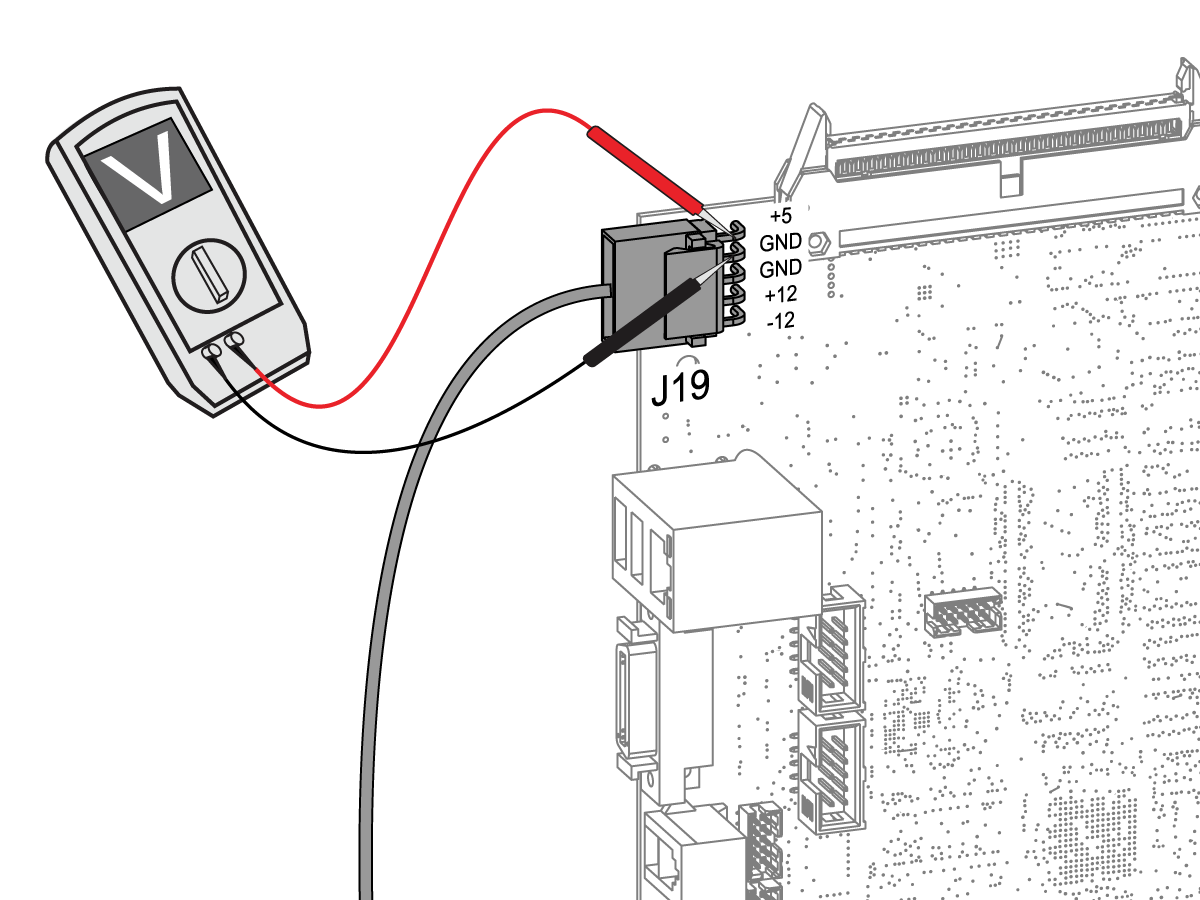
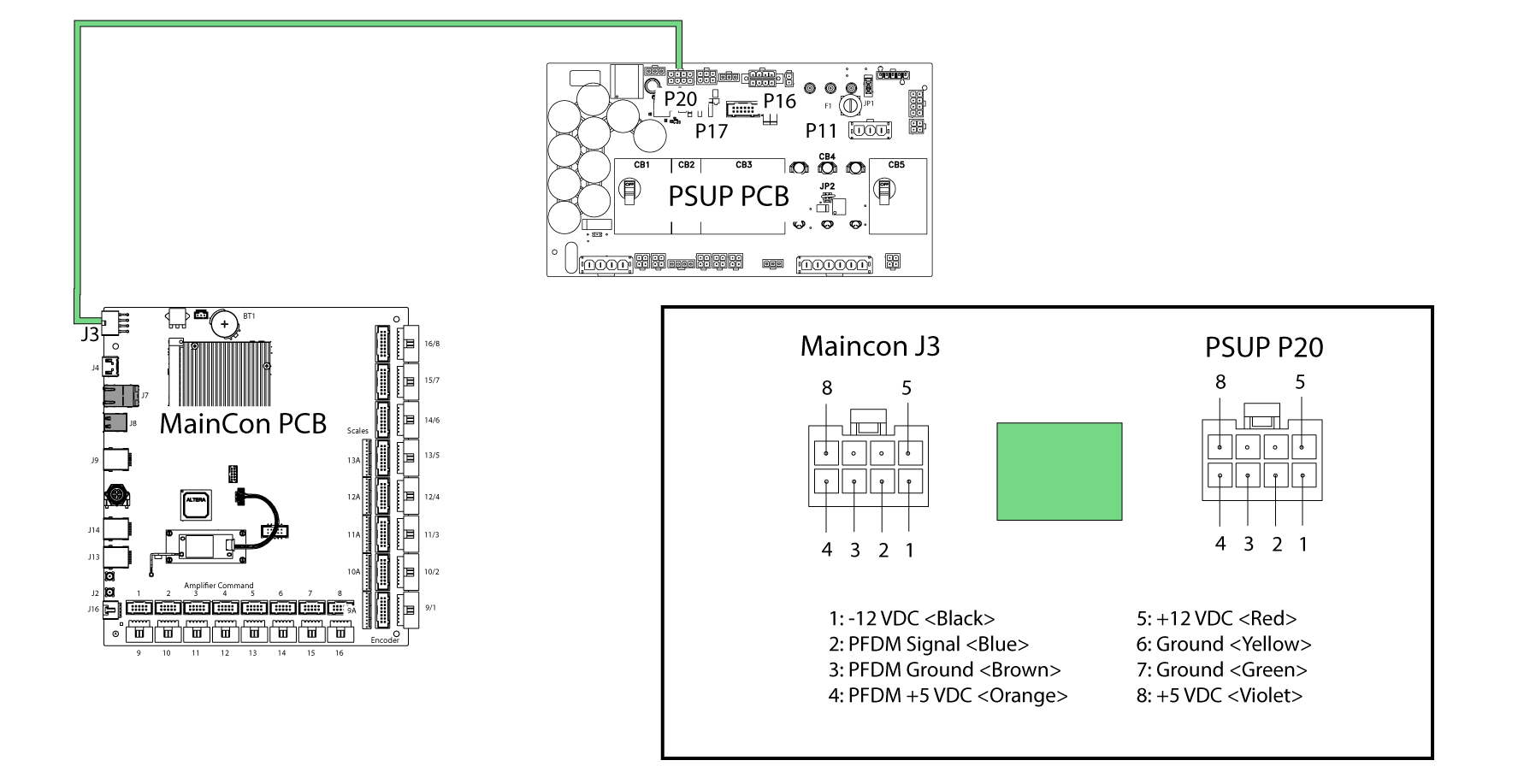
  4. Measure the PFDM Signal and PFDM Ground wires on the PSUP PCB behind the P20 connector (see diagrams below). 

     Caution: Make sure you use needle tip leads on your meter. Be careful not to short your leads together this can cause damage to the NGC power PCB.

    IMPORTANT: When the AC Line Voltage gauge displays 100% the following voltages are expected:
    • For a Rev -N Power Card 3.56 VDC.
    • For a Rev -P or -T Power Card 3.74 VDC.
    If the voltage is low or no voltage is measured, the voltage monitor circuit on the power card is damaged and will need to be replaced.

    If the voltage is correct:

    • For a Rev -N Power Card make sure parameter 2009 ADC VALUE FOR AC INPUT is set to 3550.
    • For a Rev -P or -T Power Card make sure parameter 2009 ADC VALUE FOR AC INPUT is set to 2850.

     Note: To view the parameter values refer to Next Generation Control - How to Read an Error Report for more information.

    If the value of parameter of 2009 is not correct you will need to load a patch file. Go to the HBC site and click on Service > NGC Configuration and download the patch file.

Low Voltage Inspection

Corrective Action:

Measure the low voltage power supply voltage levels at the Maincon PCB. Make sure you do not short or cross your multimeter pins.

Cycle power to the machine. If the fault stays, then the amplifier is faulty.

If every axis amplifier in the machine generates the alarm at the same time, and the low voltage power supply is correct, then the Maincon PCB may be at fault.

Pins Correct Voltage
+5 and GND +4.90 to +5.20 V dc
+12 and GND +11.85 to +12.50 V dc
-12 and GND -11.85 to -12.50 V dc

PSUP PCB Reference LED's

The -12V, +12V, and +5V reference LED's on the PSUP have different behaviors depending on whether a machine has a 15-inch monitor or a 19-inch monitor. 

Note: The 19-inch monitor machines use an iPFDM assembly. There is also a different cable used between the LVPS output and the PSUP on 19-inch machines. See the wiring diagrams below for more information.

The expected behavior for the reference LED's located next to P19/P20 on the PSUP PCB are detailed below:

19-inch monitor machines:

  1. -12V (LE1) = OFF
  2. +5V (LE2) = ON
  3. +12V (LE3) = ON

15-inch monitor machines:

  1. -12V (LE1) = ON
  2. +5V (LE2) = ON
  3. +12V (LE3) = ON

PCB Component Inspection

Intermittent symptoms or alarms can be caused by component failure. Below is a list of possible failures:

  1. Missing solder on all or some components pins
  2. Poor solder
  3. Solder bridges
  4. Wrong component installation (orientation)
  5. Missing components

     Note: Some PCB's have unused circuits and are missing components intentionally, look for broken off components.

  6. Broken components
  7. Broken pins on IC's
  8. Bent pins on the connectors
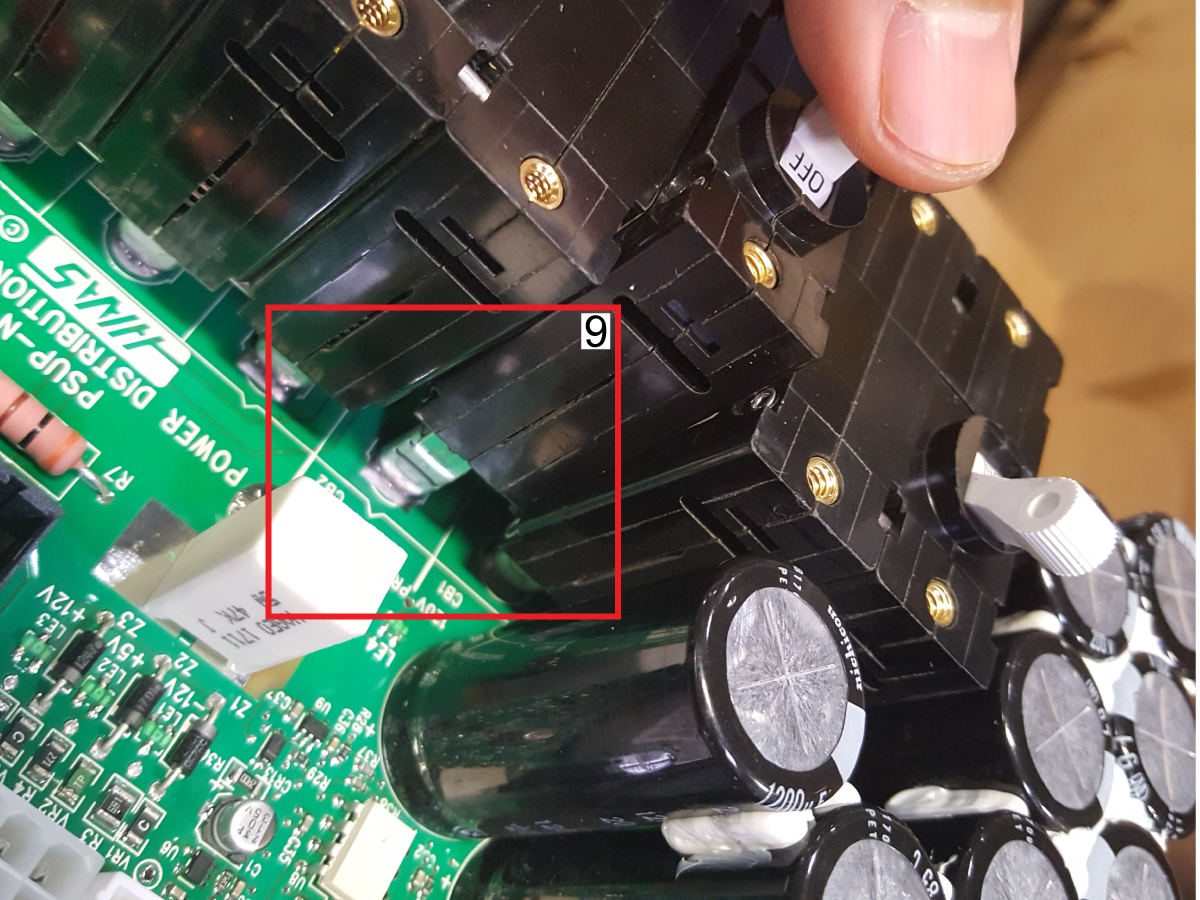
  9. Circuit breakers not installed correctly.

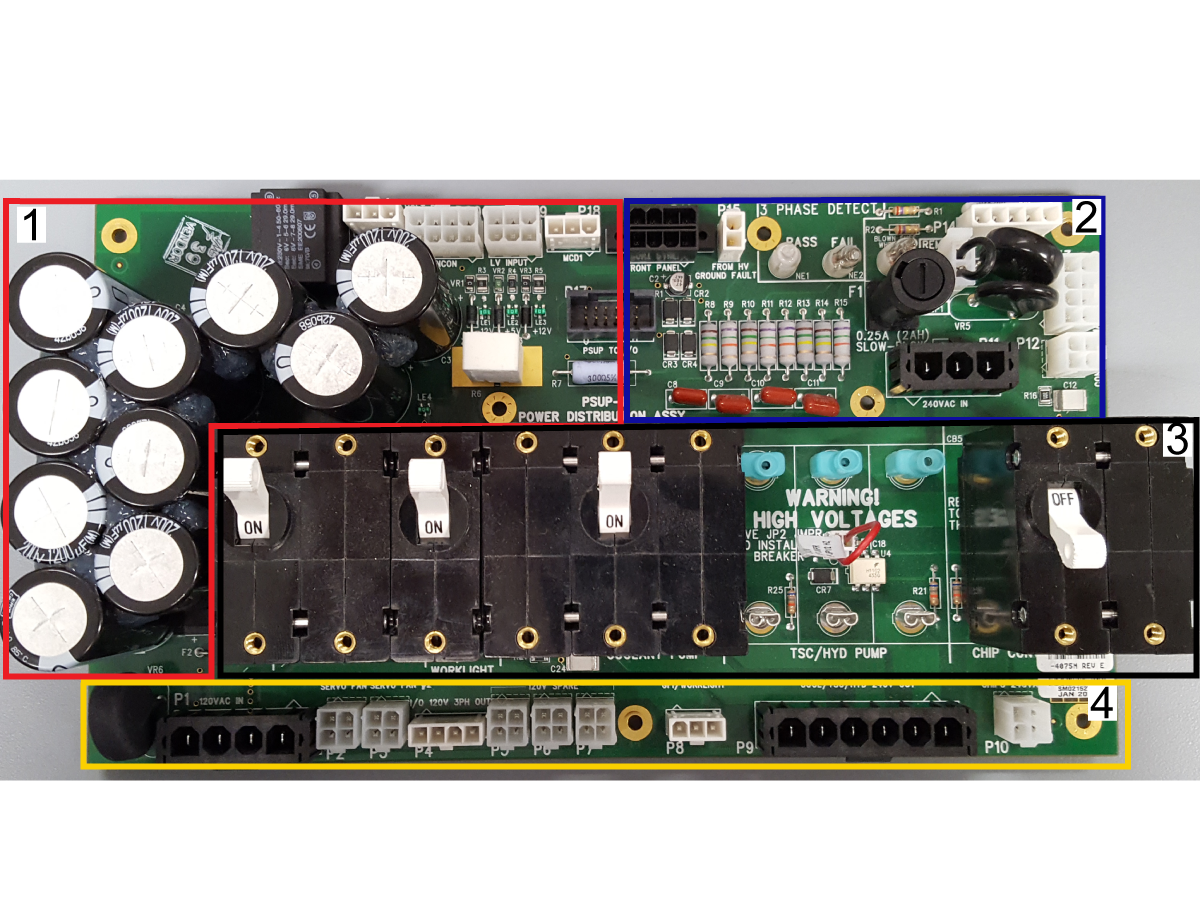
Use a magnifying glass to inspect the circuit components on the front and back of the PSUP PCB. Below are the circuit component zones to inspect depending on the alarm or symptom:

  1. Power Fault Detect Module circuit components, look for leaky capacitors, damaged components.
  2. Ground fault monitor circuit, inspect surface mount components, resistors and bent pins on the connectors.
  3. Circuit breaker trip circuit, pull breakers and inspect for burnt components underneath the breakers.
  4. Inspect for bent or missing pins on the connectors.
  5. Inspect all solder joints and surface mount components on the back of the PSUP PCB.

 Important: If you find a damaged component, replace the PSUP PCB, inspect the new PSUP PCB circuit components before installing.

15" LCD - Electrical Diagrams

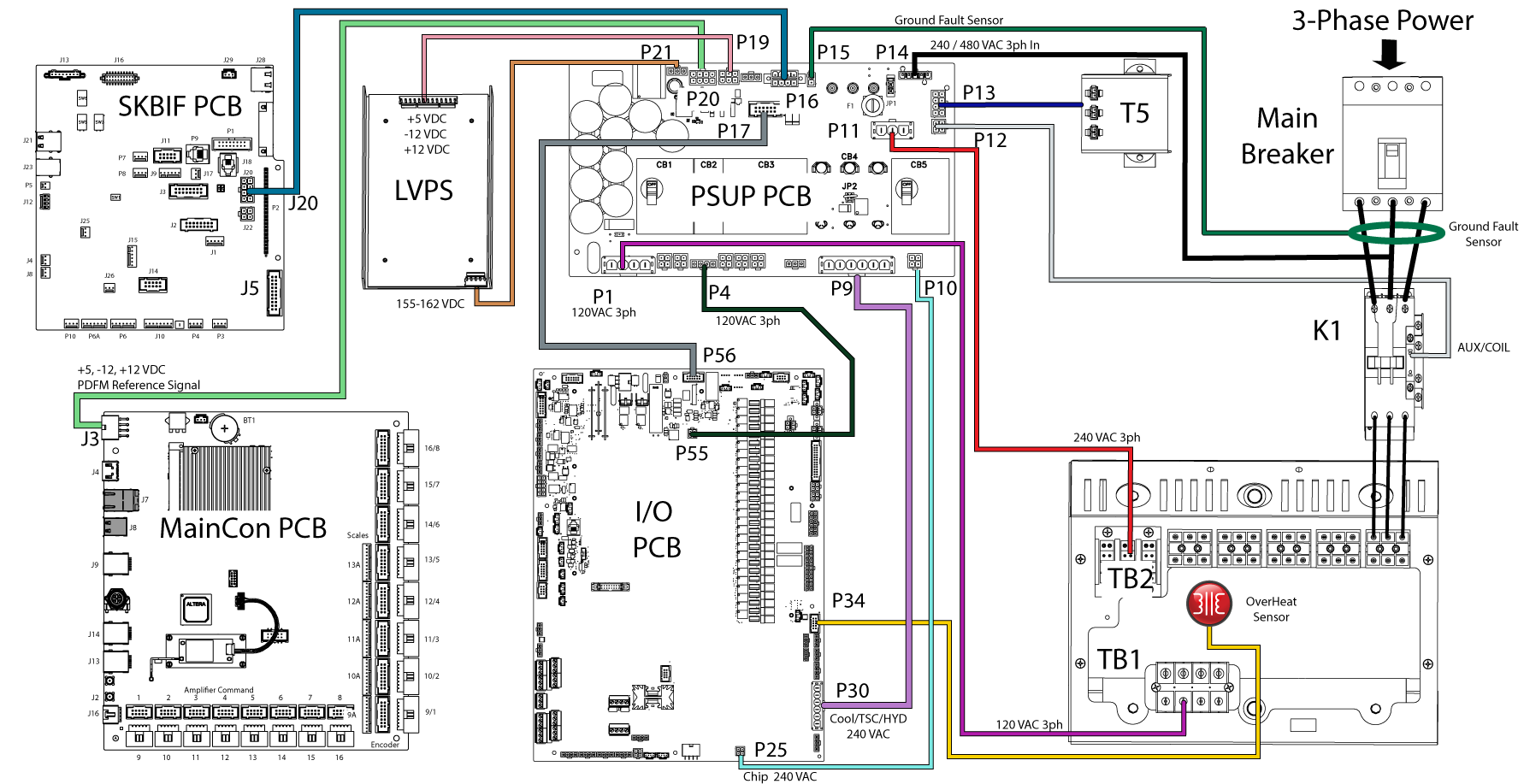
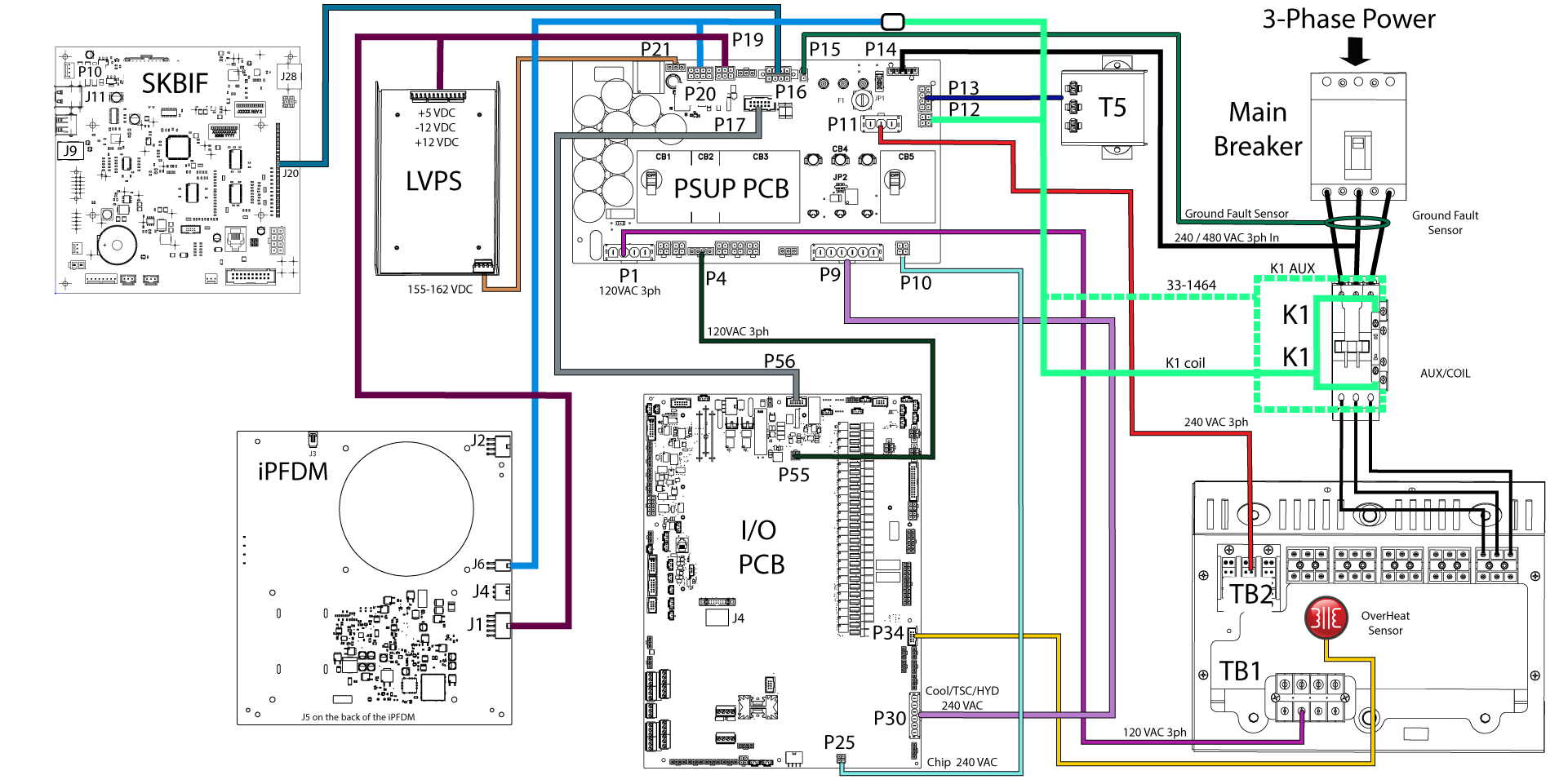
PSUP Interconnect Diagram with Gnd Fault Sensor (P15)


PSUP Interconnect Diagram with P15 Jumper


PSUP (P17) to I/O PCB (P56) Detail Diagram


Maincon PCB (J3) to PSUP PCB (P20) Detail Diagram

19" LCD - Electrical Diagrams

19 in LCD PSUP Interconnect Diagram with Gnd Fault Sensor (P15)


19 in LCD PSUP Interconnect Diagram with P15 Jumper


PSUP (P17) to I/O PCB (P56) Detail Diagram


19 in LCD Maincon PCB (J3) to iPFDM to PSUP PCB (P20) Detail Diagram

Recently Viewed Items

You Have No Recently Viewed Items Yet

Feedback
Haas Logo

Haas Delivered Price

This price includes shipping cost, export and import duties, insurance, and any other expenses incurred during shipping to a location in France agreed with you as a buyer. No other mandatory costs can be added to the delivery of a Haas CNC Product.

KEEP UP WITH THE LATEST HAAS TIPS AND TECHNOLOGY...

Sign up now!   

HAAS TOOLING ACCEPTS THE FOLLOWING:

  • Service & Support
  • Owners
  • Request Service
  • Operator Manuals
  • Haas Parts
  • Rotary Repair Request
  • Pre-Install Guides
  • Shopping Tools
  • Build & Price a New Haas
  • Available Inventory
  • The Haas Price List
  • CNCA Financing
  • About Haas
  • Accessibility Statement
  • DNSH Statement
  • Export Compliance
  • Careers
  • Certifications & Safety
  • Contact Us
  • History
  • Terms & Conditions
  • Haas Tooling Terms & Conditions
  • Privacy
  • Warranty
  • Haas Community
  • Haas Certification Program
  • Haas Motorsports
  • Gene Haas Foundation
  • Haas Technical Education Community
  • Events
  • Join the Conversation
  • Facebook
  • X
  • Flickr
  • YouTube
  • LinkedIn
  • Instagram
  • TikTok
© 2026 Haas Automation, Inc – CNC Machine Tools

This site is protected by reCAPTCHA and the Google Privacy Policy and Terms of Service apply.

2800 Sturgis Rd., Oxnard, CA 93030
Toll Free: (888) 817-4446 / Fax: 805-278-8554