My Haas Welcome,
!
Haas Tooling MyHaas/HaasConnect Sign In Register Haas Tooling MyHaas/HaasConnect Sign Out Welcome, My Machines Latest Activity My Quotes My Account My Users Sign Out
Find Your Distributor
  1. Select Language
    1. English
    2. Deutsch
    3. Español - España
    4. Español - México
    5. Français
    6. Italiano
    7. Português
    8. Český
    9. Dansk
    10. Nederlands
    11. Magyar
    12. Polski
    13. Svenska
    14. Türkçe
    15. 中文
    16. Suomi
    17. Norsk
    18. الإنجليزية
    19. български
    20. Hrvatski
    21. Ελληνικά
    22. Română
    23. Slovenský
    24. Slovenščina
    25. 한국어
    26. 日本語
    27. Українська
  • machines Main Menu
    • Vertical Mills
      Vertical Mills
      Vertical Mills View All
      • Vertical Mills
      • VF Series
      • Universal Machines
      • VR Series
      • VP-5 Prismatic
      • Pallet-Changing VMCs
      • Mini Mills
      • Mold Machines
      • High-Speed Drill Centers
      • Drill/Tap/ Mill Series
      • Toolroom Mills
      • Pocket Mill
      • Compact Mills
      • Gantry Series
      • SR Sheet Routers
      • Extra-Large VMC
      • Double-Column Mills
      • 3+2 Positioning Machines
    • Multi-Axis Solutions
      Multi-Axis Solutions
      Multi-Axis Solutions View All
      • Multi-Axis Solutions
      • Y-Axis Lathes
      • 5-Axis Mills
    • Lathes
      Lathes
      Lathes View All
      • Lathes
      • ST Series
      • Dual-Spindle
      • Box Way Series
      • Toolroom Lathes
      • Chucker Lathe
      • Haas Bar Feeders
    • Horizontal Mills
      Horizontal Mills
      Horizontal Mills View All
      • Horizontal Mills
      • 50-Taper
      • 40-Taper
    • Rotaries & Indexers
      Rotaries & Indexers
      Rotaries & Indexers View All
      • Rotaries & Indexers
      • Rotary Tables
      • Indexers
      • 5-Axis Rotaries
      • Extra-Large Rotaries
    • Special Series
      Special Series
      Special Series View All
      • Special Series
      • EU_Series_Redirect
    • Automation Systems
      Automation Systems
      Automation Systems View All
      • Automation Systems
      • Mill Automation
      • Lathe Automation
      • Automatic Parts Loaders
      • Automation Models
    • Desktop Machines
      Desktop Machines
      Desktop Machines View All
      • Desktop Machines
      • Desktop Mill
      • Desktop Lathe
      • Control Simulator, Standard
      • Control Simulator, Premium
    • Shop Equipment
      Shop Equipment
      Shop Equipment View All
      • Shop Equipment
      • Knee Mill
      • Haas Manual Lathes
      • Haas Saws
    • Fabrication Machines
      Fabrication Machines
      Fabrication Machines View All
      • Fabrication Machines
      • Laser Cutting Machines
      • CNC Press Brakes
    • QUICK LINKS Special Series  Special Series 
      EU SERIES EU SERIES BUILD & PRICE | PRICE LIST BUILD & PRICE | PRICE LIST In-Stock Machines In-Stock Machines WHAT’S NEW WHAT’S NEW YOUR FIRST CNC YOUR FIRST CNC
      SHOPPING TOOLS
      • Build & Price a Haas
      • Price List
      • Available Inventory
      • CNCA Financing
      WANT TO TALK TO SOMEONE?

      A Haas Factory Outlet (HFO) can answer your questions, and walk you through your best options.

      CONTACT YOUR DISTRIBUTOR >
  • Options Main Menu
    • The Haas Control Value Option Packages
      Value Option Packages
      Value Option Packages View All
      • Value Option Packages
    • Product Image Spindles
      Spindles
      Spindles View All
      • Spindles
    • Product Image Tool Changers
      Tool Changers
      Tool Changers View All
      • Tool Changers
    • Product Image 4th- | 5th-Axis
      4th- | 5th-Axis
      4th- | 5th-Axis View All
      • 4th- | 5th-Axis
    • Product Image Turrets & Live Tooling
      Turrets & Live Tooling
      Turrets & Live Tooling View All
      • Turrets & Live Tooling
    • Product Image Probing
      Probing
      Probing View All
      • Probing
    • Haas Chip & Coolant Management Chip & Coolant Management
      Chip & Coolant Management
      Chip & Coolant Management View All
      • Chip & Coolant Management
    • The Haas Control The Haas Control
      The Haas Control
      The Haas Control View All
      • The Haas Control
    • Product Image Product Options
      Product Options
      Product Options View All
      • Product Options
    • Product Image Tooling & Fixturing
      Tooling & Fixturing
      Tooling & Fixturing View All
      • Tooling & Fixturing
    • Product Image Workholding
      Workholding
      Workholding View All
      • Workholding
    • Product Image 5-Axis Solutions
      5-Axis Solutions
      5-Axis Solutions View All
      • 5-Axis Solutions
      • 5 Easy Steps to 5-Axis
    • QUICK LINKS Special Series  Special Series 
      EU SERIES EU SERIES BUILD & PRICE | PRICE LIST BUILD & PRICE | PRICE LIST In-Stock Machines In-Stock Machines WHAT’S NEW WHAT’S NEW YOUR FIRST CNC YOUR FIRST CNC
      SHOPPING TOOLS
      • Build & Price a Haas
      • Price List
      • Available Inventory
      • CNCA Financing
      WANT TO TALK TO SOMEONE?

      A Haas Factory Outlet (HFO) can answer your questions, and walk you through your best options.

      CONTACT YOUR DISTRIBUTOR >
  • Why Haas Main Menu
      Discover the Haas Difference
    • Why Haas
    • MyHaas
    • Education Community
    • Industry 4.0
    • Haas Certification
    • Customer Testimonials
  • Service Main Menu
      Welcome to Haas Service
      SERVICE HOME Operator’s Manuals How-To Procedures Troubleshooting Guides Preventive Maintenance Haas Parts Haas Tooling Videos
  • Videos Main Menu
  • Main Menu
    • View All
    • View All
    • View All
    • View All
      • HTEC Curriculum Support
    • View All
      • Haas 10 kg Cobot Package
      • Cobot Kits
      • DC-1 Drill Center
      • CNC Sales News
      • Do More With Your Haas
    • View All
    • View All
      • contact-us-test
      • 4 - AUTOMATION SYSTEMS
      • Carousel-V2
      • expert test
      • Demo_Day_Trident-test
      • Link Test
      • image-sale-tag-test
      • article-list-test
      • Haas 25 kg Robot Package
    • View All
      • Choose Options
    • View All
    • View All
    • View All
    • View All
    • View All
      • calc-test
    • View All
    • QUICK LINKS Special Series  Special Series 
      EU SERIES EU SERIES BUILD & PRICE | PRICE LIST BUILD & PRICE | PRICE LIST In-Stock Machines In-Stock Machines WHAT’S NEW WHAT’S NEW YOUR FIRST CNC YOUR FIRST CNC
      SHOPPING TOOLS
      • Build & Price a Haas
      • Price List
      • Available Inventory
      • CNCA Financing
      WANT TO TALK TO SOMEONE?

      A Haas Factory Outlet (HFO) can answer your questions, and walk you through your best options.

      CONTACT YOUR DISTRIBUTOR >
  • Haas Tooling Main Menu
  • Haas Service Parts Main Menu

My Haas Welcome,
!
Haas Tooling MyHaas/HaasConnect Sign In Register Haas Tooling MyHaas/HaasConnect Sign Out Welcome, My Machines Latest Activity My Quotes My Account My Users Sign Out
Find Your Distributor
  1. Select Language
    1. English
    2. Deutsch
    3. Español - España
    4. Español - México
    5. Français
    6. Italiano
    7. Português
    8. Český
    9. Dansk
    10. Nederlands
    11. Magyar
    12. Polski
    13. Svenska
    14. Türkçe
    15. 中文
    16. Suomi
    17. Norsk
    18. الإنجليزية
    19. български
    20. Hrvatski
    21. Ελληνικά
    22. Română
    23. Slovenský
    24. Slovenščina
    25. 한국어
    26. 日本語
    27. Українська
×

Search Results

Web Pages

Images

    • <
    • 1
    • >

WIPS - Installation - AD0222

Service Home How To Procedures WIPS - Installation - AD0222

WIPS - Installation - AD0222

- Jump to Section - 1. Introduction 2. Unpacking the Probe (1 step) 3. OMI - Installation (4 steps) 4. Renishaw - OMP40-2 Probe - Installation (4 steps) 5. Renishaw - OTS Probe - Installation (8 steps) 6. Probe Activation (2 steps) 7. CHC - Probe Activation (2 steps) 8. CHC - WIPS - Tool Probe - Calibration (3 steps) 9. CHC - WIPS - Work Probe - Calibration (1 step) Back to Top
Recently Updated Last updated: 10/17/2024

WIPS - IR - Installation


AD0222

Revision B 07/2025

Introduction

This procedure will show you how to install the WIPS system on a Haas Mill machine.

Machine Requirements:

  • M14.05A (Coldfire I / II processor and 10” LCD) or M15.04E (Coldfire II processor and 15” LCD) and higher for CHC machines
  • All NGC Machines

Important: CM-1 machines manufactured before 12/01/2024 need to check if they have the following parts installed on the machine before installing the WIPS option:

  • 93-4962 - CM-1 Z-axis Enc/Pwr/Brk Cable Service Kit

Note: These parts in this kit are for the Z-axis motor power cable and encoder cable. If these parts are not installed on the machine, the parts should be ordered before installing the WIPS. Refer to HBC-N-1/09/2025 for information on ordering these parts. 

Unpacking the Probe

1

If WIPS came installed on your machine, remove the table probe shipping bracket.

Remove the red shipping bracket and associated mounting hardware.

OMI - Installation

1

If WIPS did not come installed on your machine a Haas Service tech must download and apply a configuration file patch from https://hbc.haascnc.com.

The OMI detects probe signals within a 60° “cone” from the OMI window. Position the OMI such that it receives a line of sight signal from both the tool probe and the work probe over the entire machine travel range. If a rotary, fixture, or workpiece occludes line of between either probe and the OMI during a probing cycle connection will be lost and the system will alarm out. Plan your machine setup to avoid this. On some large machines it may be necessary to elevate the tool probe off the table using a riser.

CHC Machines only:

Note: For VF, EC, GR, MDC and Super Mini Mill machines, I/O board 3080U or 3083U or later is required to install WIPS. For Mini Mills and all TM machines, I/O board 3082V or later is required.

Install WIPS macors into program memory. Contact your dealer to obtain latest WIPS macros. The six parameters in the table below must be set before loading the Renishaw programs into the machine:

Parameter 57, bit 17 "Enable Rot & Scaling" Set to 1
Parameter 57, bit 21 "M19 Spindle Orientation" Set to 1
Parameter 57, bit 22 "Enable Macro" Set to 1
Parameter 57, bit 23 "Invert Skip" Set to 0 (Renishaw)
Parameter 315, bit 31 "Intuitive Programming System" Set to 1 (16.03 and earlier)
Parameter 732 "IPS Probe" Set to 2


2

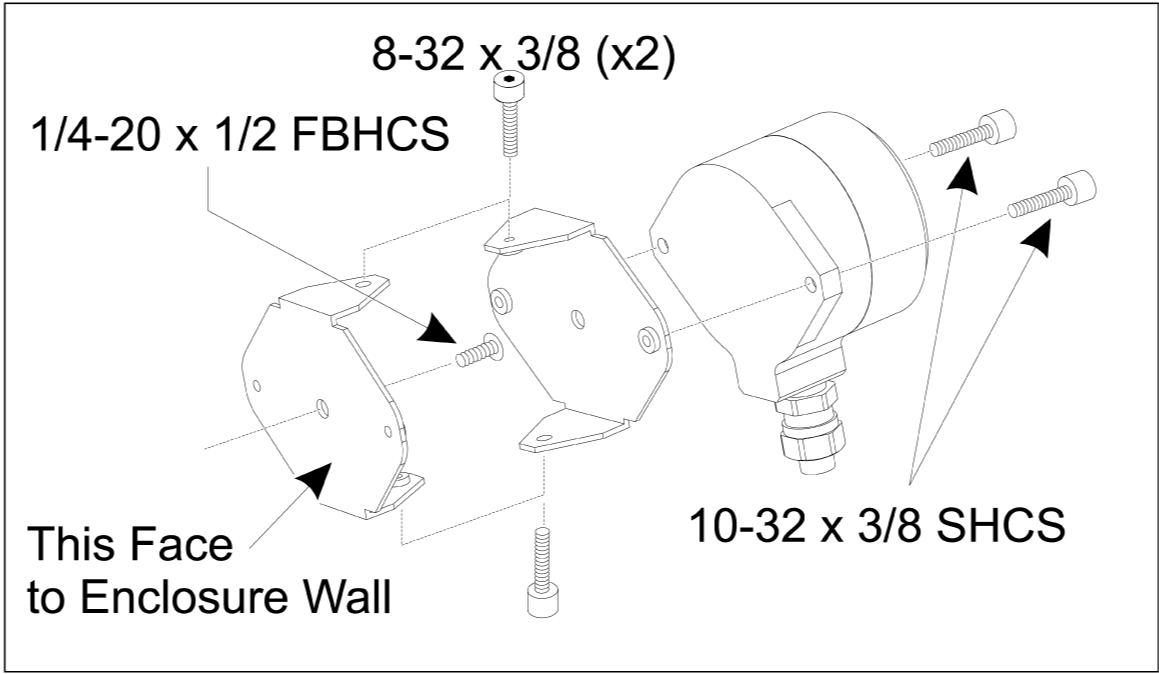
Secure one bracket to the OMI using two 10-32 x 3/8 SHCS.

Secure the other bracket to the machine enclosure wall using one 1/4-20 x 1/2 FBHCS.

Attach the wall bracket to the OMI/bracket assembly using two 8-32 x 3/8 SHCS.

3

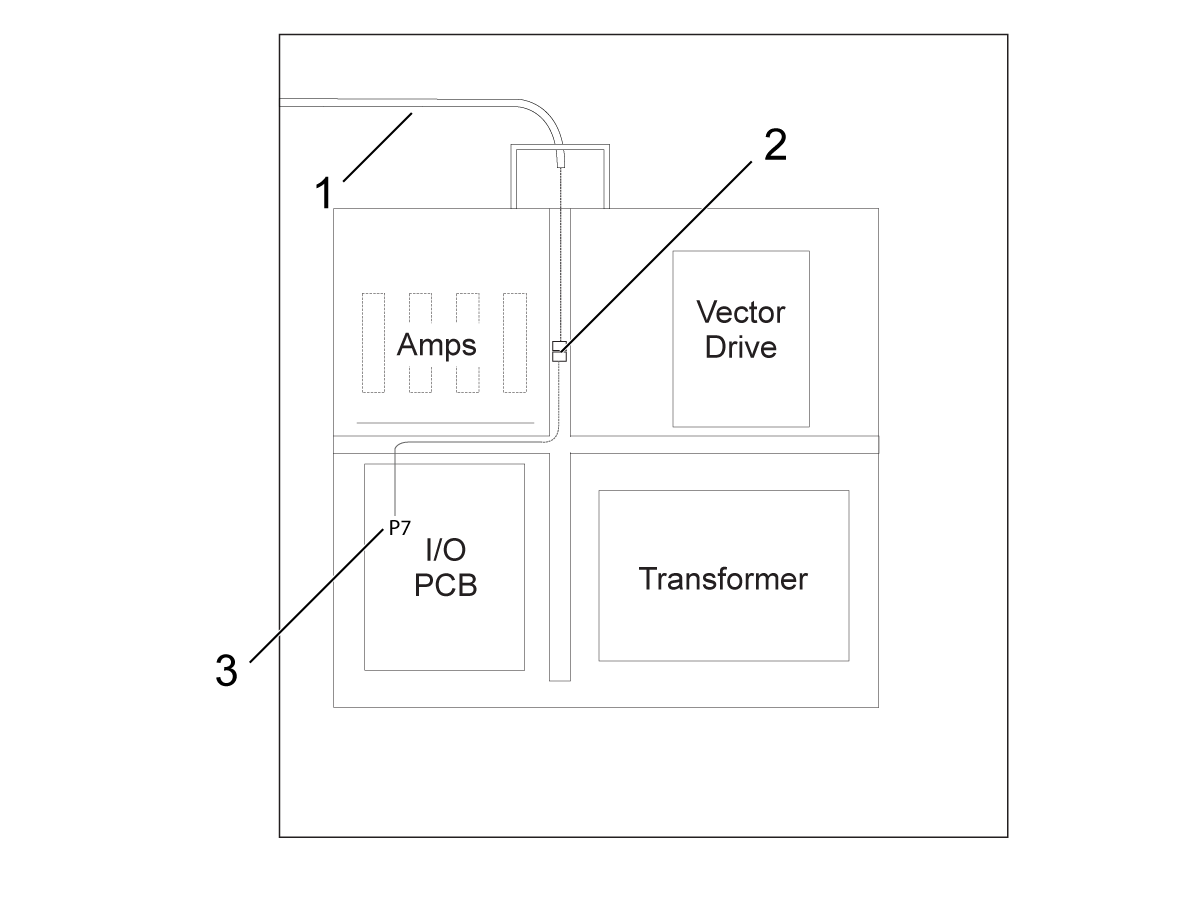
Route the OMI cable through the top of the control cabinet as shown, depending on the installation performed [1].

Join the OMI cable and 33-0625 cable plugs [2].

Plug the Haas probe cable 33-0625 into P7 on the I/O PCB board [3].

 Note: For older machines using 33-0615 CBL WIPS PROBE I/F, I/O PCB-S or I/O PCB-T is needed.

4

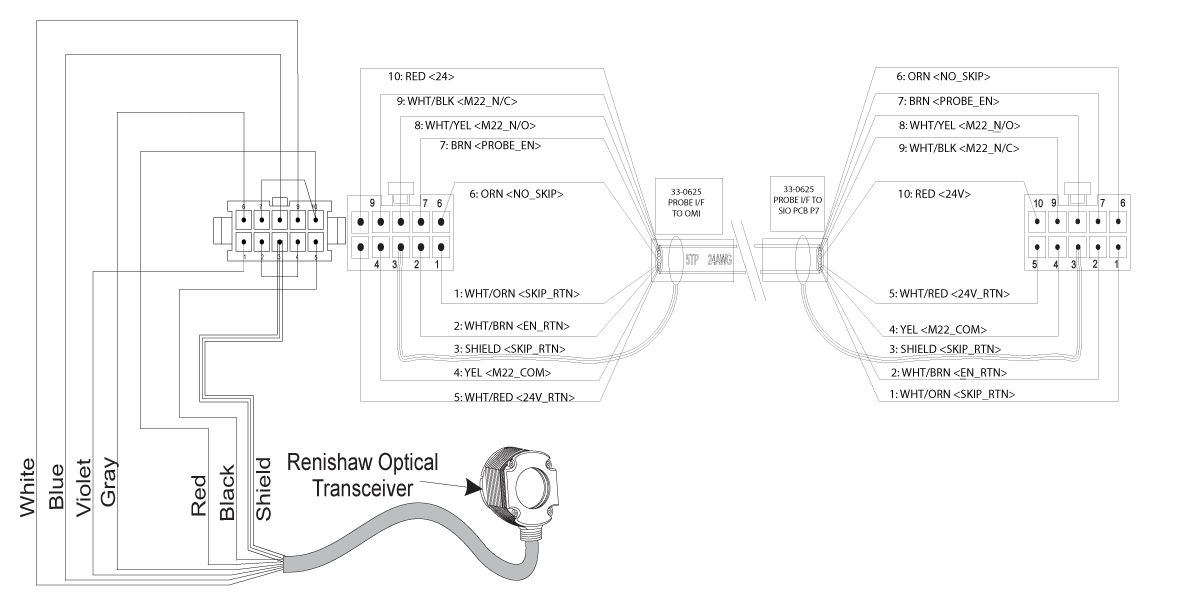
OMI cable electrical diagram.

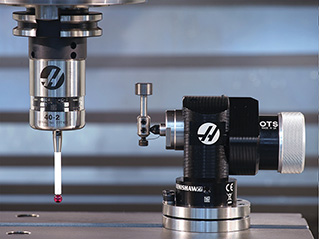
Renishaw - OMP40-2 Probe - Installation

1

Install the stylus [1] into the probe body.

Use the stylus installation tool [2] to tighten the stylus [1] into the probe body [3].

Turn the tool until the stylus is snug.

Use a coin or flat-head screwdriver to remove the battery compartment cover [3].

 Note: Do not touch the stylus after installing the batteries. Touching the stylus can change the settings.

Install batteries [4] into the battery compartment.

Install the battery compartment and tighten the cover.

2

If the probe is not yet installed to the toolholder, follow the below steps, otherwise skip to Step 3:

Loosen the all the set screws in the probe toolholder [1].

 Note: The (2) top set screws hold the probe body into place. Make sure the (2) top set screws in the probe toolholder are conical.

Insert the probe body [3] into the toolholder [1].

Use the hex wrench [2] to snug the (2) top set screws.

3

Use the hex wrench [1] to slightly loosen the (4) adjustment set screws.

Insert the OMP40-2 probe [2] into the spindle.

Place an indicator [3] onto the center of the stylus ruby.

4

Adjust the “A” screws in sequence and monitor alignment, loosening on one side and tightening on the other, bringing the probe into alignment.

When probe is aligned to within 0.0002”, tighten each “B” screw while tightening opposing “A” screw, each to no more than 0.5 ft-lb. Re-verify alignment and tighten the remaining “A” screws.

Renishaw - OTS Probe - Installation

The OTS probe may ship in two different configurations. If your stylus came assembled, follow the instructions for configuration 1. Otherwise, if your stylus needs to be assembled, follow the instructions for configuration 2. 

1

Configuration 1:

Place the retainer strap [1] over the shaft  [2].

Install the shaft [2] into the shaft mount. Snug the shaft with the open-end wrench. Use the support bar [3] to counteract twisting forces and avoid overstressing the shaft. 

Bend the retainer strap 90 degrees as shown [4]. Attach the retainer strap to the bottom of the stylus assembly using the included screw [5]. 

2

Configuration 2:

Place the retainer strap [1] over the shaft mount on the probe body [3].

Install the shaft [2] into the shaft mount. Snug the shaft with the open-end wrench.

Place the stylus [4] into the stylus mount [5]. Snug the set screw with the hex wrench.

Bend the retainer strap 90 degrees as shown [7].

Place the stylus assembly onto the probe shaft. Snug the set screw with the hex wrench.

Attach the retainer strap to the bottom of the stylus assembly using included screw [6].

3

Install the batteries:

 Note: Do not touch the stylus when you install the batteries. This can change the settings.

Remove the battery cover [1].

On new probes, make sure to remove the plastic shield between the batteries [2] and the contacts.

4

Determine position of tool probe:

Note: Ideal tool probe positioning may vary depending on the size of tools, the size of your workpiece, and your tool paths. Ensure that your tool probe will not be crashed into during normal operations. 

Tool probe should be oriented with the stylus [1] facing towards the machine spindle. The data transmission window should be pointed towards the OMI [2]. The angle of the window can be adjusted later. 

On UMC machines, the tool probe should be placed on the tool probe stand [3]. For other machines, the tool probe should be placed on the table. It should be located a minimum of 4 inches (10 cm) from the edge of the table [4]. 


5

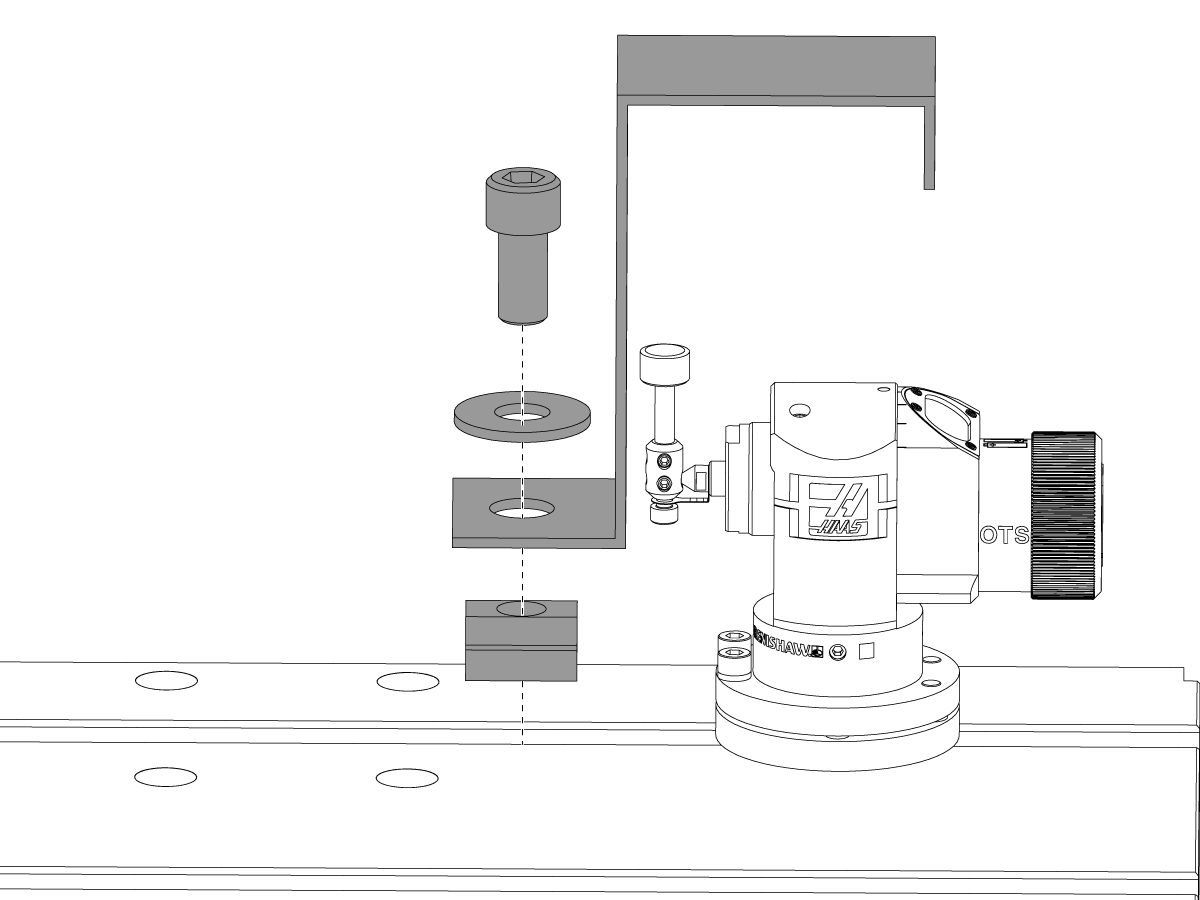
NOTE: Machines with TRT rotaries.  Refer to the TRT - Probe Riser Block - Installation procedure.

Install the tool probe to the table:

Loosen the (6) set screws [1] around the probe body.

Remove the base [2] from the probe body.

Use a 3/8" - 16 x 1 socket head cap screw [3] to anchor the base to the machine table.

Torque the mounting bolt to 25 ft lbs

Place the probe body on the base.

Snug the (4) base mount set screws [4].

Snug the (2) base rotation set screws [5].

 Note: Test that your largest diameter tools can be touched off against the tool probe before proceeding to the next step.

6

Indicate and adjust the stylus flatness:

Adjust the (2) screws [1] at the probe base to align the stylus side-to-side not to exceed +/- 0.0001" (0.003 mm).

Adjust the (2) screws [2] on the probe body to align the stylus front-to-back not to exceed +/- 0.0001" (0.003 mm).

7

Align the probe with the OMI receiver:

Loosen the set screw [3] beneath the stylus.

Turn the probe body so that the data transmission window [2] points at the OMI receiver [1].

Snug the set screw.

8

Set the direction of the OTS tool probe:

Macro variable 592 changes the radius offset direction. Change macro variable 592 to make sure the tool does not hit the probe body when it moves off center to compensate for the tool radius.

When you use the WIPS calibration pages to calibrate the probe, this will automatically sets macro variable 592 to 2.

When you use VQC calibration pages to calibrate the probe, you can select 2 or -2 for macro variable 592.

If the probe is installed in a different direction, you must change macro variable 592. This lets the tool move away from the probe during the rotating tool length cycle.

Set macro variable 592 to agree with the direction of the probe. These are the correct values:

#592 = 1.0, diameter along the X Axis setting: rotating length cutter radius offset setting in the Y- direction.

#592 = -1.0, diameter along the X Axis setting: rotation length cutter radius offset setting in the Y+ direction.

#592 = 2.0, diameter along the Y Axis setting: rotating length cutter radius offset setting in the X- direction.

#592 = -2.0, diameter along the Y Axis setting: rotation length cutter radius offset setting in the X+ direction.

For troubleshooting information please refer to the WIPS Troubleshooting Guide

Probe Activation

If your machine is CHC and WIPS did not come installed on your machine a Haas Service tech must download and apply a configuration file patch from HBC. Once logged in click the Service tab on the top left corner area, and under detailed navigation click Documents and software. Follow the path to reach the desired file 03_VQC and Probing > 01_Mill WIPS > Reinshaw > 01_CHC > RENIPS.V30

For machines with NGC software before 100.21.000.1100, that did not come with WIPS installed, contact your HFO to update to the latest software and get the latest configuration file.

For machines with the NGC software 100.21.000.1100 and higher, that did not come with WIPS installed, contact your HFO to get the latest configuration file.

  1. Click [SETTINGS] 
  2. Type 23 then press [F1] and turn OFF setting 23
  3. Press [LIST PROGRAMS] 
  4. Go to your USB tab,  select the program you wish to use by pressing [ENTER]
  5. Press [F2] to copy and follow the path memory > 09000 > Press [ENTER]

The following steps are used to verify that the spindle probe, table probe, OMI and the system’s connection to the control are all functioning correctly.

1

Press [MDI].  Enter the following program to activate the table probe:

M59 P2;

G04 P1.0;

M59 P3;

Press [CYCLE START].

After the program runs tap the table probe with your finger.  The control pendant should beep each time the probe is moved.

Press [RESET] to turn the probe off.

2

Press [MDI].  Enter the following program to activate the spindle probe:

M59 P3;

Press [CYCLE START].

After the program runs tap the spindle probe with your finger.  The control pendant should beep each time the probe is moved.

Press [RESET] to turn the probe off.

If the probe fails to cause the pendant to beep, and the probe windows are properly aligned, first try replacing the batteries in the probe before attempting any other troubleshooting or service, as dead batteries are the most likely source of problems.

CHC - Probe Activation

To download the probe programs visit https://portal.haascnc.com. Once logged in click the Service tab on the top left corner area, and under detailed navigation click Documents and software. Follow the path to reach the desired file VQC and Probing > Mill_Probing > Reinshaw > RENIPS.V30 (Use this file for machines that have wireless spindle and table probes.)

To laod the 9000 program follow the steps:

  1. Press [SETTINGS] 
  2. Type setting 23 hit [ENTER] and turn OFF setting 23
  3. Press [LIST PROGRAMS] 
  4. Press [CANCEL] to be able to get to your USB tab,  select the program you wish to use by pressing [ENTER]
  5. Press [F2] to copy and load the file to the memory designation. 

The following steps are used to verify that the spindle probe, table probe, OMI and the system’s connection to the control are all functioning correctly.

1

Press [MDI].  Enter the following program to activate the table probe:

M59 P1133;

G04 P1.0;

M59 P1134;

Press [CYCLE START].

After the program runs tap the table probe with your finger.  The control pendant should beep each time the probe is moved.

Press [RESET] to turn the probe off.

2

Press [MDI].  Enter the following program to activate the spindle probe:

M59 P1134;

Press [CYCLE START].

After the program runs tap the spindle probe with your finger.  The control pendant should beep each time the probe is moved.

Press [RESET] to turn the probe off.

If the probe fails to cause the pendant to beep, and the probe windows are properly aligned, first try replacing the batteries in the probe before attempting any other troubleshooting or service, as dead batteries are the most likely source of problems.

CHC - WIPS - Tool Probe - Calibration

1

Put the calibration bar [1] into the spindle.

Use the indicator to measure the runout of the calibration bar.

If the runout is more 0.0001" (0.0025 mm), adjust or replace the calibration bar.

If you have recorded the length of the calibration bar, proceed to Step 2.

To measure the length of the calibration bar:

Put the tip of the indicator against the bottom face [2] of the calibration bar. Set the indicator to 0.

In MDI mode, jog the X Axis until the indicator is no longer under the calibration tool.

Jog the Z Axis in the negative (-) direction until the tip of the indicator touches the bottom face [3] of the spindle.

The Z-Axis value on the DIST (distance) TO GO position is the calibration bar length. Record this value.

Use a micrometer to measure the diameter of the widest part of the calibration bar. Record the measurement.

2

In MDI mode, push [PRGRM/CONVRS]. Select the SET-UP tab. Push [WRITE/ENTER].

Select the TOOL PROBE CALIBRATION tab.

Jog the Z Axis until the calibration bar [1] is 0.40" (10 mm) above the tool probe [2].

  • Push [F1] to set z location.

To align the calibration bar to the tool probe:

  • Jog the X Axis until the calibration bar is aligned with the tool probe.
  • Push [F1] to set x location.

  • Jog the Y Axis until the calibration bar is aligned with the tool probe.

  • Push [F1] to set y location.

  • Enter this information for the calibration bar:

    • the tool number [3]
    • the bar length [4]
    • the bar diameter [5]

 Note: If you do not see the probe calibration tabs or intuitive programming system, you must enable the IPS probe. Set Parameter 732, IPS PROBE, to 2.

Push [CYCLE START].

The Calibration Box shows COMPLETED.

3

Attach the ring gauge [3] to the table near the tool probe.

Move the calibration bar [1] above the edge of the ring gauge.

Put a shim, feeler gauge, or slip of paper [2] over the gauge.

Push [.0001/.1].

Jog the Z Axis until the tip of the calibration bar lightly touches the paper.

Push [PRGRM/CONVRS]. Select WORK PROBE CALIB.

Push [F1] to enter the Z-Axis position.

Enter the length of the calibration bar. Push [WRITE/ENTER].

Measure the thickness of the shim used. For example, a piece of paper at 0.003 inch.

Enter the thickness in the SHIM field [4]. Push [WRITE/ENTER].

CHC - WIPS - Work Probe - Calibration

1

Jog the z axis upwards.

Put the work probe [1] into the spindle.

Measure the length [2] of the work probe. Enter the approximate length of the work probe.

Enter the diameter of the ball at the end of the work probe. For the standard Renishaw probe, use 0.2362" (6 mm).

Measure the inside diameter of the ring gauge. Use an inside micrometer or a bore gauge. If the inside diameter is written on the gauge, use that number.

Enter the diameter of the ring gauge. Push [WRITE/ENTER].

Jog the axes until the work probe is approximately 0.3" (7 mm) above the center of the ring gauge [3].

Push [CYCLE START].

The calibration box shows COMPLETED.

Recently Viewed Items

You Have No Recently Viewed Items Yet

Feedback
Haas Logo

Haas Delivered Price

This price includes shipping cost, export and import duties, insurance, and any other expenses incurred during shipping to a location in France agreed with you as a buyer. No other mandatory costs can be added to the delivery of a Haas CNC Product.

KEEP UP WITH THE LATEST HAAS TIPS AND TECHNOLOGY...

Sign up now!   

HAAS TOOLING ACCEPTS THE FOLLOWING:

  • Service & Support
  • Owners
  • Request Service
  • Operator Manuals
  • Haas Parts
  • Rotary Repair Request
  • Pre-Install Guides
  • Shopping Tools
  • Build & Price a New Haas
  • Available Inventory
  • The Haas Price List
  • CNCA Financing
  • About Haas
  • Accessibility Statement
  • DNSH Statement
  • Export Compliance
  • Careers
  • Certifications & Safety
  • Contact Us
  • History
  • Terms & Conditions
  • Haas Tooling Terms & Conditions
  • Privacy
  • Warranty
  • Haas Community
  • Haas Certification Program
  • Haas Motorsports
  • Gene Haas Foundation
  • Haas Technical Education Community
  • Events
  • Join the Conversation
  • Facebook
  • X
  • Flickr
  • YouTube
  • LinkedIn
  • Instagram
  • TikTok
© 2026 Haas Automation, Inc – CNC Machine Tools

This site is protected by reCAPTCHA and the Google Privacy Policy and Terms of Service apply.

2800 Sturgis Rd., Oxnard, CA 93030
Toll Free: (888) 817-4446 / Fax: 805-278-8554