My Haas Welcome,
!
Haas Tooling MyHaas/HaasConnect Sign In Register Haas Tooling MyHaas/HaasConnect Sign Out Welcome, My Machines Latest Activity My Quotes My Account My Users Sign Out
Find Your Distributor
  1. Select Language
    1. English
    2. Deutsch
    3. Español - España
    4. Español - México
    5. Français
    6. Italiano
    7. Português
    8. Český
    9. Dansk
    10. Nederlands
    11. Magyar
    12. Polski
    13. Svenska
    14. Türkçe
    15. 中文
    16. Suomi
    17. Norsk
    18. الإنجليزية
    19. български
    20. Hrvatski
    21. Ελληνικά
    22. Română
    23. Slovenský
    24. Slovenščina
    25. 한국어
    26. 日本語
    27. Українська
  • machines Main Menu
    • Vertical Mills
      Vertical Mills
      Vertical Mills View All
      • Vertical Mills
      • VF Series
      • Universal Machines
      • VR Series
      • VP-5 Prismatic
      • Pallet-Changing VMCs
      • Mini Mills
      • Mold Machines
      • High-Speed Drill Centers
      • Drill/Tap/ Mill Series
      • Toolroom Mills
      • Pocket Mill
      • Compact Mills
      • Gantry Series
      • SR Sheet Routers
      • Extra-Large VMC
      • Double-Column Mills
      • 3+2 Positioning Machines
    • Multi-Axis Solutions
      Multi-Axis Solutions
      Multi-Axis Solutions View All
      • Multi-Axis Solutions
      • Y-Axis Lathes
      • 5-Axis Mills
    • Lathes
      Lathes
      Lathes View All
      • Lathes
      • ST Series
      • Dual-Spindle
      • Box Way Series
      • Toolroom Lathes
      • Chucker Lathe
      • Haas Bar Feeders
    • Horizontal Mills
      Horizontal Mills
      Horizontal Mills View All
      • Horizontal Mills
      • 50-Taper
      • 40-Taper
    • Rotaries & Indexers
      Rotaries & Indexers
      Rotaries & Indexers View All
      • Rotaries & Indexers
      • Rotary Tables
      • Indexers
      • 5-Axis Rotaries
      • Extra-Large Rotaries
    • Special Series
      Special Series
      Special Series View All
      • Special Series
      • EU_Series_Redirect
    • Automation Systems
      Automation Systems
      Automation Systems View All
      • Automation Systems
      • Mill Automation
      • Lathe Automation
      • Automatic Parts Loaders
      • Automation Models
    • Desktop Machines
      Desktop Machines
      Desktop Machines View All
      • Desktop Machines
      • Desktop Mill
      • Desktop Lathe
      • Control Simulator, Standard
      • Control Simulator, Premium
    • Shop Equipment
      Shop Equipment
      Shop Equipment View All
      • Shop Equipment
      • Knee Mill
      • Haas Manual Lathes
      • Haas Saws
    • Fabrication Machines
      Fabrication Machines
      Fabrication Machines View All
      • Fabrication Machines
      • Laser Cutting Machines
      • CNC Press Brakes
    • QUICK LINKS Special Series  Special Series 
      EU SERIES EU SERIES BUILD & PRICE | PRICE LIST BUILD & PRICE | PRICE LIST In-Stock Machines In-Stock Machines WHAT’S NEW WHAT’S NEW YOUR FIRST CNC YOUR FIRST CNC
      SHOPPING TOOLS
      • Build & Price a Haas
      • Price List
      • Available Inventory
      • CNCA Financing
      WANT TO TALK TO SOMEONE?

      A Haas Factory Outlet (HFO) can answer your questions, and walk you through your best options.

      CONTACT YOUR DISTRIBUTOR >
  • Options Main Menu
    • The Haas Control Value Option Packages
      Value Option Packages
      Value Option Packages View All
      • Value Option Packages
    • Product Image Spindles
      Spindles
      Spindles View All
      • Spindles
    • Product Image Tool Changers
      Tool Changers
      Tool Changers View All
      • Tool Changers
    • Product Image 4th- | 5th-Axis
      4th- | 5th-Axis
      4th- | 5th-Axis View All
      • 4th- | 5th-Axis
    • Product Image Turrets & Live Tooling
      Turrets & Live Tooling
      Turrets & Live Tooling View All
      • Turrets & Live Tooling
    • Product Image Probing
      Probing
      Probing View All
      • Probing
    • Haas Chip & Coolant Management Chip & Coolant Management
      Chip & Coolant Management
      Chip & Coolant Management View All
      • Chip & Coolant Management
    • The Haas Control The Haas Control
      The Haas Control
      The Haas Control View All
      • The Haas Control
    • Product Image Product Options
      Product Options
      Product Options View All
      • Product Options
    • Product Image Tooling & Fixturing
      Tooling & Fixturing
      Tooling & Fixturing View All
      • Tooling & Fixturing
    • Product Image Workholding
      Workholding
      Workholding View All
      • Workholding
    • Product Image 5-Axis Solutions
      5-Axis Solutions
      5-Axis Solutions View All
      • 5-Axis Solutions
      • 5 Easy Steps to 5-Axis
    • QUICK LINKS Special Series  Special Series 
      EU SERIES EU SERIES BUILD & PRICE | PRICE LIST BUILD & PRICE | PRICE LIST In-Stock Machines In-Stock Machines WHAT’S NEW WHAT’S NEW YOUR FIRST CNC YOUR FIRST CNC
      SHOPPING TOOLS
      • Build & Price a Haas
      • Price List
      • Available Inventory
      • CNCA Financing
      WANT TO TALK TO SOMEONE?

      A Haas Factory Outlet (HFO) can answer your questions, and walk you through your best options.

      CONTACT YOUR DISTRIBUTOR >
  • Why Haas Main Menu
      Discover the Haas Difference
    • Why Haas
    • MyHaas
    • Education Community
    • Industry 4.0
    • Haas Certification
    • Customer Testimonials
  • Service Main Menu
      Welcome to Haas Service
      SERVICE HOME Operator’s Manuals How-To Procedures Troubleshooting Guides Preventive Maintenance Haas Parts Haas Tooling Videos
  • Videos Main Menu
  • Main Menu
    • View All
    • View All
    • View All
    • View All
      • HTEC Curriculum Support
    • View All
      • Haas 10 kg Cobot Package
      • Cobot Kits
      • DC-1 Drill Center
      • CNC Sales News
      • Do More With Your Haas
    • View All
    • View All
      • contact-us-test
      • 4 - AUTOMATION SYSTEMS
      • Carousel-V2
      • expert test
      • Demo_Day_Trident-test
      • Link Test
      • image-sale-tag-test
      • article-list-test
      • Haas 25 kg Robot Package
    • View All
      • Choose Options
    • View All
    • View All
    • View All
    • View All
    • View All
      • calc-test
    • View All
    • QUICK LINKS Special Series  Special Series 
      EU SERIES EU SERIES BUILD & PRICE | PRICE LIST BUILD & PRICE | PRICE LIST In-Stock Machines In-Stock Machines WHAT’S NEW WHAT’S NEW YOUR FIRST CNC YOUR FIRST CNC
      SHOPPING TOOLS
      • Build & Price a Haas
      • Price List
      • Available Inventory
      • CNCA Financing
      WANT TO TALK TO SOMEONE?

      A Haas Factory Outlet (HFO) can answer your questions, and walk you through your best options.

      CONTACT YOUR DISTRIBUTOR >
  • Haas Tooling Main Menu
  • Haas Service Parts Main Menu
My Haas Welcome,
!
Haas Tooling MyHaas/HaasConnect Sign In Register Haas Tooling MyHaas/HaasConnect Sign Out Welcome, My Machines Latest Activity My Quotes My Account My Users Sign Out
Find Your Distributor
  1. Select Language
    1. English
    2. Deutsch
    3. Español - España
    4. Español - México
    5. Français
    6. Italiano
    7. Português
    8. Český
    9. Dansk
    10. Nederlands
    11. Magyar
    12. Polski
    13. Svenska
    14. Türkçe
    15. 中文
    16. Suomi
    17. Norsk
    18. الإنجليزية
    19. български
    20. Hrvatski
    21. Ελληνικά
    22. Română
    23. Slovenský
    24. Slovenščina
    25. 한국어
    26. 日本語
    27. Українська
×

Search Results

Web Pages

Images

    • <
    • 1
    • >

I/O PCB - Troubleshooting Guide - NGC - TG0002

Service Home I/O PCB - Troubleshooting Guide - NGC - TG0002

I/O PCB - Troubleshooting Guide - NGC - TG0002

Jump to Section Back to Top

8.4 I/O PCB - Troubleshooting Guide

Recently Updated Last updated: 10/06/2025

I/O PCB - Troubleshooting Guide - NGC


TG0002

Revision B - 05/2026

Introduction

Download and fill out the NGC I/O PCB Inspection Report Checklist below before replacing any parts.

NGC I/O PCB Inspection Report Checklist
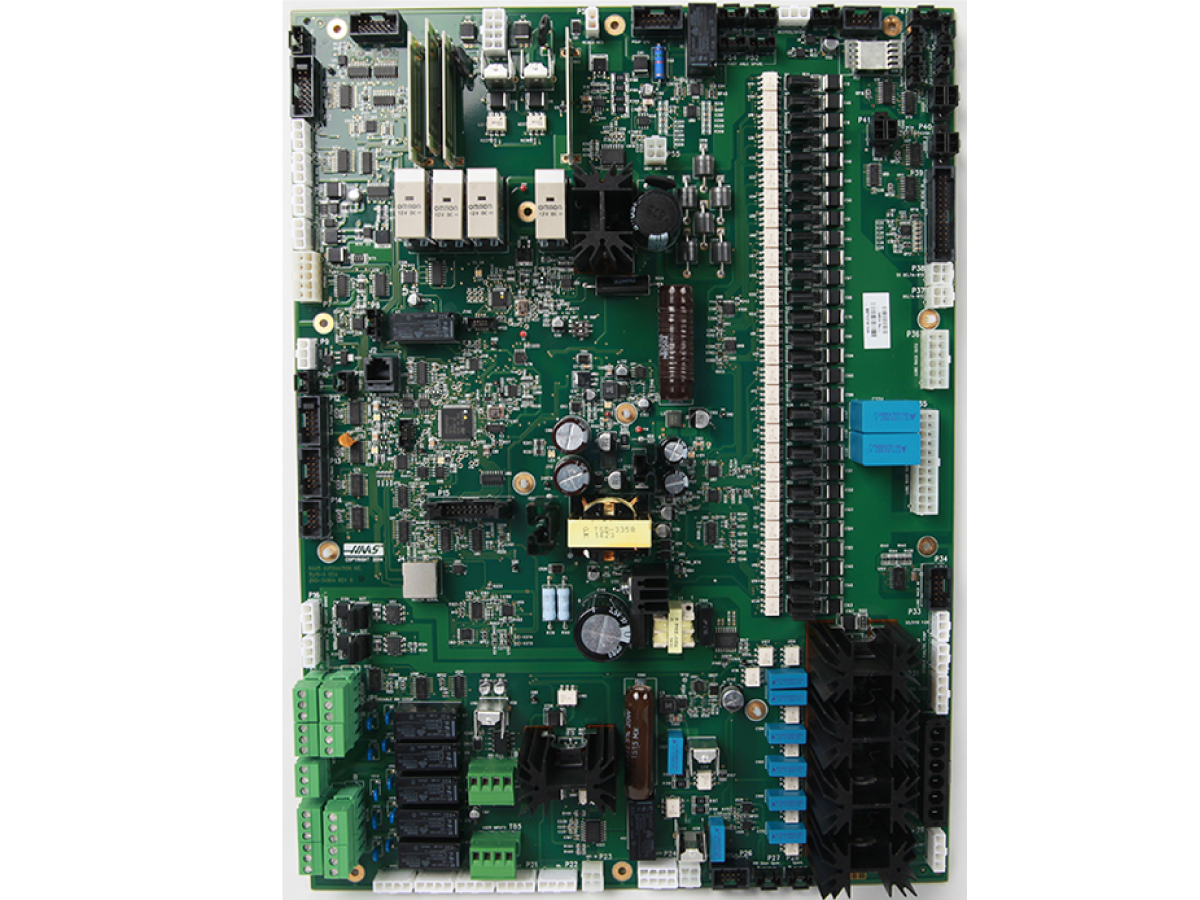
34-348xA
  • Release Date: 09/2014
  • Main Firmware Version: 01.XX

    Note: Firmware version cannot be upgraded to version 02.XX

  • TC Firmware Version: 01.XX

    Note: Firmware version cannot be upgraded to version 02.XX

34-348xC
  • Release Date: 05/2016
  • Main Firmware Version: 02.XX

    Note: Firmware version cannot be upgraded to version 03.XX

  • TC Firmware Version: 01.XX

    Note: Firmware version cannot be upgraded to version 02.XX

  • Backwards compatible with 34-348xA
  • Y/D Feedback Support
  • TSC/HPC 1K Fan Support
34-349xA/B
  • Release Date: 05/2018
  • Main Firmware Version: 03.XX - 04.XX
    Note: See the  I/O Firmware Compatibility chart for recommended firmware version.

  • TC Firmware Version: 02.XX 
    Note: The 02.xx version will show if the I/O PCB has a TC PCB installed.  If the TC PCB is not installed the firmware version will show "No TC".

  • Backwards compatible with 34-348xA/B
  • Redundant Axis Brake Support
  • Optional TC PCB
  • Outputs have LED's lights
34-349xC
  • Release Date: 03/2023
  • Main Firmware Version: 04.XX
    Note: See the I/O Firmware Compatibility chart for recommended firmware version.

  • TC Firmware Version: 02.XX 
    Note: The 02.xx version will show if the I/O PCB has a TC PCB installed.  If the TC PCB is not installed the firmware version will show "No TC".

  • Backwards compatible with 34-348xA/B/C and 34-349xA/B
  • Redundant Axis Brake Support
  • Optional TC PCB
  • Outputs have LED's lights
  • Supports low power valves by incorporating the I/O power supply and solenoid filters into the board
  • Variable frequency drive (VFD) adapter board is built in
  • E-stop Debounce circuit is also built in

I/O PCB Connector and Pin Information

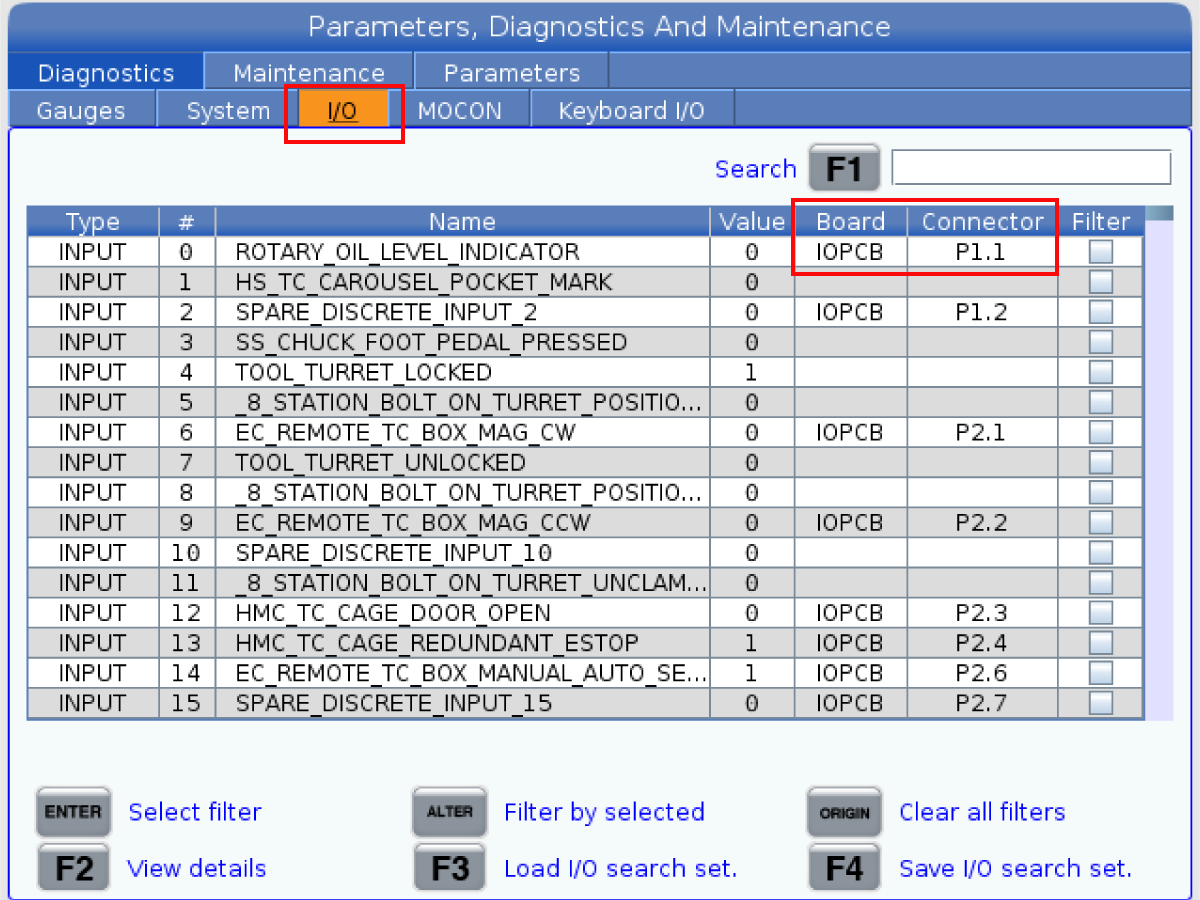
As of NGC software version 100.17.000.1016 or higher connector and pin number has been added to the I/O diagnostic tab.  The PCB board name has also been added.  This will help when troubleshooting a machine and trying to figure out which connector and pin number to probe.

The format for the connector and pin numbers are Pmm.nn where mm is the connector number and nn is the pin number.  For example, connector P56 and pin 5 would be represented as P56.5.  In some cases, a given signal may be present on more than one pin or connector.  In this case, they will be separated by a comma.

In addition to providing information on I/O signals, the table now includes rows for things like power and ground pins.

You can also use the search function to search for specific connector numbers.  For example you can search for connector P3 then press the [F1],  this will display all the input and output fuctions of connector P3.

PCB serial number

Note: The PCB's serial number must be included in the inspection report checklist. The serial number is on a sticker [1] on the top of the inspection checklist. 

The serial number will start with two letters, followed by eight digits. Include both the letters and numbers on the inspection report. 

Electrical Safety

 DANGER: Working with the electrical services required for CNC machines is extremely hazardous and can result in serious injury or death.

Before connecting line wires to the CNC:

  • Turn off all power to the machine at the source.
  • Perform a Lockout-Tagout (LOTO) procedure to ensure the power remains off during service.
  • Verify that power has been disconnected by using an AC voltage detector on all incoming lines.

If you are uncertain about how to safely disconnect power or perform LOTO procedures:

  • Do not proceed.
  • Contact qualified personnel or obtain appropriate assistance before continuing.

Failure to follow these precautions may result in electrical shock, equipment damage, or fatal injury.

 Danger: Before beginning any work inside the control cabinet, verify that the High Voltage indicator light on the 320V Power Supply / Vector Drive has been off for a minimum of five (5) minutes. This waiting period ensures that residual voltage has dissipated and reduces the risk of electric shock.

Certain service procedures involve high-risk electrical components and may pose serious injury or fatality hazards. Technicians must not attempt any procedure unless they have a complete understanding of the steps involved and the associated risks.

If there is any uncertainty regarding a procedure, contact your Haas Factory Outlet (HFO) to arrange for a qualified service technician.

Symptom Table

Symptom / Alarm Possible Cause Corrective Action
Alarm 9924 CONTROL AND IO BOARD COMMUNICATION LOST
Alarm 9925 CONTROL AND IO BOARD COMMUNICATION DID NOT INITIALIAZE.
Alarm 9915 IO BOARD CONFIGURATION CRC MISMATCH
The I/O PCB built-in Low Volt Power Supply (LVPS) voltages are not present or the LVPS is not working. Troubleshoot the I/O PCB LVPS.  Refer to the I/O PCB Low Volt Power Supply section below.
Alarm 9924 CONTROL AND IO BOARD COMMUNICATION LOST The I/O PCB is not receiving any power Check the PSUP breaker that supplies power to the I/O board. If the breaker is on, there should be LED lights on the I/O PCB. Check to see if the lights on the I/O board are on.
There is an issue with the RJ45 cable connected from the I/O PCB to the Maincon board. This RJ45 cable connected to J1 on the I/O PCB may be damaged. Check the cable and connectors for damage. Swap the cable with another RJ45 and try to clear the alarm. If the alarm clears then the original cable needs to be replaced.
Alarm 9924 CONTROL AND IO BOARD COMMUNICATION LOST is generated intermittently. There is electrical noise interfering with communication signals connected to the I/O PCB.

Use a service key and navigate to the MISC page on the control by pressing Diagnostics -> MISC. Look at the IOPerformance fields that show the communication errors that have been generated. See the Check IO Performance section below.

If the number of errors is growing, this indicates electrical noise in the control cabinet.

  1. Press [E-STOP] to turn the servos off. Then check to see if the number of errors continues to grow.
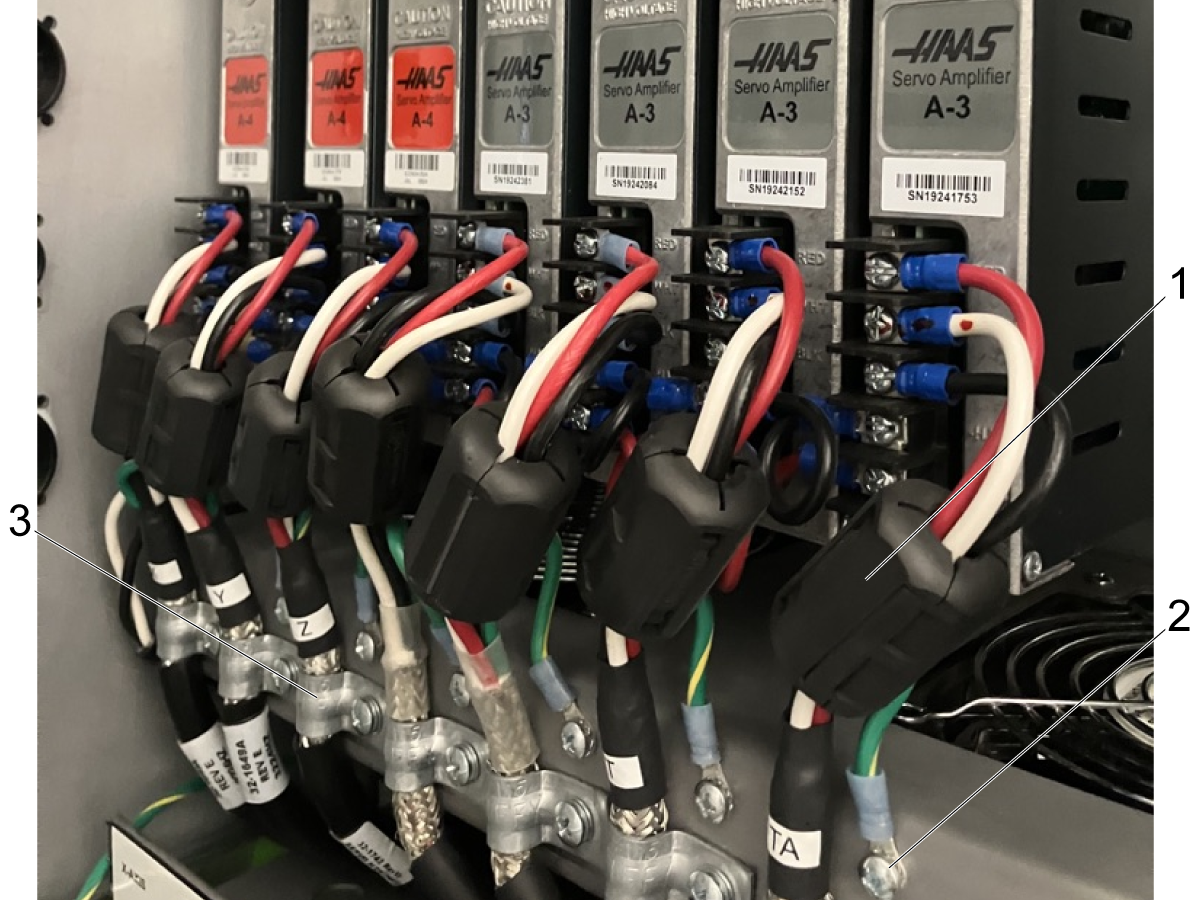
  2. Check that all ferrite filters are installed on communication cables.
  3. Check that the amplifier power cables are properly grounded to chasis.
Alarm 9924  CONTROL AND IO BOARD COMMUNICATION LOST and 9100 NON RESETTABLE SYSTEM ERROR Same possible causes as 9924 alarm above. Follow the Corrective Action listed above for 9924 alarms. If this action doesn't clear the alarm, cycle power on the machine. If the alarm is present after cycling power, take an error report and contact Haas Service.
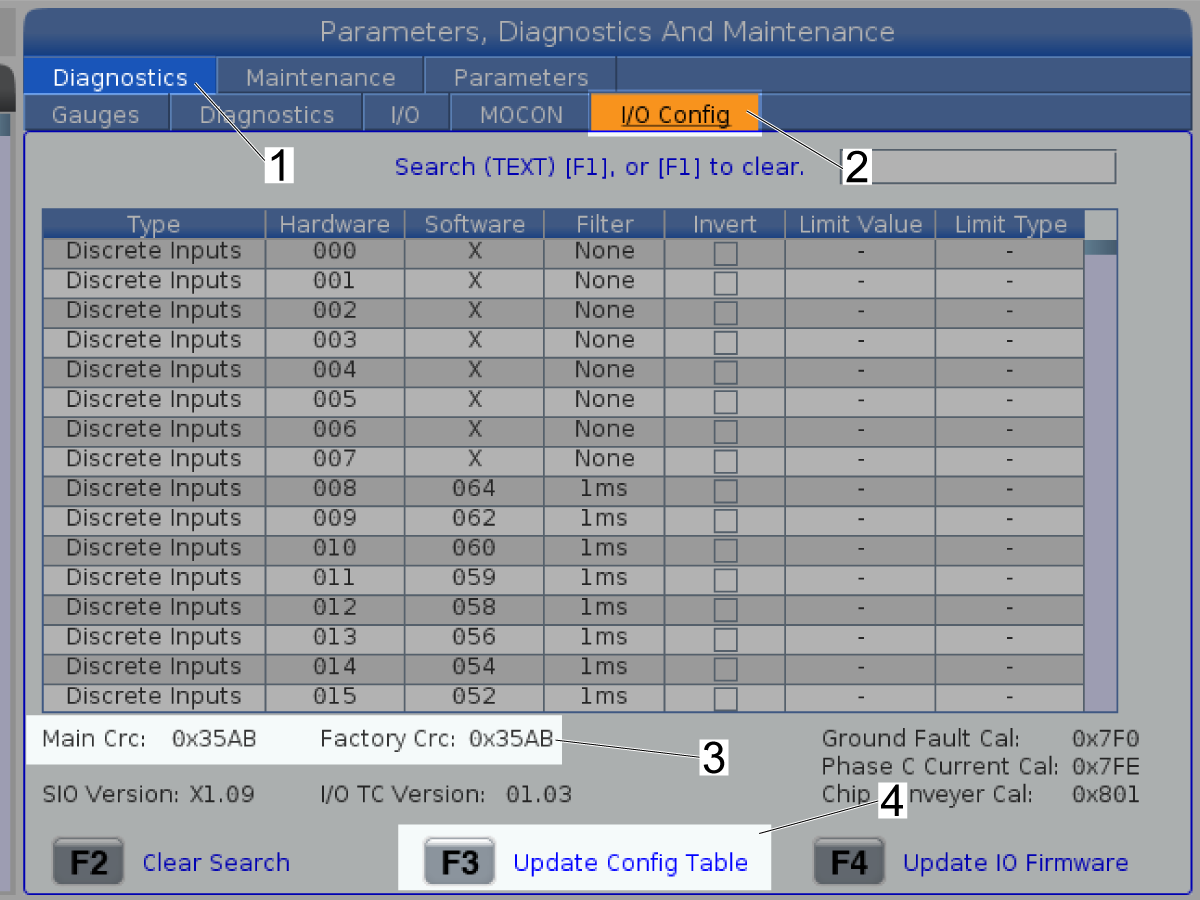
Alarm 9100 NON RESETTABLE SOFTWARE ERROR at Power On, or Alarm 9915 IO BOARD CONFIGURATION MISMATCH. Main CRC and Factory CRC do not match due to the I/O PCB being swapped out.
  1. Press [POWER OFF].
  2. Put the USB memory device into the control.

    Note: The USB memory device must contain your Haas Control Key and the correct configuration files.

  3. Press [POWER ON].
  4. Press [DIAGNOSTIC].
  5. Go to I/O Config [2] in the Diagnostics tab [1].
  6. Press [F3] to Update Config Table [4].
  7. Press [RESET] to continue. If the alarm does not clear, cycle the machine power.

The Main CRC and the Factory CRC[3] are now the same.

Alarm 9933 SOFTWARE VERSION MISMATCH and 9100
 NON RESETTABLE SOFTWARE ERROR
The firmware update failed, or I/O firmware is corrupted. Reload the I/O PCB main firmware refer to Next Generation Control - I/O PCB Main Firmware - Update.
Alarm 9899 IOPCB CAN FAULT and/ or 9105 IO BOARD COMMAND EXECUTION FAILURE. See the CAN Bus Systems Troubleshooting Guide for more information. The CAN node I/O Configuration is incorrect. Update the I/O configuration via the I/O Config tab.
The incorrect CAN node is enabled. Verify that Factory Settings 9000.001 -> 9031.001 are set correctly. Only active nodes should be enabled.
The Autodoor CAN PCB does not have power. Verify that the Low Volt Power supply is supplying power to the CAN Autodoor PCB.
The CAN node Communication cable is disconnected. Power down machine for at least a minute. Verify all CAN communication cables are connected correctly.
The CAN Module ID Selector is incorrect. Power down machine for at least a minute. Set ID selector correctly. Power up machine.
The CAN Modules have incorrect termination. Power down machine for at least a minute. Verify that only last node in the chain is terminated. Power up machine.
The CAN Node needs to be reset. Disable CAN Node via 9000.001 -> 9031.001. If the machine recovers (I/O page isn’t “X”) after disabling a particular node, try to enable the node again.
Spindle load pegs to 200%

There is a problem with the 120 VAC outputs circuit components (solenoids, Wye-Delta, Oil Pump etc.)

Inspect the wiring, pins, and connectors for this circuit.  Inspect the I/O board for faults. Replace the I/O if necessary
Machine generates multiple Alarm 20014.1 SIO TOOL CHANGER PCB IS NOT PRESENT and 20014.0 SIO TOOL CHANGER PCB PRESENT after the I/O TC PCB is installed.
The I/O or TC PCB firmware is outdated.   Update I/O Main and TC firmware version to the latest.  Refer to Next Generation Control - I/O PCB Main Firmware - Update.
Machines equipped with I/O PCB P/N: 34-3490A/B with an auxiliary estop that generates an estop alarm after the closing of machine doors. The doors closing have shaken the estop and caused a momentarily disconnect and caused an estop of the machine. A debounce capacitor will need to be added to the I/O PCB. Refer to the E-Stop - Debounce procedure.
Main I/O Firmware fails to load.  TC PCB is causing the failure. Remove the TC PCB from the Main I/O PCB.  Then try the Firmware upgrade again.  
Alarm 2001 EMERGENCY STOP SWITCH ERROR

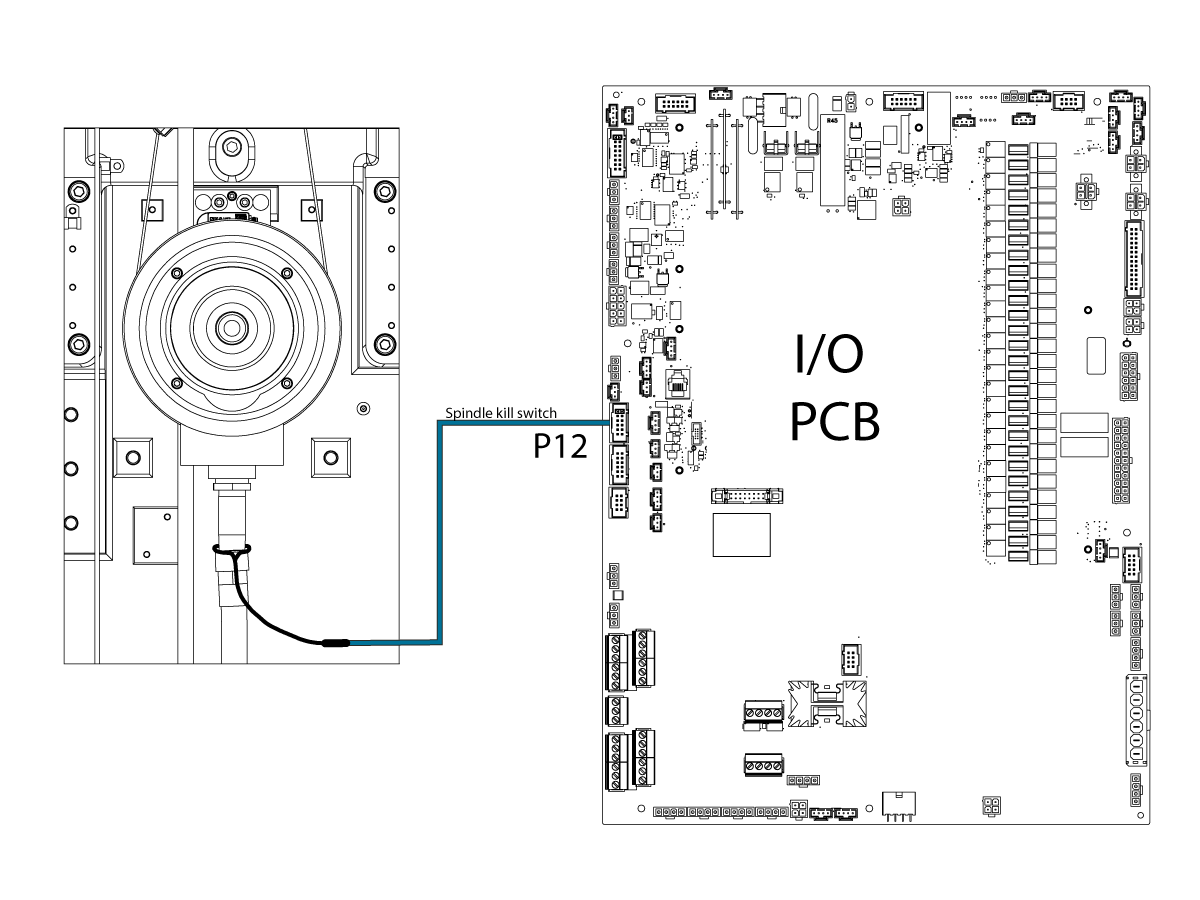
There is a loose connection from the Hydraulic Union Safety Device adaptor to the I/O PCB. 

Only applies to these machines built after 12/20/2023:

ST - 10/15/20/25/28/30/35/L/Y/LY 

REBOOT ONLY: ST-40/40Y/45/45Y (note: For ST-45/45L/45Y machines equipped with optional workholding)

Check the cable connected to the I/O PCB at P12, make sure the cable is not damaged or has a loose connection. 

Serial I/O PCB Alarms

Depending on the machine software version, I/O PCB main firmware version you will get a different alarm, see table below:

Alarm# / Title

Software 100.17.000.2021 and lower

I/O PCB Main Firmware 02.04 and lower

Alarm# / Title

Software 100.17.000.2030 and higher

I/O PCB (34-348xC) Main Firmware 02.05 and higher

Alarm Troubleshooting

  9830-IOPCB MEMORY DATA LOCKED Attempts were made to download an I/O configuration file while configuration memory was locked.
850-INTERNAL I/O ERROR 9800-INTERNAL I/O ERROR- SHIFT CHAIN An internal I/O circuit board error has been sensed in it's shift chain. - Press the [RESET] button. Power off, and inspect the circuit components on the I/O PCB, see section below.
9801-INTERNAL I/O ERROR-TC COMMUNICATION

An internal I/O circuit board error has been sensed where the main and tool changer microcontrollers could not communicate. - Press the [RESET] button.

Inspect the tool changer relays, make sure the relay sockets are solder into the PCB board.

Do not replace the I/O PCB.

For IO PCB (34-348xA):

·         Upgrade the I/O PCB Tool Changer firmware to the latest 01.xx version.

For IO PCB (34-348xC):

·         Update the I/O PCB Main firmware to the latest 02.xx version.

·         Update the I/O PCB Tool Changer firmware to the latest 01.xx version.

For IO PCB (34-349x):

·         Update the I/O PCB Main firmware to the latest 03.xx version.

Refer to Next Generation Control - I/O PCB Main Firmware - Update procedure.

9900-IOPCB COMMUNICATION LOST 9802-SIO MCU COMMUNICATION LOSS Communication has been lost to the I/O PCB. Check that the I/O PCB has power by looking for the 12/24V green LED's. Look for a tripped circuit breaker. If the board has power, then
1. Check the RJ-45 cable connection from Maincon PCB (J14) to I/O PCB (J4). To test the cable refer to Network Cable Tester Tool procedure.
2. Check the 3-Phase power input from PSUP (P4) to I/O PCB (P55).
3. Inspect the RJ-45 connector on the Maincon PCB & I/O PCB for bent pins.
Upgrade the software to 100.17.000.2045 or higher. If you get this alarm with version 100.17.000.2045 or higher download an error report and e-mail to Haas service.
  9831-I/O # ERROR The main processor has command an output that is not configured in the I/O configuration file.
  9832-SIO COMMUNICATION ERROR The I/O PCB has received partial or invalid communication from the main processor.
  9833-PCB OVER TEMPERATURE The I/O PCB is reporting a temperature that exceeds limits (65 degrees C)
  9834-12V FAULT The 12V supply on the I/O PCB is outside of its limits of 10 to 14V.
175-GROUND FAULT DETECTED 9803-120VAC GROUND FAULT A 120 VAC ground fault condition was detected by the I/O PCB.  The ground fault signal gets generated by the PSUP PCB.  The ground fault signal gets sent to  I/O PCB at  P56 for monitoring. Check all 120V outputs for possible shorts to earth ground. See ground fault troubleshooting section below.
9804-240VAC GROUND FAULT A 240 VAC ground fault condition was detected by the I/O PCB.  The ground fault signal gets generated by the PSUP PCB.  The ground fault signal gets sent to I/O PCB at  P56 for monitoring. Check all 240 V outputs for possible shorts to earth ground. This includes short circuits in any amplifier or vector drive output as well as any 240V pumps or chip conveyor. See ground fault troubleshooting section below.
9903-120 VAC SHORT CIRCUIT 9805-120VAC PHASE C SHORT CIRCUIT A short circuit was detected in the 120V outputs from the I/O PCB. Check all 120V outputs for possible shorts to earth ground. See ground fault troubleshooting section below.
  9835-120VAC PHASE C OVER CURRENT A partial short circuit was detected in the 120V outputs from the I/O PCB. Check all 120V outputs for possible shorts to earth ground. See ground fault troubleshooting section below.
  9836-120VAC PHASE C NO CURRENT An output was turned on but no change in current was detected. Check for broken wires/cables.
  9837-CALIBRATION ERROR I/O PCB Calibration error. Either calibration did not occur during power up. Or the new calibration values don't match the previous values.
  9838-TSC FAN FAILURE The fan for the TSC heat sink stopped; could cause TSC over heating later on.
  9820-TSC HEAT SINK OVER TEMP The TSC Heat sink temperature is over the limit of 85°C. Check for a damaged fan.
9904-PCOOL MALFUNCTION 9806-PCOOL SHORT CIRCUIT The programmable coolant circuit has detected a short circuit (>2.5A) and has shut down. Press the [RESET] button to clear alarms. If necessary, cycle power on the machine. Check for a shorted cable.
9807-PCOOL GROUND FAULT The programmable coolant circuit has detected a ground fault condition and has shut down. Press the [RESET] button to clear alarms. If necessary, cycle power on the machine. Check for a shorted cable to earth ground.
9808-PCOOL OVERHEAT The programmable coolant circuit has overheated and shut down. Give time for it to cool, then press the [RESET] button to clear alarms. Check for obstructions to Pcool movement.
  9839-PCOOL STALLED A high current (2.5A> I >1A) was detected in the programmable coolant circuit. Check for obstructions to Pcool movement. Check for binding in the Pcool unit.
  9840-PCOOL OVERLOAD The programmable coolant circuit has detected an overload condition. Check for binding in the Pcool unit.
  9841-PCOOL MOTOR DISCONNECTED The programmable coolant circuit was commanded on but no current was detected. Check to see if the Pcool will turn when commanded. Check for broken wires.   If the machine is equipped with 34-3090B I/O PCB make sure the Main I/O firmware has version 3.18 or higher. Refer to Next Generation Control - I/O PCB Main Firmware - Update procedure.
9905-IOPCB TOOL CHANGER FAULT 9809-TOOL CHANGER BUS SHORT CIRCUIT The I/O PCB experienced an internal short circuit. Replace the 4 tool changer relays. If problem persists, then replace the I/O PCB.
9810-INTERNAL I/O ERROR-TC TRANSISTOR FAILURE The I/O PCB tool changer (or bar feeder) transistor appears to be damaged. Replace the I/O PCB.
9811-TOOL CHANGER CABLE SHORT CIRCUIT One of the tool changer outputs has detected a short circuit. Check all tool changer motor outputs for possible short circuits.
9812-TOOL CHANGER GROUND FAULT A ground fault condition was detected by the I/O PCB tool changer. Check all tool changer motor outputs for possible short circuits to earth ground.
9813-TOOL CHANGER REGEN SHORTED The I/O PCB experienced a short circuit on the tool changer regen circuit. Check for a short circuit on it's external regen resistor at P57.
9814-CAROUSEL BRAKE RESISTOR OVER TEMPERATURE TBD
9815-ARM BRAKE RESISTOR OVER TEMPERATURE TBD
9816-REGEN OVERLOAD TBD
9817-MULTIPLE MOTOR COMMANDS TBD
9818-TOOL CHANGER OVERLOAD TBD
  9842-OVER VOLTAGE TBD
  9822 - IOPCB VERTICAL BRAKE FAILURE NGC machines equipped with I/O PCB P/N: 34-3490A/B and a servo brake motor may generate alarm 9822 IOPCB Brake.  Upgrade the Main I/O PCB firmware to 3.06 or higher.  Refer to I/O PCB Firmware - Update - NGC procedure.

Upgrade the Main I/O PCB Firmware to 4.21 or higher.

HSG-A 07-11-2023

880 - UNDER VOLTAGE ON 160V DC BUS 9843-TC UNDER VOLTAGE

The system detected an undervoltage condition from the TC circuit or the TC PCB.  Check the 115 VAC input to the TC PCB, check for shorts on the tool changer motors.

  1. Phase missing on the 120VAC power from the PSUP
  2. Low voltage level in the 120VAC power from the PSUP
  3. Open diode (s)  in the 120Vac bridge rectifier circuit either in the I/O PCB (34-348x A, 34-348x C  PCBs) or the TC PCB 34-5502 used on 34-349X I/O PCBs
  4. Faulty TC PCB 34-5502 PCB
  5. Faulty I/O PCB
  9844-REGEN OPEN TBD
  9845-CONFIGURATION CONFLICT TBD
  9846-MOTOR STALLED TBD
  9847-MOTOR DISCONNECTED The control software and the I/O firmware are not compatible, or the I/O firmware is outdated. 
9906-CHIP CONVEYOR MALFUNCTION 9819-CHIP CONVEYOR SHORT CIRCUIT TBD
  9848-CHIP CONVEYOR MOTOR DISCONNECTED TBD

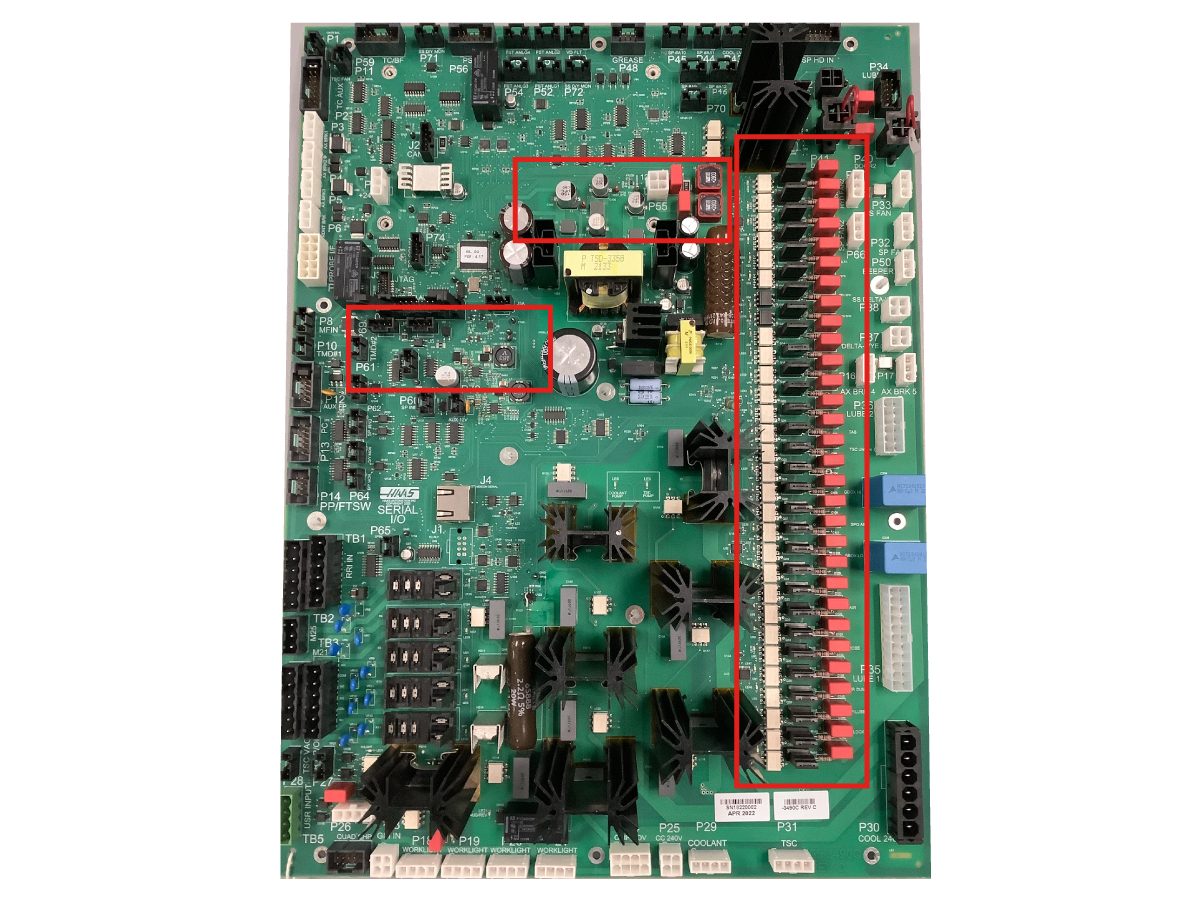
IO PCB LE7 Light

Note: The image above shows the location for LE7 on IO board 34-349C. The position of LE7 can differ based on the version of IO PCB on the machine.

LE7 [1] is one of the lights that come on when the machine is powered up. LE7 has three states that it can be used to troubleshoot potential issues:

LE7 is OFF

  1. This indicates the IO PCB is not receiving power or the software isn't functioning correctly. Check the breakers and make sure the IO board is receiving proper power.

LE7 is Blinking - This can mean several things:

  1. This indicates that the board is not communicating the IO states at the regular rate. It is normal for this to happen when the machine is booting up and also during firmware upgrades. 
  2. Check the serial communication cable going to the Maincon.
  3. LE7 will also be blinking if there is an internal IO PCB alarm (9800 Internal error/shift).
  4. Since LE7 blinks when booting up, if the control screen won't turn on and LE7 is blinking this may indicate that the Maincon is stuck in it's boot process. This doesn't mean that there is an issue with the IO board, but can indicate the state of the machine.

LE7 is On Solid

  1. This is the normal state of LE7 when the machine is powered on and booted up. It indicates the IO is communicating with the Maincon.


Lathe I/O PCB Hydraulic Union Safety Device Connection

  1. Push [POWER OFF]. Go to P12 on the I/O PCB, unplug the Hydraulic Union Safety Device adaptor. 
  2. Plug the cable back into P12 making sure its fully seated in the port. Push [POWER ON]. Push [ALARMS]. Push [RESET].
  3. Verify that the EMERGENCY STOP alarm has cleared.

Check IO Performance

Note: The MISC tab can only be seen when a service key is used on the machine.

Enter service mode using the service key.

Press Diagnostics and then going to the MISC tab [1].

Monitor the Total Errors and CRC Errors for both Transmitting (Tx) and Receiving (Rx) [2].

If the number of errors is growing, there is likely electrical noise present in the control cabinet.

Press [E-STOP] to turn off the servo motors. Check if this stops the number of errors from growing. Electrical noise may be produced by the power cables coming from the servo amplifiers located above the IO board.

If the number of errors stops increasing when the servos are off, make sure that all ferrite filters are installed on communication cables and that amplifier power cables coming from the amplifiers and vector drives are properly grounded. 

Make sure there are ferrite filters [1] ground connections [2] and that the exposed shielding is grounded on all amplifiers [3].

Ground Fault Circuit Monitor

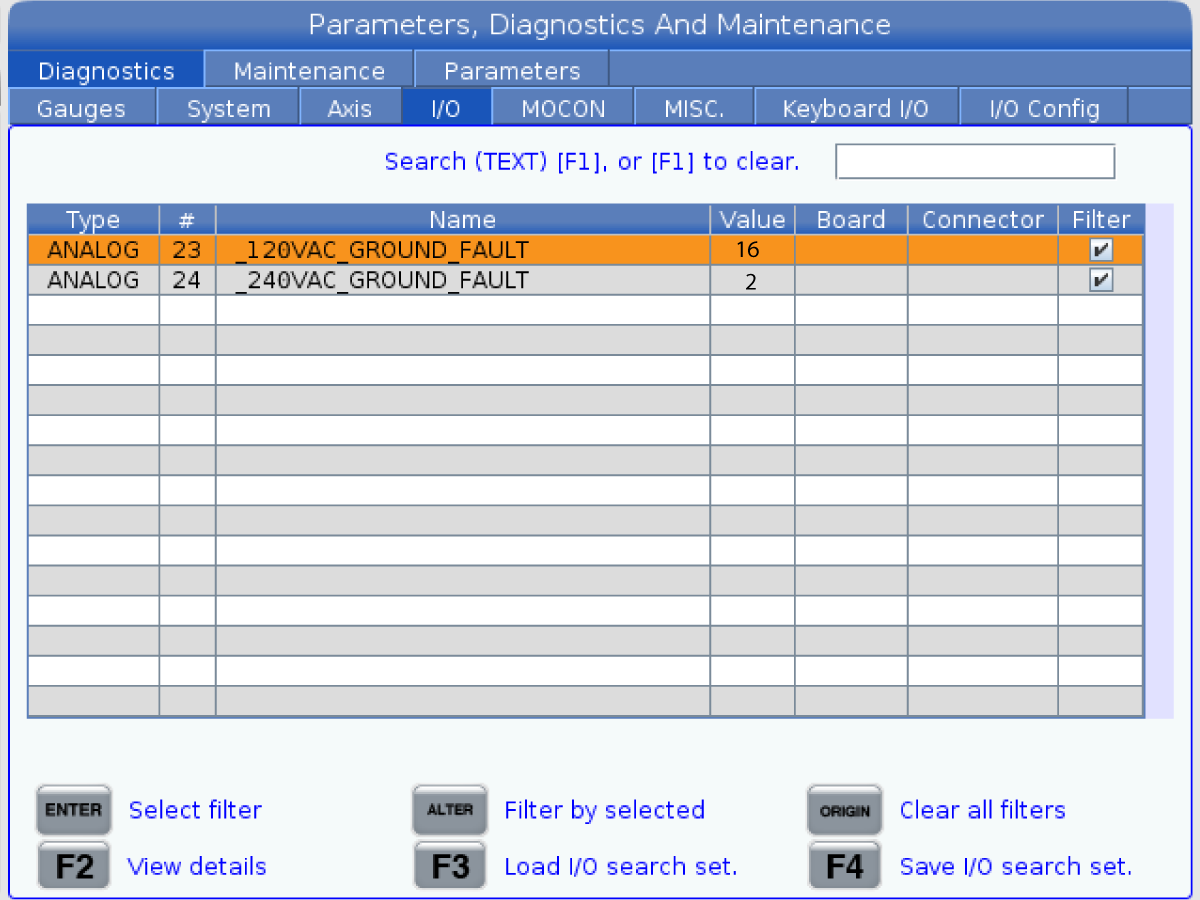
On the NGC control there is a ground fault circuit monitor. This circuit monitors the 115V and 230V for a ground fault condition.

  1. For 175 GROUND FAULT alarm. Determine if the alarm is caused by a 115 or 230 VAC component.
  2. Press the [DIAGNOSTIC] button, cursor to the I/O tab.
  3. Type in: "Ground", then press [F1].
  4. Look at the _120VAC/_240VAC_GROUND FAULT analog value. The circuit with the highest value is the one that reported the ground fault.
  5. Test the components that operate in that voltage range, for a short-circuit (see the table below).
  6. The ground fault analog value will drop when the component with the short circuit is disconnected from the machine control.

Components to Check when a Ground Fault Alarm Occurs

 Note: *These devices can be disconnected from the I/O PCB without an alarm being generated.

Machine Components I/O PCB Location Operating Voltage
4th and 5th Axis Brake Solenoids* P16 - P17 120 VAC
Worklights* P18 - P21 120 VAC
High Intensity Lights* P22 120 VAC
GFI P23 120 VAC
Door Interlocks* P40, P41, P42 120 VAC
Lube Panel Solenoids P35, P36 120 VAC
Y/D Contactor Coil P37, P38 120 VAC
DC Tool Change Motors* P58 160 VDC, generated from the 120 VAC
Spindle Motor Fan / Oil Pump P32 120 VAC
Sub Spindle Fan / Hydraulic Pump Fan P33 120 VAC
TSC/HPC Pump* P31 240 VAC
Coolant Pump* P29 240 VAC
Chip Auger / Conveyor* P24, Quad PCB 240 VAC
Axis Motors   240 VAC
Spindle Motor   240 VAC
Hydraulic Pump Motor   240 VAC

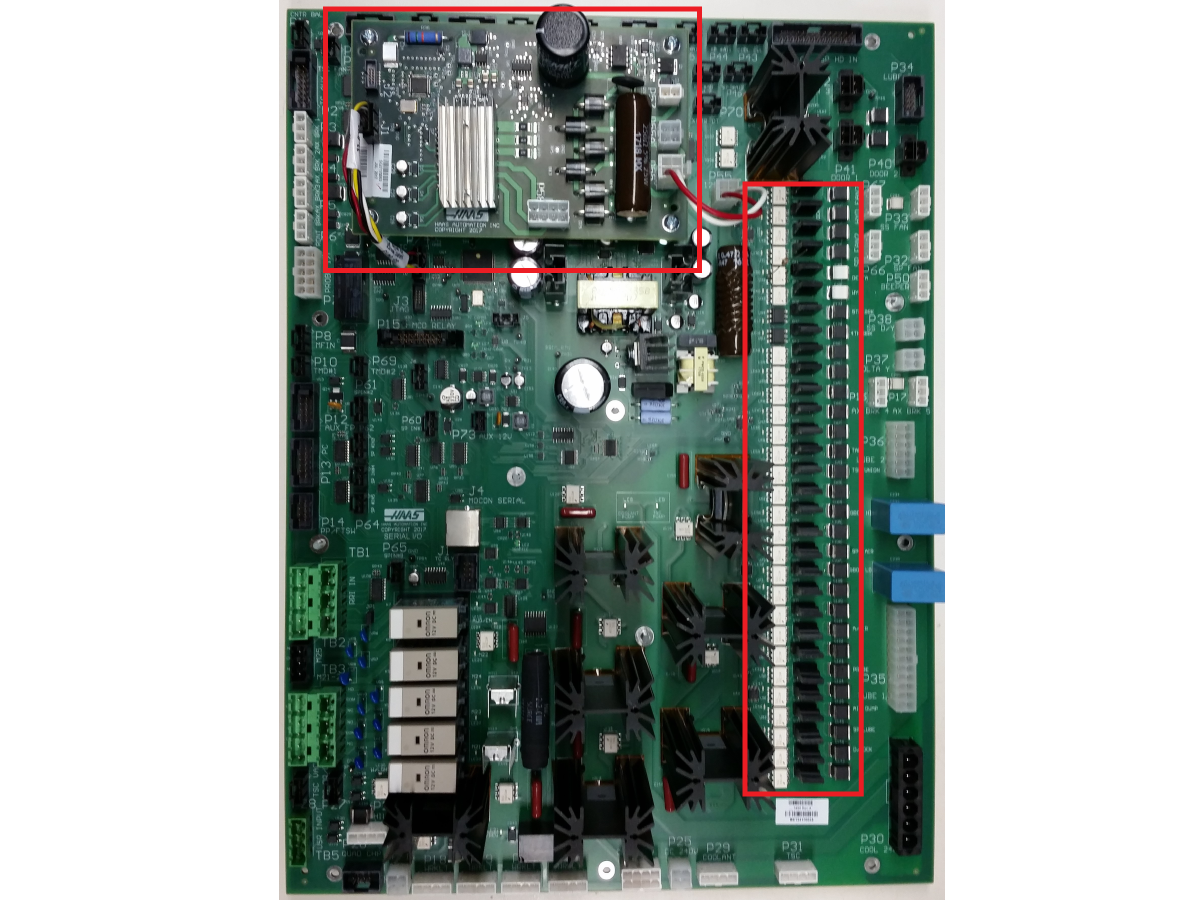
I/O PCB Low Volt Power Supply

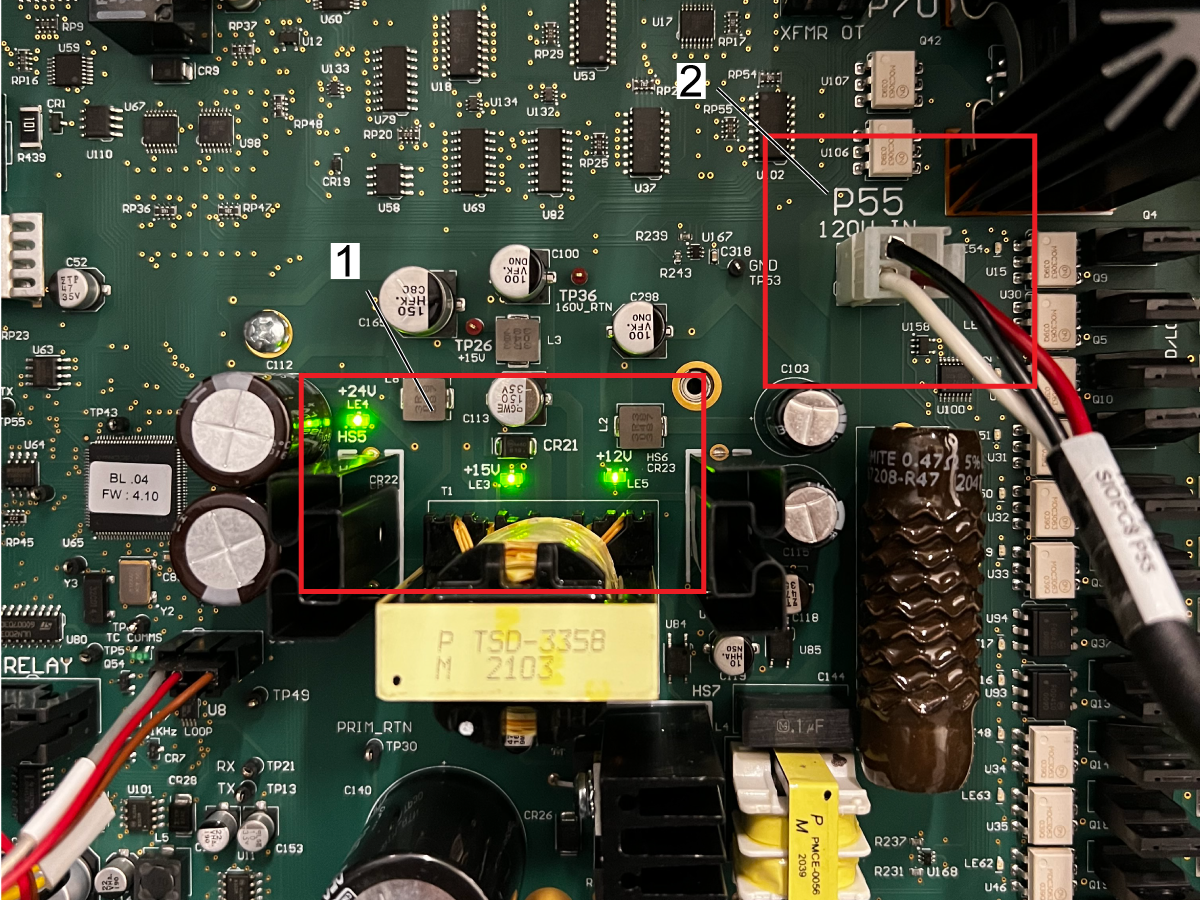
The I/O PCB is equipped with a built in Low Volt Power Supply (LVPS).  This power supply generates 3 DC voltages:  +24V, +15V and +12V [1].

These voltages are used to power low volt circuits on the I/O PCB and also to power external devices like Probes, Axis Brakes, and User Inputs.

There are 3 LEDs that show the presence of these voltages on the I/O PCB. 

  • When the I/O LVPS is working correctly these LED's will glow solid.  
  • When there is a short circuit on the low volt circuits these LED's can begin to flash on and off. 
    • When this happens you will need to find the source of the short circuit, start by disconnecting devices that are being powered by the LVPS like the Probe, Axis Brakes, User Inputs until LED lights begin to remain solid.
  • When the LED's are OFF and the machine is turned on.  The I/O PCB may not be getting the 115VAC Voltage input [2] or the Circuit Breaker for the I/O PCB may have tripped.

PCB Component Inspection

Intermittent alarms or symptoms can be caused by component failure. Below is a list of possible failures:

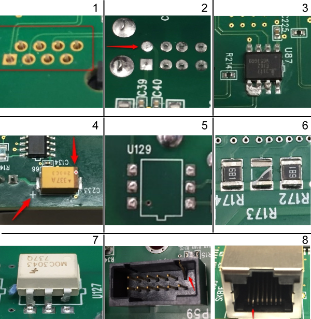
  1. Missing solder on all or some components pins
  2. Poor solder
  3. Solder bridges
  4. Wrong component installation (orientation)
  5. Missing components

     Note: Some PCB's have unused circuits and are missing components intentionally, look for broken off components.

  6. Broken components
  7. Broken pins on IC's
  8. Bent pins on the connectors

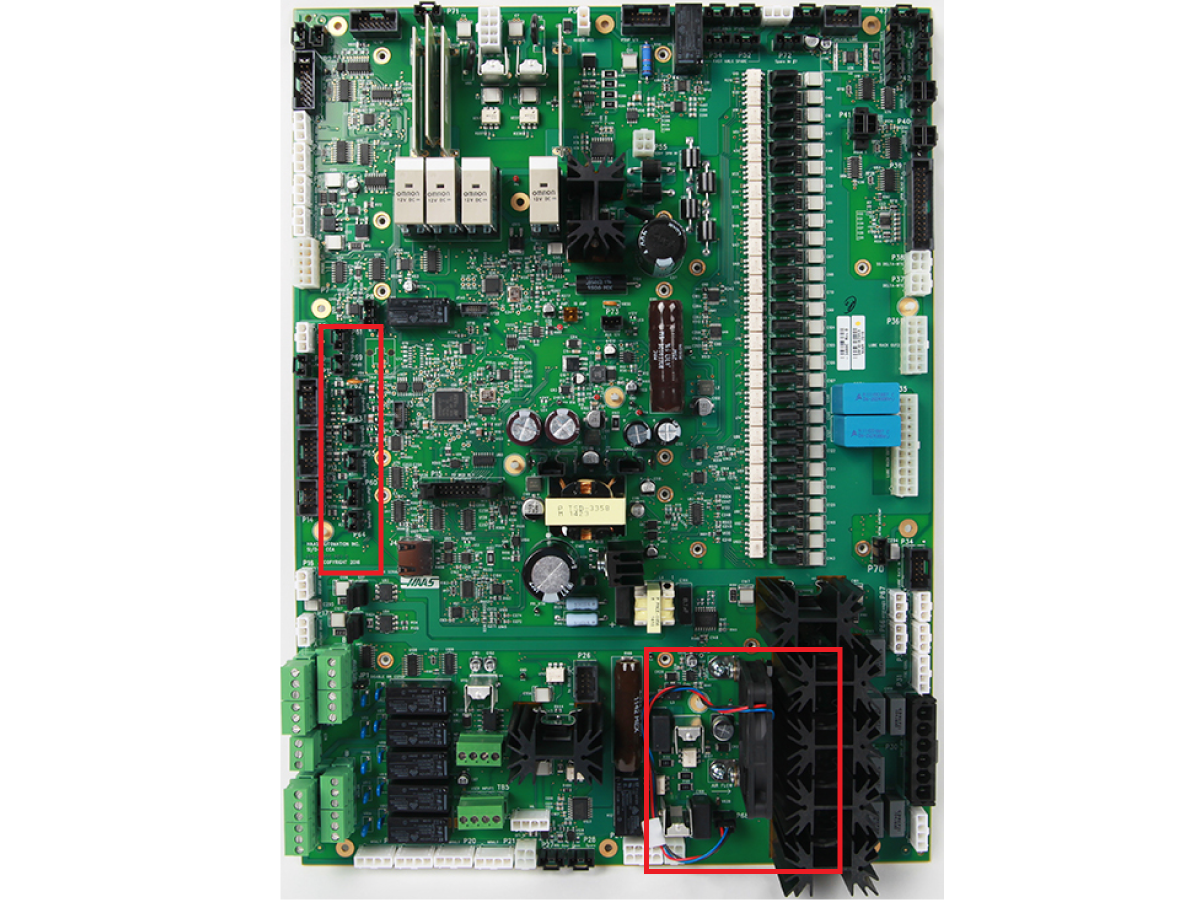
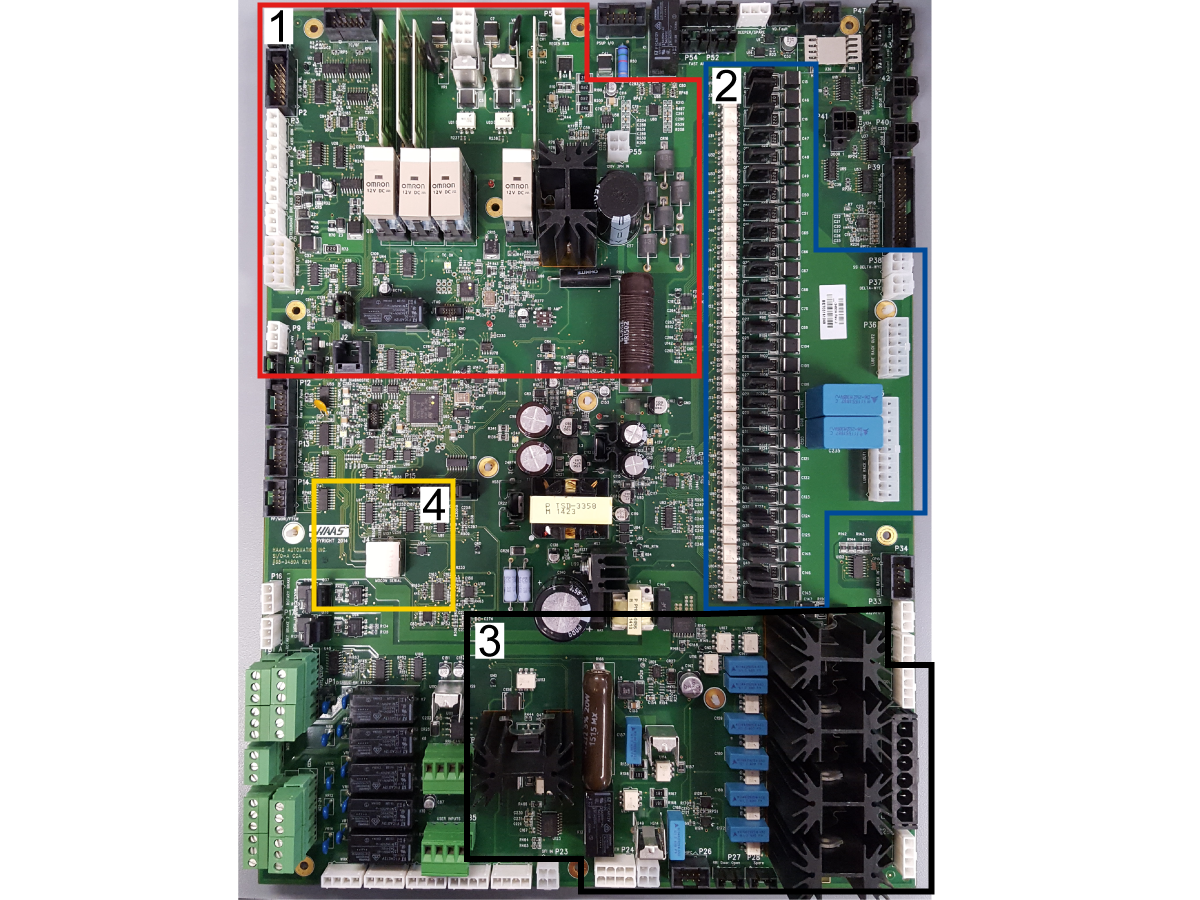
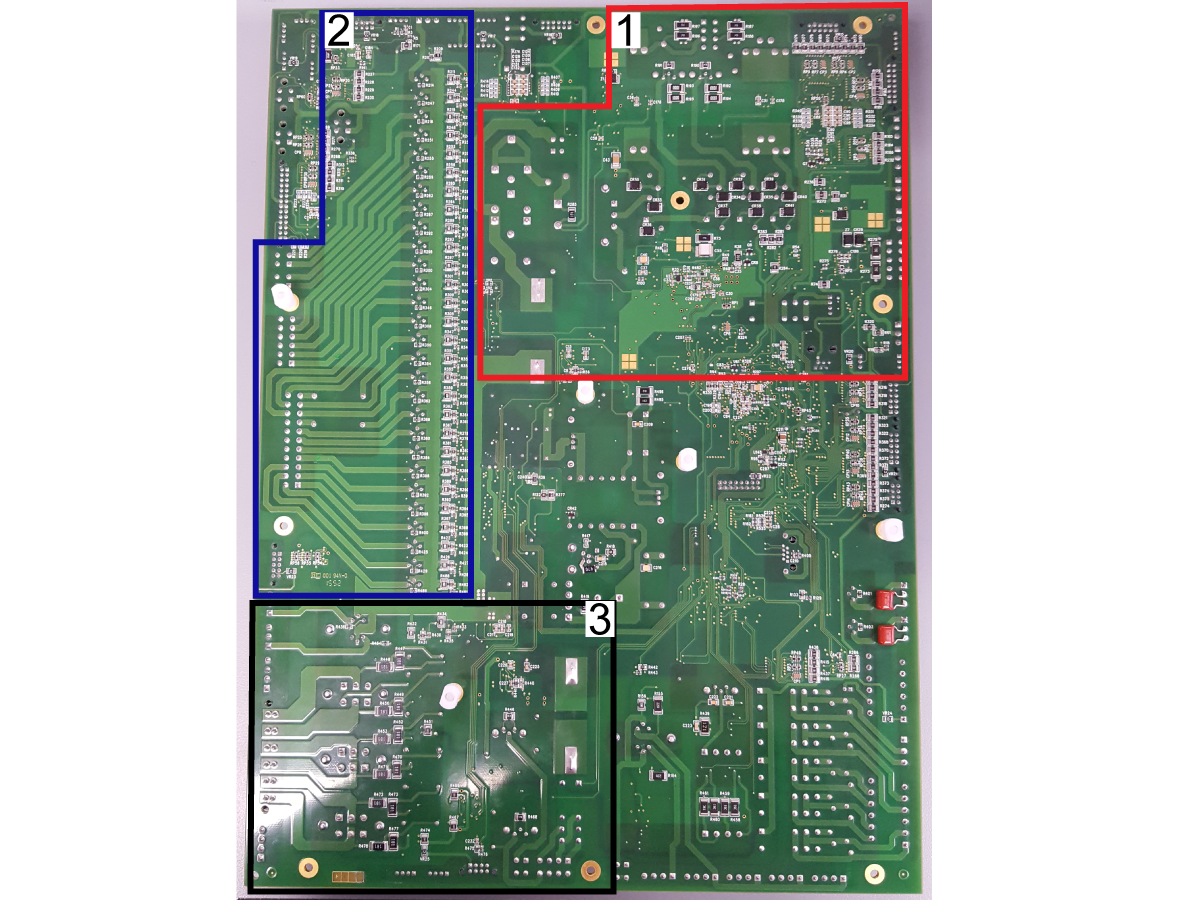
Use a magnifying glass to inspect the circuit components on the front and back of the I/O PCB. Below are the circuit component zones to inspect:

  1. 24 VDC, 160 VDC circuit components (DC motor tool changers, axis brake, probe).
  2. 120 VAC outputs circuit components (solenoids, Wye-Delta, Oil Pump etc.)
  3. 240 VAC outputs circuit components (Coolant, TSC, Auger).
  4. Check the RJ45 connector for loose housing and bent pins.

 Important: If you find a damaged component, replace the I/O PCB, inspect the new I/O PCB circuit components before installing.

Electrical Diagrams

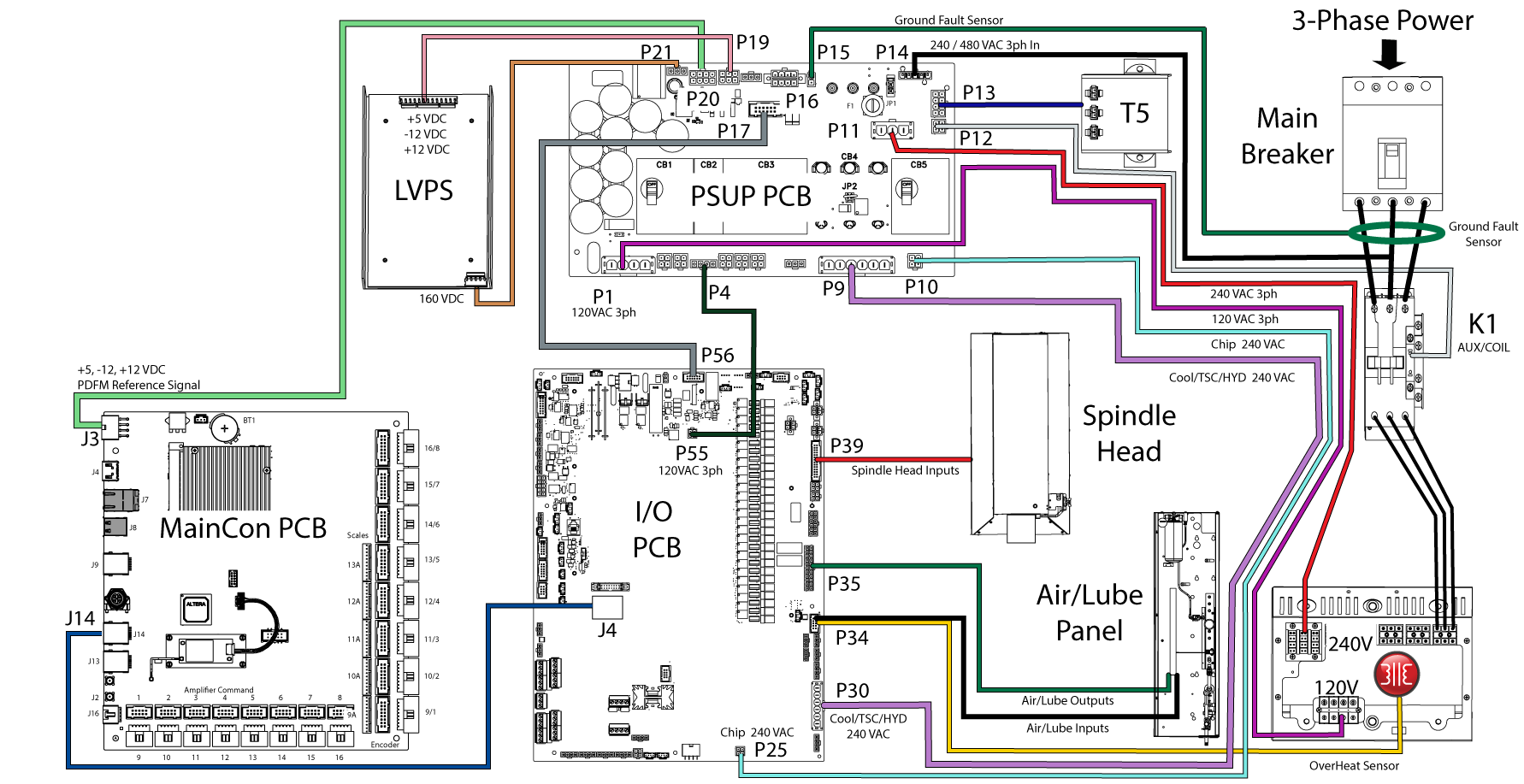
I/O PCB Interconnect Diagram

I/O PCB (P39) to Mill - Spindle Head Inputs Detail Diagram

I/O PCB (P34, P35) to Mill - Air/Lube Panel Detail Diagram

Updated

PSUP (P17) to I/O PCB (P56) Detail Diagram

Related Content

CAN I/O Systems
Robot Integration
DIagnostic Data

Recently Viewed Items

You Have No Recently Viewed Items Yet

Feedback
Haas Logo

Haas Delivered Price

This price includes shipping cost, export and import duties, insurance, and any other expenses incurred during shipping to a location in France agreed with you as a buyer. No other mandatory costs can be added to the delivery of a Haas CNC Product.

KEEP UP WITH THE LATEST HAAS TIPS AND TECHNOLOGY...

Sign up now!   

HAAS TOOLING ACCEPTS THE FOLLOWING:

  • Service & Support
  • Owners
  • Request Service
  • Operator Manuals
  • Haas Parts
  • Rotary Repair Request
  • Pre-Install Guides
  • Shopping Tools
  • Build & Price a New Haas
  • Available Inventory
  • The Haas Price List
  • CNCA Financing
  • About Haas
  • Accessibility Statement
  • DNSH Statement
  • Export Compliance
  • Careers
  • Certifications & Safety
  • Contact Us
  • History
  • Terms & Conditions
  • Haas Tooling Terms & Conditions
  • Privacy
  • Warranty
  • Haas Community
  • Haas Certification Program
  • Haas Motorsports
  • Gene Haas Foundation
  • Haas Technical Education Community
  • Events
  • Join the Conversation
  • Facebook
  • X
  • Flickr
  • YouTube
  • LinkedIn
  • Instagram
  • TikTok
© 2026 Haas Automation, Inc – CNC Machine Tools

This site is protected by reCAPTCHA and the Google Privacy Policy and Terms of Service apply.

2800 Sturgis Rd., Oxnard, CA 93030
Toll Free: (888) 817-4446 / Fax: 805-278-8554