My Haas Welcome,
!
Haas Tooling MyHaas/HaasConnect Sign In Register Haas Tooling MyHaas/HaasConnect Sign Out Welcome, My Machines Latest Activity My Quotes My Account My Users Sign Out
Find Your Distributor
  1. Select Language
    1. English
    2. Deutsch
    3. Español - España
    4. Español - México
    5. Français
    6. Italiano
    7. Português
    8. Český
    9. Dansk
    10. Nederlands
    11. Magyar
    12. Polski
    13. Svenska
    14. Türkçe
    15. 中文
    16. Suomi
    17. Norsk
    18. الإنجليزية
    19. български
    20. Hrvatski
    21. Ελληνικά
    22. Română
    23. Slovenský
    24. Slovenščina
    25. 한국어
    26. 日本語
    27. Українська
  • machines Main Menu
    • Vertical Mills
      Vertical Mills
      Vertical Mills View All
      • Vertical Mills
      • VF Series
      • Universal Machines
      • VR Series
      • VP-5 Prismatic
      • Pallet-Changing VMCs
      • Mini Mills
      • Mold Machines
      • High-Speed Drill Centers
      • Drill/Tap/ Mill Series
      • Toolroom Mills
      • Pocket Mill
      • Compact Mills
      • Gantry Series
      • SR Sheet Routers
      • Extra-Large VMC
      • Double-Column Mills
      • 3+2 Positioning Machines
    • Multi-Axis Solutions
      Multi-Axis Solutions
      Multi-Axis Solutions View All
      • Multi-Axis Solutions
      • Y-Axis Lathes
      • 5-Axis Mills
    • Lathes
      Lathes
      Lathes View All
      • Lathes
      • ST Series
      • Dual-Spindle
      • Box Way Series
      • Toolroom Lathes
      • Chucker Lathe
      • Haas Bar Feeders
    • Horizontal Mills
      Horizontal Mills
      Horizontal Mills View All
      • Horizontal Mills
      • 50-Taper
      • 40-Taper
    • Rotaries & Indexers
      Rotaries & Indexers
      Rotaries & Indexers View All
      • Rotaries & Indexers
      • Rotary Tables
      • Indexers
      • 5-Axis Rotaries
      • Extra-Large Rotaries
    • Special Series
      Special Series
      Special Series View All
      • Special Series
      • EU_Series_Redirect
    • Automation Systems
      Automation Systems
      Automation Systems View All
      • Automation Systems
      • Mill Automation
      • Lathe Automation
      • Automatic Parts Loaders
      • Automation Models
    • Desktop Machines
      Desktop Machines
      Desktop Machines View All
      • Desktop Machines
      • Desktop Mill
      • Desktop Lathe
      • Control Simulator, Standard
      • Control Simulator, Premium
    • Shop Equipment
      Shop Equipment
      Shop Equipment View All
      • Shop Equipment
      • Knee Mill
      • Haas Manual Lathes
      • Haas Saws
    • Fabrication Machines
      Fabrication Machines
      Fabrication Machines View All
      • Fabrication Machines
      • Laser Cutting Machines
      • CNC Press Brakes
    • QUICK LINKS Special Series  Special Series 
      EU SERIES EU SERIES BUILD & PRICE | PRICE LIST BUILD & PRICE | PRICE LIST In-Stock Machines In-Stock Machines WHAT’S NEW WHAT’S NEW YOUR FIRST CNC YOUR FIRST CNC
      SHOPPING TOOLS
      • Build & Price a Haas
      • Price List
      • Available Inventory
      • CNCA Financing
      WANT TO TALK TO SOMEONE?

      A Haas Factory Outlet (HFO) can answer your questions, and walk you through your best options.

      CONTACT YOUR DISTRIBUTOR >
  • Options Main Menu
    • The Haas Control Value Option Packages
      Value Option Packages
      Value Option Packages View All
      • Value Option Packages
    • Product Image Spindles
      Spindles
      Spindles View All
      • Spindles
    • Product Image Tool Changers
      Tool Changers
      Tool Changers View All
      • Tool Changers
    • Product Image 4th- | 5th-Axis
      4th- | 5th-Axis
      4th- | 5th-Axis View All
      • 4th- | 5th-Axis
    • Product Image Turrets & Live Tooling
      Turrets & Live Tooling
      Turrets & Live Tooling View All
      • Turrets & Live Tooling
    • Product Image Probing
      Probing
      Probing View All
      • Probing
    • Haas Chip & Coolant Management Chip & Coolant Management
      Chip & Coolant Management
      Chip & Coolant Management View All
      • Chip & Coolant Management
    • The Haas Control The Haas Control
      The Haas Control
      The Haas Control View All
      • The Haas Control
    • Product Image Product Options
      Product Options
      Product Options View All
      • Product Options
    • Product Image Tooling & Fixturing
      Tooling & Fixturing
      Tooling & Fixturing View All
      • Tooling & Fixturing
    • Product Image Workholding
      Workholding
      Workholding View All
      • Workholding
    • Product Image 5-Axis Solutions
      5-Axis Solutions
      5-Axis Solutions View All
      • 5-Axis Solutions
      • 5 Easy Steps to 5-Axis
    • QUICK LINKS Special Series  Special Series 
      EU SERIES EU SERIES BUILD & PRICE | PRICE LIST BUILD & PRICE | PRICE LIST In-Stock Machines In-Stock Machines WHAT’S NEW WHAT’S NEW YOUR FIRST CNC YOUR FIRST CNC
      SHOPPING TOOLS
      • Build & Price a Haas
      • Price List
      • Available Inventory
      • CNCA Financing
      WANT TO TALK TO SOMEONE?

      A Haas Factory Outlet (HFO) can answer your questions, and walk you through your best options.

      CONTACT YOUR DISTRIBUTOR >
  • Why Haas Main Menu
      Discover the Haas Difference
    • Why Haas
    • MyHaas
    • Education Community
    • Industry 4.0
    • Haas Certification
    • Customer Testimonials
  • Service Main Menu
      Welcome to Haas Service
      SERVICE HOME Operator’s Manuals How-To Procedures Troubleshooting Guides Preventive Maintenance Haas Parts Haas Tooling Videos
  • Videos Main Menu
  • Main Menu
    • View All
    • View All
    • View All
    • View All
      • HTEC Curriculum Support
      • Haas Value Option Packages (VOP) Journey
    • View All
      • Haas 10 kg Cobot Package
      • Cobot Kits
      • DC-1 Drill Center
      • CNC Sales News
      • Do More With Your Haas
    • View All
    • View All
      • contact-us-test
      • 4 - AUTOMATION SYSTEMS
      • Carousel-V2
      • expert test
      • Demo_Day_Trident-test
      • Link Test
      • image-sale-tag-test
      • article-list-test
      • Haas 25 kg Robot Package
      • test-algolia-page
    • View All
    • View All
    • View All
    • View All
      • calc-test
    • View All
    • QUICK LINKS Special Series  Special Series 
      EU SERIES EU SERIES BUILD & PRICE | PRICE LIST BUILD & PRICE | PRICE LIST In-Stock Machines In-Stock Machines WHAT’S NEW WHAT’S NEW YOUR FIRST CNC YOUR FIRST CNC
      SHOPPING TOOLS
      • Build & Price a Haas
      • Price List
      • Available Inventory
      • CNCA Financing
      WANT TO TALK TO SOMEONE?

      A Haas Factory Outlet (HFO) can answer your questions, and walk you through your best options.

      CONTACT YOUR DISTRIBUTOR >
  • Haas Tooling Main Menu
  • Haas Service Parts Main Menu

My Haas Welcome,
!
Haas Tooling MyHaas/HaasConnect Sign In Register Haas Tooling MyHaas/HaasConnect Sign Out Welcome, My Machines Latest Activity My Quotes My Account My Users Sign Out
Find Your Distributor
  1. Select Language
    1. English
    2. Deutsch
    3. Español - España
    4. Español - México
    5. Français
    6. Italiano
    7. Português
    8. Český
    9. Dansk
    10. Nederlands
    11. Magyar
    12. Polski
    13. Svenska
    14. Türkçe
    15. 中文
    16. Suomi
    17. Norsk
    18. الإنجليزية
    19. български
    20. Hrvatski
    21. Ελληνικά
    22. Română
    23. Slovenský
    24. Slovenščina
    25. 한국어
    26. 日本語
    27. Українська
×

Search Results

Web Pages

Images

    • <
    • 1
    • >

11 - NGC - 4th and 5th Axis

Next Gen Control Electrical - Service Manual


  • 1 - NGC - Introduction
  • 2 - NGC - Activation
  • 3 - NGC - Software Update
  • 4 - NGC - Firmware Update
  • 5 - NGC - Configuration
  • 6 - NGC - Error Report and Backup
  • 7 - NGC - Main Processor
  • 8 - NGC - I/O and TC PCB
  • 9 - NGC - CAN Systems and Autodoor
  • 10 - NGC - Servo Motors and Axis Cables
  • 11 - NGC - 4th and 5th Axis
  • 12 - NGC - Servo Amplifiers
  • 13 - NGC - Vector Drive
  • 14 - NGC - Regen
  • 15 - NGC - 320V Power Supply
  • 16 - NGC - Wye / Delta
  • 17 - NGC - Circuit Breaker and Transformer
  • 18 - NGC - PSUP PCB
  • 19 - NGC - SKBIF and LCD Monitor
  • 20 - NGC - Remote Jog Handle
  • 21 - NGC - 115V LED - WorkLights
  • 22 - NGC - CabCool
  • 23 - NGC - MyHaas
  • 24 - NGC - Networking
  • 25 - NGC - 8M PCB
  • 26 - NGC - Robot and Automation
  • 27 - NGC - Machine Data Collection
  • 28 - NGC - Control Icons
  • 29 - NGC - Sensors and Switches
  • 30 - NGC - USB
  • 31 - NGC - Keypad
  • 32 - NGC - Broken Tool Detection
  • 33 - NGC - IPFDM PCB
  • 34. NGC - LVPS
  • 35 - NGC - Camera Monitor System
  • 36 - NGC - High Intensity Lights
  • 37 - NGC - 24V LED - Worklights
  • 38 - NGC - Mill - Rotary Scale Cable Installation

Go To :

  • 11.1 4th and 5th Axis Drive - Installation
  • 11.2 Rotary - Enable and Disable
  • 11.3 Reverse Rotary Direction - Setup

11.1 4th and 5th Axis Drive - Installation

Recently Updated

4th and 5th Axis Drive - Installation - NGC


AD0319

Revision A - 10/2025

Introduction

Refer to the Rotary - Installation procedure to install a TR, TRT, or a T5C rotary unit on a Haas VMC.

Machine Requirements:
  • Mills that have brushless servo amplifiers.
  • Machines with NGC.

Document Applies to these parts:

  • P/N 93-2389 4TH-AXIS DRIVE, NGC
  • P/N 93-1000276 4TH-AXIS DRIVE
  • P/N 93-2544 5TH-AXIS DRIVE, NGC
  • P/N 93-1000275 5TH AXIS DRIVE

Note: All machines must be geolocated by a service technician when a 5th axis upgrade is installed and activated. 

Motion sensor support has been posted on HBC in HBC -> Service -> Utilities -> Documents and software -> 11_Geolocation & Motion Sensor.

Electrical Safety

 DANGER: Working with the electrical services required for CNC machines is extremely hazardous and can result in serious injury or death.

Before connecting line wires to the CNC:

  • Turn off all power to the machine at the source.
  • Perform a Lockout-Tagout (LOTO) procedure to ensure the power remains off during service.
  • Verify that power has been disconnected by using an AC voltage detector on all incoming lines.

If you are uncertain about how to safely disconnect power or perform LOTO procedures:

  • Do not proceed.
  • Contact qualified personnel or obtain appropriate assistance before continuing.

Failure to follow these precautions may result in electrical shock, equipment damage, or fatal injury.

 Danger: Before beginning any work inside the control cabinet, verify that the High Voltage indicator light on the 320V Power Supply / Vector Drive has been off for a minimum of five (5) minutes. This waiting period ensures that residual voltage has dissipated and reduces the risk of electric shock.

Certain service procedures involve high-risk electrical components and may pose serious injury or fatality hazards. Technicians must not attempt any procedure unless they have a complete understanding of the steps involved and the associated risks.

If there is any uncertainty regarding a procedure, contact your Haas Factory Outlet (HFO) to arrange for a qualified service technician.

Rotary Scale Cable - Installation

Machine Compatibility:  Next Generation Control Machines with a trunnion rotary.

Document Applies to these Parts:

[A] 32-10053 QTY: 1 CABLE, [+12V] ROTARY SCALE FEEDBACK CONTROL END (NGC)

[B] 41-0040 QTY: 4 BOLT, PTHS 4-40X3/8 TRUSS MCMASTER-CARR

1

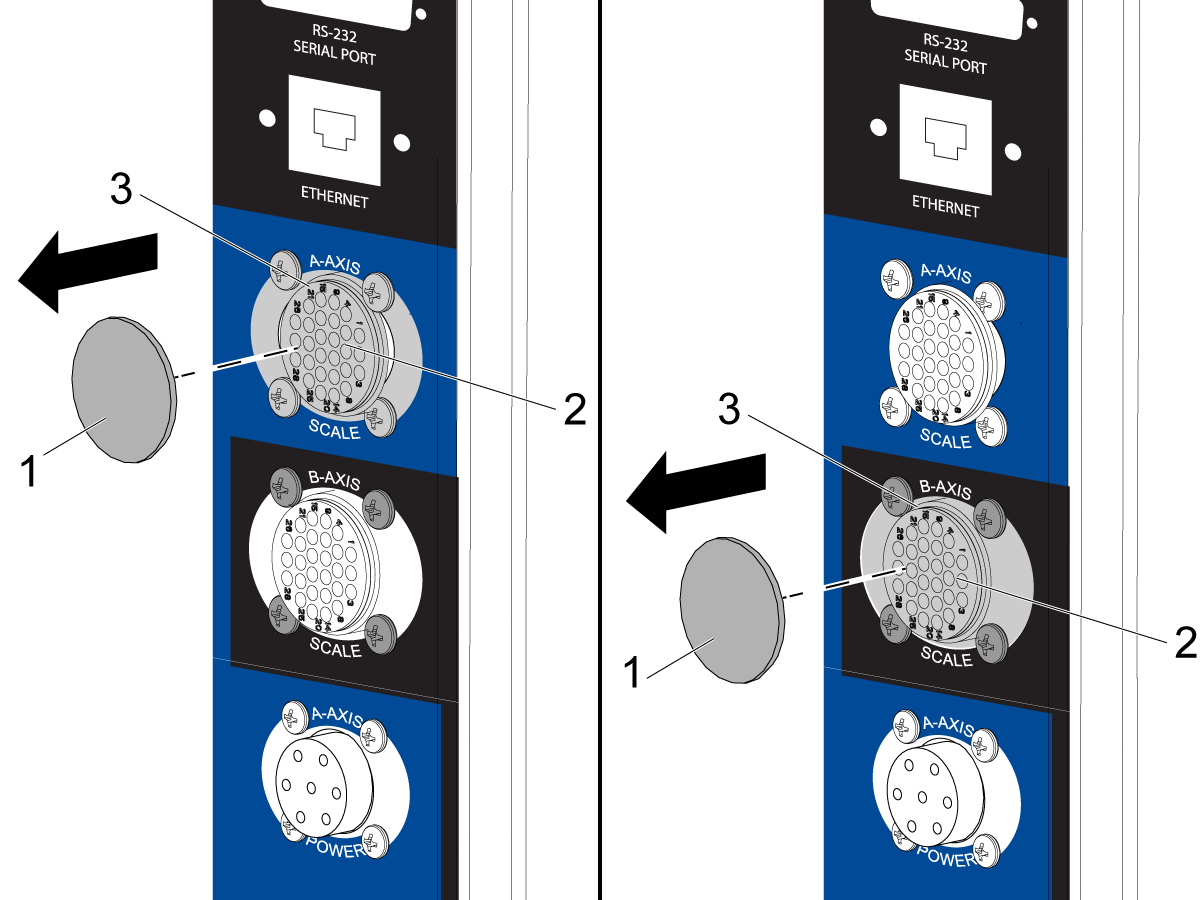
Find the plug [1] for the 4th-AXIS SCALE / A-AXIS SCALE or 5th-AXIS SCALE / B-AXIS SCALE receptacle. The plug is on the side of the control cabinet. Pull the plug out of the hole.

Connect the 28-pin connector [2] from the rotary scale feedback cable to the receptacle. Use the (4) 4-40 screws [3].

2

Remove the center cable track cover and the track cover below the MainCon PCB.

Remove the MainCon PCB cover.

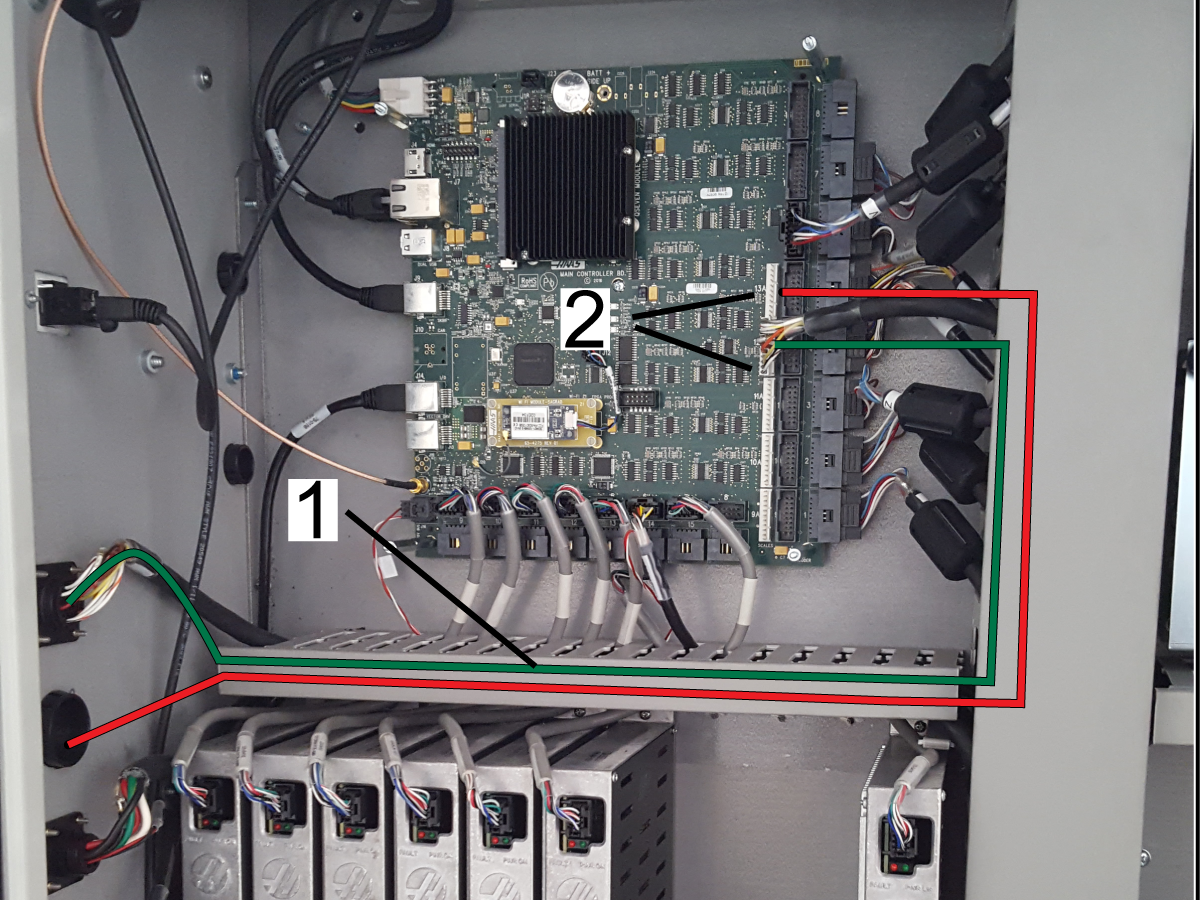
Route the 4th-AXIS SCALE / A-AXIS SCALE or 5th-AXIS SCALE / B-AXIS SCALE cable [1] as shown.

Connect the 11-pin connector of the rotary scale feedback cable to the correct connector on the MainCon PCB:

  • 4th-AXIS SCALE / A-AXIS SCALE Scales Channel 12A (P36)
  • 5th-AXIS SCALE / B-AXIS SCALE Scales Channel 13A (P37)

Install the covers.

4th Drive - Installation - Mill

1

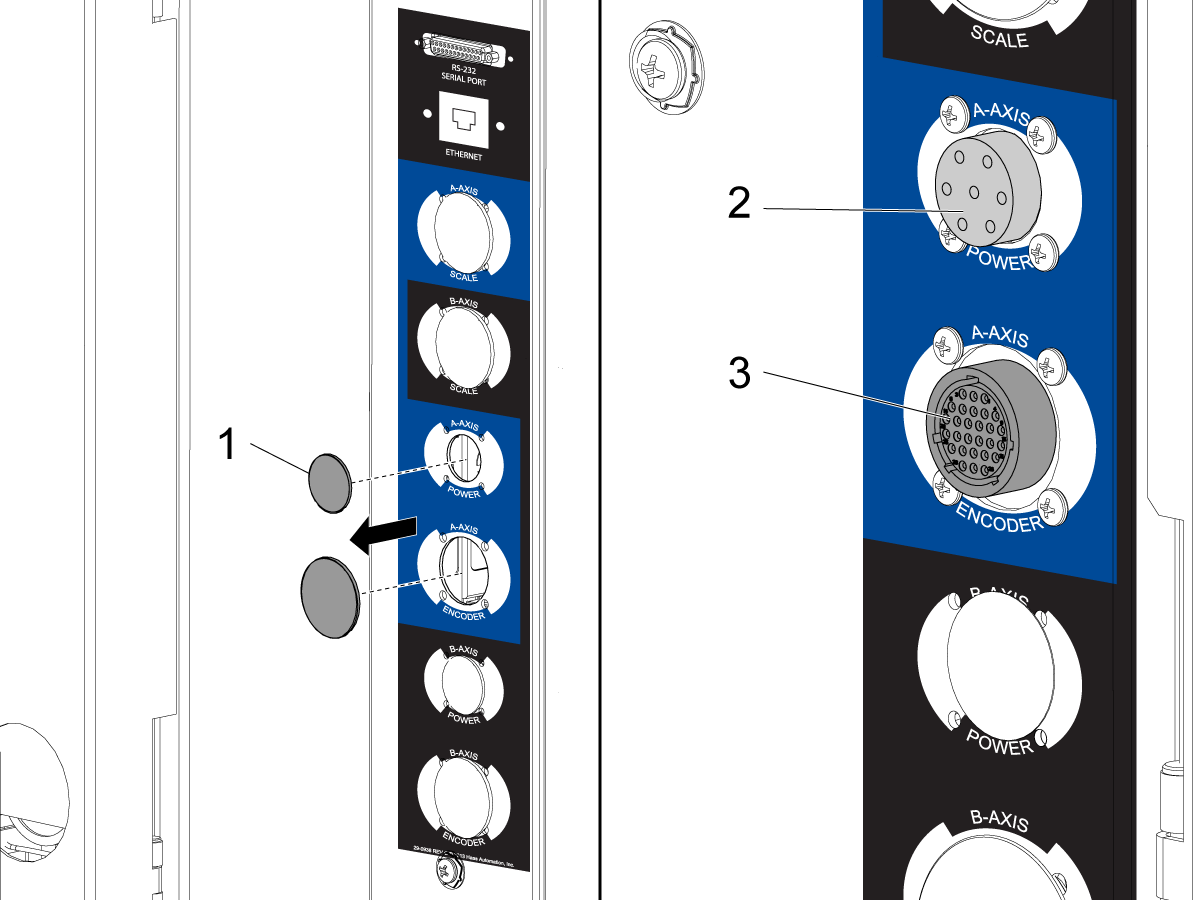
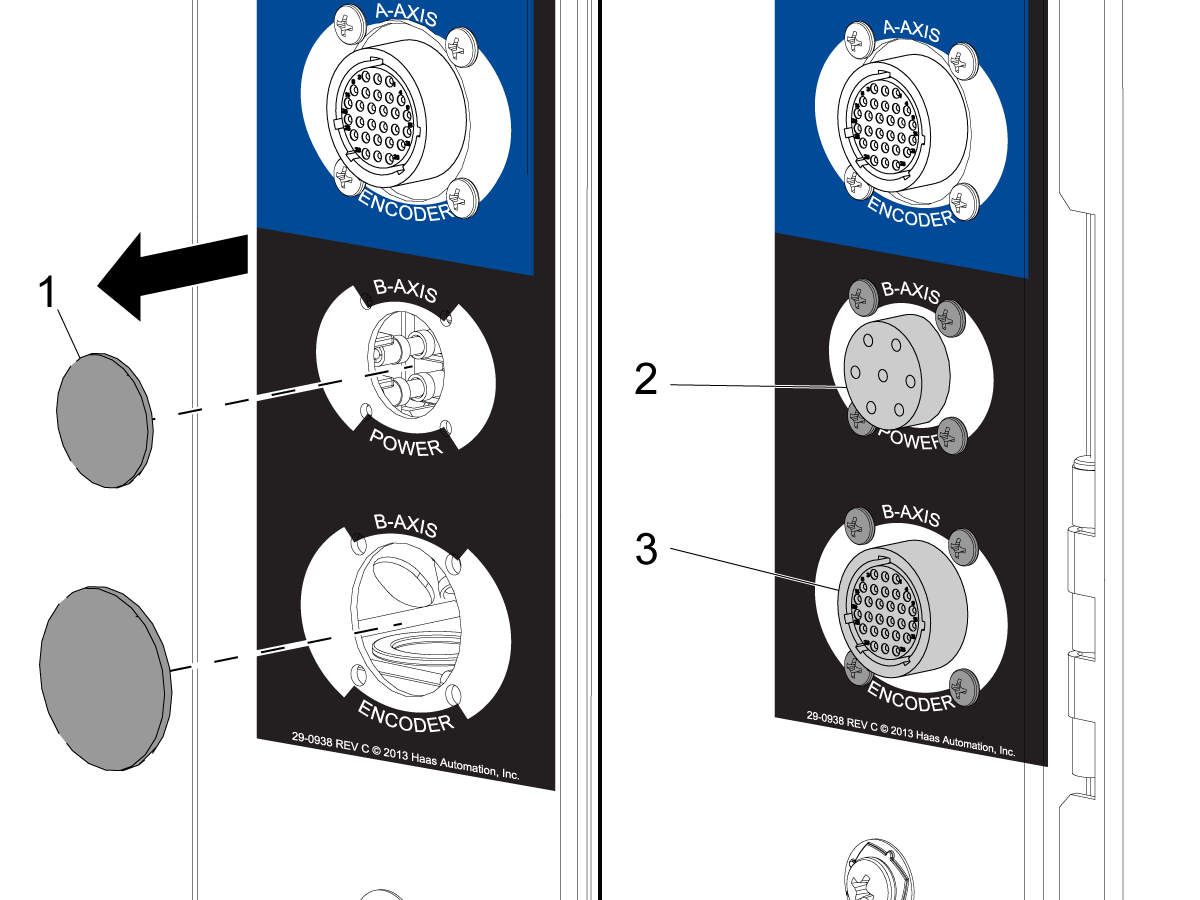
Find the (2) plugs [1] for the 4th-Axis / A-Axis receptacles. The plugs are on the side of the control cabinet. Push the plugs out of the holes.

Install the 7-pin power connector [2] into the receptacle that has the label 4th-AXIS POWER / A-AXIS POWER. Use the (4) screws.

Install the 28-pin encoder connector [3] in the receptacle that has the label 4th-AXIS ENCODER / A-AXIS POWER. Use the (4) screws.

Remove the I/O PCB cover.

Remove the Maincon PCB cover.

2

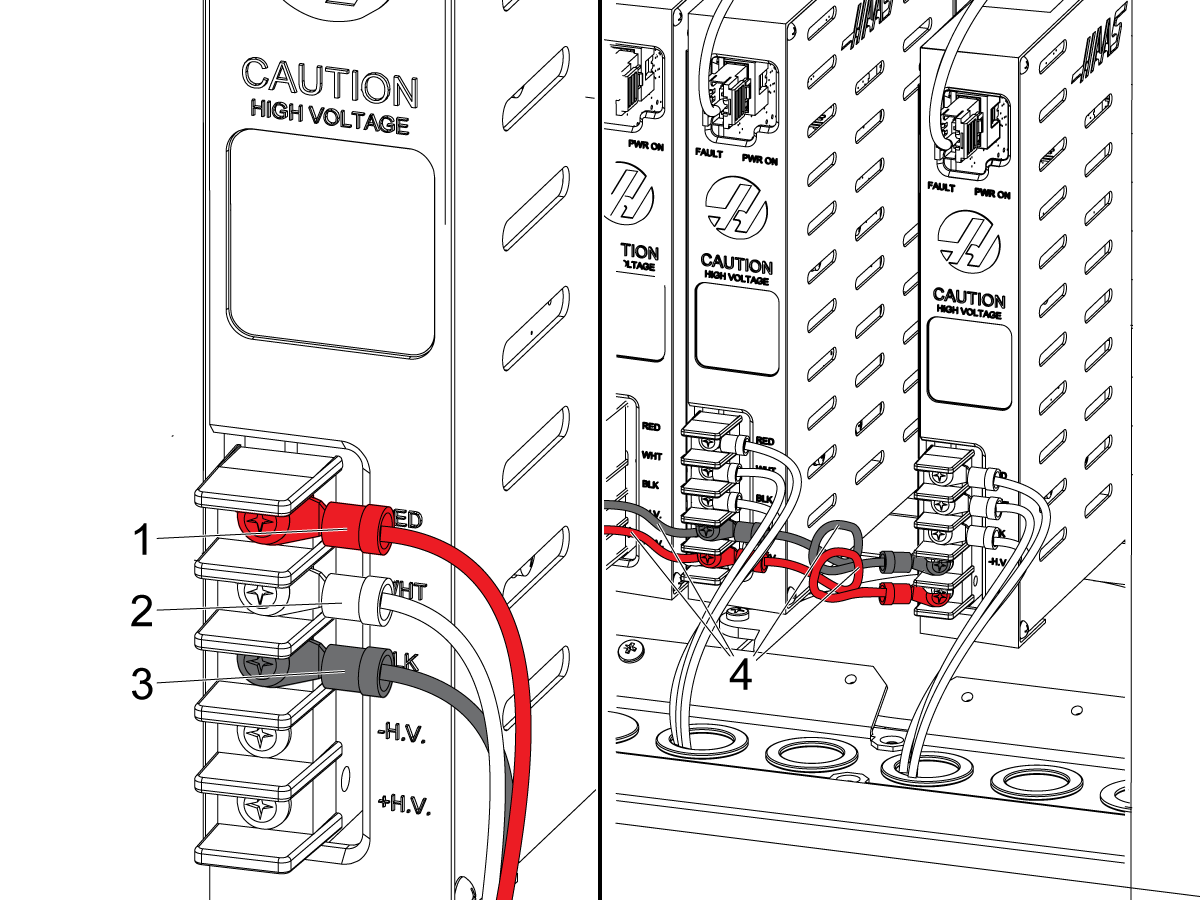
Find the location on the amplifier bank that has the A Axis / 4th Axis label. Install the amplifier for the fourth-axis drive at this location.

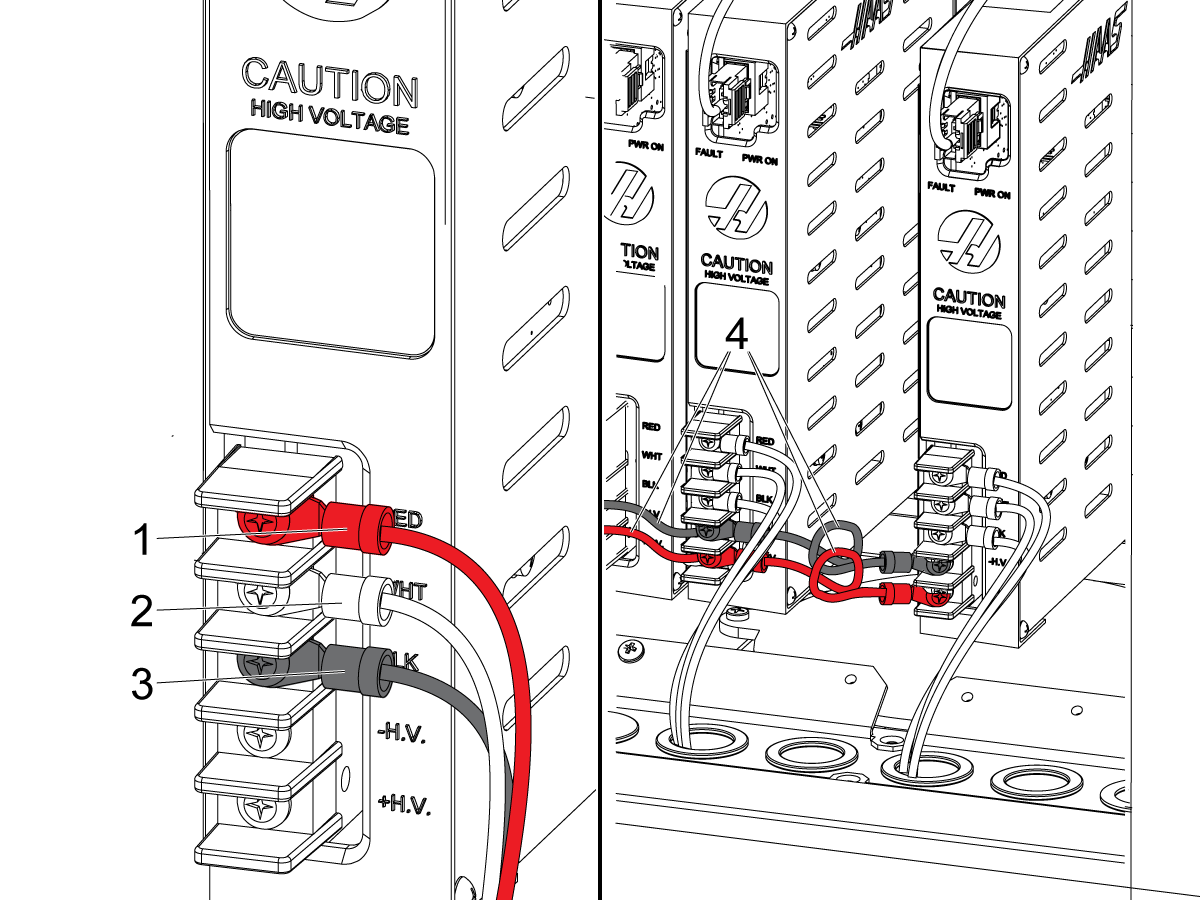
Connect the fourth-axis servo cable wires to the high-voltage terminals on the amplifier:

  • red to RED [1]
  • white to WHT [2]
  • black to BLK [3]

Connect jumpers [4] from the fourth-axis drive to the nearest amplifier on each side:

  • Connect the black wire to -H.V..
  • Connect the red wire to +H.V..

Put the cables in the cable tray.

3

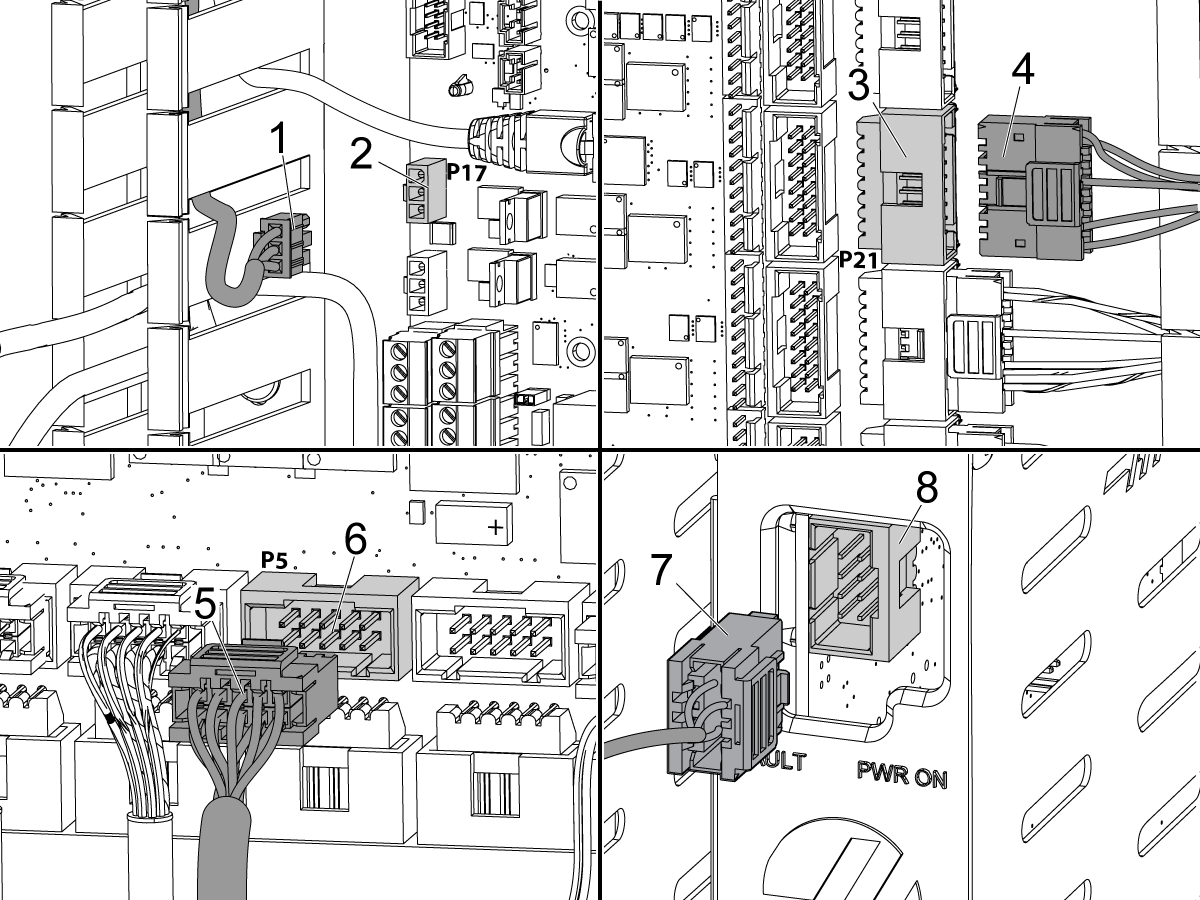
Connect the 3-pin connector [1] on the A-Axis brake cable to P16 [2] on the I/O PCB.

Connect the 16-pin connector [4] on the encoder cable to Encoder Channel 4 (P20) [3] on the Main Control PCB.

Connect the 8-pin connector [5] on the current-command cable to the Amplifier Channel 4 (P4) socket [6] of the Main Control PCB.

Connect the 8-pin connector [7] on the current-command cable to the ampifier [8].

4

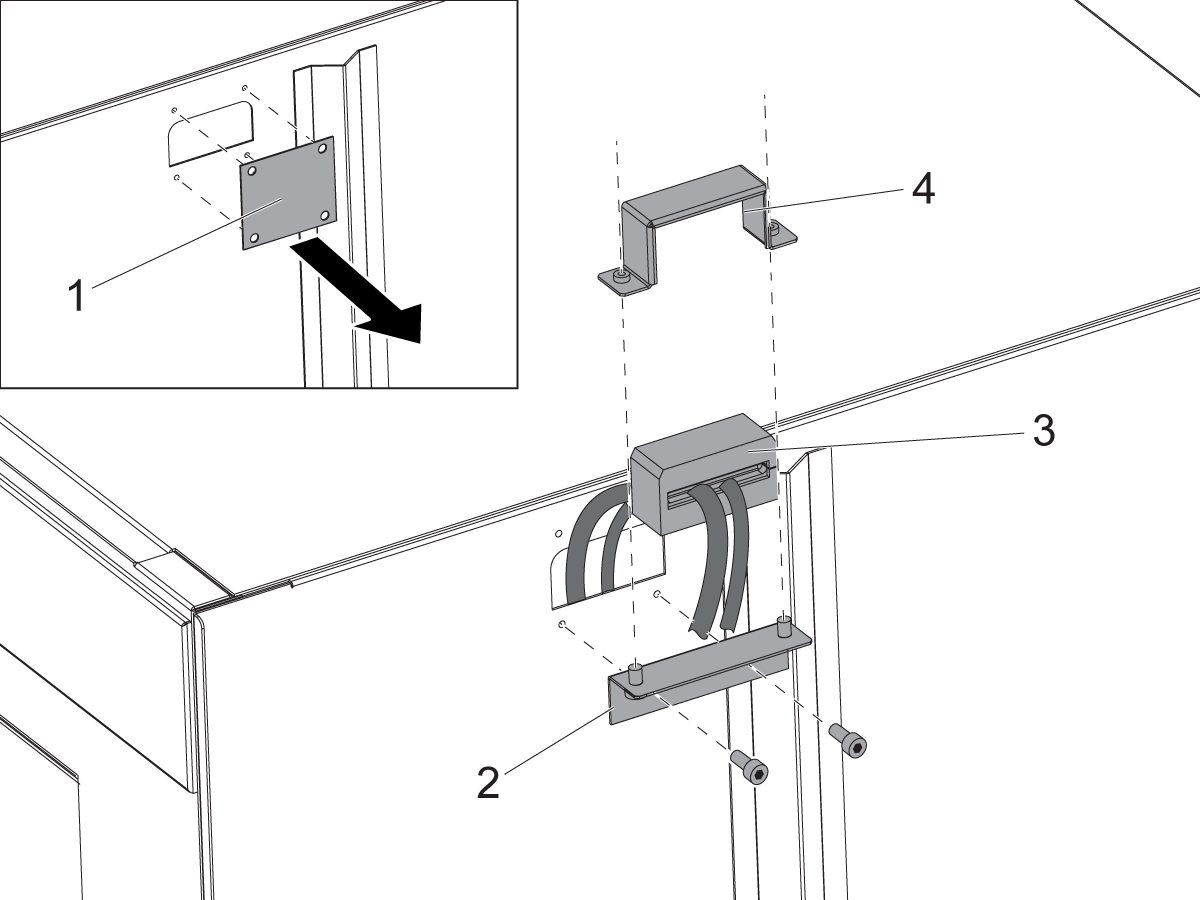
Remove the blanking plate [1].

Install the clamp block mount [2].

Put the rotary cables through the clamp block [3].

Install the clamp block retainer [4].

5

If you are not installing a fifth-axis drive, install the cover plates for the Maincon PCB and I/O PCB.

Set the main circuit breaker to the ON position.

Push [POWER ON].

Refer to: Next Generation Control - Option Activation Code to enable the fourth axis software.

5th Drive - Installation - Mill

1

Find the (2) plugs [1] for the 5th-Axis / B-Axis sockets. The plugs are on the side of the control cabinet. Pull the plugs out of the holes.

Install the 7-pin power connector [2] in the location that has the label 5th-AXIS POWER / B‑AXIS POWER. Use the (4) screws.

Install the 28-pin encoder connector [3] in the location that has the label 5th-AXIS ENCODER / B-AXIS ENCODER. Use the (4) screws.

Remove the I/O PCB cover.

Remove the Maincon PCB cover.

2

Find the location on the amplifier bank that has the B Axis label. Install the amplifier for the fifth-axis drive at this location.

Connect the fifth-axis servo cable wires to the high-voltage terminals on the amplifier:

  • red to RED [1]
  • white to WHT [2]
  • black to BLK [3]

Connect jumpers [4] from the fifth-axis drive to the nearest amplifier on each side:

  • Connect the black wire to -H.V..
  • Connect the red wire to +H.V..

Put the cables in the cable tray.

3

Connect the 3-pin connector [1] on the B-Axis brake cable to P17 [2] on the I/O PCB.

Connect the 16-pin connector [3] on the encoder cable to Encoder Channel 5 (P21) [4] on the MainCon PCB.

Connect the 10-pin connector [5] on the current-command cable to the Amplifier Channel 5 (P5) socket [6] of the MainCon PCB.

Connect the 8-pin connector [7] on the current-command cable to the ampifier [8].

4

Remove the blanking plate [1].

Install the clamp block mount [2].

Put the rotary cables through the clamp block [3].

Install the clamp block retainer [4].

5

Install the cover plates for the Maincon PCB and I/O PCB.

Set the main circuit breaker to the ON position.

Push [POWER ON].

Refer to: Next Generation Control - Option Activation Code to enable the fifth axis software.

11.2 Rotary - Enable and Disable

Recently Updated

Rotary - Enable and Disable - NGC


Introduction

These procedures tell you how to enable, disable, and clear a rotary unit on a machine with the Next Generation Control:

Note: Rotary products equipped with a Sigma-7 motor require software version 100.17.000.2030 or higher for full 4th axis operation.

  • Next Generation Control - Rotary - Enable: Do this procedure after you install a rotary unit. This procedure tells you how to tell the control what rotary unit you installed.
  • Next Generation Control - Rotary - Disable: Do this procedure to temporarily disable the rotary axis while you keep the rotary axis configured.
  • Next Generation Control - Rotary - Clear: Do this procedure when you remove a rotary unit from the machine, and you must install a different rotary unit.

Rotary - Enable

Do this procedure after you install a rotary unit. This procedure tells you how to tell the control what rotary unit you installed. Do this procedure on a machine that has the Next Generation Control. This rotary selection tool replaces Setting 30 and 78 used on CHC controls. See enable Rotary axis - CHC for instructions. 

1

Push [POWER ON].

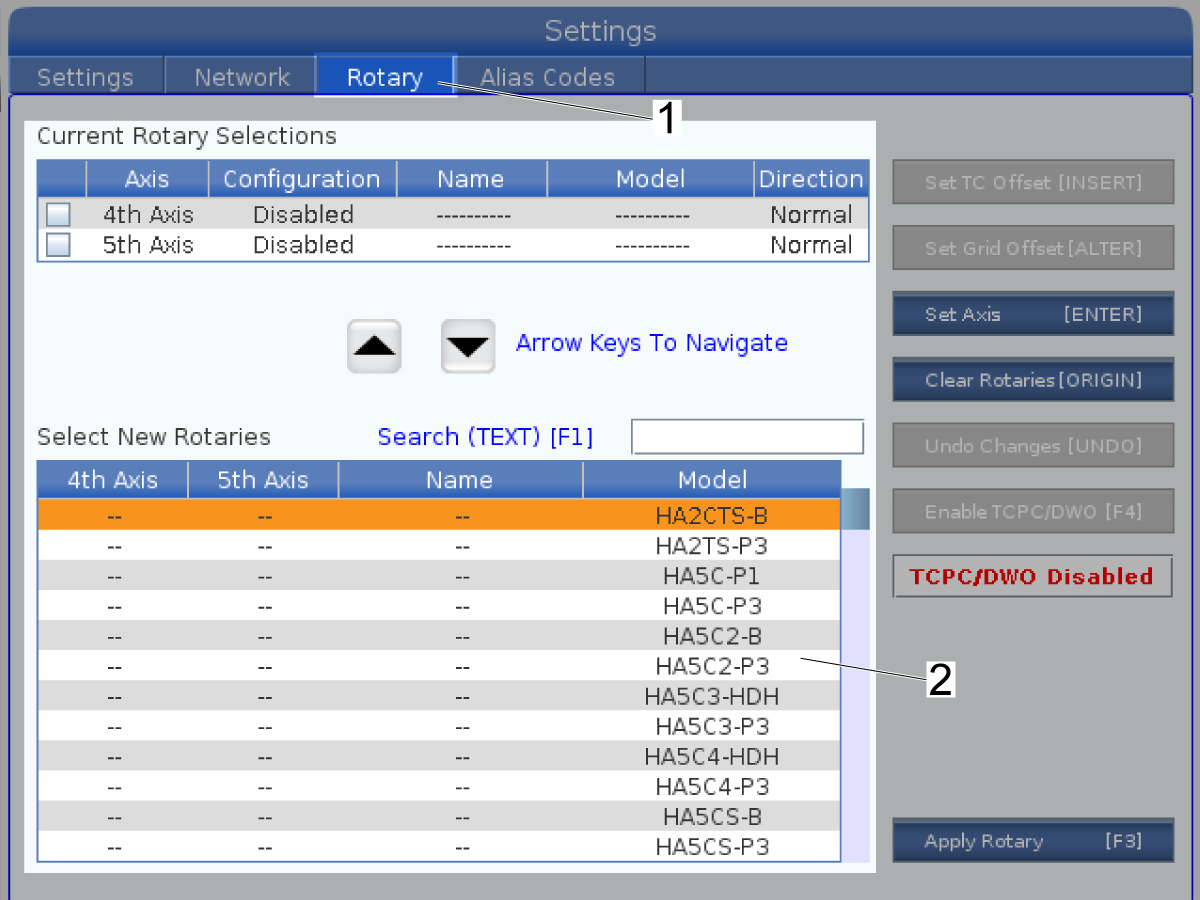
Push [SETTING].

Select the Rotary tab [1].

2

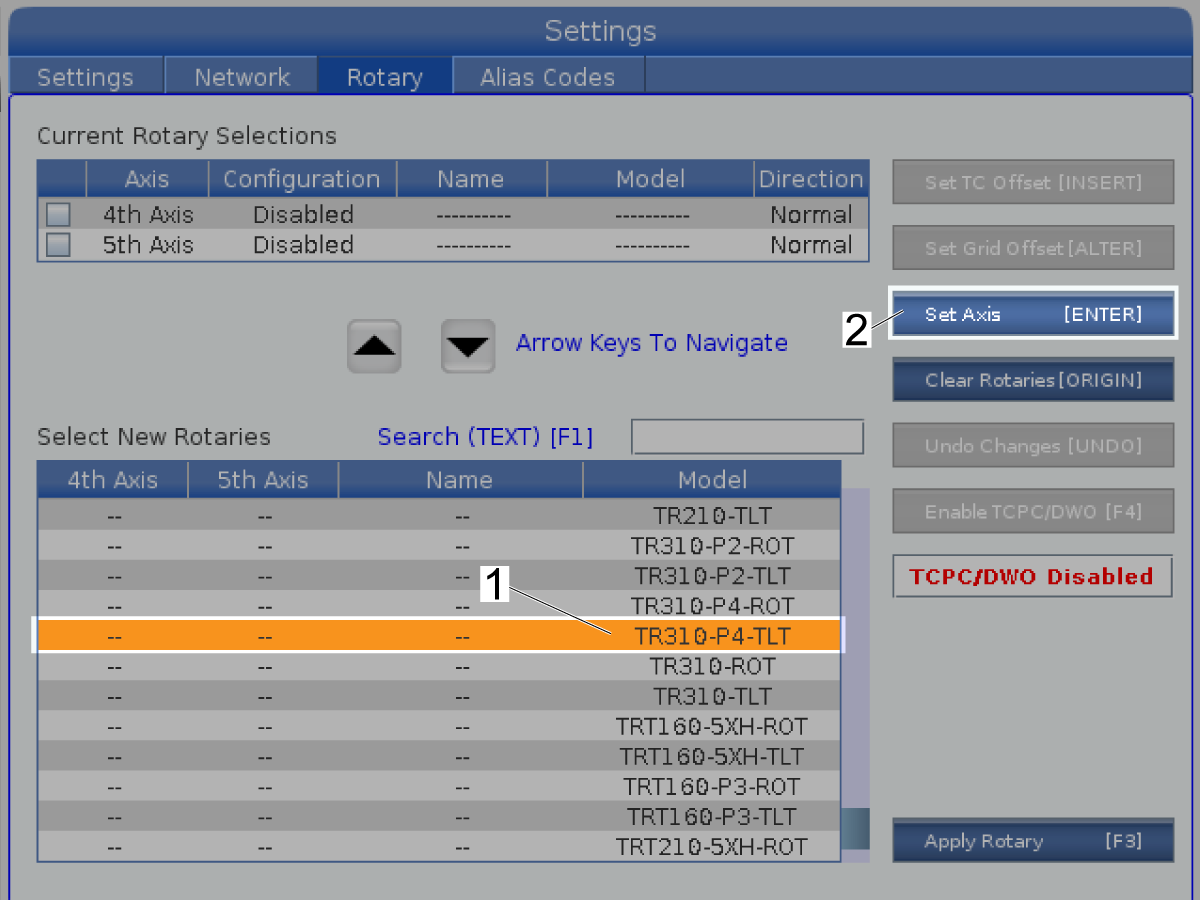
Highlight the 4th Axis rotary unit that is installed [1].

Push [ENTER] to Set Axis [2].

 Note: This screen shows the TR310-P4-TLT rotary.

Note:  If your rotary product does not appear in the list, the control may need to update the rotary configuration. Only Haas technicians can update configuration files. Contact your HFO to schedule the update and refer to the Update Rotary Configuration Files procedure.

NOTE: CONFIG FILE NAME INFORMATION

Single axis rotaries require one config file, while dual axis requires two files. 

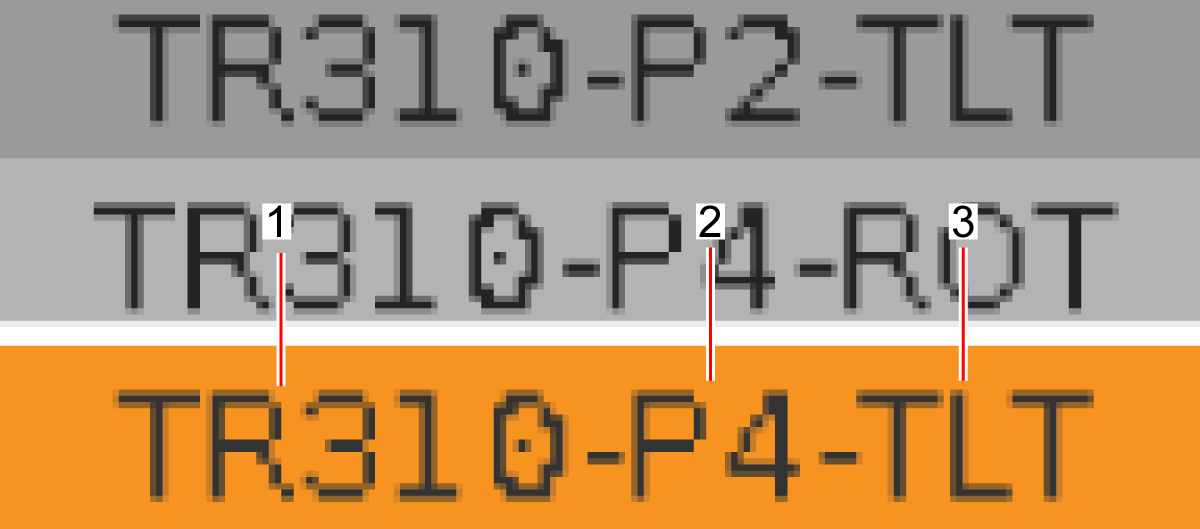
All config file names are broken up into several parts separated by dashes. 

The first part is the model number of the rotary unit [1]. This can be found on the serial plate of the unit. Some Rotary units have a dash in their name, that dash may or may not be included in the file name. 

The next part of the file name is the P version number of the unit [2]. This can also be found on the serial plate of the unit.  

The next part of the files only appears on dual axis Rotaries. The next part is either "TLT" or "ROT" [3]. TLT applies to the 4th axis, and ROT applies to the 5th axis. Single axis rotaries will not have this part.

The last part of the name is an R at the end. Using this configuration file would make the Rotary turn in the opposite direction.

3

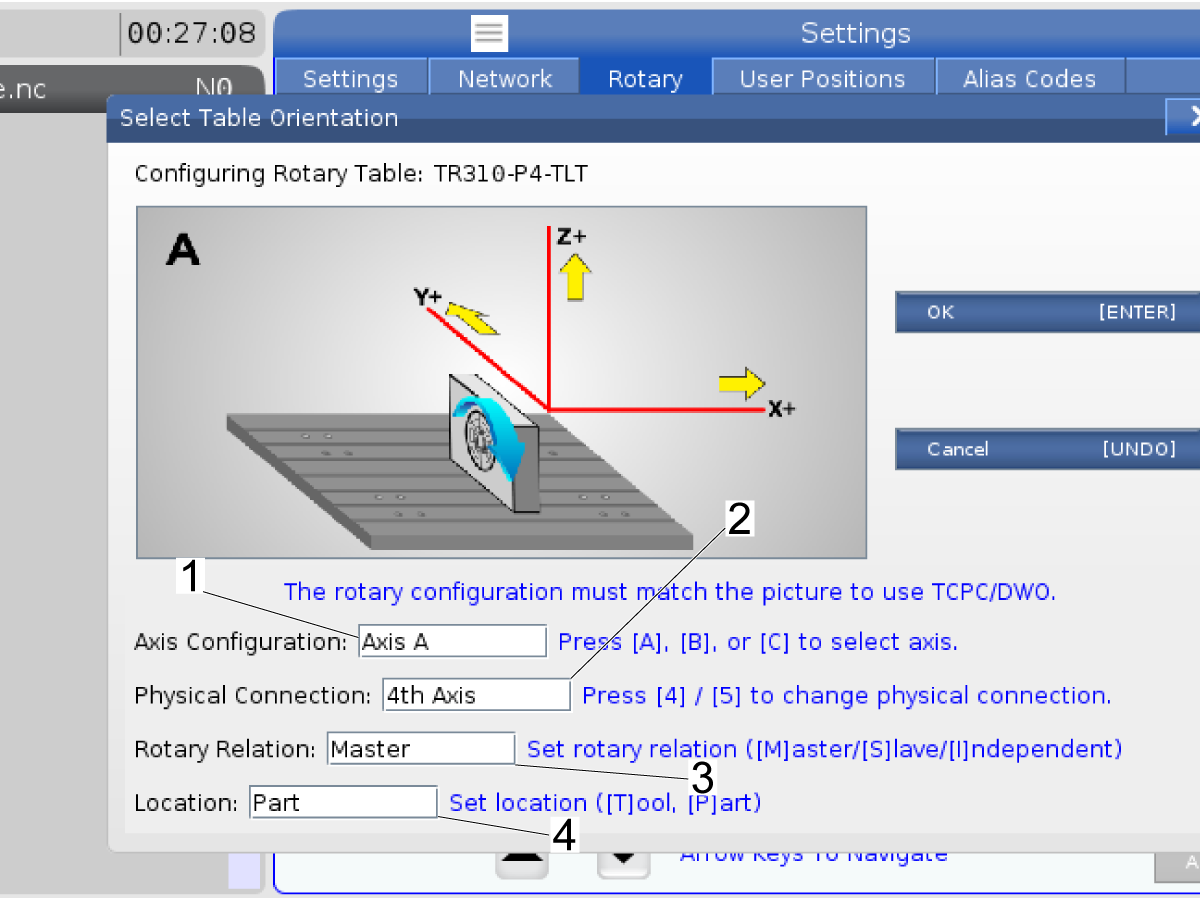
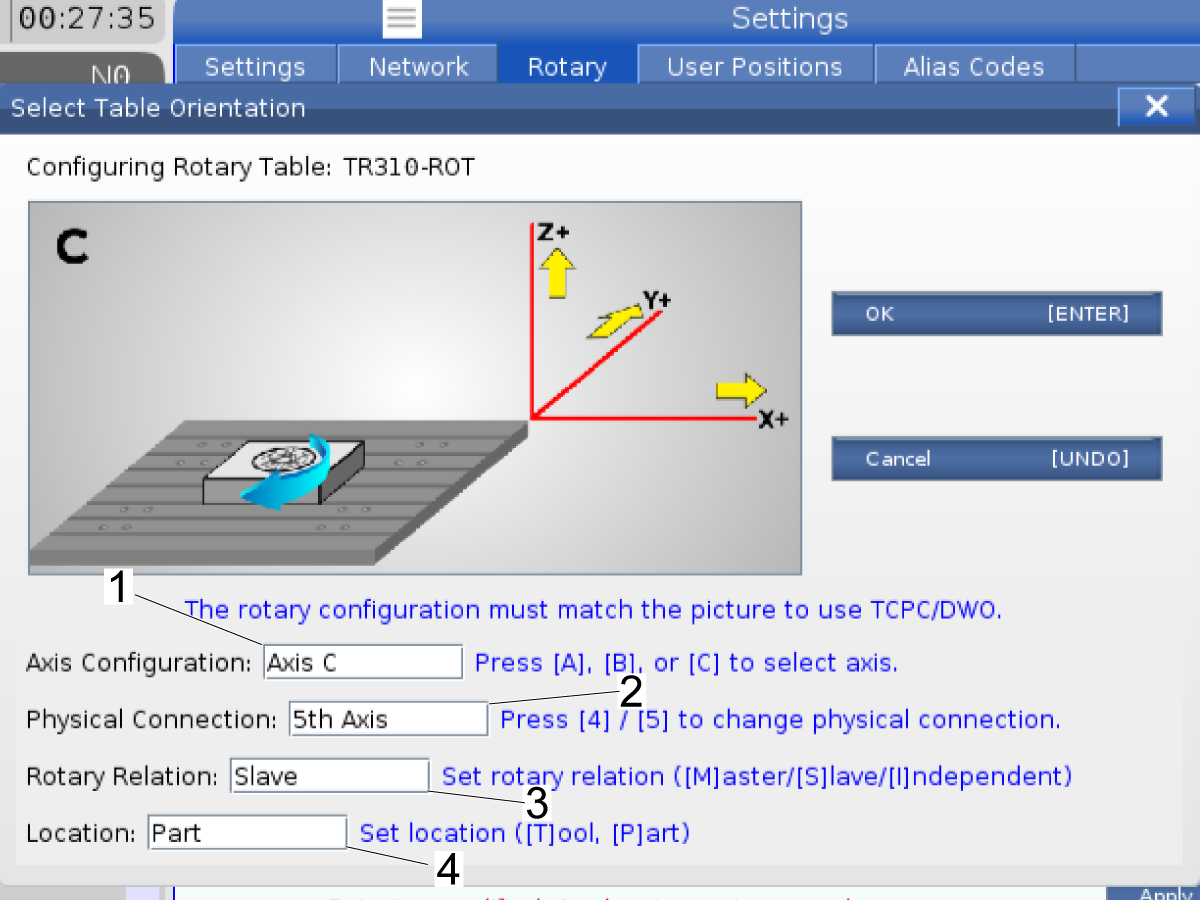
Push [A], [B], or [C] to select the Axis Configuration [1]. By default, the 4th axis is set to A. 

Push [4] / [5]  to change the physical connection [2].

Push [M] , [S] , [I] to select Rotary relation to change the physical connection [3]. 

Push [T] / [P]  to Set Loaction [2].

For this example, the Axis Configuration is Axis A [1], and the Physical Connection is the 4th axis [2].

 Note: To use the Tool Center Point Control (TCPC, G234) or Dynamic Work Offset (DWO, G254), make sure the position of the rotary unit is the same as the illustration on the display.

Push [ENTER].

4

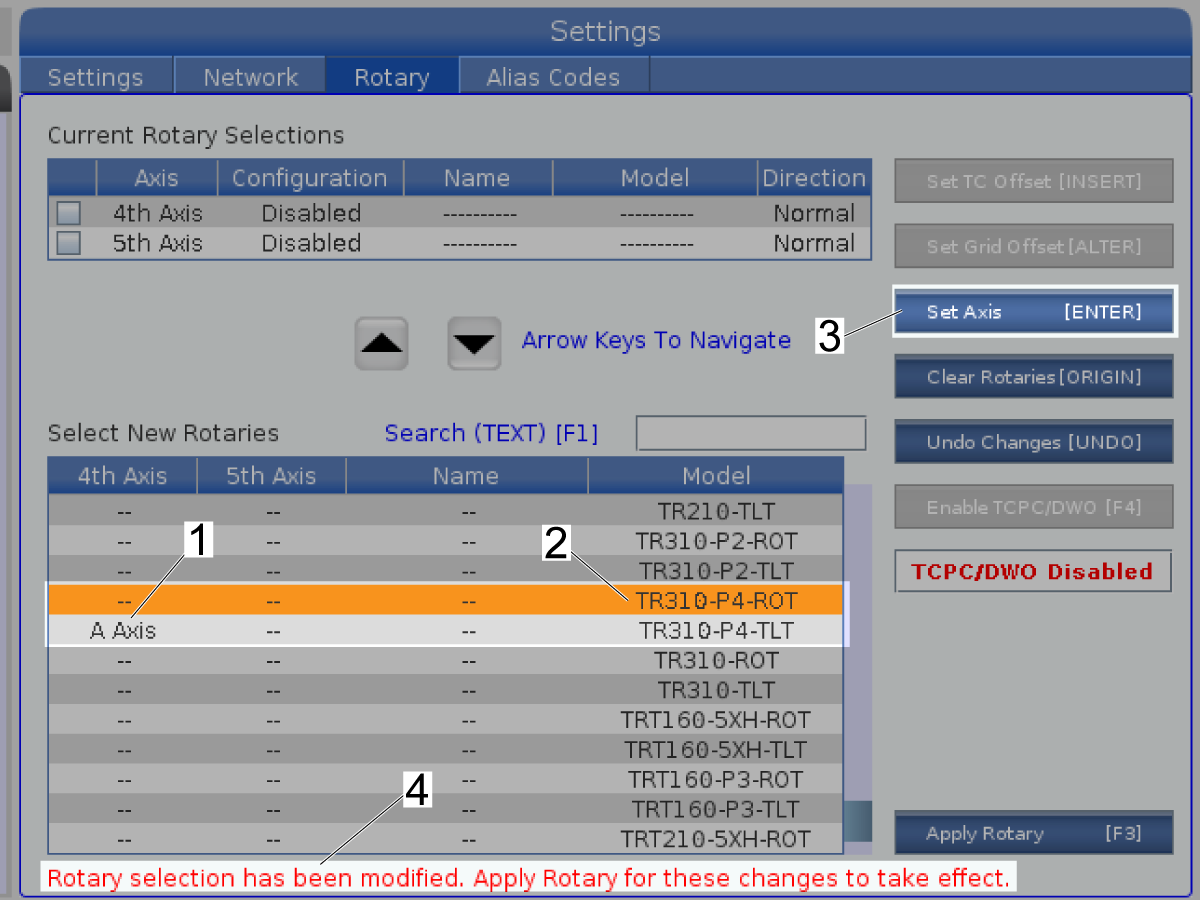
This example sets the TR310-P4-TLT to the A Axis [1].

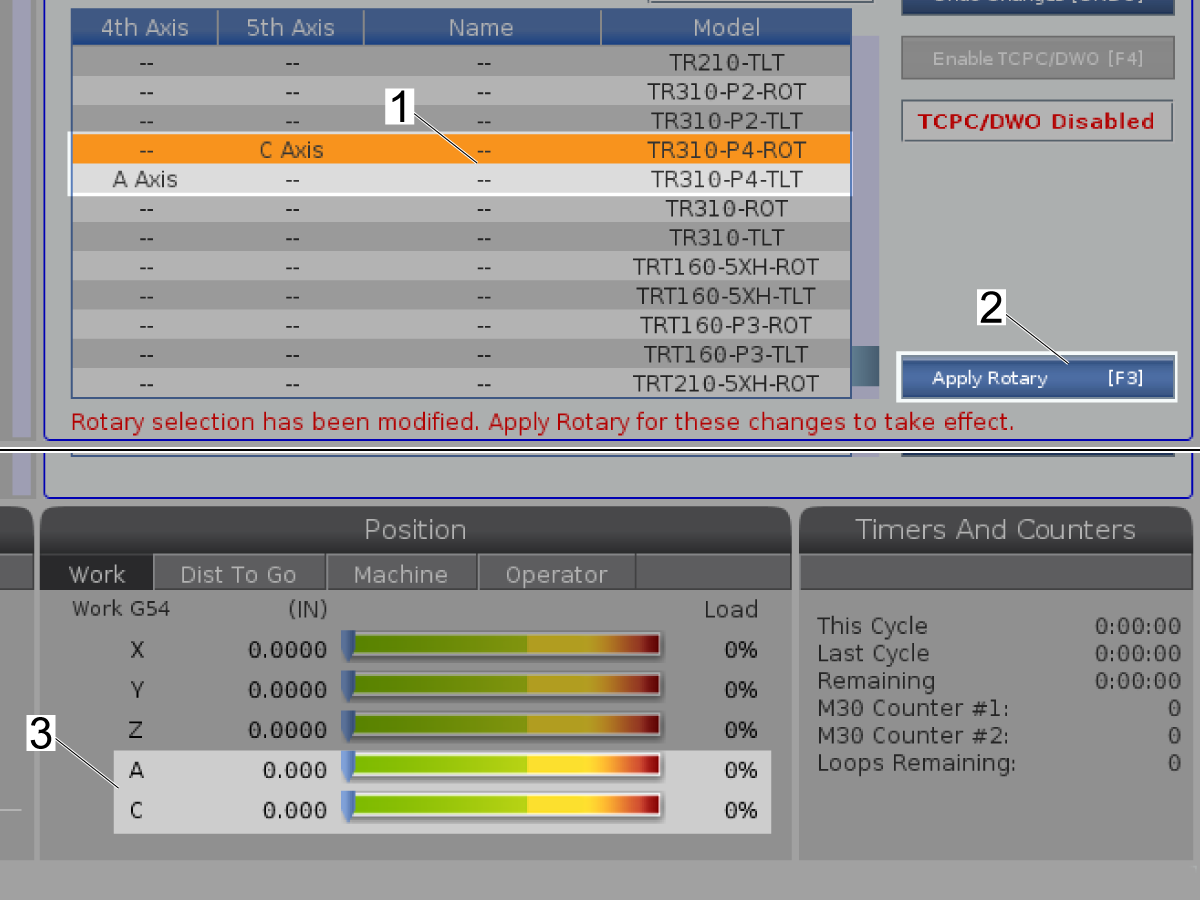
 Note: The rotary changes do not go into effect until you push [F3] (Apply Rotary) [4]. Go to Step 6 if you are ready to press [F3] (Apply Rotary).

Select the 5th Axis rotary unit that is installed [2].

Push [ENTER] to Set Axis [3].

 Note: This screen shows the TR310-P4-ROT rotary.

5

Push [A], [B], or [C] to select the Axis Configuration [1]. By default, the 4th axis is set to A. 

Push [4] / [5]  to change the physical connection [2].

Push [M] , [S] , [I] to select Rotary relation to change the physical connection [3]. 

Push [T] / [P]  to Set Loaction [2].

For this example, the Axis Configuration is Axis A [1], and the Physical Connection is the 4th axis [2].

 Note: To use the Tool Center Point Control (TCPC, G234) or Dynamic Work Offset (DWO, G254), make sure the position of the rotary unit is the same as the illustration on the display.

Push [ENTER].

6

This example sets the TR310-P4-TLT to the A Axis and set TR310-P4-ROT to the C Axis[1].

Then, push [EMERGENCY STOP].

Push [F3] to Apply Rotary [2].

Go to the next step to use TCPC or DWO if you do not use TCPC or DWO, power cycle the machine.

The A and C Axes are shown under Position [3].

7

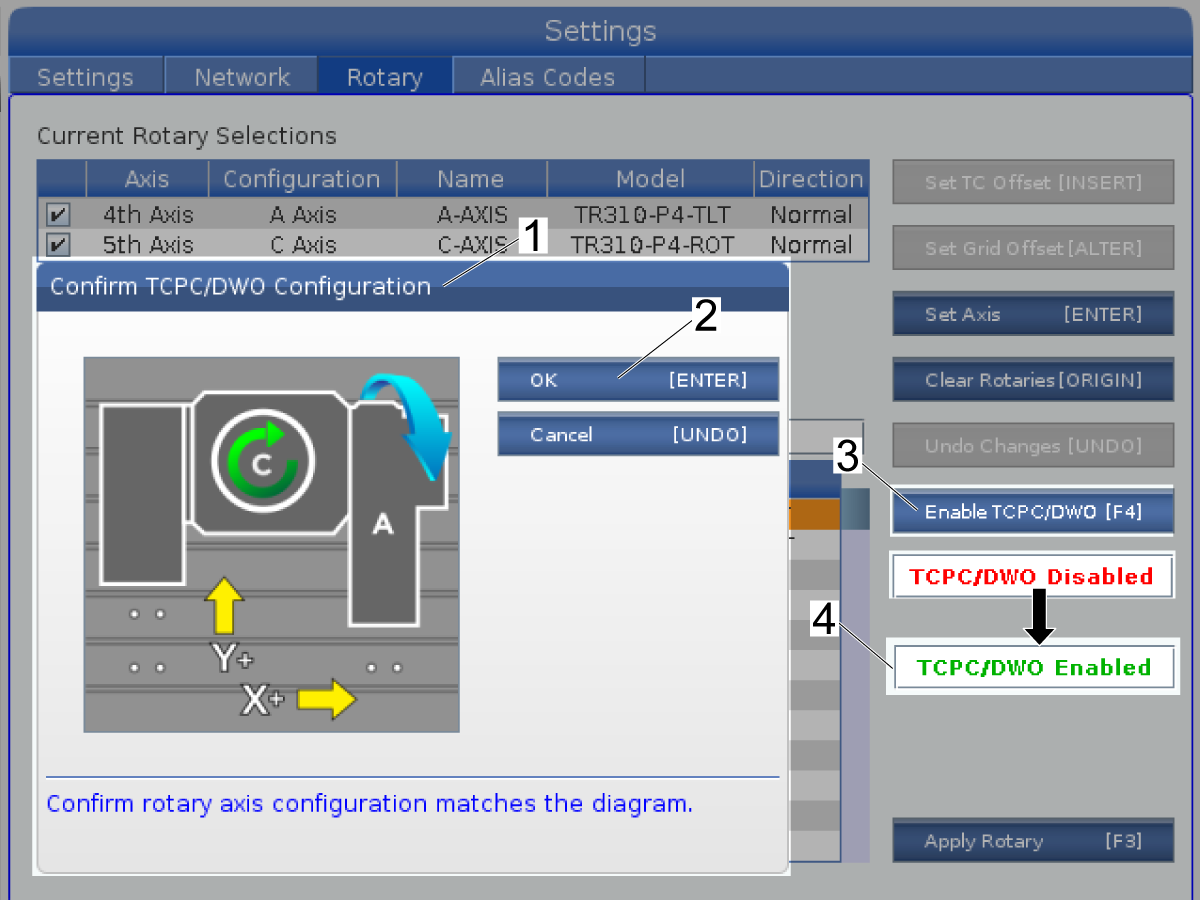
To use TCPC or DWO:

Push [F4] to Enable TCPC/DWO [3].

Confirm TCPC/DWO Configuration [1] shows in the display.

Ensure the rotary unit's position is the same as the illustration in the display.

Push [ENTER] [2] to confirm.

TCPC/DWO Disabled changes to TCPC/DWO Enabled [4].

Push [F3] to apply the Rotary.

Power cycle the machine.

8

Push [ZERO RETURN]. Start with the X Axis.

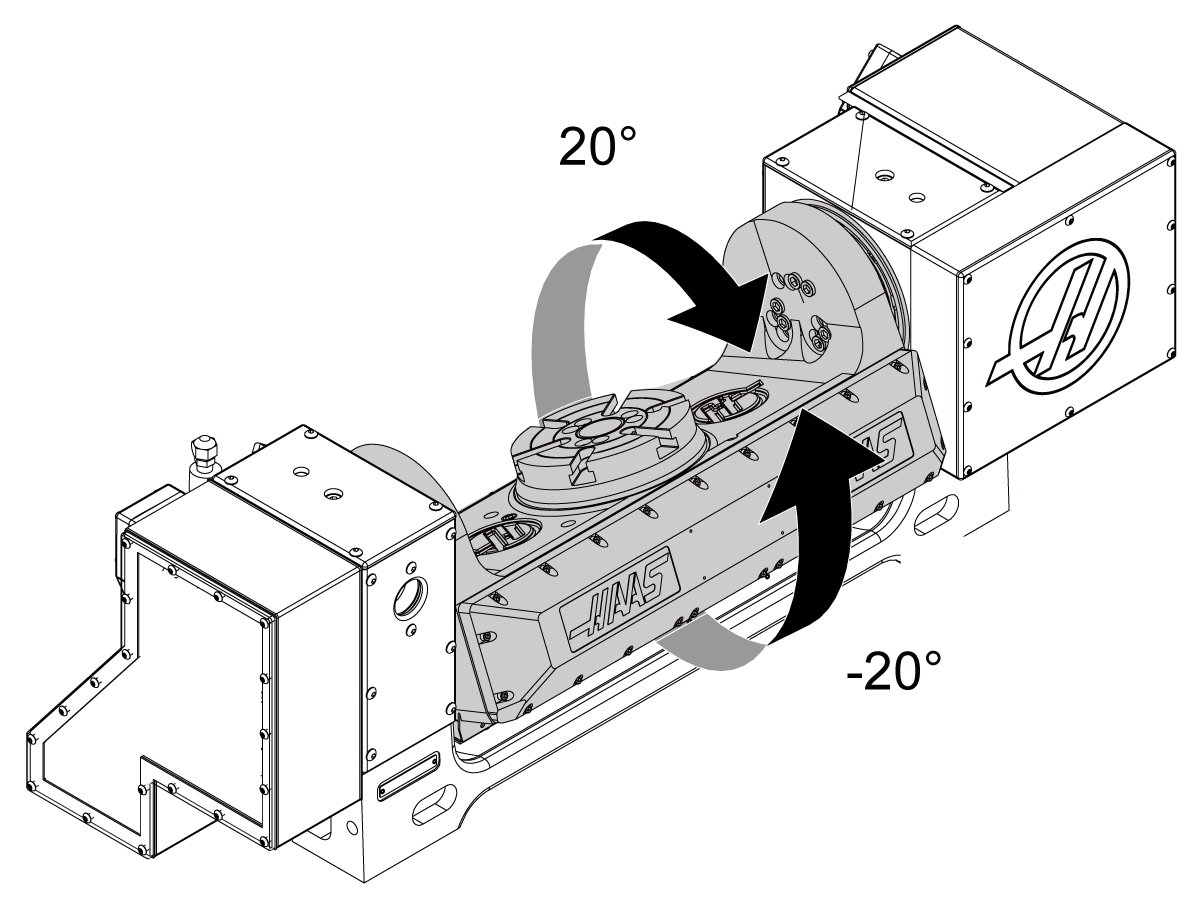
 Caution: If the A axis (tilt) moves more than 20 degrees past the home position,

Push [EMERGENCY STOP] to prevent damage. Ensure you selected the correct config file for your rotary model, 4TH AXIS ENABLE, and 5TH AXIS ENABLE.

Jog the machine table to the maximum travel in each axis.

 Caution: Ensure the cables do not get caught on the table or crushed between the table and the enclosure to prevent damage.

Rotate ("tilt") A axis to get access to the T-Nuts.

Then, push [EMERGENCY STOP].

Install the remaining studs, washers, and nuts.

9

TRT70 Only:

Enable Setting 53 Jog W/O Zero Return.

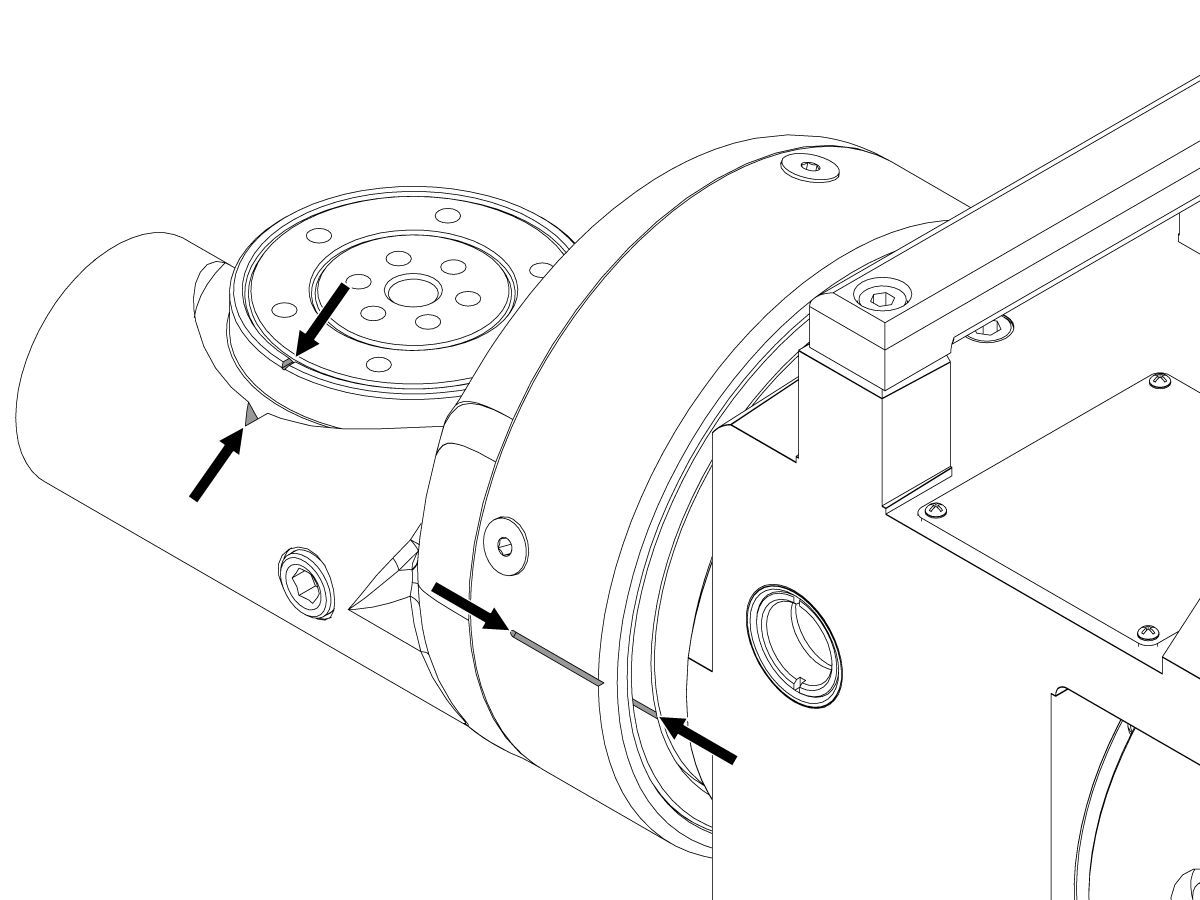
Jog the A axis (tilt) until the slots are aligned as shown.

Jog the B axis (rotary) until the notches are aligned as shown.

Push [ZERO RETURN], [A].  Wait for the axis to find the home position.

Push [ZERO RETURN], [B].  Wait for the axis to find the home position.

 Caution: Make sure the cables do not get caught on the table or get crushed between the table and the enclosure to prevent damage.

Disable Setting 53 Jog W/O Zero Return.

Rotary - Disable

This procedure tells you how to disable a rotary axis. When you disable a rotary axis, you can prevent it from moving but keep it configured.

A rotary axis is enabled when it has a mark [3] to the left of the rotary axis. The rotary axis is enabled in the Position [4] screen.

Select the rotary axis [1] to disable.

Push [ENTER].

The mark for the rotary axis goes away [5].

The axis goes away from the Position screen [6].

If necessary, do this step again for the other rotary axis [2].

Note: If you intend to lift the rotary, see the lifting instructions in the rotary manual 3.1 Lifting Instructions. 

Rotary - Clear

This procedure tells you how to clear a rotary axis configuration from the Current Rotary Selection. Do this procedure when you remove a rotary unit from the machine, and you must install a different rotary unit.

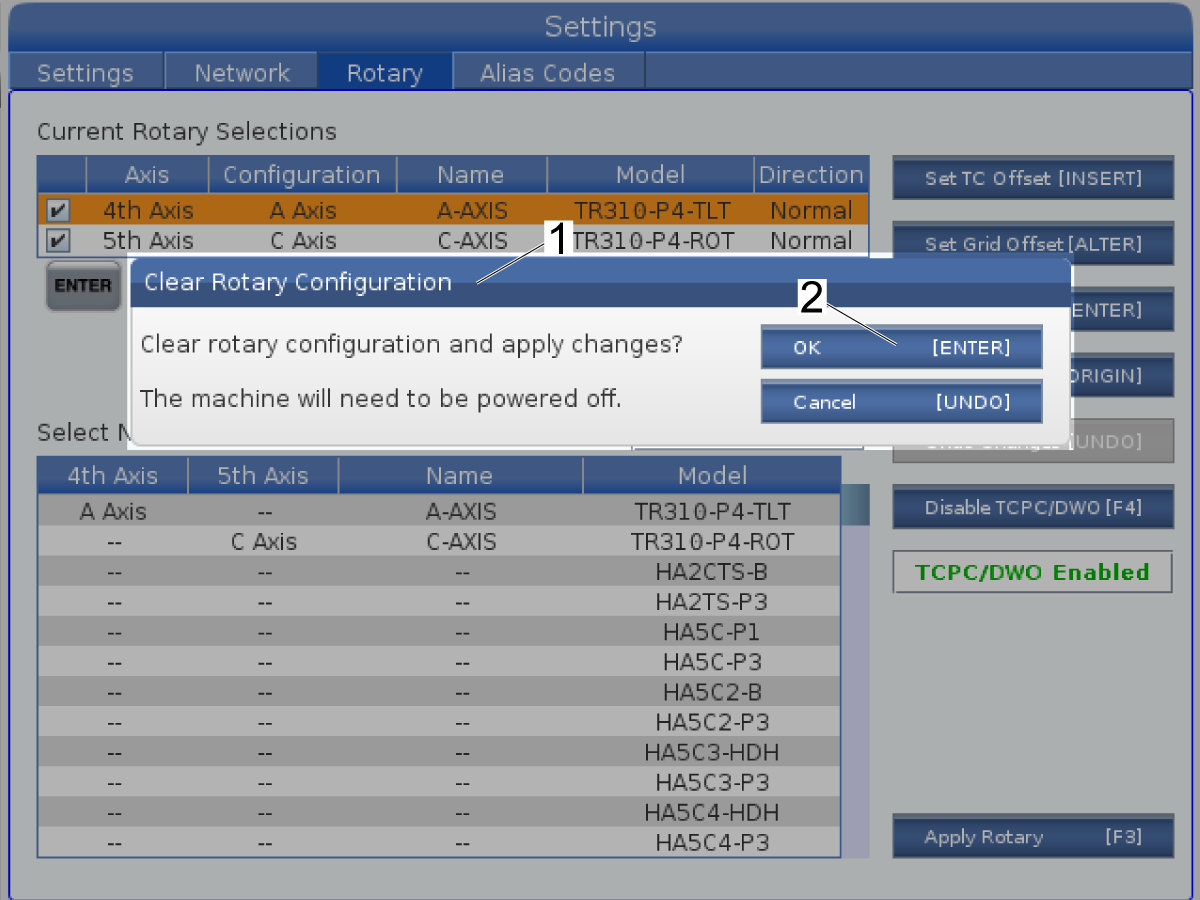
Push [EMERGENCY STOP].

Push [ORIGIN] to clear the rotaries.

The$Clear Rotary Configuration [1] display shows.

Push [ENTER] [2].

Power cycle the machine.

The rotary configurations are cleared from the rotary selection.

Warning: If you are removing a rotary, it must be connected to 

 Note: If you intend to lift the rotary, see the lifting instructions in the rotary manual 3.1 Lifting Instructions. 

11.3 Reverse Rotary Direction Setup

Recently Updated

Reverse Rotary Direction Setup - NGC


Revision B - 05/2026

Introduction

This procedure tells you how to load rotary files to reverse the rotary direction of your Haas rotary. The files supplied only apply to available Haas rotaries.

This procedure applies only to Haas rotaries on machines with software version 100.16.000.1030 and higher.

Note: Software version 100.21.000.1130 and later will not come with reverse rotary files.

This procedure will work for previous software versions that did not come with the desired reverse rotary file. Verify that your software is compatible with the rotary you wish to install. See Rotary - Compatibility and Servo Motor Configuration Identification for more information about rotary compatibility. 

Reverse Rotary Direction Setup - NGC

1

Updated

Download and extract the reverse rotary direction files. 

Note: The complete reverse rotary folder must be loaded. Do not load an individual reverse rotary file from within the folder, as the procedure will not complete correctly.

Download Rev_User_Rot.zip

Find your rotary model in the extracted folder and copy it to a USB memory device.

Insert the USB memory device with the rotary configuration file into the USB port on the control pendant.

Press [LIST PROGRAM] and navigate to the USB tab [1].

Select your reverse rotary file [2]. Press [ENTER]. 

Note: The reverse rotary files that are loaded with this procedure will have an R in the Name column. These files will have the same name in the Model column as normal rotary files. Reverse files preloaded with the software will end with -R in the Model column. 

Press [F2] to copy the reverse rotary file.

Navigate to User Data [3] on the Copy To screen.

2

Press the [RIGHT] CURSOR arrow to enter the User Data directory.

Navigate to the My Rotary directory.

Press the [RIGHT] CURSOR arrow to enter the My Rotary directory [1].

Press [ENTER] [2] to copy the rotary configuration file to this location.

3

Press [SETTING].

Navigate to the Rotary tab [1].

Type the model of your rotary and press [F1] to search. This example uses TRT210-P20 [2]. Reverse rotary files have the letter “R” in the Name column. Normal rotary files will be blank in the Name column.

Your reverse rotary file [3] is in the Select New Rotaries page.

Highlight the rotary files you want to activate and press [ENTER] to pull up the Select Table Orientation screen.

4

In the Select Table Orientation [1] screen.

Press [A], [B], or [C] to select the Axis Configuration [2].

Press [4] or [5] to change the physical connection [3].

Press [M], [S], or [I] to set the rotary relation as master, slave, or independent [4]. 

Press [T], [L], or [N] to set the location of the spindle at either the table, live tool spindle, or main spindle [5]. 

For this example, the Axis Configuration is Axis A [2], the Physical Connection is the 4th axis [3], the relation is independent [4], and the location is the table [5].

 Note: The rotary direction must match the rotary direction on the image to use Tool Center Point Control (TCPC, G234) or Dynamic Work Offset (DWO, G254).

Press [ENTER] [6].

Press [F3] to Apply the Rotary.

Cycle the power on the machine when you are prompted.

Jog the axis to make sure it operates correctly.

Recently Viewed Items

You Have No Recently Viewed Items Yet

Feedback
Haas Logo

Haas Delivered Price

This price includes shipping cost, export and import duties, insurance, and any other expenses incurred during shipping to a location in France agreed with you as a buyer. No other mandatory costs can be added to the delivery of a Haas CNC Product.

KEEP UP WITH THE LATEST HAAS TIPS AND TECHNOLOGY...

Sign up now!   

HAAS TOOLING ACCEPTS THE FOLLOWING:

  • Service & Support
  • Owners
  • Request Service
  • Operator Manuals
  • Haas Parts
  • Rotary Repair Request
  • Pre-Install Guides
  • Shopping Tools
  • Build & Price a New Haas
  • Available Inventory
  • The Haas Price List
  • CNCA Financing
  • About Haas
  • Accessibility Statement
  • DNSH Statement
  • Export Compliance
  • Careers
  • Certifications & Safety
  • Contact Us
  • History
  • Terms & Conditions
  • Haas Tooling Terms & Conditions
  • Privacy
  • Warranty
  • Haas Community
  • Haas Certification Program
  • Haas Motorsports
  • Gene Haas Foundation
  • Haas Technical Education Community
  • Events
  • Join the Conversation
  • Facebook
  • X
  • Flickr
  • YouTube
  • LinkedIn
  • Instagram
  • TikTok
© 2026 Haas Automation, Inc – CNC Machine Tools
This site is protected by reCAPTCHA and the Google Privacy Policy and Terms of Service apply.

2800 Sturgis Rd., Oxnard, CA 93030
Toll Free: (888) 817-4446 / Fax: 805-278-8554